Inspiration
A customer’s complaint should lead to a clear owner and a next step. At Northwind Utilities, it could instead become another handoff between disconnected systems.
The CGI challenge gave us a fictional utility serving 1.8 million homes and businesses, with 1,599 open complaints and average resolution time rising from 9.1 to 38.2 days. Northwind wanted an AI-powered complaint system, but it had already paused an AI assistant pilot whose results deteriorated over time.
We started by questioning what another assistant would actually fix. Across the six supplied datasets, we found connections between complaint outcomes, system transfers, regional metering conditions, and operational bottlenecks. Transferred complaints had worse outcomes, while systems documentation described lost case histories and fragmented workflows.
That inspired TrueSight: a complaint-operations platform that connects the evidence, helps teams prioritise work, and uses AI to explain what they are seeing.
What it does
TrueSight brings three connected workflows into one application:
- Intake and routing: An agent enters a complaint’s structured details. TrueSight applies a proposed ownership policy, suggests resolution paths from similar historical cases, and attaches relevant account history and regional alerts.
- Backlog prioritisation: A ranked queue combines priority, time remaining or overdue, estimated breach risk, transfer history, and regional alerts. Each case explains its ranking and shows what happened, what comes next, who owns it, and potential blockers.
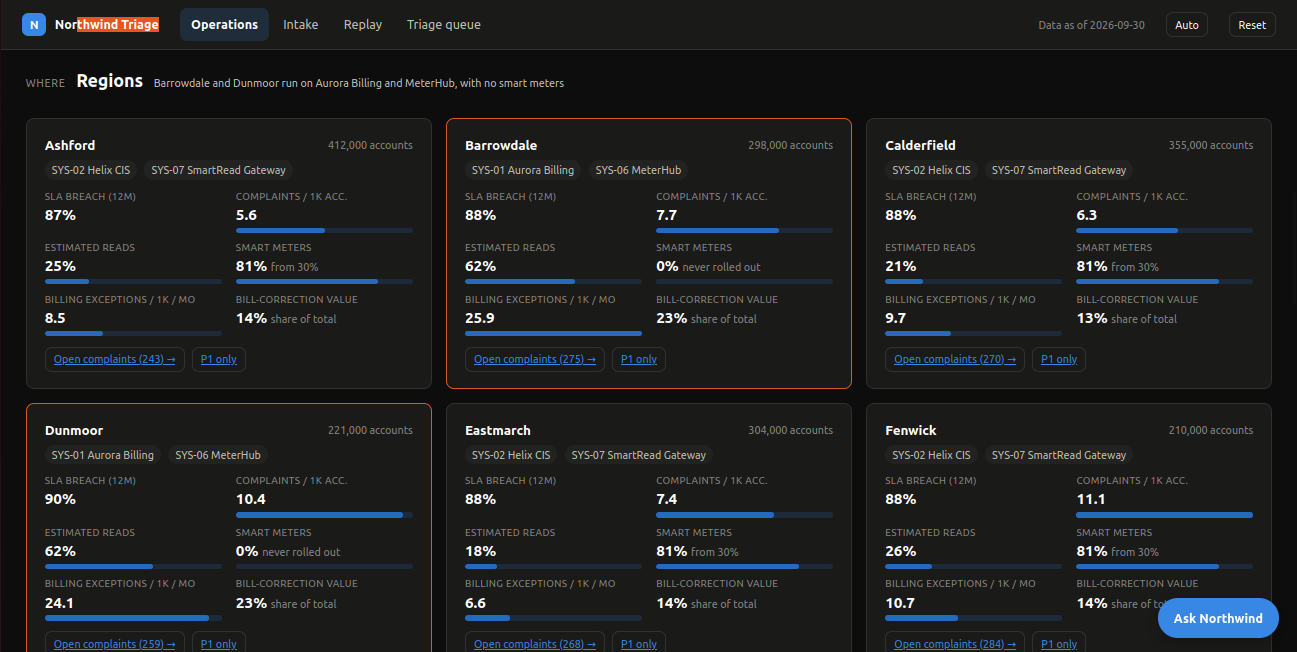
- Early warning: Statistical detectors monitor complaint volumes, billing exceptions, estimated reads, and SLA performance. Related alerts across regions are grouped and linked to shared systems, giving teams concrete places to investigate.
A replay view lets users explore possible benefits under adjustable adoption and transfer-avoidance assumptions. A backlog planner shows how staffing, incoming demand, and assumed efficiency changes affect projected workload.
Gemini powers an assistant and investigation briefs using evidence supplied by the application, with references users can inspect. ElevenLabs provides spoken assistant responses and template-based case updates. Customer updates play within the prototype; outbound calls, emails, and SMS are future work.
Our demonstration connects these features: inject a labelled synthetic regional issue, investigate the shared systems, submit a related complaint, and inspect its context and position in the queue.
How we built it
We combined all six Northwind datasets: complaints, systems, monthly KPIs, meter reads, unit costs, and the previous AI pilot.
The backend uses Python, FastAPI, pandas, and NumPy. The frontend uses React and Vite, with Recharts for operational charts and React Flow for system relationships.
The analytical core uses lightweight, explainable methods:
- Rolling z-scores to identify unusual increases.
- CUSUM to detect gradual deterioration in SLA performance.
- Kaplan–Meier survival estimates to assess deadline risk while accounting for unresolved cases.
- Smoothed historical probabilities to estimate likely resolution needs.
- Explicit rules for ownership and queue ranking.
These calculations do not require an LLM call for every complaint. Gemini supports explanation rather than controlling routing or case status.
We integrated Auth0 authentication with permissions enforced by the backend. Storage supports SQLite and an optional PostgreSQL/Tiger Data backend, including TimescaleDB support for the signal feed. The repository
Built With
- auth0
- caddy
- docker
- elevenlabs
- fastapi
- google-gemini
- html5
- javascript
- numpy
- pandas
- postgresql
- python
- react
- react-flow
- recharts
- sqlite
- tiger-data
- timescaledb
- vite
- vultr


Log in or sign up for Devpost to join the conversation.