Inspiration
Big construction projects finish about 20 months late and up to 80% over budget (McKinsey). 65% of firms say supply-chain problems delayed their projects (AGC, 2026). In one real case, a vendor quoted 40 weeks — and delivered after more than 100.
Today, the industry's fix is a person called an expediter: someone whose whole job is chasing vendors so materials arrive on time. Their real skill is knowing how each vendor actually behaves. That knowledge leaves the company the day they leave.
So we asked one question: what if that knowledge lived in a system that never forgets?
What it does
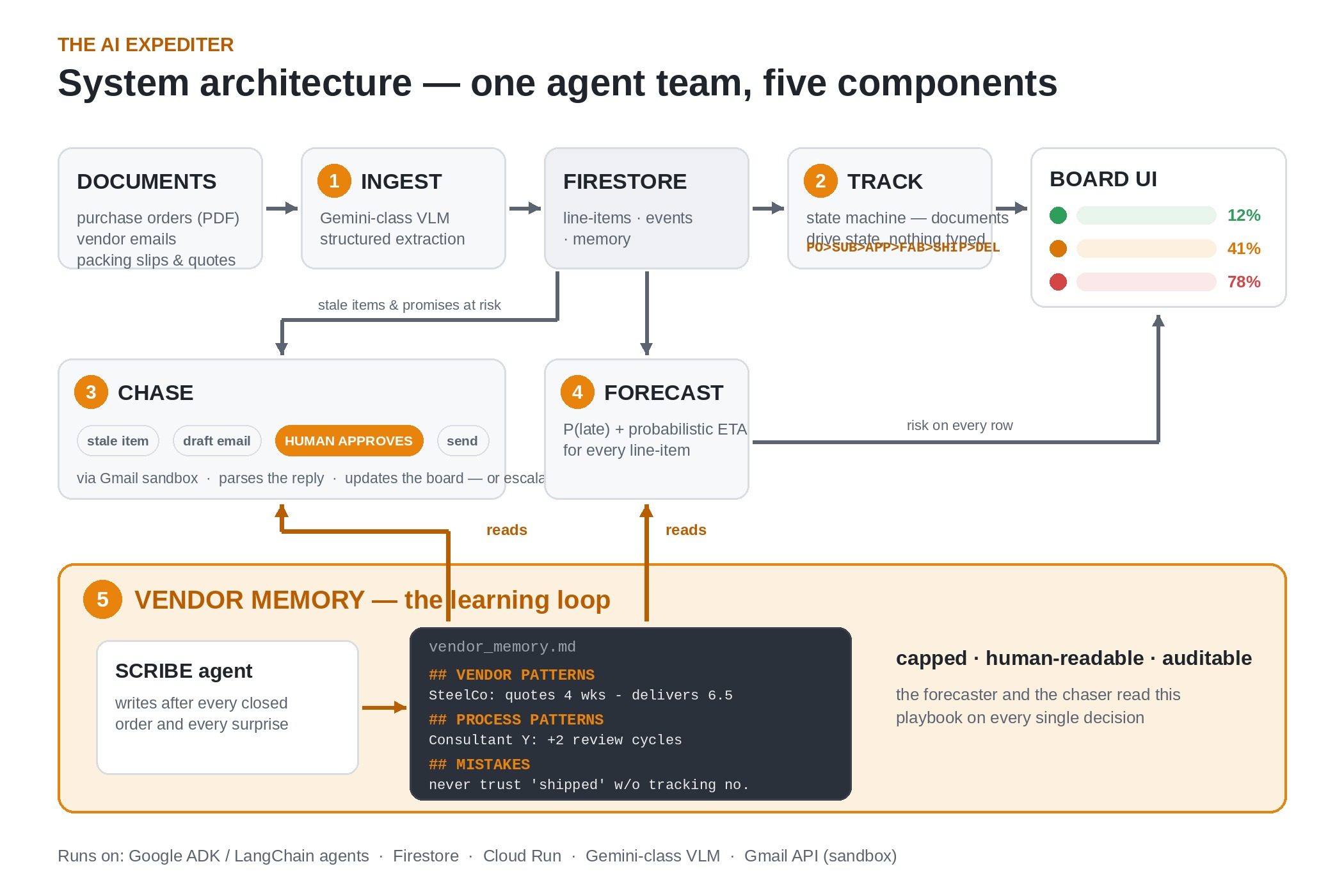
The AI Expediter is a team of AI agents that does the expediter's job, end to end:
- Ingest — reads purchase orders, vendor emails, quotes, and packing slips with a vision-language model, and turns them into clean, structured line-items.
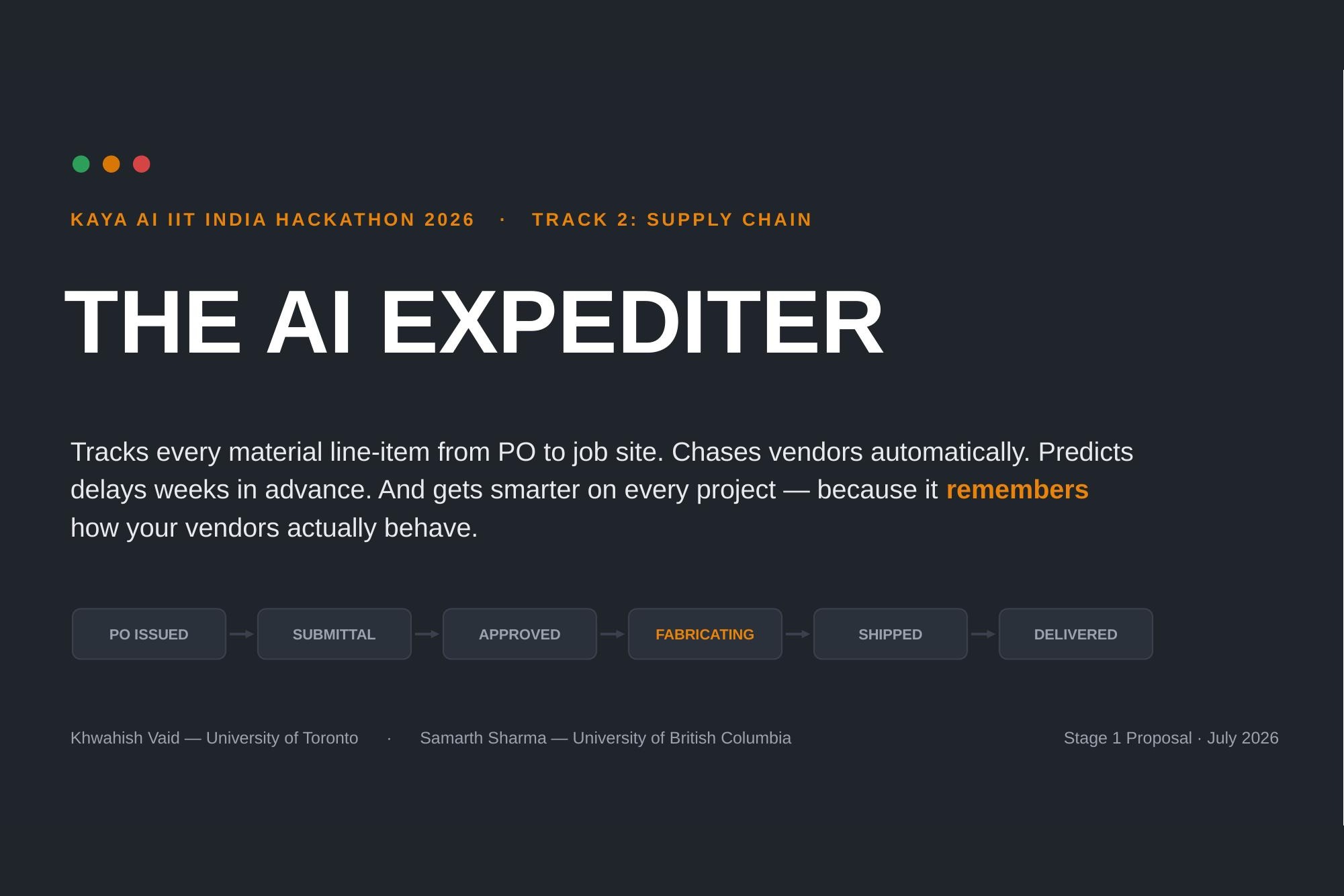
- Track — every item moves through a simple pipeline: PO issued → submittal → approved → fabricating → shipped → delivered. Nothing is typed by hand; documents drive the state.
- Chase — if an item goes quiet, the agent drafts a status email to the vendor. A human approves it with one click. The agent reads the reply and updates the board — or escalates to the project manager.
- Forecast — every item gets a probability of being late and a realistic ETA, not just a yes/no flag.
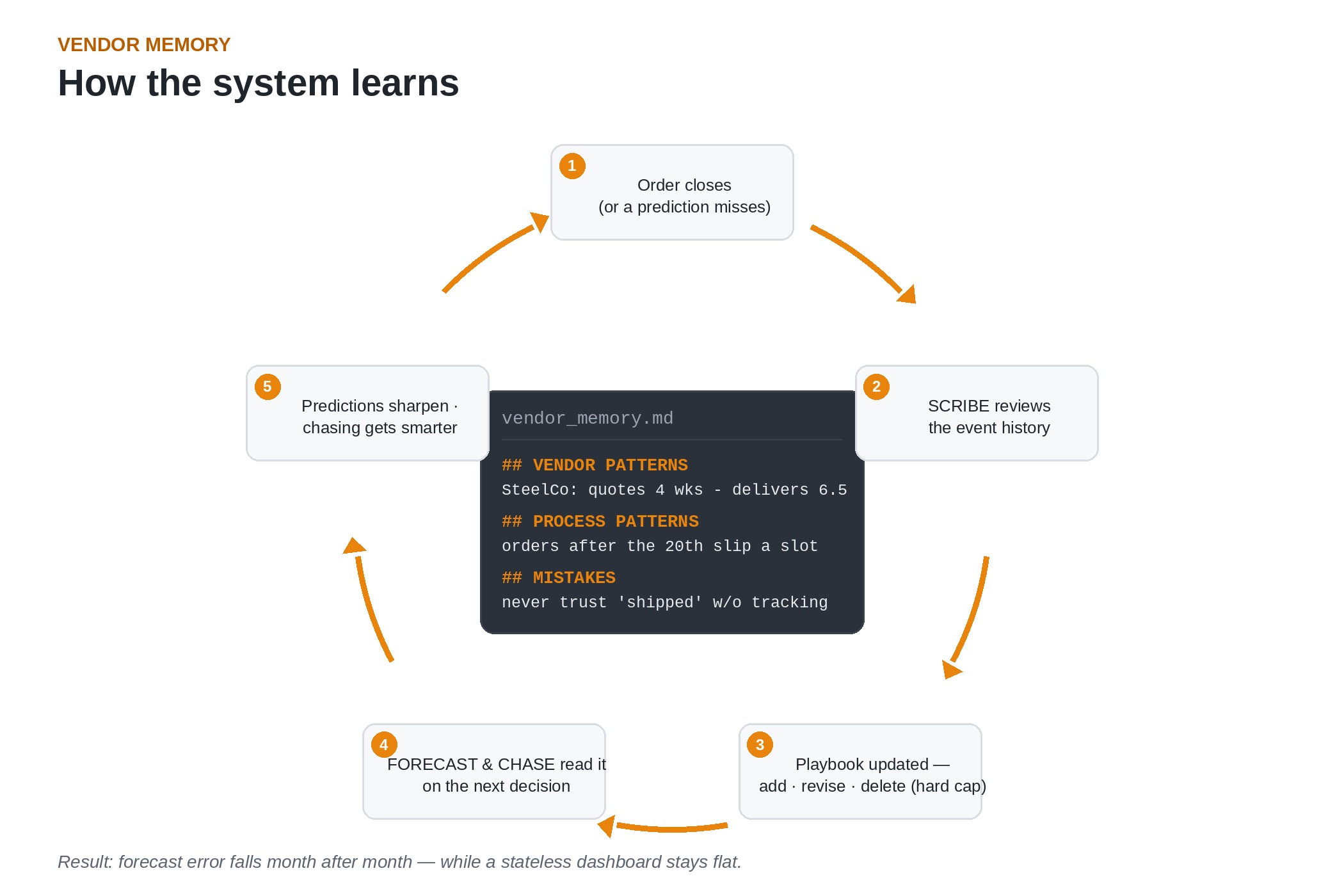
- Vendor Memory (our differentiator) — after every finished order, a Scribe agent writes what it learned into a small plain-text playbook (for example: "SteelCo quotes 4 weeks, delivers in 6.5"). The forecaster and the chaser read this playbook on every decision. One board shows every item in green, amber, and red. And because of Vendor Memory, the predictions get more accurate every month — while a normal dashboard stays flat. Every other tool forgets. Ours learns.
How we built it
- Architecture: five agent roles (Ingestor, Tracker, Chaser, Forecaster, Scribe) on Google ADK / LangChain, with Firestore for data, Cloud Run for services, a Gemini-class model for document reading and email drafting, and the Gmail API (sandbox) for the chase loop. The frontend is one page: the board, an item view, and the memory file.
- Data — declared openly: we don't have a real contractor's data, so we designed a synthetic construction company: 3 projects and about 40 vendors, each vendor with hidden behavior parameters (true lead times, reply speed, slip habits) that generate 12 months of realistic documents. Because the truth is hidden from the models, we can score our forecasts against ground truth they never see.
Evaluation: extraction accuracy on held-out documents; forecast error and calibration as memory grows, against a no-memory baseline; and one full chase cycle recorded on video.
Challenges we ran into
Proving learning honestly. A demo chart is easy to fake. Our fix: hidden-parameter synthetic data — the improvement has to be real to show up.
Trust. Construction is a conservative industry. Our fix: every outgoing email waits for one-click human approval.
Memory bloat. Notes can grow forever. Our fix: a hard size cap — the Scribe must add, revise, and delete entries to stay useful.
Accomplishments that we're proud of
A differentiator that is measurable and falsifiable: one chart — forecast error falling month after month while a stateless baseline stays flat. If the line doesn't fall, the idea failed, and we will say so.
A complete, gated 7-day build plan where every step has a clear "done" check.
What we learned
The best ideas are one measurable innovation on top of boring, proven parts.
Construction is one of the least digitized major industries — and India is building at historic scale (₹12.2 lakh crore capital budget in FY 2026-27, on top of a ₹111 lakh crore infrastructure pipeline).
Frontier AI research maps directly onto this pain: Letta's "memory models" thesis inspired Vendor Memory, and OpenPipe's ART·E showed a small fine-tuned model can beat a frontier model at 64× lower cost — that is our roadmap for document extraction.
What's next for The AI Expediter
Our gated 7-day build: synthetic data + ingest → the board + forecaster → the chase loop on sandbox Gmail → Vendor Memory + the measured accuracy chart. Stretch goal: an RL fine-tuned, per-company document extractor (GRPO with an exact-match reward) that runs at roughly 1/100th of frontier-model cost.

Log in or sign up for Devpost to join the conversation.