-
Title
-
The Problem
-
The Solution
-
The AI Dependency Balance Sheet
-
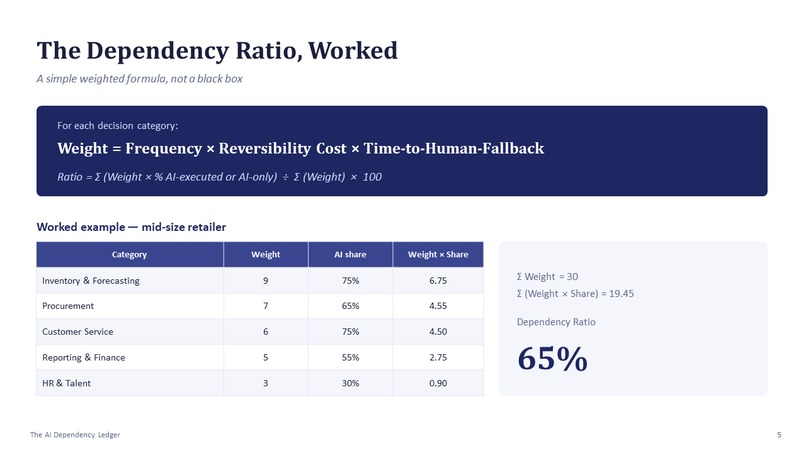
The Mathematical Model & Worked Ratio
-
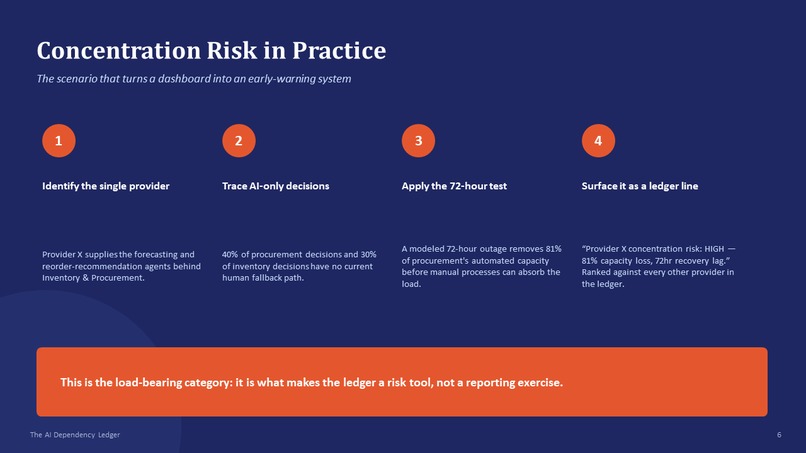
Concentration Risk In Practice
-
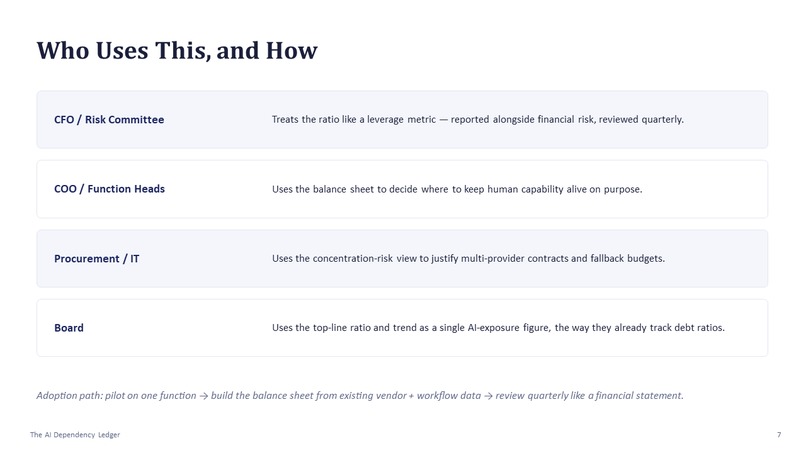
Who Uses It
-
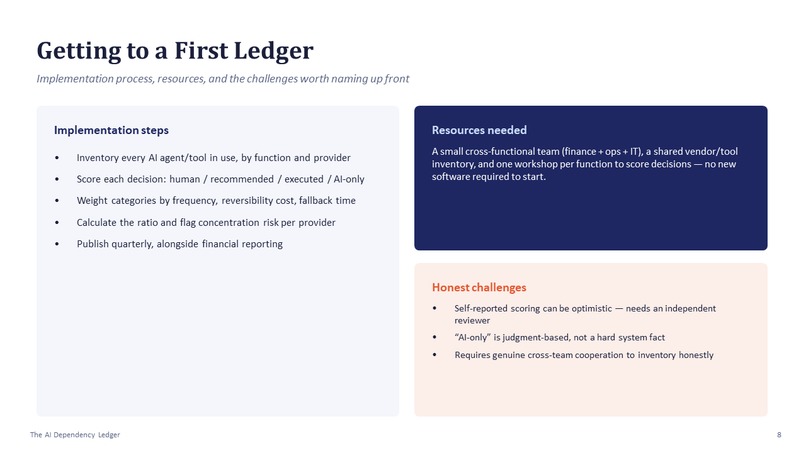
Getting To A First Ledger
-
Why This Matters
-
Spreadsheet Dashboard
-
End
Inspiration
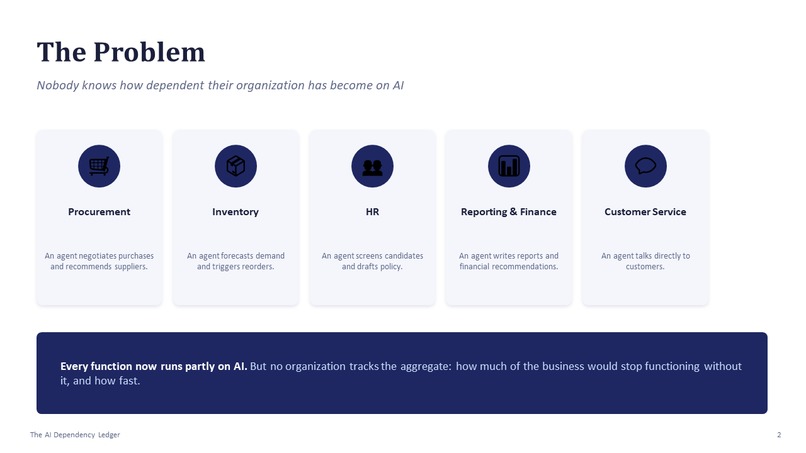
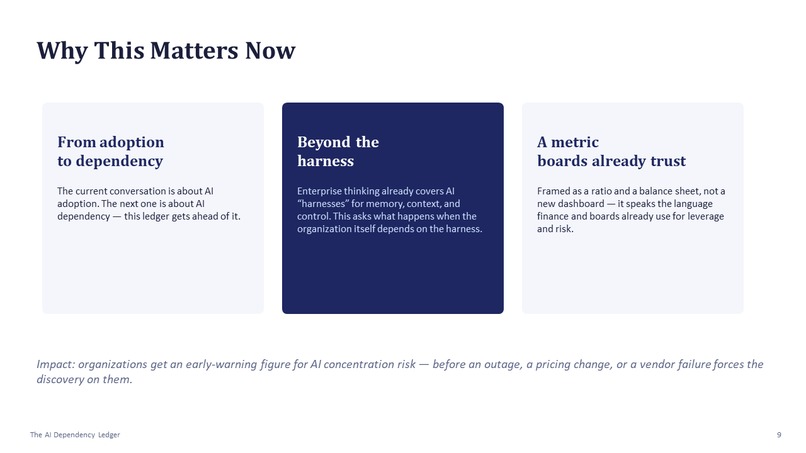
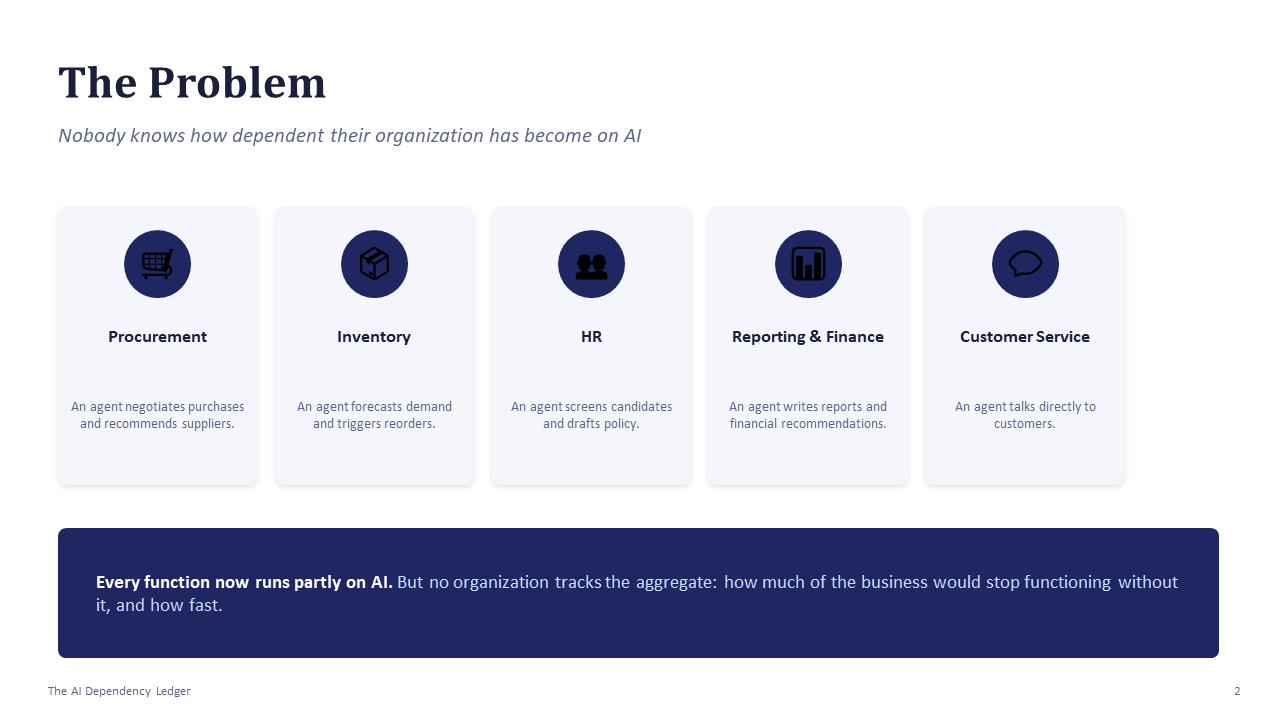
Organizations are racing to deploy AI agents across every operational vertical: procurement, inventory forecasting, HR screening, automated financial reporting, and customer support[cite: 1]. Yet, leadership operates with a critical blind spot: nobody knows how dependent the organization has become on AI[cite: 1].
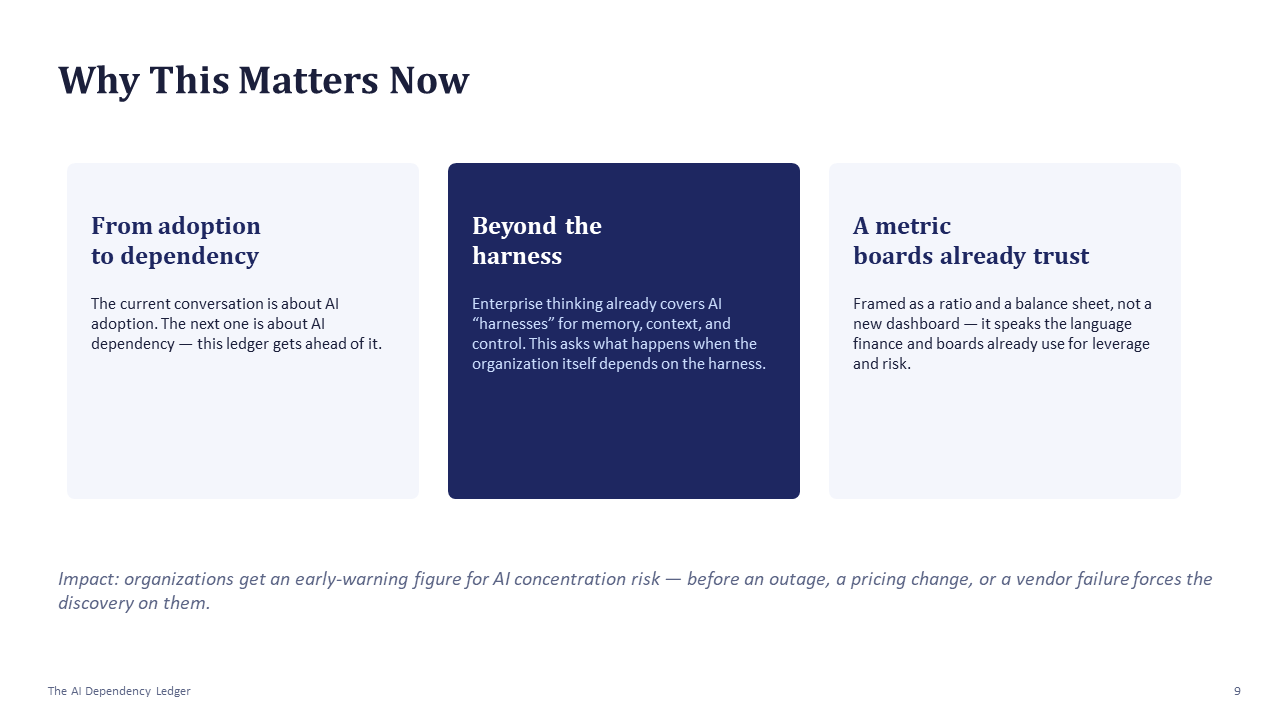
The current discourse is obsessed with AI adoption, but the defining enterprise challenge of the next decade will be AI dependency[cite: 1]. Existing approaches rely on complex governance frameworks or technical model registries that fail to communicate operational exposure to leadership. We asked: What if measuring AI vulnerability could be redesigned to be as clear and standardized as a financial statement? Instead of building another software dashboard, we designed The AI Dependency Ledger—a framework that treats operational capability like a corporate balance sheet[cite: 1].
What it does
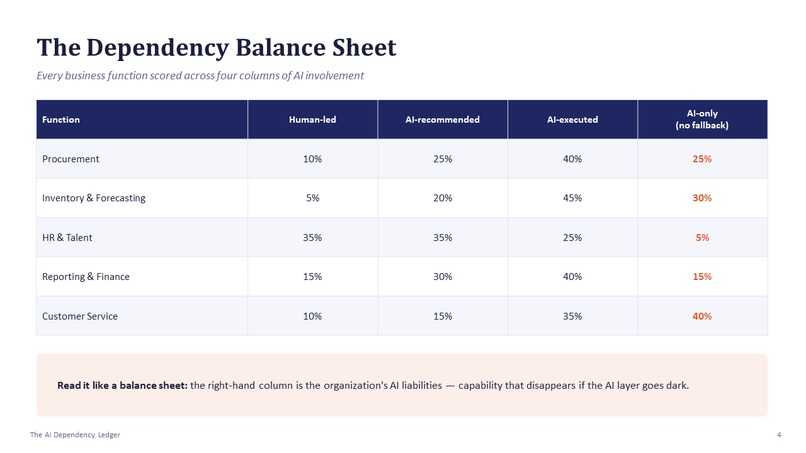
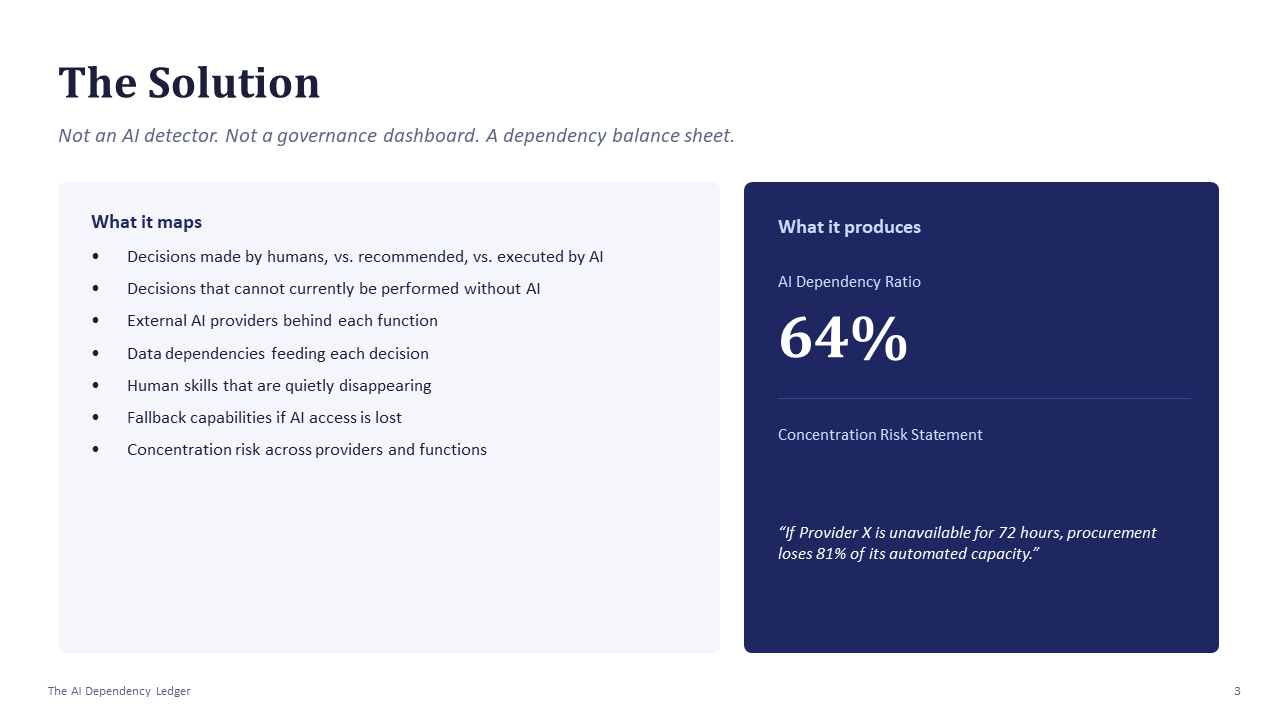
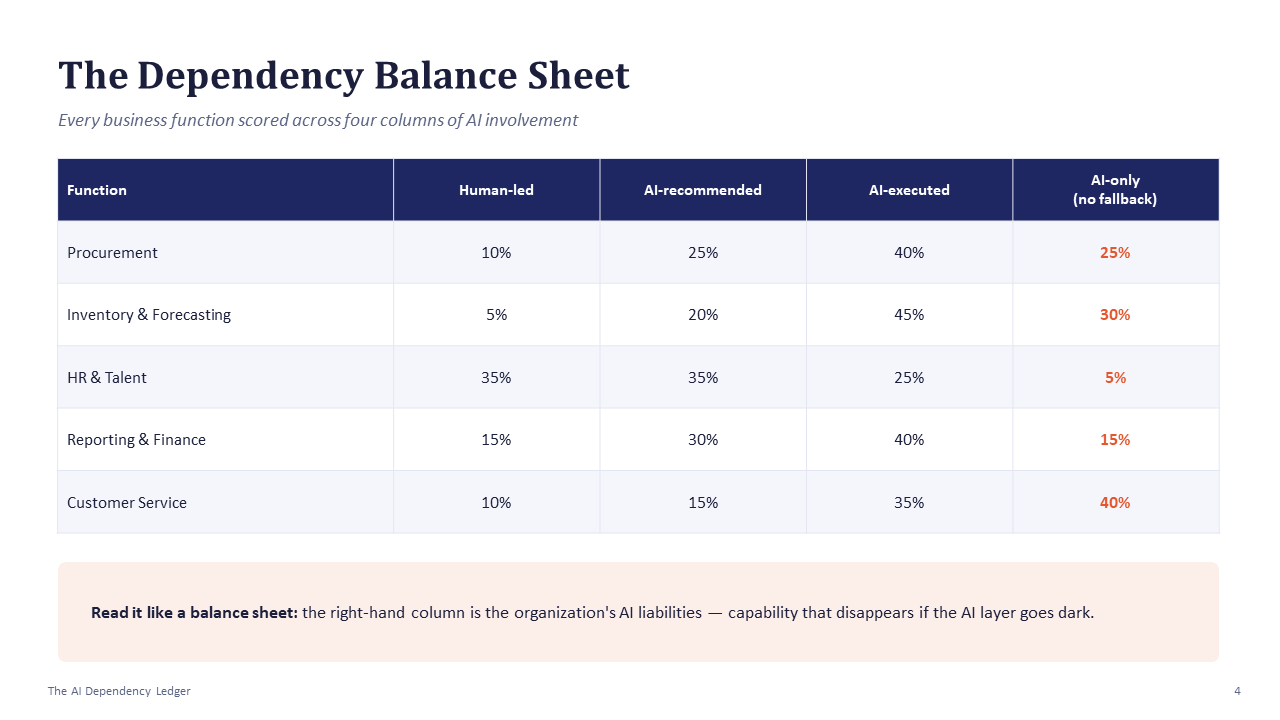
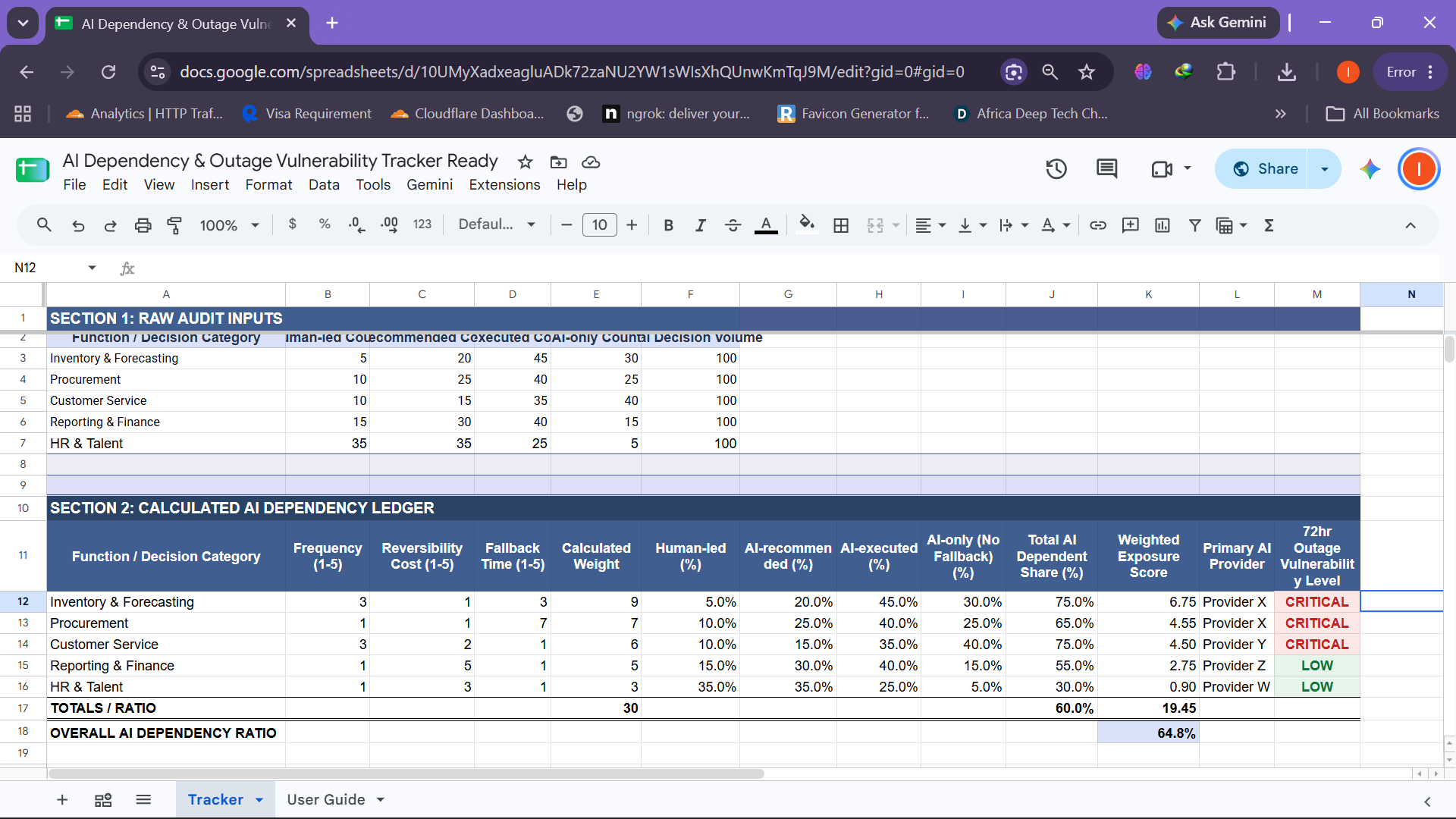
The AI Dependency Ledger (Business & Entrepreneurship theme)maps enterprise decisions across four distinct tiers of operational involvement[cite: 1]:
- Human-led: Fully manual judgment[cite: 1].
- AI-recommended: Machine analysis with required human sign-off[cite: 1].
- AI-executed: Automated actions with passive human oversight[cite: 1].
- AI-only (No Fallback): Decisions the organization can no longer execute manually without catastrophic delays[cite: 1].
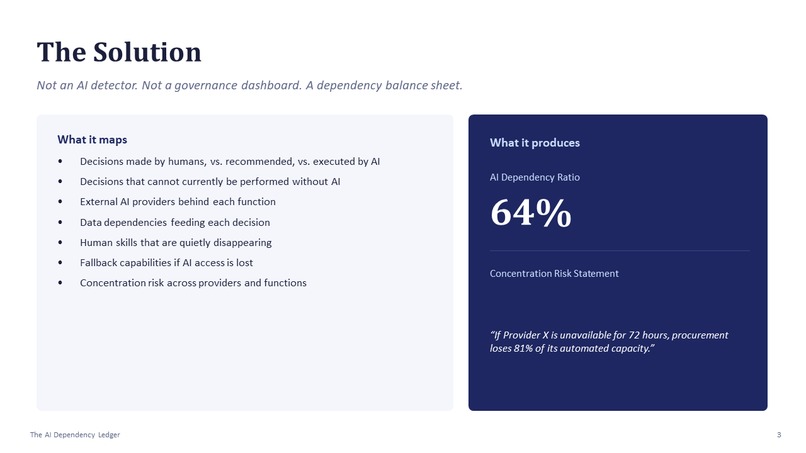
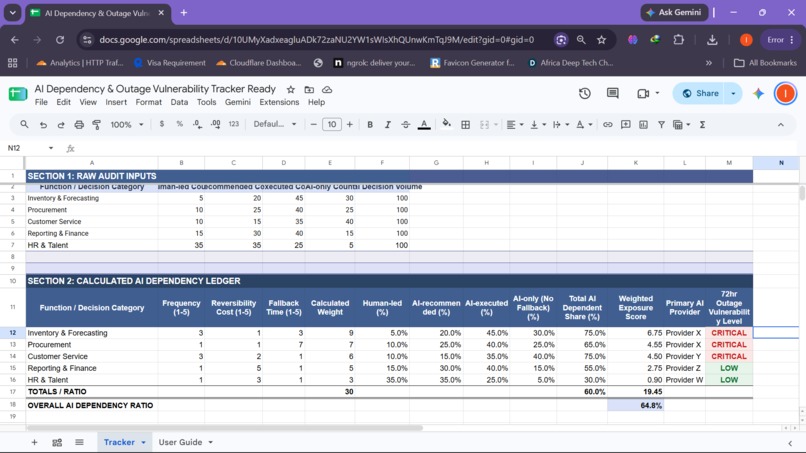
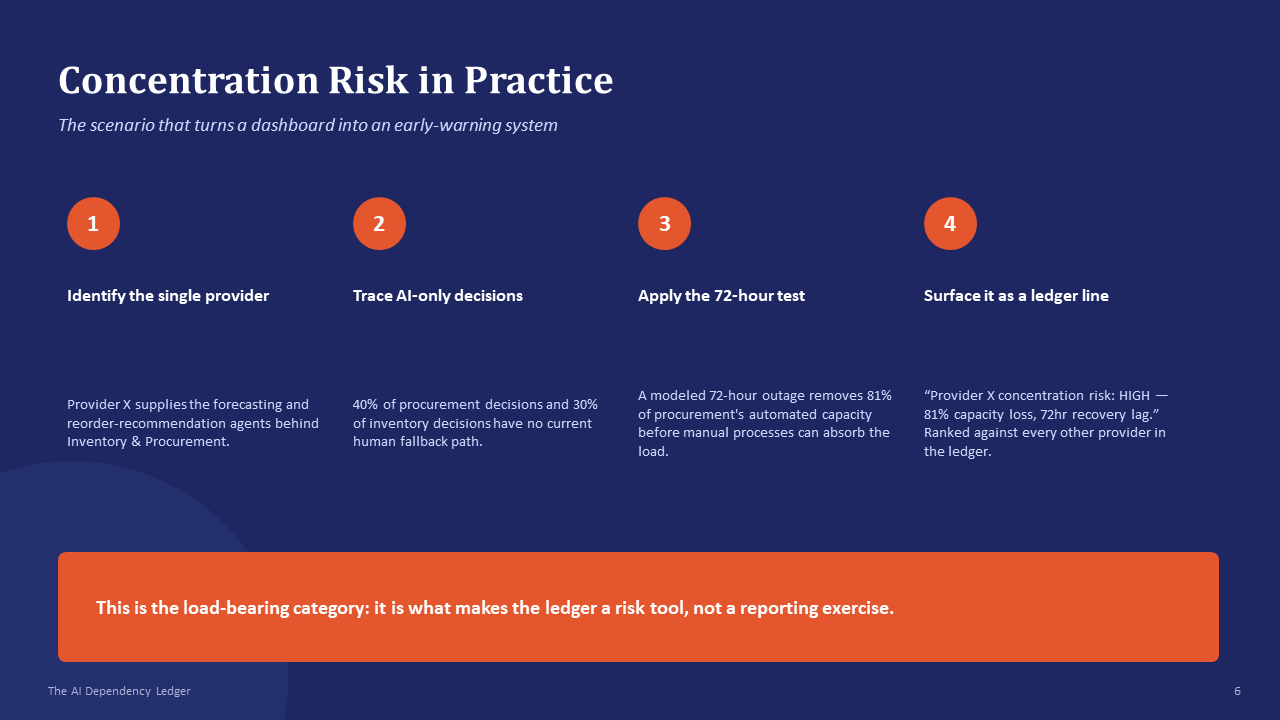
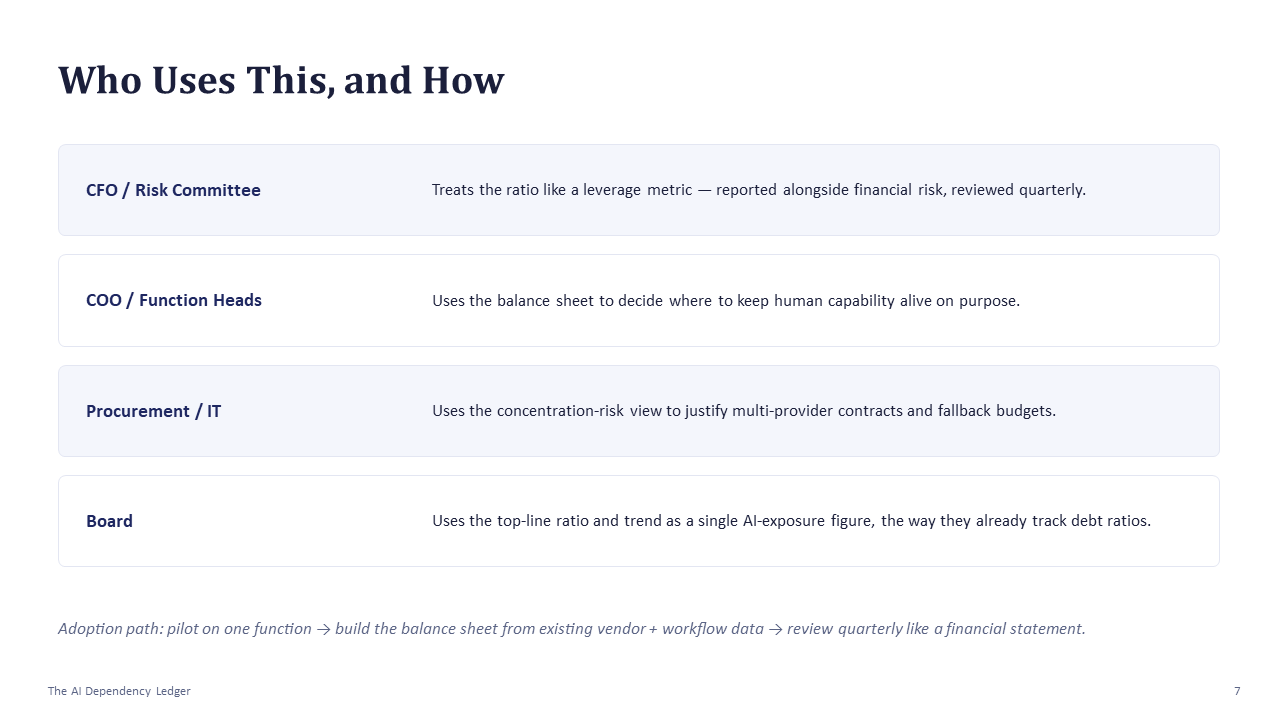
From this taxonomy, the Ledger calculates an AI Dependency Ratio and surfaces actionable Concentration Risk Statements (e.g., "If Provider X is unavailable for 72 hours, procurement loses 81% of its automated capacity")[cite: 1]. It enables CFOs, COOs, and boards to monitor capability erosion and single points of failure alongside traditional financial leverage metrics[cite: 1].
How we built it
We designed the framework around three core components:
- The Dependency Matrix: A tabular balance sheet categorizing core business functions against the four operational tiers[cite: 1].
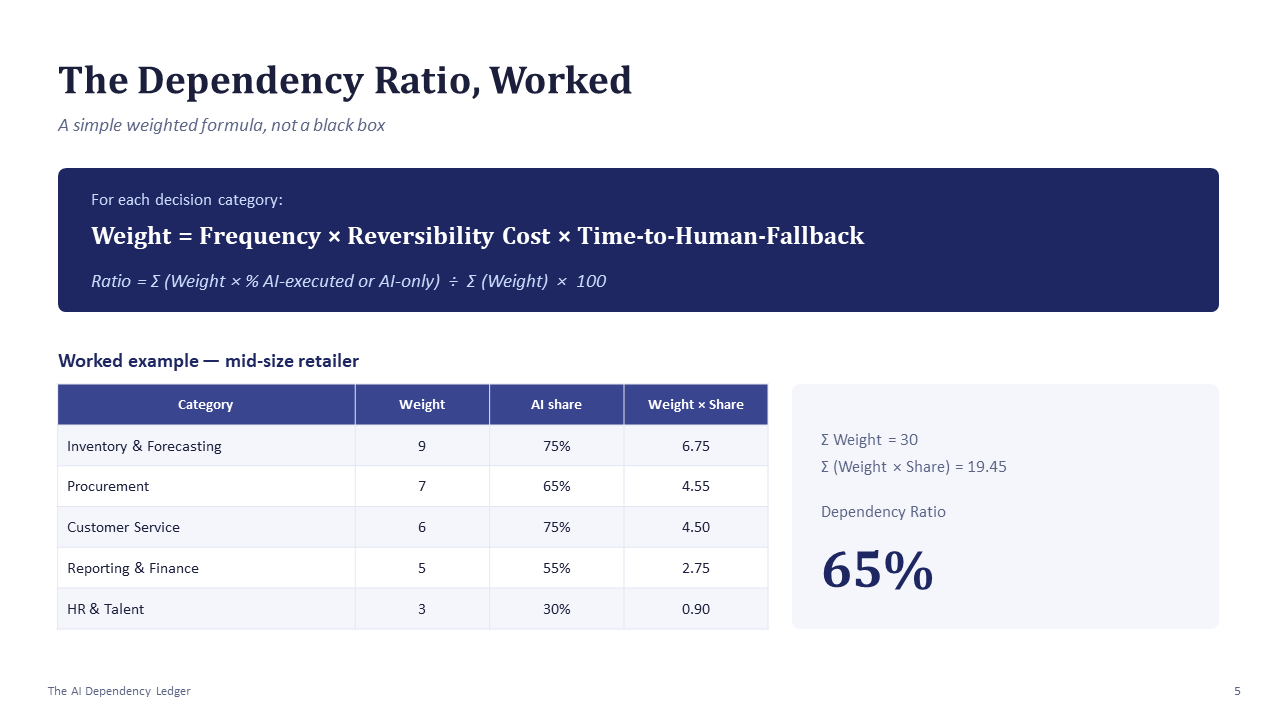
- Weighted Mathematical Model: A deterministic formula evaluating decision categories based on operational impact: $$\text{Weight} = \text{Frequency} \times \text{Reversibility Cost} \times \text{Time-to-Human-Fallback}$$ $$\text{AI Dependency Ratio} = \frac{\sum (\text{Weight} \times \text{\% AI-executed or AI-only})}{\sum \text{Weight}} \times 100$$[cite: 1]
- The 72-Hour Outage Stress-Test: An empirical scenario model tracing vendor overlap, identifying non-reconstructible processes, and generating risk rankings for executive decision-making[cite: 1].
Challenges we ran into
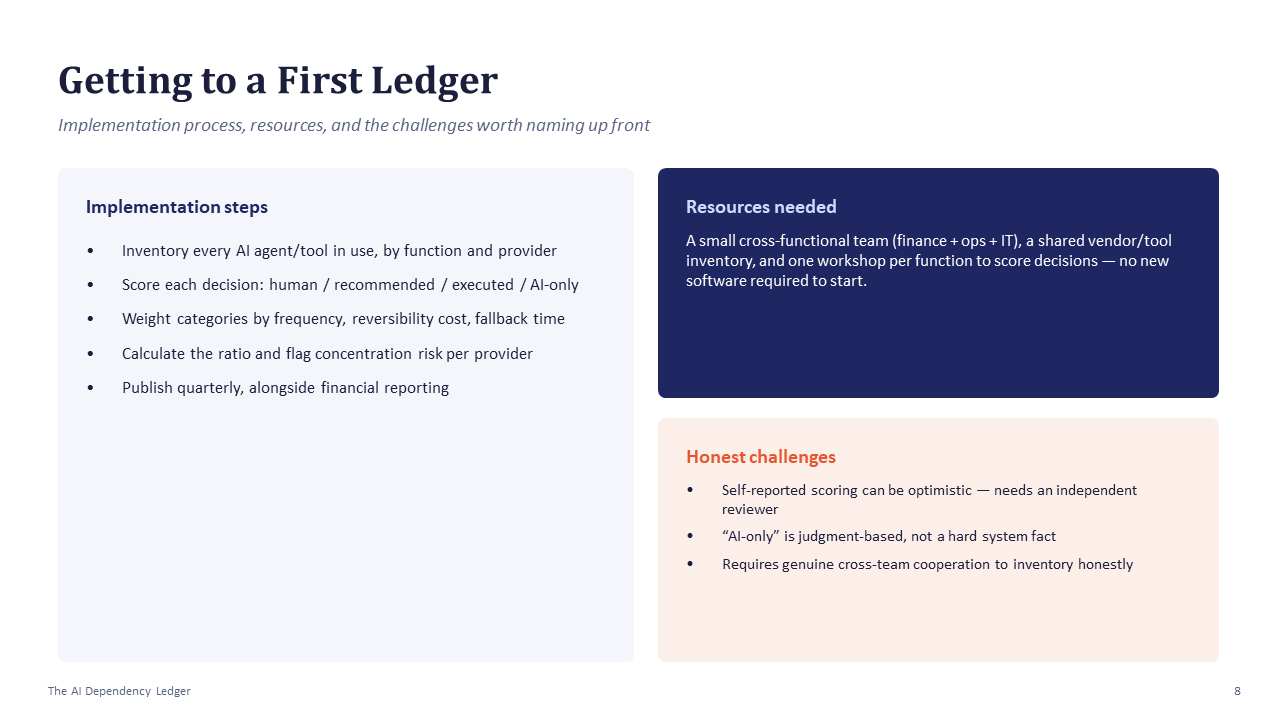
- Subjective Scoring Bias: Internal teams tend to overestimate their ability to perform automated tasks manually during audits[cite: 1]. We resolved this by defining an objective rule: a process is deemed AI-only if no human on staff has executed it manually within 90 days, or if manual execution creates a >300% operational SLA delay.
- Metric Standardization: Translating qualitative workflow descriptions into standardized weights across diverse functions (e.g., comparing HR decisions to automated inventory replenishment) required defining strict, bounded scales for reversibility and fallback time[cite: 1].
Accomplishments that we're proud of
- A Frictionless, No-Code Solution: Redesigned enterprise risk assessment into a lightweight methodology that teams can deploy immediately using existing vendor and workflow data—without purchasing complex SaaS platforms[cite: 1].
- Bridging Technical Risk and Boardroom Language: Successfully translated deep algorithmic dependencies into standard corporate governance metrics (ratios, liabilities, balance sheets) that non-technical executives and boards already understand and trust[cite: 1].
What we learned
We discovered that AI operational risk is rarely about model accuracy; it is about skill atrophy and silent vendor concentration[cite: 1]. When organizations automate workflows, the human capacity to execute fallback routines decays far faster than anticipated[cite: 1]. Measuring this capability gap is vital for long-term organizational resilience.
What's next for The AI Dependency Ledger
- Open-Source Ledger Templates: Releasing downloadable spreadsheet models and audit guides for startups and mid-market enterprises.
- Dynamic Vendor Mapping: Expanding the model to trace second-order model dependencies (e.g., when multiple distinct internal tools rely on the same underlying foundation model API).
- Industry Benchmarks: Developing sector-specific baseline Dependency Ratios to help organizations compare their operational exposure against industry peers.
Built With
- ai-agents
- ai-governance
- ai-safety
- applied-mathematics
- business-continuity
- business-strategy
- capacity-planning
- corporate-governance
- data-modeling
- decision-framework
- dependency-mapping
- enterprise-risk-management
- executive-reporting
- google-spreadsheets
- operational-resilience
- powerpoint
- risk-assessment
- stress-testing
- systemic-risk
- vendor-risk-management


Log in or sign up for Devpost to join the conversation.