
💡 Inspiration
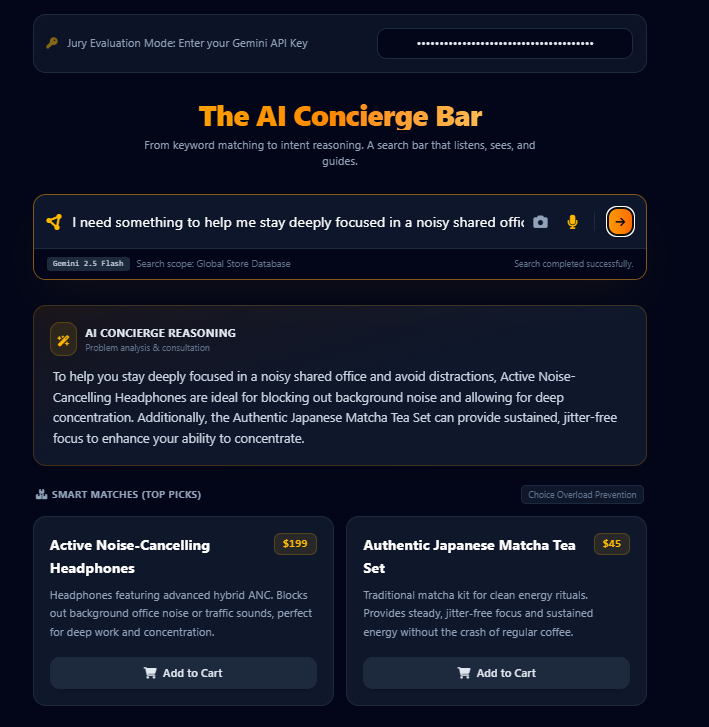
Traditional e-commerce search is frustrating. It relies on strict keyword matching, which means if a user doesn't know the exact name of a product, they get zero results. We wanted to build a search experience that feels like walking into a premium boutique, where a personal assistant actually listens to your real-life problems, looks at your environment, and guides you to the perfect solution. This inspired us to build The AI Concierge Bar.
🛠️ How We Built It
The project is built as a highly responsive web application designed for seamless deployment.
- Frontend & UI: Crafted using vanilla JavaScript and styled with Tailwind CSS to ensure a modern, accessible, and fast interface.
- Core Intelligence: Integrated the Google Gemini 2.5 Flash model via client-side API architecture.
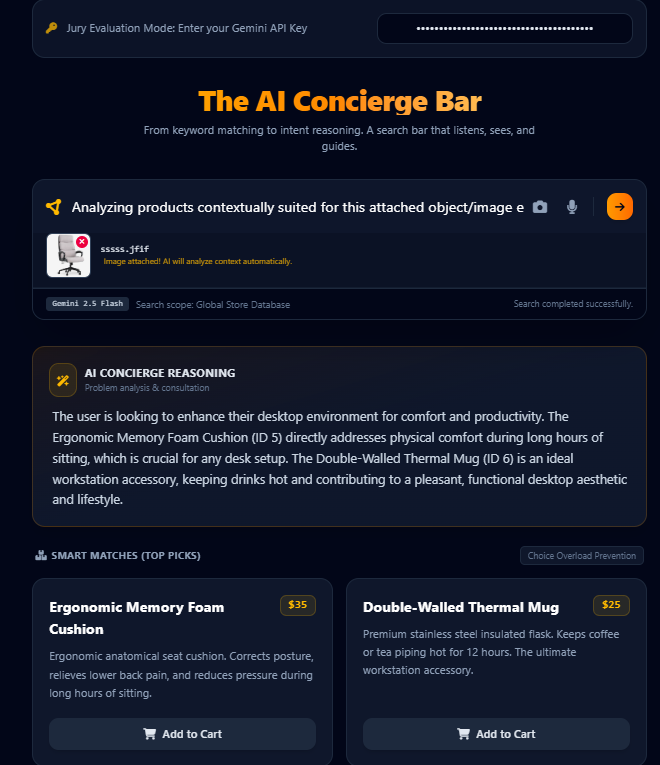
- Multimodal Architecture: Built features to support structured text queries, simulated voice wave interactions, and real desktop photo uploads. Gemini processes these mixed-media inputs and maps them into safe, predictable JSON arrays containing matching product IDs.
🚧 Challenges We Faced
- API Security vs. Evaluation Ease: One major challenge was making the project secure for public code sharing while allowing the hackathon jury to evaluate it instantly. We resolved this by building a customized sandbox panel. The jury can paste their own Gemini API Key directly into the web interface, which is then securely loaded via
localStoragelocally in their browser without exposing any backend credentials. - Handling Choice Overload: We had to fine-tune our system prompt instructions to ensure Gemini wouldn't overwhelm the user. We forced the model to return strict JSON structures matching our exact mock database schema, ensuring a $1:1$ or $1:2$ perfect conversion match rather than thousands of unrelated items.
📚 What We Learned
During this journey, we discovered the true power of multimodal context awareness. When we tested the app by uploading a raw photo of an office chair, Gemini didn't just search for the word "chair"—it understood the context of sitting and dynamically recommended an ergonomic foam cushion and a thermal mug for the workspace setup. This proved to us that the future of search is not based on indexed text strings, but on semantic reasoning.
Built With
- css3
- gemini-api
- html5
- javascript
- localstorage
- tailwind

Log in or sign up for Devpost to join the conversation.