-
-
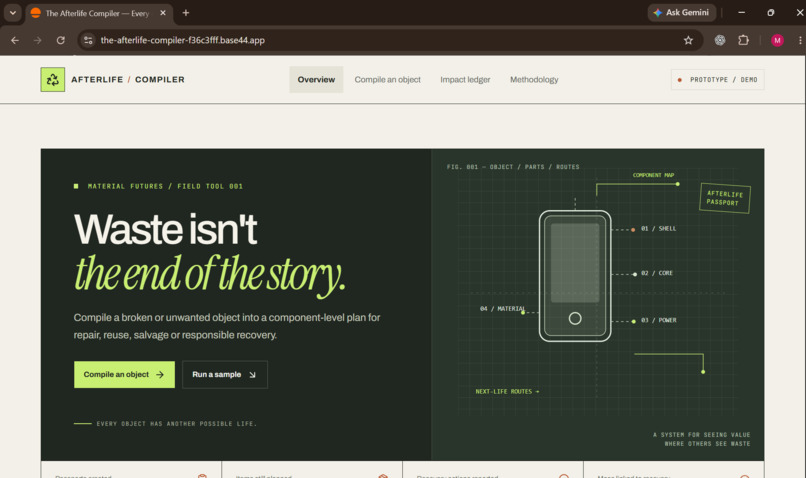
Front Webpage
-
-
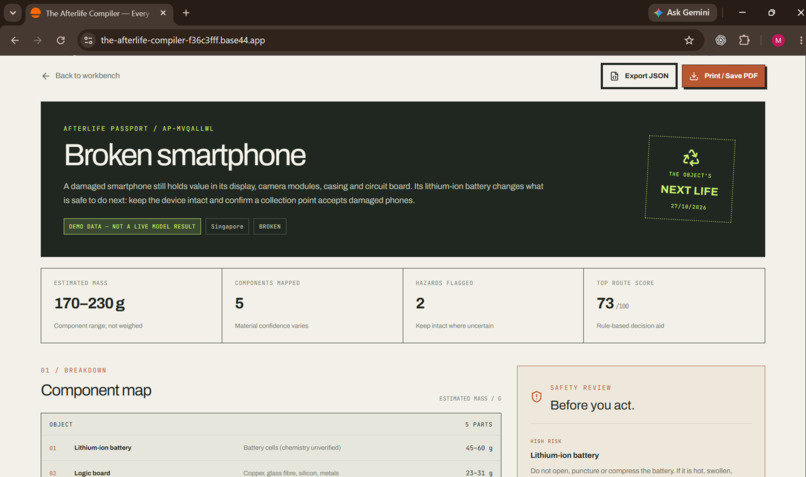
Sample
-
-
-
The Afterlife Compiler
Every object has another possible life.
About the project
What if recycling guidance did more than tell us which bin to use? What if it helped us decide whether an object should be repaired, reused, salvaged for parts or recycled—and explained why?
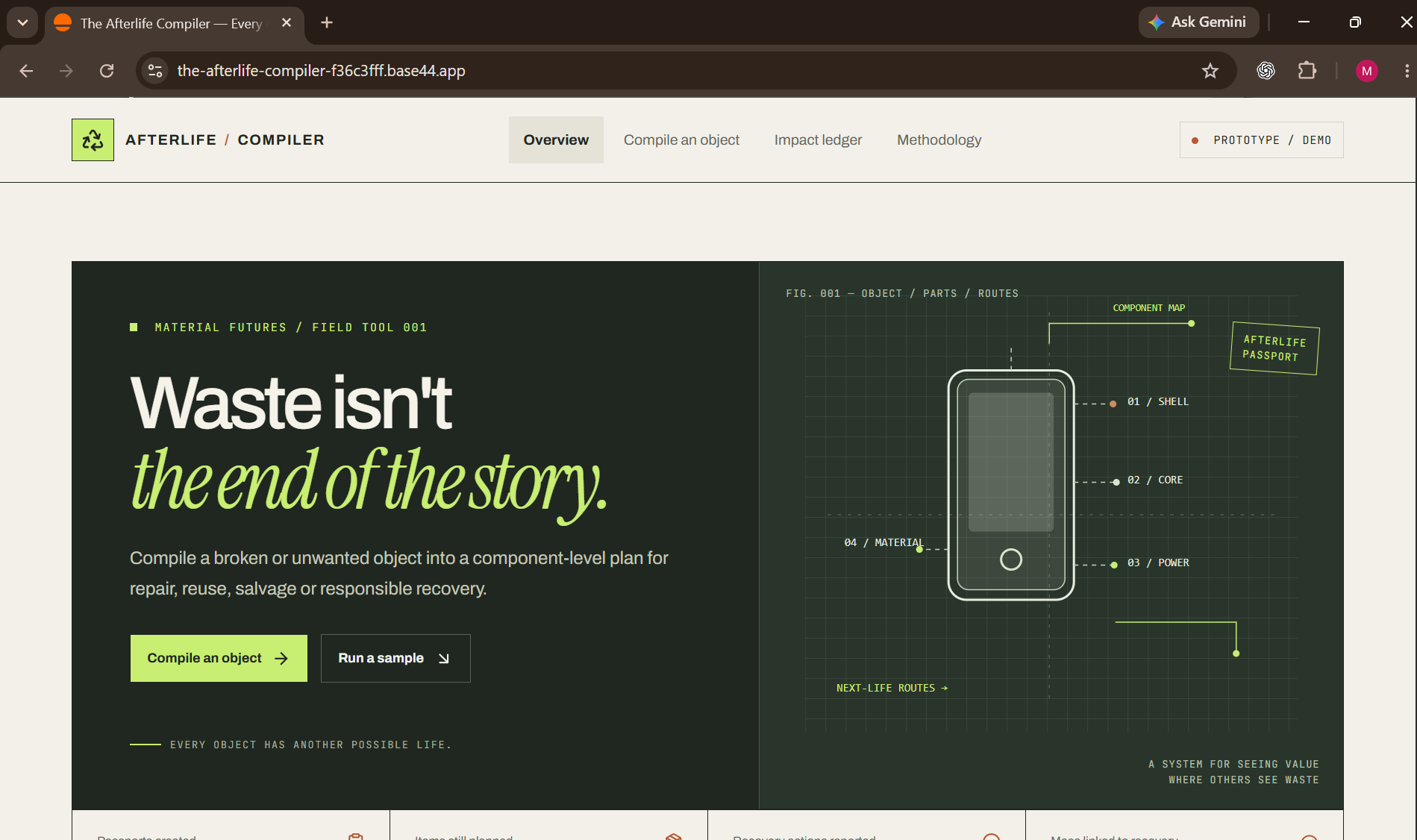
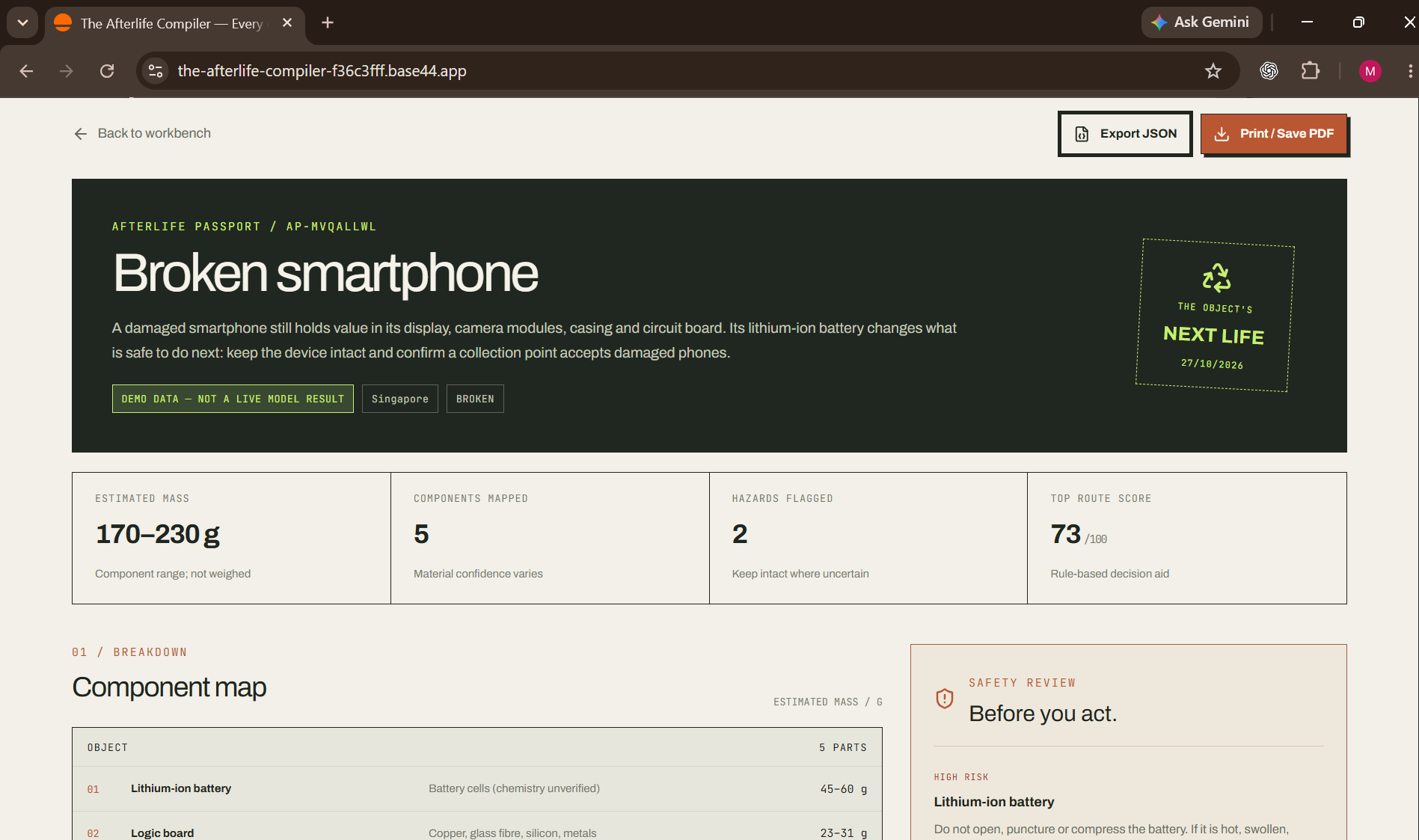
The Afterlife Compiler is a circularity decision-support prototype that turns an unwanted object into an inspectable Afterlife Passport. Instead of treating an object as one block of waste, it breaks the problem into likely components, potential hazards and competing next-life routes.
What it does
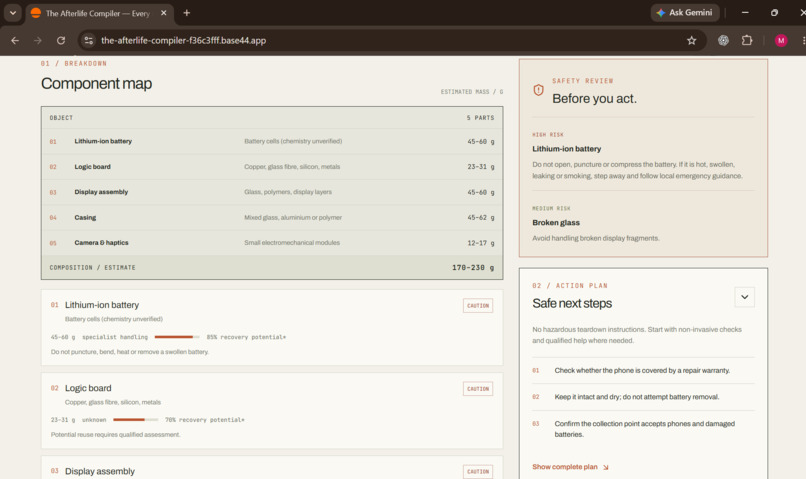
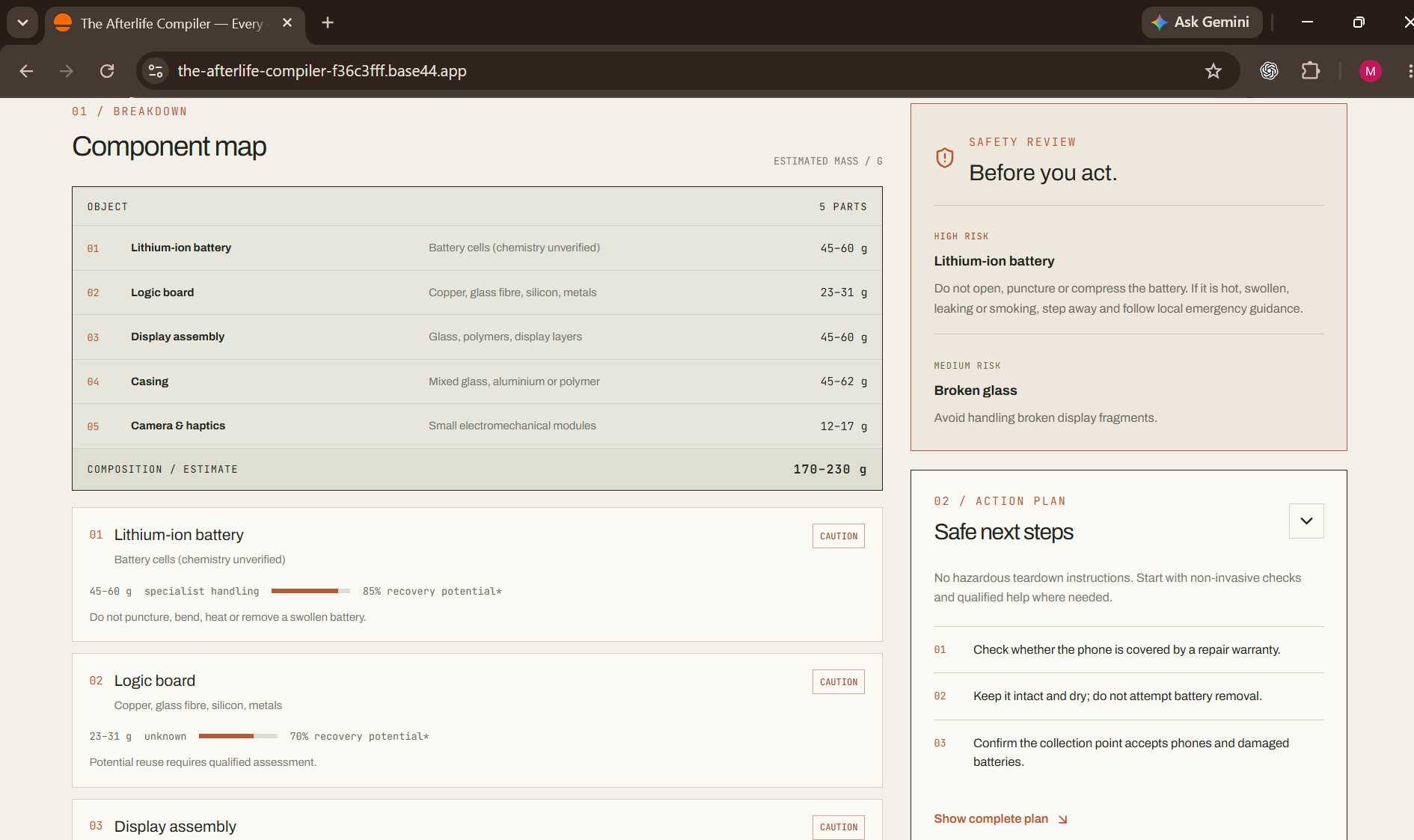
- Component mapping: Displays likely components, material assumptions and estimated mass ranges.
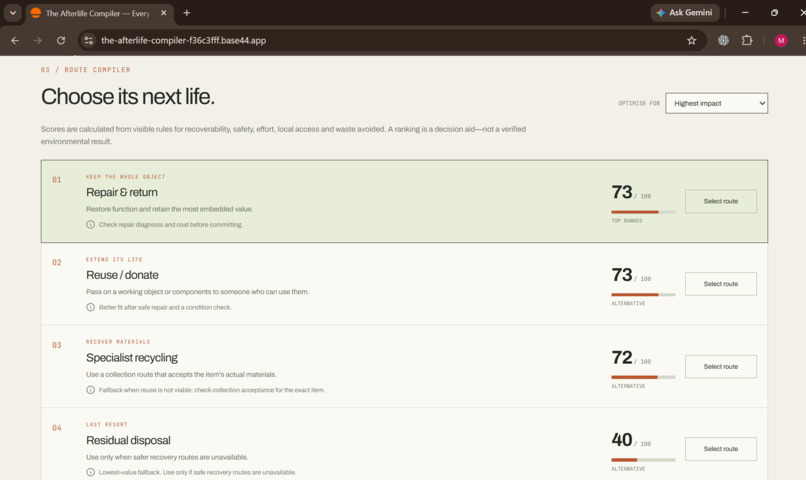
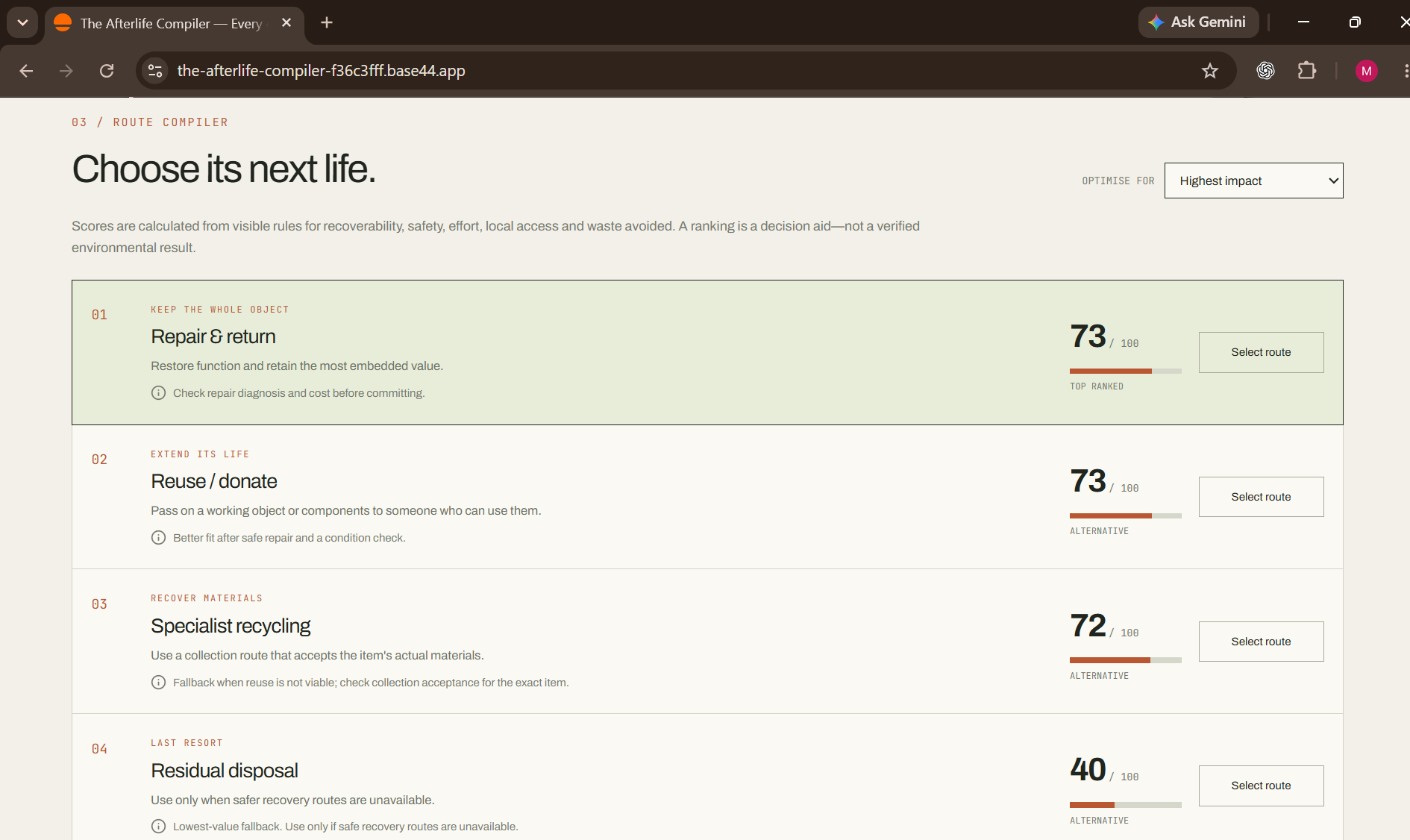
- Route comparison: Compares repair, reuse or donation, parts salvage, specialist recycling and residual disposal.
- Explainable ranking: Uses a deterministic scoring engine with visible factors for recoverability, safety, effort, local accessibility and waste avoided. Users can prioritise impact, speed or a cost/effort proxy.
- Safety-first guidance: Flags concerns such as lithium-ion batteries, broken glass and mains electrical components, and avoids dangerous DIY teardown instructions.
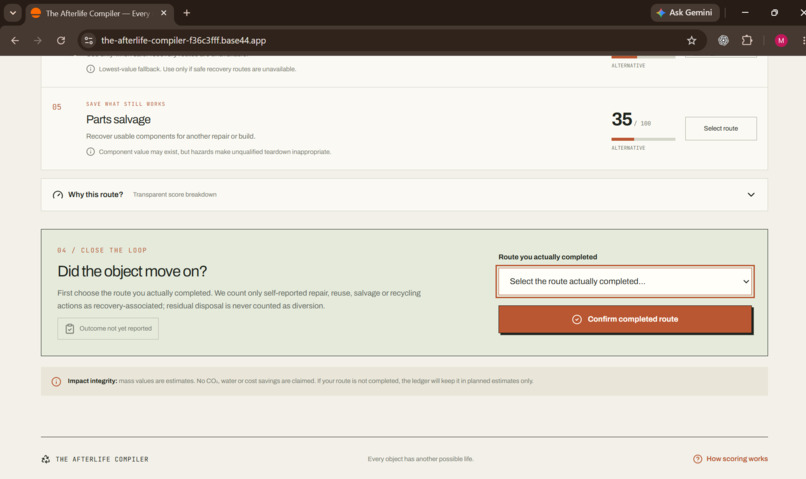
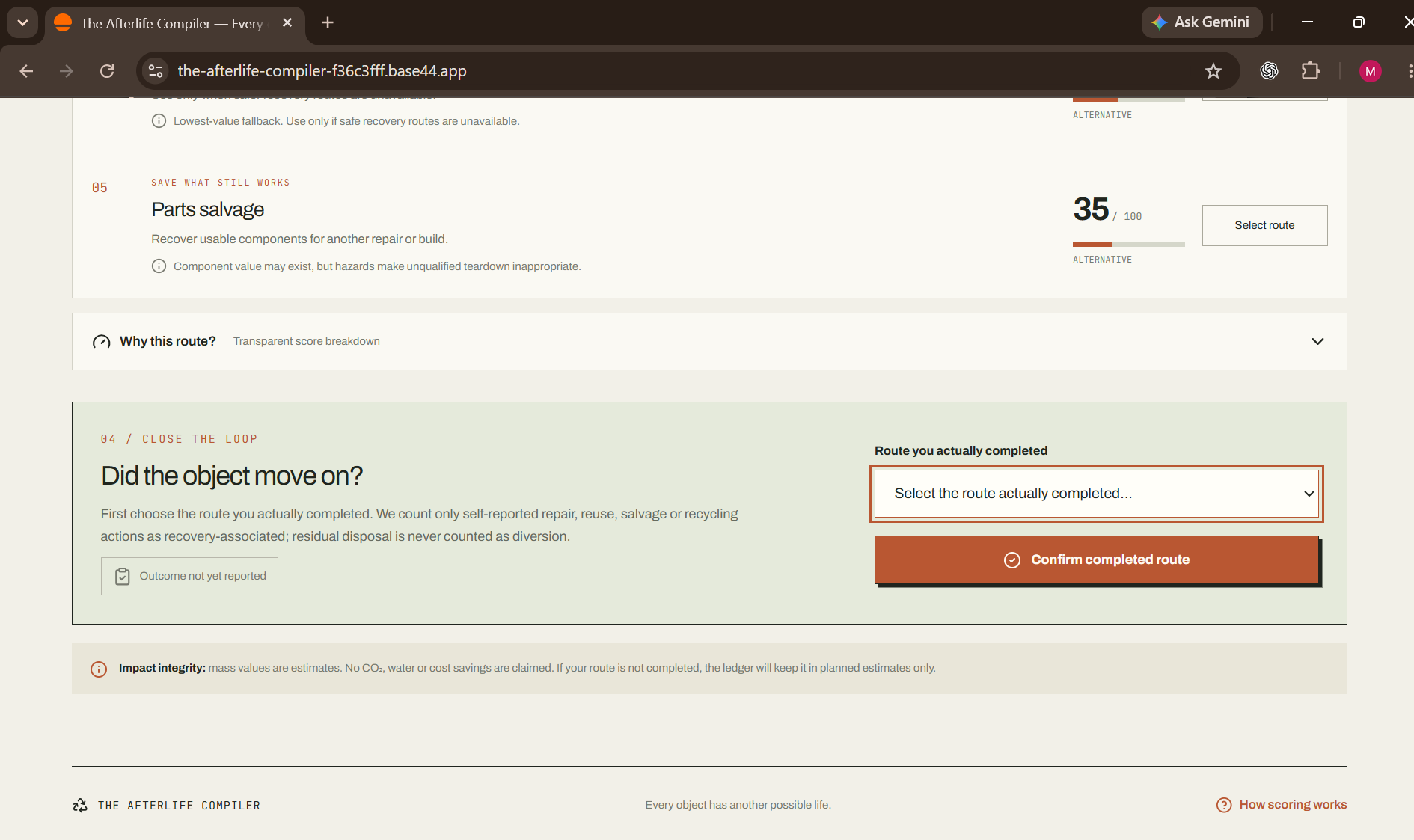
- Outcome tracking: Separates planned routes from self-reported completed actions. Residual disposal is not counted as recovery-associated activity.
- Portable passports: Lets users export a JSON record or print/save a passport as PDF.
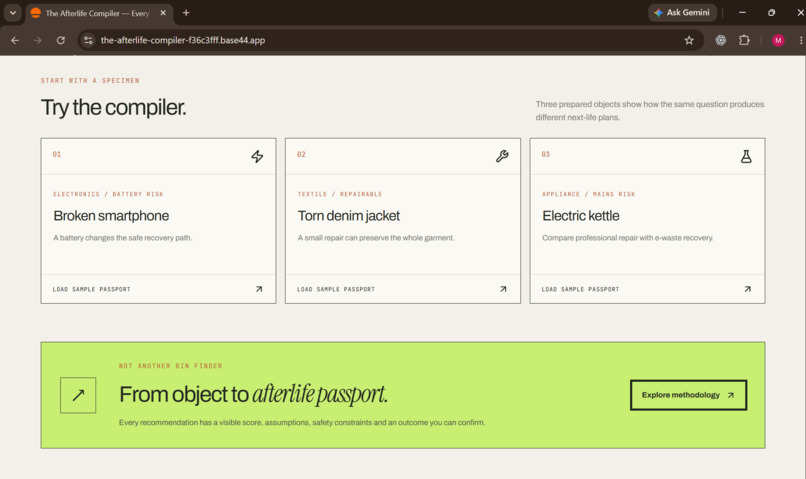
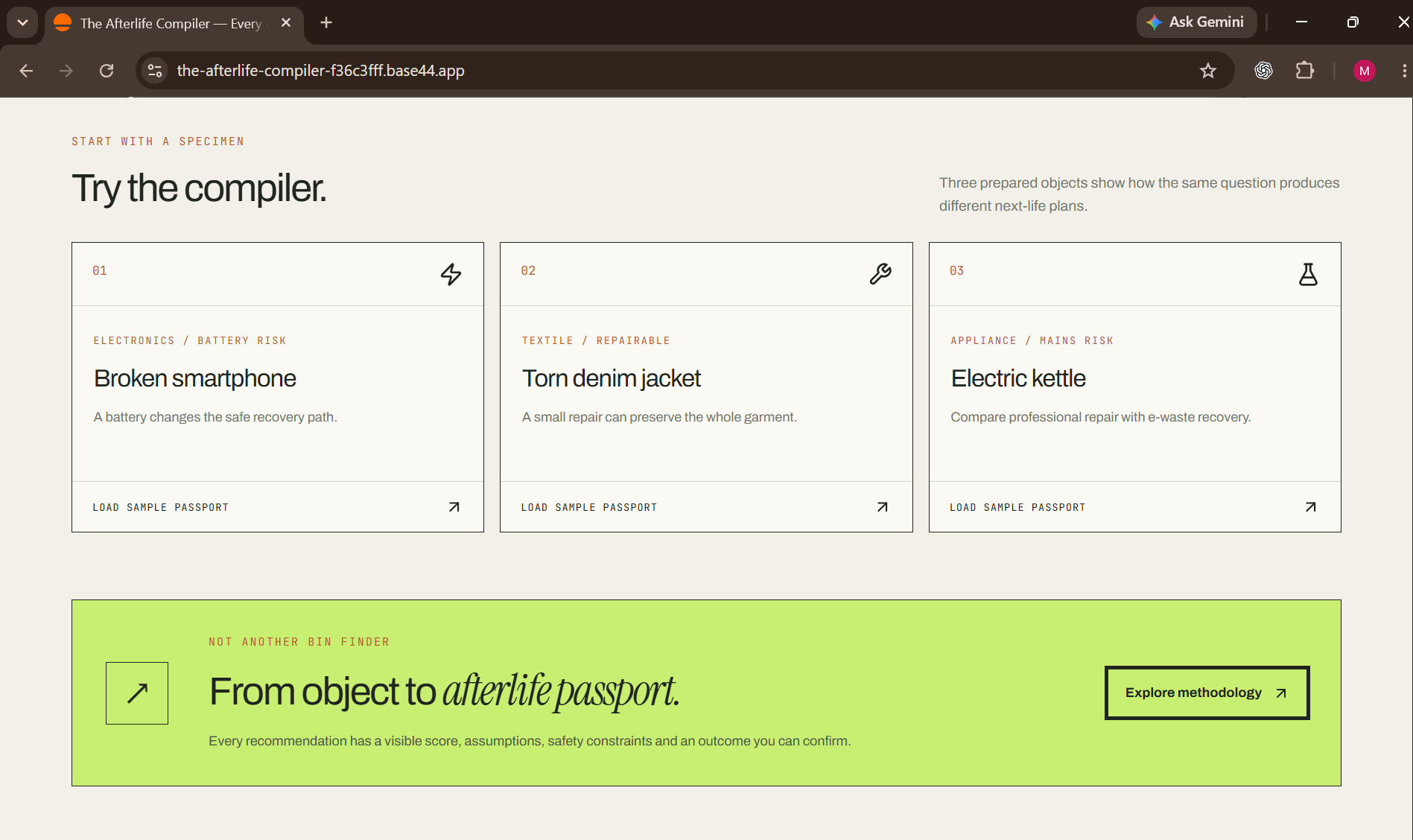
The prototype includes curated demonstrations for a broken smartphone, a torn denim jacket and an electric kettle. User-entered objects can also receive a rule-based draft.
An optional authenticated server-side AI analysis path supports image-and-text or text-only input. This path has been implemented in code but has not yet been verified end-to-end with a live model response, so it is not presented as a proven capability.
What makes it different?
A conventional bin finder focuses on sorting an item into a waste stream. The Afterlife Compiler asks a broader question: what is the most plausible next life for this object and its components?
The goal is to make repair and reuse visible before recycling becomes the default choice, while exposing the uncertainty behind each recommendation.
How it was built
The application uses React, TanStack Start, JavaScript and a custom responsive interface. It uses browser-local storage for prototype passport history, a separate scoring module for deterministic route ranking, and automated tests covering route ordering, priority weighting, hazard penalties and fallback behaviour.
The optional AI analysis handler uses the Base44 AI gateway and schema validation. The app distinguishes curated demo data, category-based drafts and AI-assisted output rather than silently presenting sample data as a live prediction.
What we learned
A recommendation is not the same as an outcome. A route can appear attractive in a scoring model without being available locally, affordable or actually completed. For that reason, this prototype does not claim measured waste reductions, verified recovered material, or carbon savings.
The next stage is to validate the AI analysis path, improve the reliability of local route information, evaluate the scoring rules with qualified repair and recycling partners, and test whether people actually choose better next-life routes.
Theme Track: Target waste problem and how success will be measured
This project targets premature disposal of potentially repairable small electronics, small appliances and wearable textiles when people are uncertain whether to repair, reuse, salvage or recycle them. For a Singapore pilot, success would be measured by the proportion of passports that lead to a self-reported repair, reuse, salvage or recycling action; the number of handoffs validated by participating repair or collection partners; and the mass of items actually diverted, recorded through item-level weighing rather than model estimates. We would also measure time to reach a decision, recommendation accuracy reviewed by qualified partners, and the frequency of unsafe or infeasible recommendations. The current prototype records self-reported outcomes but has not yet demonstrated a reduction in waste. Environmental savings would only be reported after defensible measurements and appropriate lifecycle factors are available.
Built With
- base44
- css
- javascript
- localstorage
- react
- tanstack-ai
- tanstack-start
- zod


Log in or sign up for Devpost to join the conversation.