A shared, open look at blood-sugar control
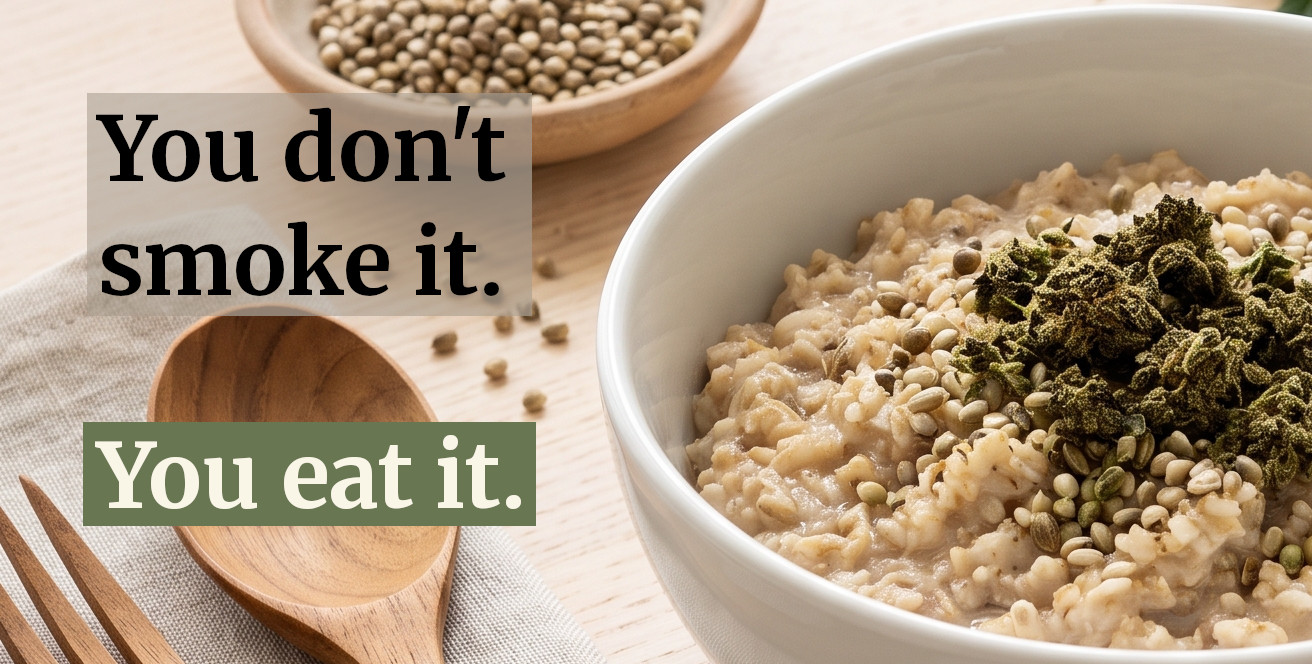
When hemp seed and raw cannabis flower are eaten as food — raw, the flower never heated — does blood-sugar control shift over four weeks? This study asks that question in the open, with every record available for anyone to examine.
Why would food move blood sugar at all?
Consider scurvy. For centuries it looked like a disease — sailors wasted away from it — until it turned out to be something simpler: a missing nutrient. Give the body vitamin C, and it repairs itself. No drug. Just the input it had been lacking.
This study asks a careful version of that question for blood sugar. Not whether a food can push the number down — but whether the body’s been missing an input, and rights itself once it has it back.
The study is built so that if the answer is no, that shows too — in public.
How will we know?
Blood sugar leaves two marks at two speeds: fructosamine reflects the last few weeks, A1C the last few months. Both can move — a drug that simply holds glucose down would move them too. So the question isn’t whether they move, but in what order.
If the correction is real and upstream, the faster mark shifts first and the slower one follows. That ordering is the signature of a nutritional correction — the pattern you’d expect if a condition like Type 2 Diabetes had a nutritional component, not only a glucose to be pushed down.
Even then it wouldn’t be proof: if both marks move more than standard care would predict, that’s striking — and still doesn’t rule out other explanations. The ordering is the fingerprint we’re watching for, and four weeks is just long enough to see it begin.
The shape of it
A starting A1C, four weeks of the food with a five-minute check-in each week, then a second A1C. That before-and-after — yours, and the crowd’s — is the whole study. No name, no email.
Open science
This app is open-source and feeds an append-only Zenodo dataset. The visualization and extract layer reads from that same open-access data. Everything — spec, implementation, and data — is available for anyone to analyze or repurpose.
The study is built to the published specifications at OSF and Zenodo, with matching implementation documentation for those who wish to follow the methodology.
What you’ll need
The food
Hemp seed (whole or shelled, raw, kept cold) and raw cannabis flower — flower that has never been heated or decarboxylated. Heat changes it from the food we're looking at into something else.
A way to measure
An A1C reading at the start and again at week 4. A home kit, a pharmacy, or a clinic — whatever you can reach. Fructosamine is optional but valuable if you have access.
The Science
Stomach Acid, Blood pH, and Liver Metabolism: The Stability and Transformation of Acidic Cannabinoids DOI 10.5281/zenodo.21756221
Interpretive Conclusions from the Biochemical Alignment of Human Breast Milk and Hemp Seed + Raw Cannabis Leaf/Flower Across Endocannabinoid System-Relevant Nutritional Axes DOI 10.5281/zenodo.20437815
The A1C Challenge: Pre-Registered Statistical Analysis Plan and Study Methodology (RWE cohort) DOI 10.5281/zenodo.20653093
OSF pre-registered DOI 10.17605/OSF.IO/R4UFG
Convergent Nodes, Bifurcating Failure: Compartment, Substrate, and the Gate in Glucose Control DOI 10.5281/zenodo.21534251

Log in or sign up for Devpost to join the conversation.