Inspiration
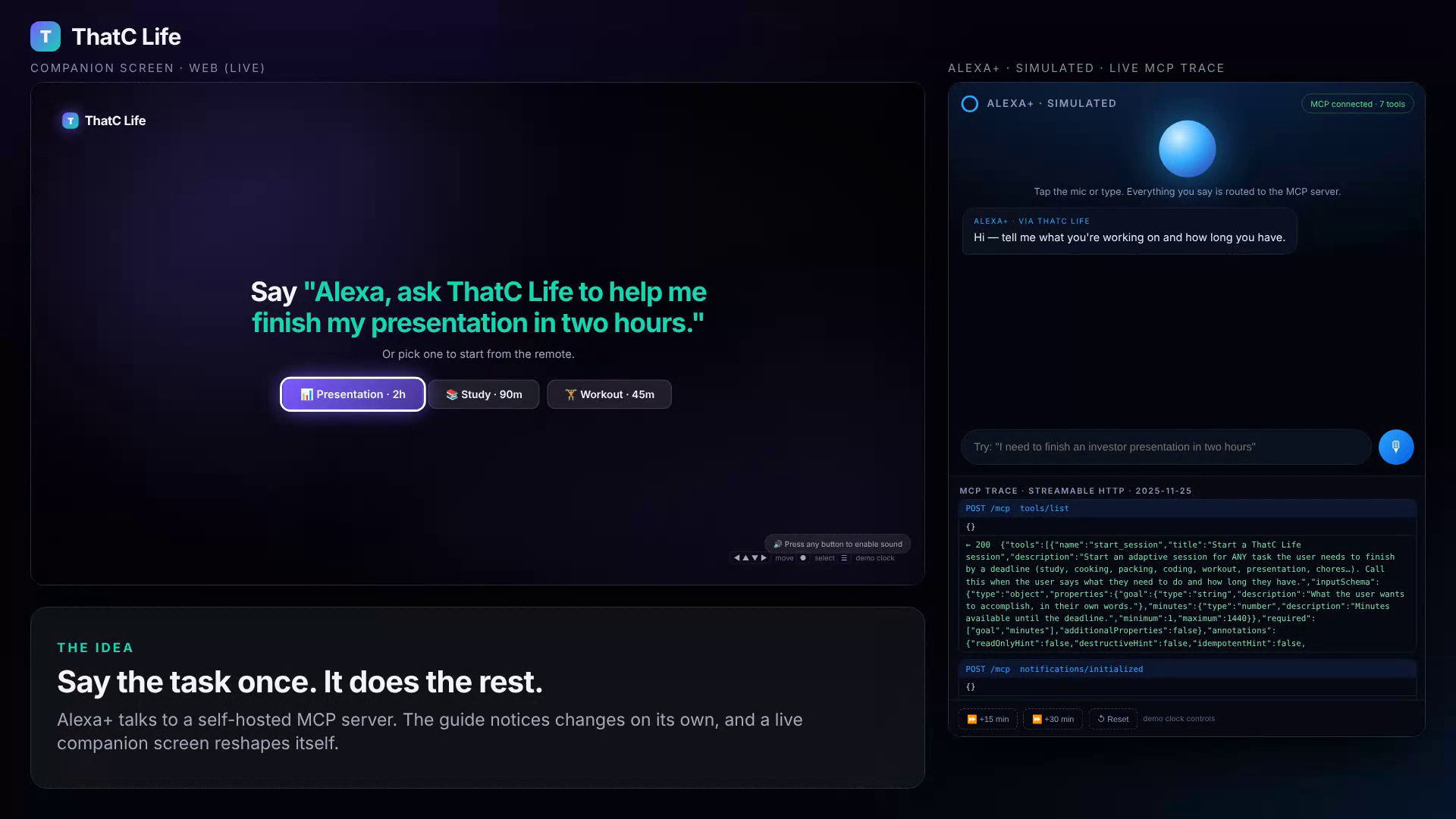
Every deadline has two enemies: the clock, and the moment you realise you’re behind, usually too late. Timers only count. To-do lists only sit there. Chatbots wait for you to ask. We wanted a guide that notices it before you , and changes how it helps as your time shrinks.
What it does
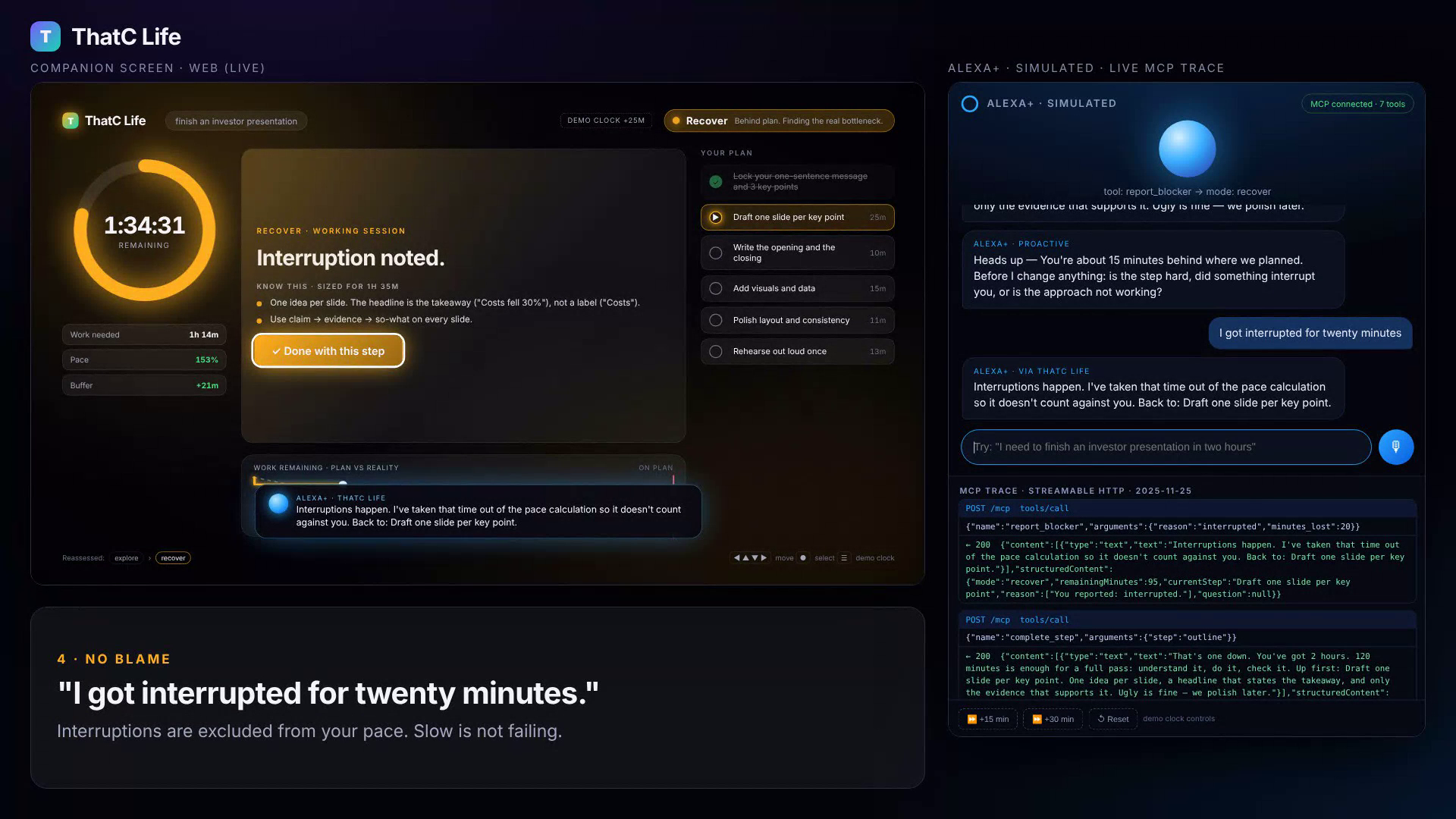
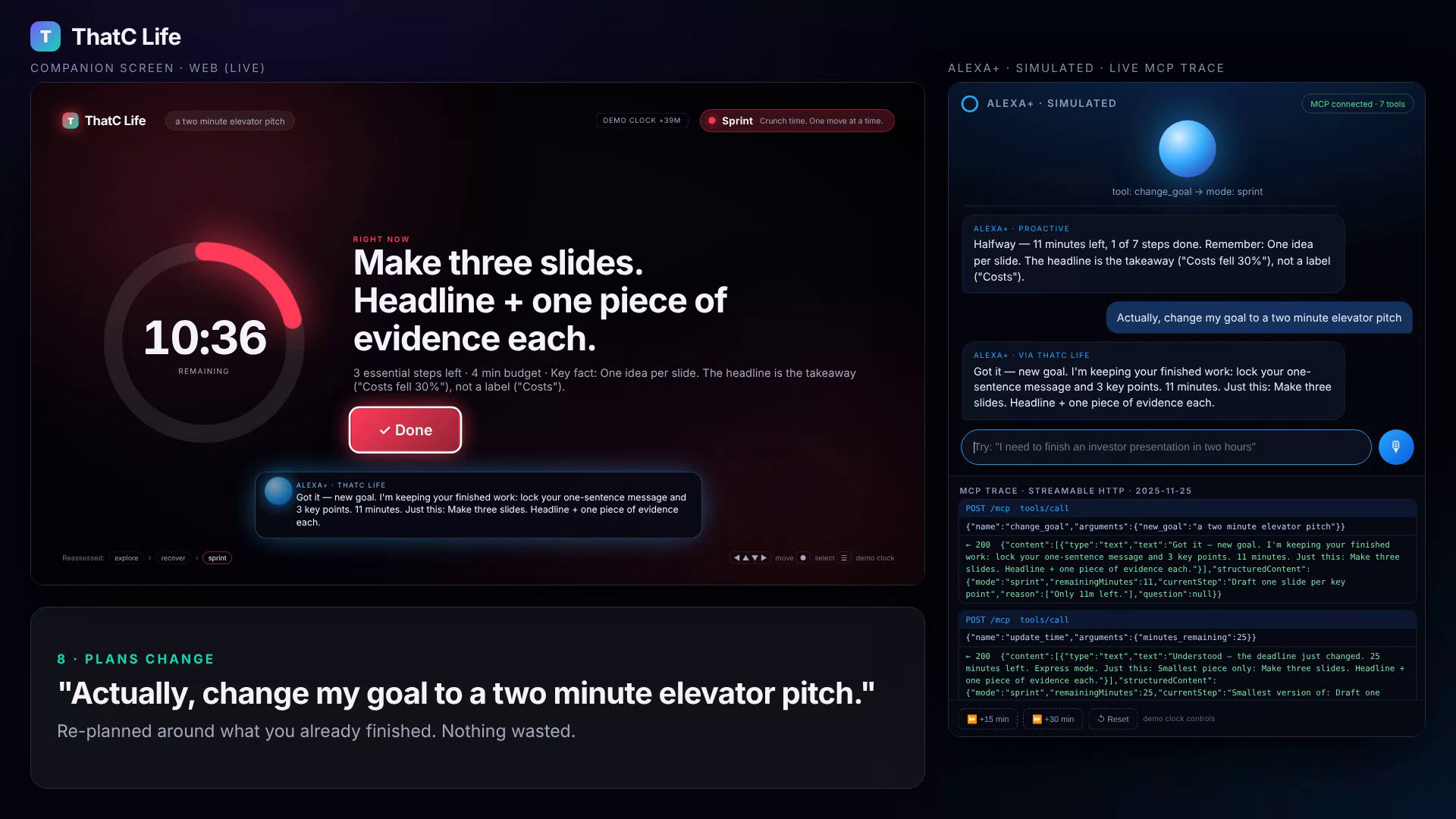
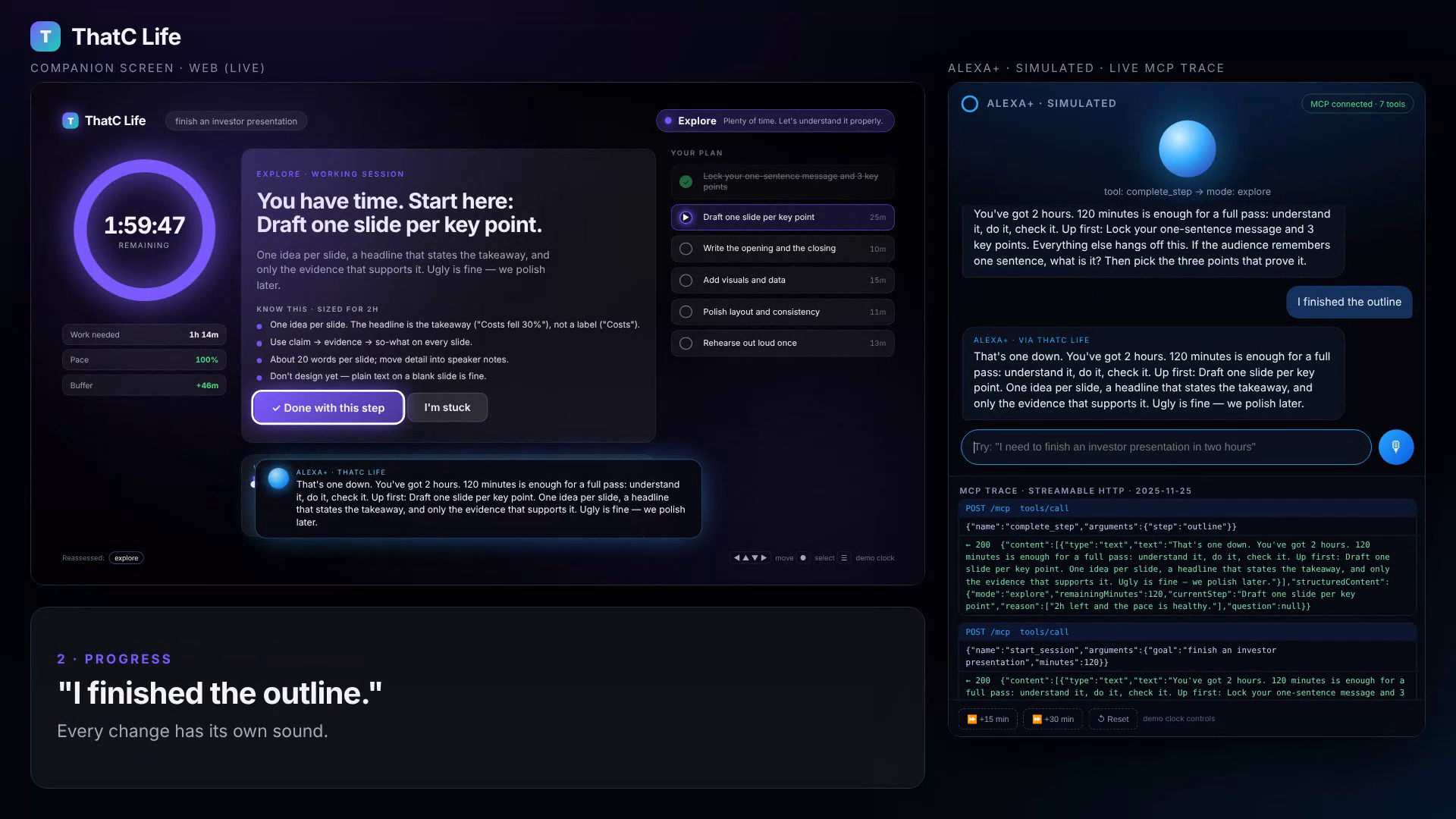
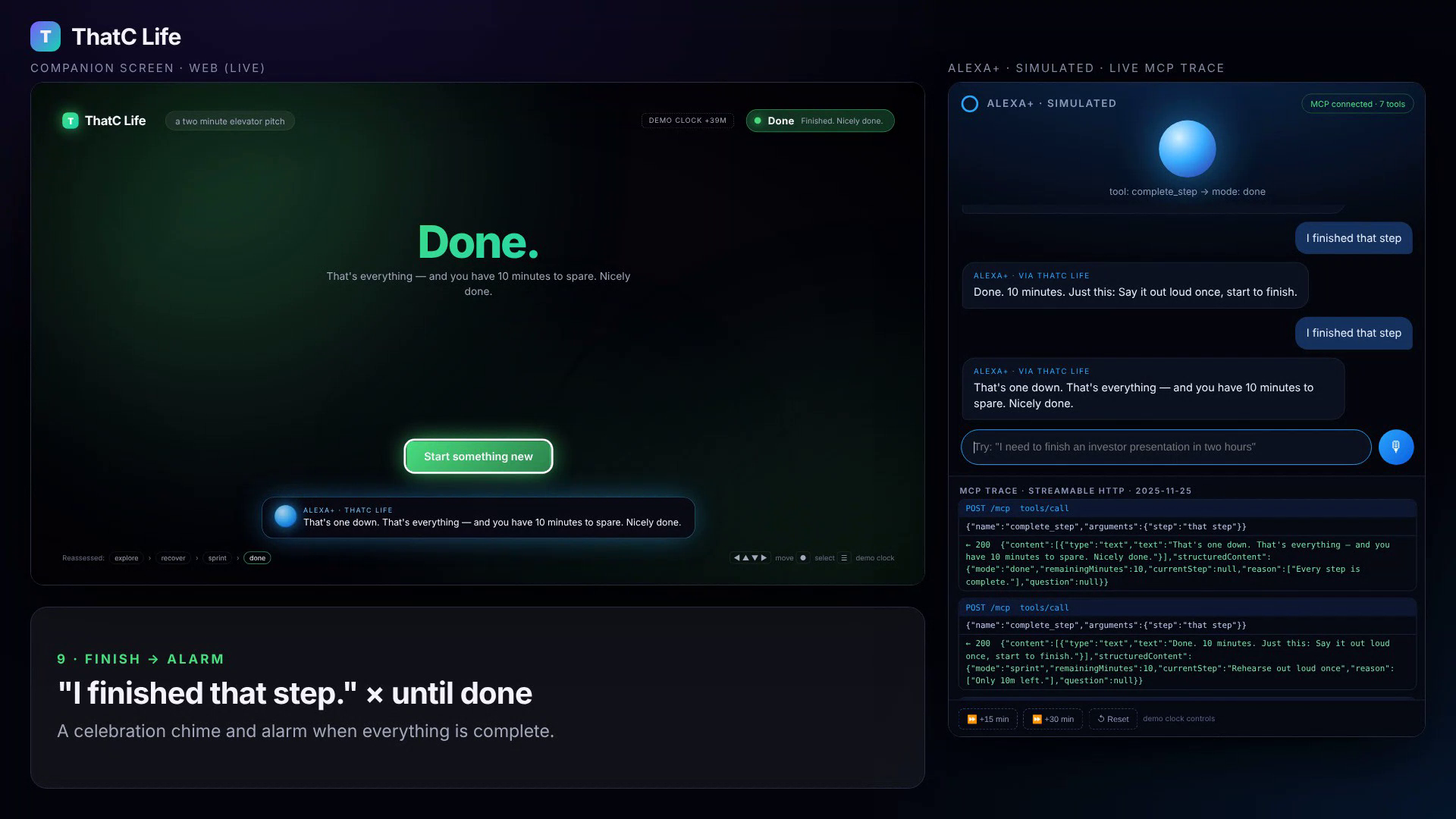
ThatC Life is a time-aware guide for Alexa+. Tell it what you need to do and how long you have: a presentation, an exam, packing, a workout. It builds a plan sized to that time and gives you the key facts for the step in front of you. Then it keeps watching. Nobody has to say “I’m falling behind.” It notices on its own, speaks up through Alexa+, and a live companion screen reshapes itself: Explore: plenty of time, so it explains. Flow: you’re on pace. Recover: it asks whether the step is hard, you were interrupted, or the approach isn’t working. It never assumes you’re slacking. Triage: it parks the nice-to-haves. Sprint: one instruction and one key fact. Every kind of change has its own sound, and an alarm plays when you finish or time runs out. If the deadline moves or the goal changes, it re-plans around what you’ve already done.
How we built it
Brain: a dependency-free Node.js engine for time awareness, progress awareness, adaptive interaction and continuous reassessment. Alexa+: a self-hosted MCP server (Streamable HTTP, spec 2025-11-25) with seven tools. A simulated Alexa+ web client acts as a real MCP client, with the live JSON-RPC trace on screen. The source is in the repo. Proactivity: a monitor reassesses every session every 2 seconds and raises notices on its own. Companion screen: a web UI updated live over Server-Sent Events. Sound: 16 synthesized sounds with the Web Audio API, so there are no audio files. Planning: built-in plans for 16 task families, with facts sized to the time left. An AI planner can be plugged in through an optional key. Quality: 16 automated end-to-end tests over real HTTP.
Challenges we ran into
I discovered this hackathon late, and Alexa+, the Model Context Protocol and voice-first design were all new to me, so I had to learn them while building. Making “automatic” trustworthy was the hardest design problem: slow progress doesn’t mean failure, so the guide gathers evidence first, excludes interruption time from your pace, and asks before it concludes. Keeping voice replies instant mattered too. We also fixed real bugs found in testing, such as “a two minute pitch” being heard as “two minutes left”.Another biggest challenge wasn’t technical, it was money. I couldn’t afford a paid AI API key, and I didn’t want to build a guide that only works for people who can pay. So I made a hard choice: ThatC Life runs entirely on its own logic, with no key and no cost.
Accomplishments that we’re proud of
A guide that notices on its own. In the demo, 25 minutes pass in silence and the screen changes, chimes and asks what’s wrong. One interface with five completely different experiences. A spec-compliant MCP server with a visible protocol trace and 16 passing tests. A distinct sound for every kind of change, plus an alarm at the finish. Honest behaviour: when a plan can’t fit the time left, it says so and offers a smaller goal. Shipping something real, in very little time, from a standing start.
What we learned
I found this hackathon late, and With so little time, It was hard. Alexa+, the Model Context Protocol and voice-first design were all new to me, and I had to learn them while building. A voice isn’t a screen, and a guide that speaks needs to say only the next move. Every day brought a new thing I didn’t know yet, and some things didn’t work the first time, or the second. What I learned from that was the best part of this whole experience. I learned how to build a different kind of app. It wasn’t a single screen but a guide that lives across a voice and a live companion screen, notices things by itself, and changes how it helps. I came away understanding how an assistant talks to a service, why a voice should carry only what you need right now while a screen holds the detail, and how the two work best when they stay in sync. Those are things I’d never have learned from reading about them. It also gave me a lot of exposure. I saw how far a small idea can go when you build the real thing instead of just imagining it. Most of all, it showed me my passion. I love making things. I love the moment when something I imagined starts to work and respond. And I learned that it doesn’t have to be perfect to be worth making. ThatC Life isn’t the finished version of what I see in my head. But it exists, it works, and it taught me more than waiting ever would have. So that’s what I’m taking from this: start anyway, even late, even if it won’t be perfect. That’s how I found out how much I love building.
What’s next for ThatC Life
Account linking so Alexa+ and the screen share one workspace per customer, camera-based progress signals, and AI-tailored plans for every task through Amazon Bedrock.
Built With
- alexa+
- css3
- html5
- http
- javascript
- json-rpc
- mcp
- node.js
- serversentevents
- webaudioapi
- webspeechapi

Log in or sign up for Devpost to join the conversation.