Inspiration
Every year, thousands of children in India are born with Thalassemia, a genetic blood disorder that requires lifelong blood transfusions. Yet, most families struggle with access to timely blood, awareness of care, and support systems. Inspired by the tireless efforts of NGOs like Blood Warriors and the gaps we observed in manual donor coordination, we wanted to create a scalable AI-powered system to ease this burden. Our aim was to empower patients, donors, and NGOs with a unified digital solution that turns reactive care into proactive support.
What it does
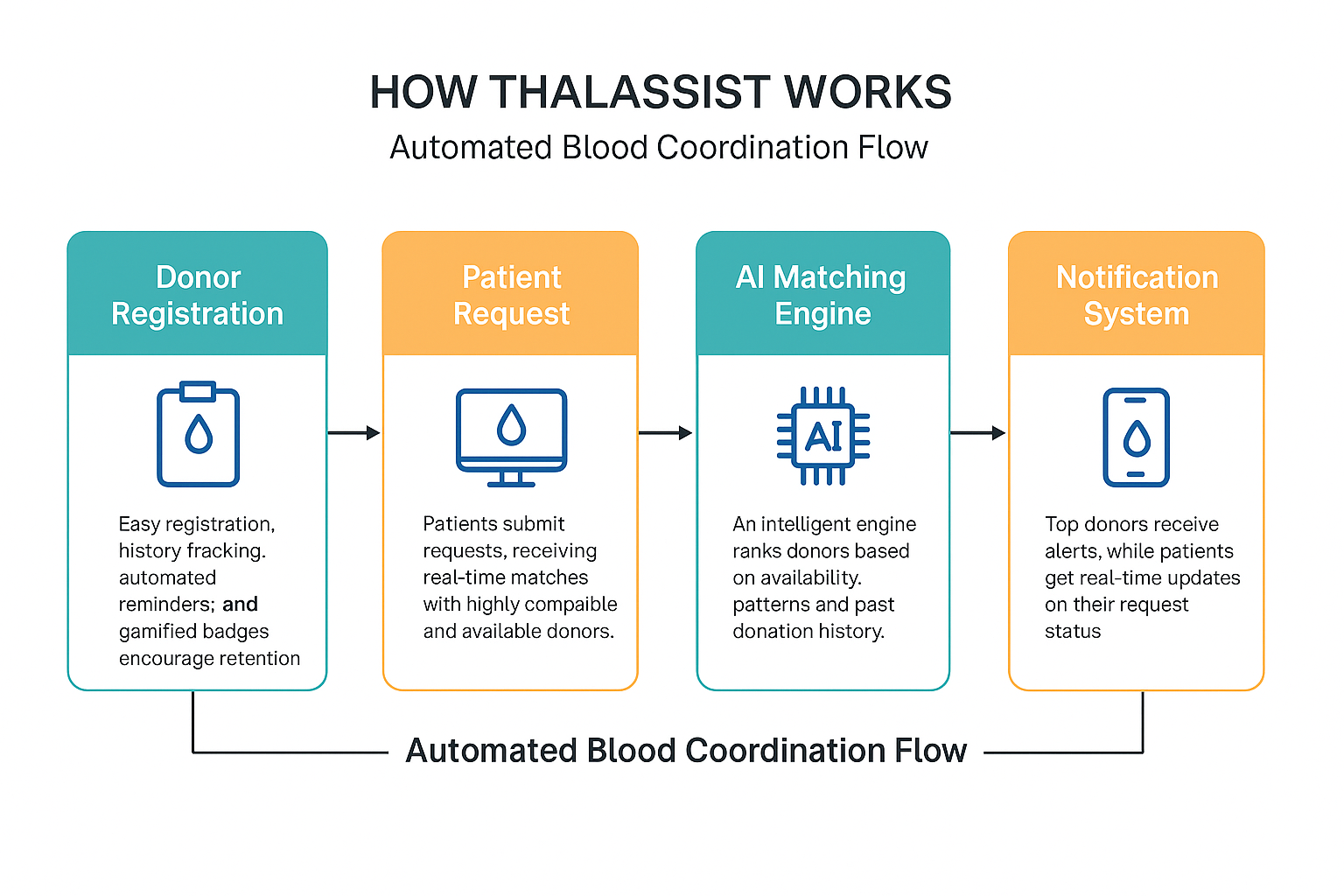
ThalAssist is a real-time blood donation and transfusion management platform designed specifically for Thalassemia patients. It connects patients with compatible donors using geolocation and donor availability predictions powered by machine learning. The platform also includes a donor contribution tracker to encourage recurring donations, automated alerts and reminders, and a patient support chatbot. It integrates (or simulates integration) with national systems like e-RaktKosh and Blood Warriors’ Blood Bridge to streamline workflows for NGOs and hospitals.
How we built it
We built the frontend using React.js and styled it with Tailwind CSS for a clean, responsive UI. The backend was developed using Flask in Python, handling API requests, authentication, and data logic. For the AI component, we used scikit-learn to train a model that predicts donor availability based on historical donation data and behavioral patterns. MongoDB served as our database, storing donor/patient records and request statuses. We simulated integration with APIs like e-RaktKosh and used Twilio for SMS notifications. We also included a chatbot prototype using IBM Watson Assistant to provide patient education.
Challenges we ran into
One major challenge was the lack of access to real-world donor datasets, which limited the depth of our AI model. We addressed this by building a well-structured mock dataset to demonstrate our concept. Integrating multiple features (prediction engine, notification system, dashboard) into a unified platform within the time constraints was also technically demanding. Ensuring secure handling of sensitive donor/patient data, even in simulation, posed additional complexity.
Accomplishments that we're proud of
We’re proud that we successfully built a working end-to-end prototype that includes real-time donor matching, AI-based predictions, and donor gamification — all within a short hackathon period. Our AI model, though based on mock data, showed promising results. We also created a clean, intuitive UI that could be readily adopted by NGOs and hospitals. The scope and scalability of ThalAssist is something we’re truly excited about.
What we learned
We learned how AI can be meaningfully applied in health-tech beyond just data analysis — in real-time systems that make life-saving decisions. We also deepened our understanding of patient-centric design, data privacy, and scalable web architecture. Most importantly, we gained insight into the realities of healthcare NGOs and the value of tech-for-good when tailored to real problems.
What's next for ThalAssist
Post-hackathon, we plan to:
- Integrate live APIs from e-RaktKosh and Blood Bridge.
- Expand the AI model with real donor datasets in partnership with NGOs.
- Build a mobile version for better accessibility in rural areas.
- Conduct user testing with Blood Warriors and other field partners.
- Explore voice assistant support for low-literacy users.
ThalAssist has the potential to become the digital backbone for managing Thalassemia transfusions in India and beyond — and this hackathon is just the beginning.
Built With
- bcrypt-(security)
- css
- firebase
- flask-(python)
- github
- google-maps
- html
- ibm-cloud-/-render-/-heroku-(deployment)
- ibm-watson-assistant-(for-chatbot)
- jupyter-notebook
- jwt-authentication
- mongodb
- pandas
- react.js
- scikit-learn
- tailwind-css
- twilio-api-(sms)
- version
- whatsapp-cloud-api
