-
-
Thalasscare AI
-
Thalassemia Support System


Inspiration
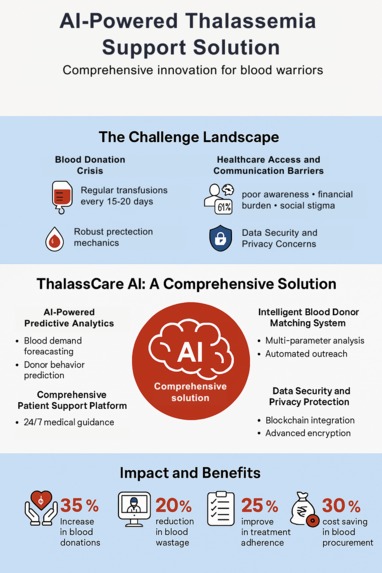
Living in India, we're no strangers to the harsh realities of healthcare challenges. The sheer scale of the thalassemia crisis in our country is heartbreaking. We learned that India is considered the "Thalassemia capital of the world," with over 100,000 people, many of them young children, battling this condition. These "Blood Warriors" need blood transfusions every 15-20 days just to survive. We were deeply moved by the work of organizations like the Blood Warriors Foundation, who are on the front lines, fighting for a thalassemia-free future for India. The statistics were staggering: a 34% gap between blood demand and supply, and the pandemic only made things worse. Patients were struggling to find replacement donors for every single transfusion. We knew we had to do something. It wasn't just about the technical challenge; it was a call to action. We felt a strong pull to use our skills in technology to support these warriors and the organizations that tirelessly help them. That’s how the idea for ThalassCare AI was born – from a desire to build something that truly matters, something that could bring a ray of hope to thousands of families across our nation.
What we learned
This project was a massive learning curve for us. We dove deep into the complexities of the healthcare world, and what we found was both challenging and enlightening.
1) The Depth of the Blood Donation Crisis: We understood that it's not just about finding any blood donor. We learned about the critical need for fresh blood (less than 14 days old) and the complication of alloimmunization, which affects over 35% of multi-transfused patients, making it even harder to find compatible blood.
2) The Power of AI in Healthcare: This project opened our eyes to the immense potential of Artificial Intelligence. We discovered that machine learning models, like the Random Forest algorithm, can predict whether a donor will return with up to 98.7% accuracy. We also learned how time-series analysis could forecast blood demand 30-60 days in advance. It was amazing to see how technology could bring such precision to a critical, life-saving process.
3) The Human Side of Technology: We realized that technology, no matter how advanced, must be human-centric. We learned about the immense financial and social burdens on patients' families, with treatment costs averaging ₹2 lakhs annually and the social stigma they face. This reinforced our decision to build features like a 24/7 AI chatbot for emotional support and telemedicine integration for easier access to specialists, especially for those in rural areas.
4) Data Security is Paramount: In healthcare, trust is everything. The fact that the healthcare industry faces the highest data breach costs, averaging $9.8 million per incident, was a wake-up call. This pushed us to explore and integrate cutting-edge security measures like Blockchain and advanced encryption to ensure that patient and donor data is always safe and secure.
How we built it
Bringing ThalassCare AI to life was a marathon, not a sprint, starting with an intense hackathon phase. Our goal was to create a comprehensive, AI-driven platform to tackle the challenges from every angle. Here’s a glimpse into our tech stack and architecture:
The Brains of the Operation (AI/ML): At the core is our AI-powered predictive analytics engine. We used Python with libraries like scikit-learn, TensorFlow, and PyTorch to build our models. We developed Random Forest models for predicting donor behavior and LSTM networks for forecasting blood demand.
1) For the Users (Frontend): We wanted a seamless experience for everyone. We used React Native to build a cross-platform mobile app for patients and donors, and a React.js web dashboard for healthcare providers. We also built a Progressive Web App to ensure accessibility even in areas with poor internet connectivity.
2) The Backbone (Backend): Our backend is built on a microservices architecture using Docker and runs on AWS for scalability. We used Node.js with Express.js for our API gateway and MongoDB for flexible data storage.
3) Connecting the Dots (Integrations): To create a truly unified system, we planned for crucial integrations. A key one is the e-RaktKosh API, which connects us to the national blood bank system. We also used HL7 FHIR standards to ensure our platform can talk to existing hospital management systems.
4) Ensuring Security: To protect sensitive data, we integrated Hyperledger Fabric for a blockchain-based record system and used robust AES-256 encryption.
The system has four main interfaces, designed for patients, donors, healthcare providers, and the Blood Warriors Foundation, each with features tailored to their specific needs, from smart health tracking for patients to campaign management tools for the foundation.
Challenges we ran into
1) Data, Data, Data: The biggest challenge was data quality. Real-world healthcare data can be messy and inconsistent. We had to design robust protocols for cleaning and standardizing the data to ensure our AI models were accurate and unbiased.
2) Bridging the Old and New: Integrating our modern platform with existing, often legacy, hospital systems was complex. We had to design a flexible API that could handle these connections without breaking.
3) Navigating Regulations: Healthcare is a heavily regulated field, and for good reason. We had to be extremely careful about data privacy and compliance with standards equivalent to HIPAA. We planned a phased rollout, starting with non-diagnostic features to navigate the medical device regulations carefully.
4) Winning Trust: Perhaps the most significant challenge is user adoption. We knew that just building a great app wasn't enough. We had to earn the trust of patients, doctors, and donors. This meant focusing on user-friendly design, providing comprehensive training, and demonstrating our unwavering commitment to data security.

