-
-
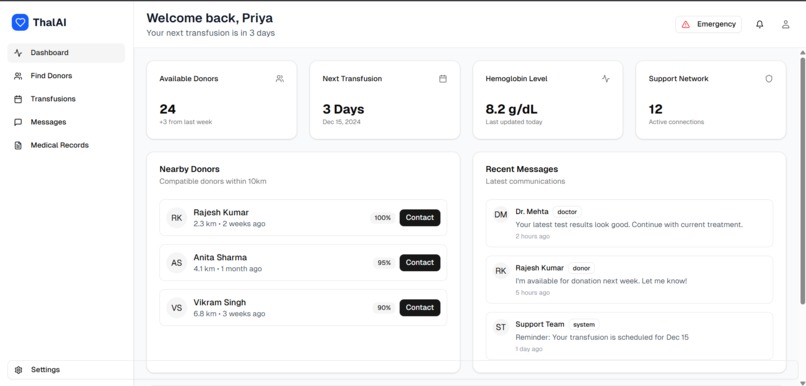
ThalAI
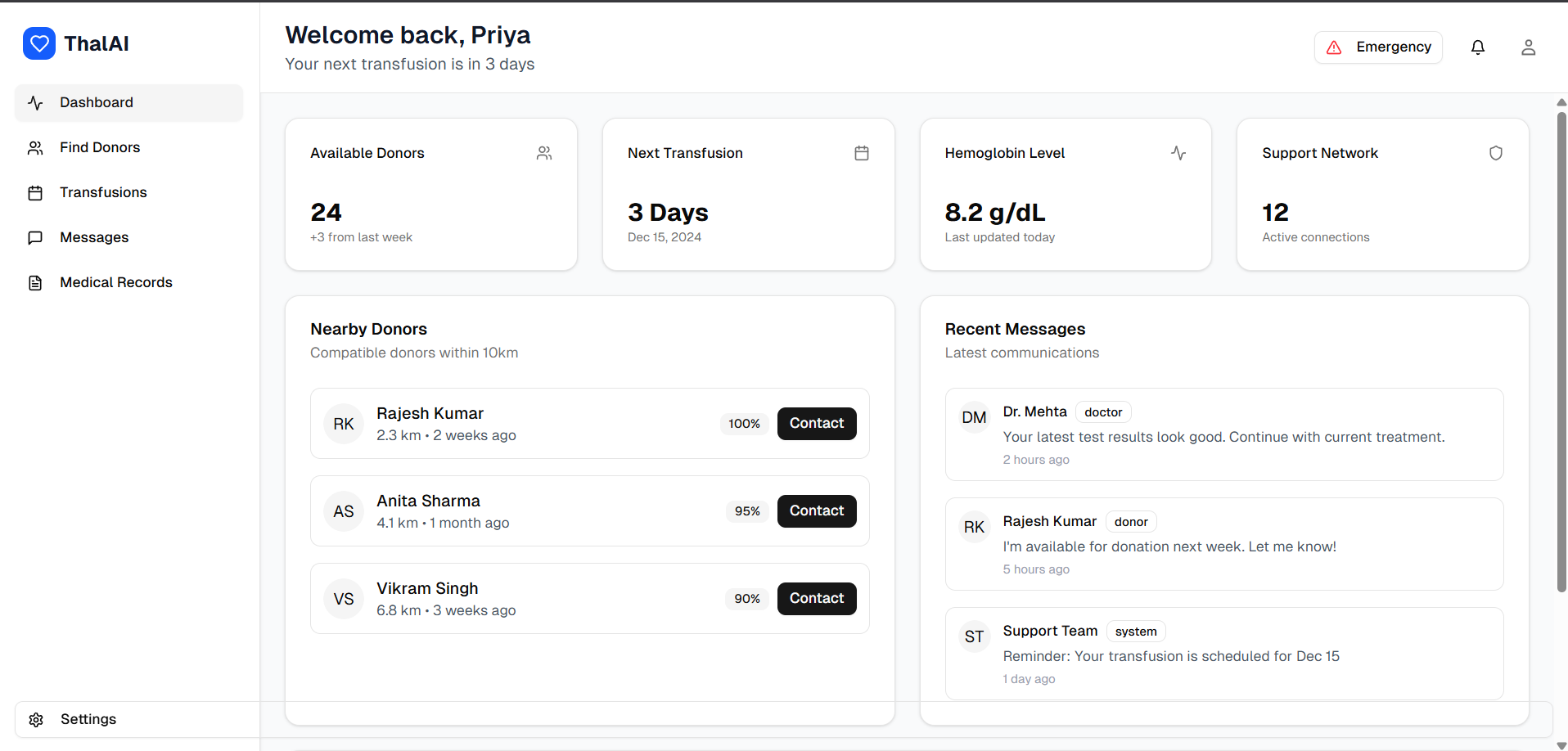
ThalAI – Empowering Lives with Every Drop
Inspiration
While volunteering at a Thalassemia awareness camp, we met families who had traveled over 100 km just to receive a scheduled blood transfusion — only to return home because no blood was available. This experience made us realize that the problem isn't just about supply; it's about timing, prediction, and communication.
Thalassemia patients need recurring transfusions. But India lacks a proactive system to predict their needs and prepare donors ahead of time. This gap inspired us to create ThalAI — an intelligent, preventive care platform that uses AI, voice technology, and low-cost IoT to support patients and their families.
What it does
ThalAI is a unified platform that provides:
Transfusion Risk Prediction
Predicts the next transfusion date using AI models trained on patient history, symptoms, and vitals.IoT-Enabled Vitals Monitoring
A low-cost wearable or mobile sensor reads pulse and temperature. When vitals drop below normal, the system issues early warnings to family members and local hospitals.Voice-Based Virtual Assistant
Enables caregivers to ask health-related questions in Hindi, Gujarati, or Marathi using voice. Answers are personalized and verified by medical experts.Blockchain-Backed Medical Timeline
Stores transfusions, lab reports, and consultations securely. Patients control who accesses their data.Proactive Donor Engagement
Predicts availability of nearby donors based on past donation patterns and notifies them before a crisis.
How we built it
- Frontend: React Native and Flutter for the mobile app, with a WhatsApp chatbot fallback for low-tech environments.
- Backend: FastAPI and Firebase for secure storage and real-time communication.
- AI Models:
- LSTM and XGBoost for transfusion risk prediction.
- BERT and fine-tuned speech-to-text for regional language voice assistant.
- IoT Prototype: NodeMCU with a pulse sensor and thermometer, optionally connected via mobile phone or standalone.
- Blockchain: Used Hyperledger/IPFS to simulate an immutable patient health ledger with consent-based access control.
We used synthetic patient data based on real-world patterns and WHO data to train and test our models.
Challenges we ran into
- Lack of publicly available Thalassemia patient data for model training.
- Building an inclusive voicebot that understands regional dialects with low noise tolerance.
- Designing an interface for families with low digital literacy.
- Ensuring affordability and offline functionality in the IoT module.
- Balancing medical data privacy with seamless communication between patients, hospitals, and donors.
Accomplishments that we're proud of
- Developed a unique Transfusion Risk Scoring Engine based on real-world patient patterns.
- Built a multilingual voice assistant that can operate offline and help low-literacy users.
- Created a secure medical data ecosystem where patients fully control their information.
- Designed a proactive system that alerts donors before a critical request is raised.
- Integrated AI, voice technology, and IoT into a working, field-adaptable solution.
What we learned
- Preventive care is far more effective than reactive systems, especially in chronic conditions like Thalassemia.
- For many families, literacy is not just about reading — it's about understanding and trusting the healthcare system.
- Voice and audio-first interfaces can bridge the accessibility gap where traditional apps fail.
- AI needs to be explainable, especially in medical contexts where outcomes affect lives.
- Strong data governance is essential in any healthcare solution involving patients and real-time decisions.
What's next for ThalAI
- Partner with Blood Warriors and government hospitals to conduct pilot testing.
- Add image-based support for prescription recognition and medicine identification.
- Expand language support to include Tamil, Bengali, and Kannada.
- Deploy the IoT monitoring module to rural health centers and homes with CSR-backed funding.
- Collaborate with ABHA (Ayushman Bharat Health Account) for integrated patient health ID linkage.
- Open up APIs for NGOs, hospitals, and community health workers to integrate with ThalAI services.

Log in or sign up for Devpost to join the conversation.