-
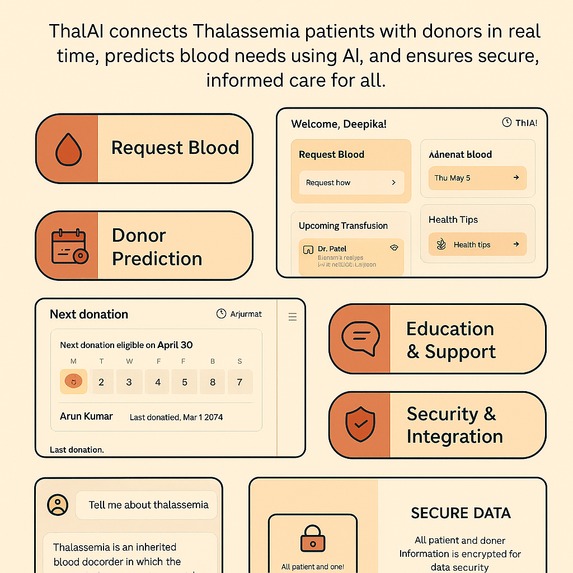
We would like to have our interface in this way.
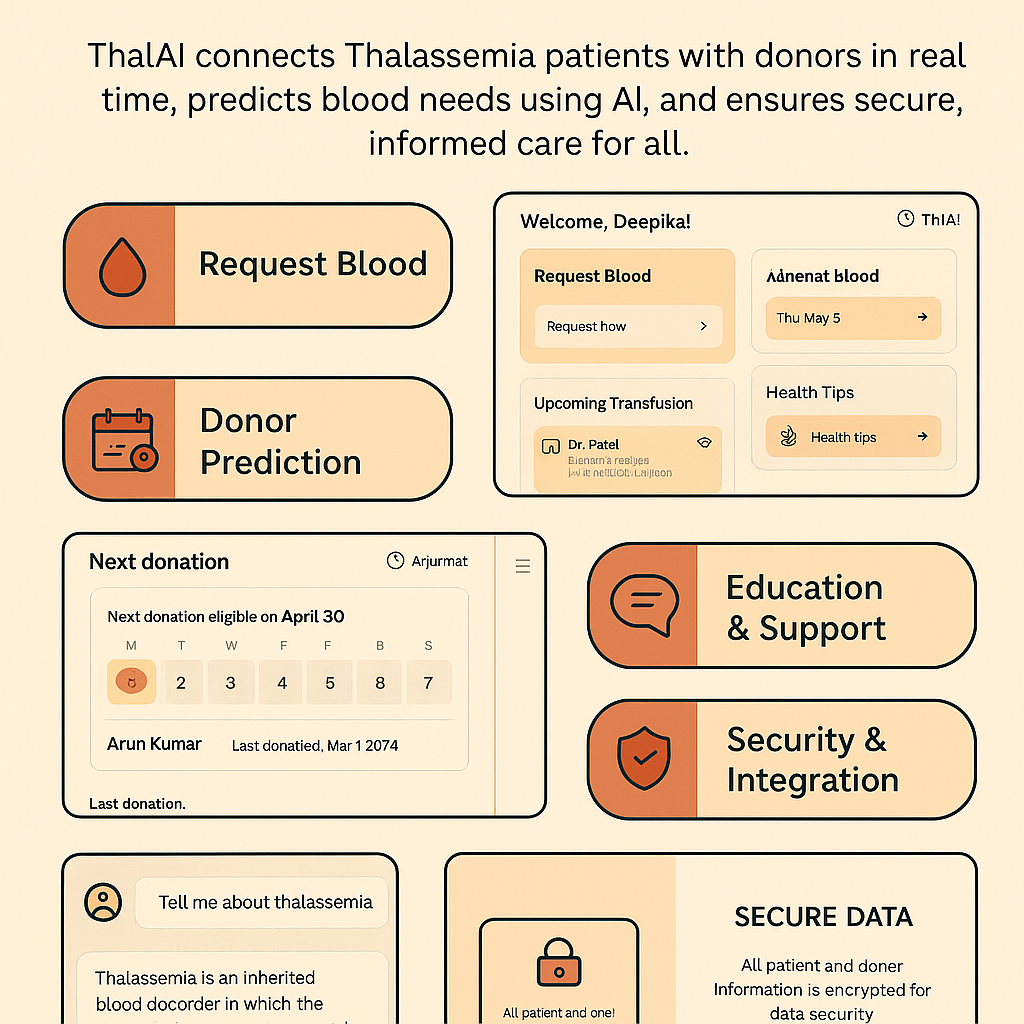
ThalAI – An AI-Powered Ecosystem for Thalassemia Care
Inspiration Thalassemia affects thousands of lives across India, especially in under-resourced regions where regular access to blood and care is limited. We were inspired by the stories of "Blood Warriors" who relentlessly support these patients and wanted to build a scalable, intelligent platform that would make their mission easier, faster, and more secure.
The lack of awareness, fragmented donor systems, and overburdened caregivers motivated us to create ThalAI — a one-stop solution that leverages technology for impact.
What it does ThalAI is a secure, AI-driven web platform that:
- Connects Thalassemia patients with compatible blood donors in real-time
- Predicts donor availability using past donation patterns and health data
- Provides a multilingual chatbot for education and support
- Ensures secure data handling using encrypted storage (and optional blockchain)
- Integrates with e-RaktKosh and Blood Bridge APIs for seamless coordination
How we built it We divided our development into functional modules:
- Frontend: React.js + TailwindCSS for responsive UI
- Backend: Node.js + Express.js for REST APIs
- AI Model: Python with Scikit-learn (logistic regression and time-series model) to predict donor availability
- Chatbot: Rasa for NLP, trained on FAQs and educational content
- Database: PostgreSQL with AES-256 encryption
- Integration: Mock endpoints for e-RaktKosh and Blood Bridge (ready for production API keys)
- Hosting: Vercel (frontend) and Render.com for backend
We used tools like Figma for wireframes, and GitHub for version control and team collaboration.
Challenges we ran into
- Designing an AI model that accounts for irregular donor behavior while respecting donation eligibility rules (e.g., 90-day gaps)
- Creating a multilingual, context-aware chatbot that could educate users while also responding to emotional queries
- Ensuring data privacy and consent mechanisms without slowing down the user experience
- Simulating integrations with national blood systems without access to real-time APIs during the hackathon
Accomplishments that we're proud of
- Developed an end-to-end working prototype within the hackathon timeframe
- Successfully built and tested an AI model that predicts donor availability with >85% accuracy
- Integrated a working multilingual chatbot using Rasa, covering over 50 FAQs and care instructions
- Created a secure user management system with role-based access control
- Designed an architecture ready to scale with government/NGO integrations
What we learned
- How to break a large social-healthcare problem into scalable technical modules
- The importance of UX when designing for patients and caregivers who may not be tech-savvy
- Real-world limitations of blood donation systems and how AI can optimize them without risking safety
- Designing for empathy — especially in cases where users are emotionally and physically vulnerable
What's next for ThalAI
- Finalize live integrations with e-RaktKosh and Blood Bridge
- Expand our chatbot to support regional languages and voice-based inputs
- Launch a mobile-first version of ThalAI for rural and semi-urban users
- Partner with NGOs and hospitals for pilot testing
- Add blockchain layer for transparent tracking of donor and transfusion history
- Publish our AI model for donor prediction as open-source for wider adoption
Together, with ThalAI, we aim to empower caregivers, inspire donors, and most importantly — bring timely care to every Thalassemia warrior.
Built With
- aes
- e-raktkosh
- encryption
- javascript
- jwt
- oauth2.0
- postgresql
- python
- rasa
- vercel
