-
-
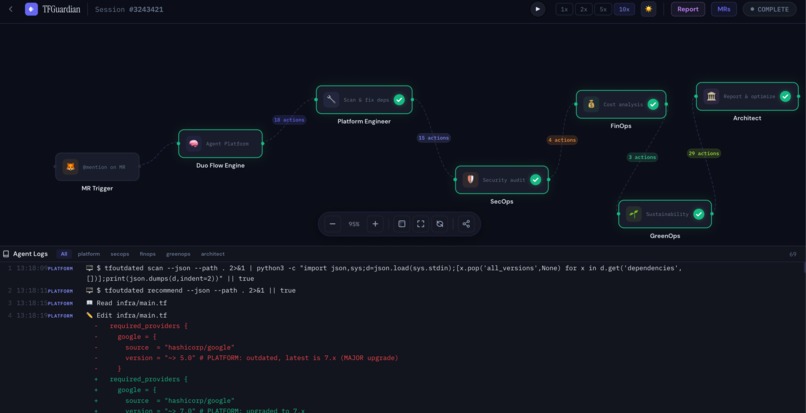
dark mode
-
-
Inspiration
Every week, platform engineering teams ship 50+ Terraform merge requests. Only a fraction get reviewed. Security vulnerabilities, cost overruns, and compliance gaps ship to production unchecked — invisible until something breaks. We asked: what if a team of AI agents could review every single MR, just like a real platform engineering team?
## What it does
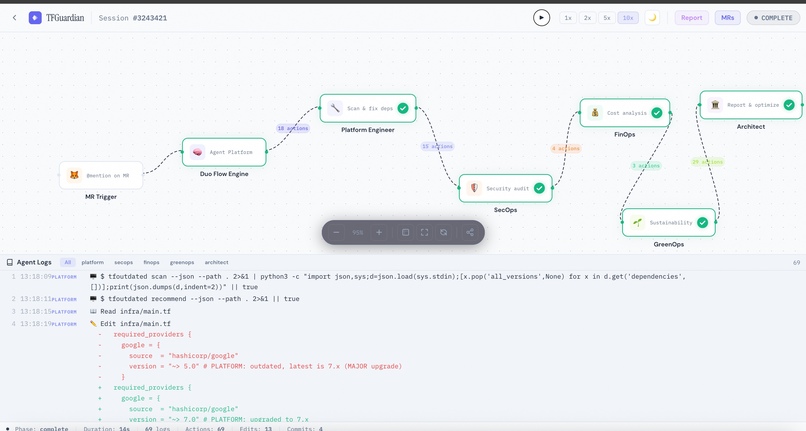
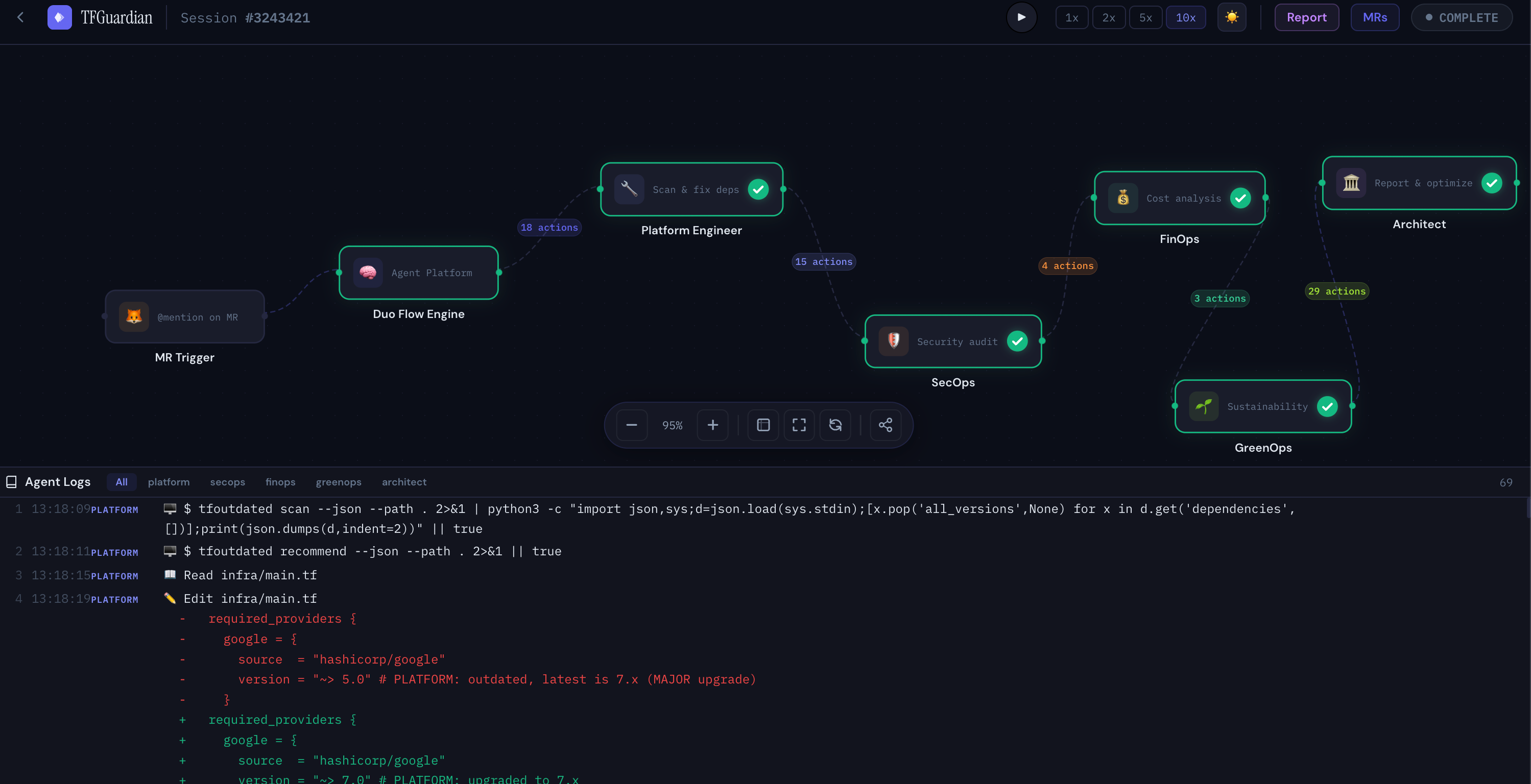
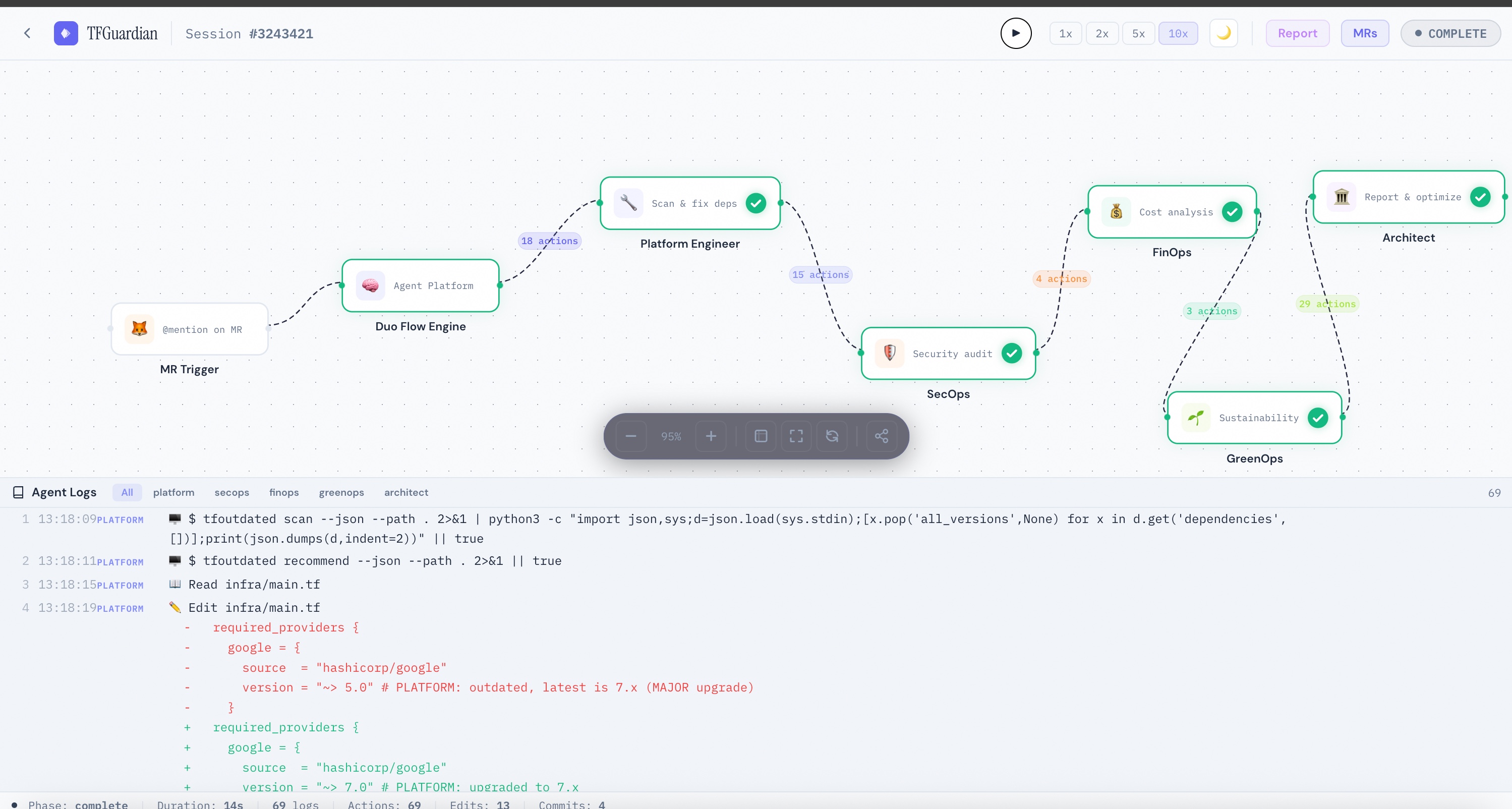
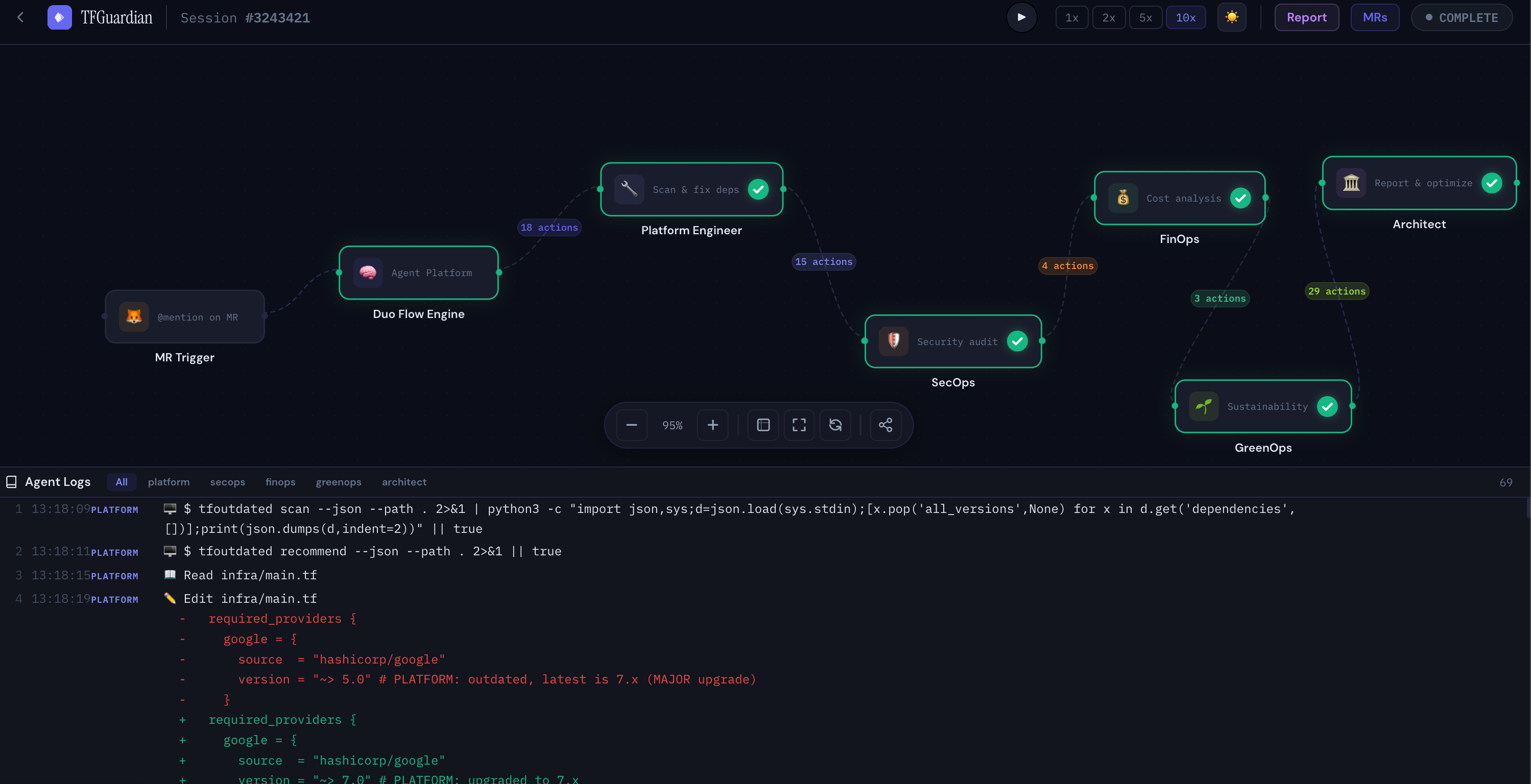
TFGuardian is 5 specialized AI agents on the GitLab Duo Agent Platform that review Terraform infrastructure automatically:
- Platform Engineer — Scans dependencies with tfoutdated (our custom Go CLI), auto-fixes version constraints, runs terraform validate and plan
- SecOps — Audits security with tfsec, gitleaks, and checkov. Finds and auto-fixes vulnerabilities, commits changes
- FinOps — Calculates real infrastructure costs using infracost with GCP pricing API
- GreenOps — Analyzes carbon footprint using Google Cloud's published Carbon Free Energy data across 45 regions
- Architect — Compiles everything into a Review Board report with a governance verdict and posts it directly on the merge request
One @mention triggers all five agents. Results from our latest run: 18 security vulnerabilities fixed, costs reduced from $556/mo to $18/mo, and 96% carbon emission reduction.
## How we built it
- GitLab Duo Agent Platform — 5 sequential AgentComponents with context passing, routers, and AGENT_DONE markers for reliable transitions
- Anthropic Claude — Powers all agents with tool use, extended thinking, and multi-step reasoning. Each agent calls 5-7 real CLI tools autonomously
- Real security tools — tfsec (static analysis), gitleaks (secret detection), checkov (CIS compliance) — not hallucinated findings
- Real cost tool — infracost with GCP pricing API for actual dollar amounts
- Custom Go CLI — tfoutdated, built from scratch, scans Terraform dependencies, detects breaking changes, and auto-fixes version constraints
- Live Dashboard — React + FastAPI at tfguardian.live with GitLab OAuth, MR list with agent status detection, one-click trigger scan, real-time flow visualization, per-agent log filtering, full report viewer with mermaid diagrams, and an Azure AI Foundry-style Flow Editor for prompt engineering
- Google Cloud — Cloud Run hosting, Workload Identity Federation (zero-secret auth), Artifact Registry, deployed via official Google GitLab Components
- Policy-as-Code — AGENTS.md defines hard rules (BLOCK), soft rules (REVIEW_REQUIRED), and recommendations with environment-specific policies for sandbox, staging, and production
## Challenges we ran into
- Making 5 agents reliably hand off context and produce a unified 10K+ character report on the merge request
- The GreenOps agent had all carbon data in its prompt, so Claude skipped tool calls entirely — we had to force explicit commands
- AI Catalog caches flow YAML aggressively — changes require git tags to force sync
- OAuth tokens expire every 2 hours but signed cookie sessions last 24 hours — built auto-refresh with token rotation
- Parsing raw GitLab job traces to classify which actions belong to which agent required AGENT_DONE markers and a multi-pass parser
## Accomplishments that we're proud of
- All 5 agents work end-to-end — from @mention to 10K+ Review Board report posted on the MR, fully automated
- Real tools, real results — tfsec found 18 vulnerabilities, infracost calculated actual GCP pricing, Google CFE data for 45 regions
- Custom Go CLI — tfoutdated published on GitHub, handles dependency scanning, breaking change detection, and auto-fix
- Live dashboard — tfguardian.live lets you watch agents work in real-time, trigger scans with one click, edit agent prompts, and export reports as PDF
- Zero-secret deployment — GCP Workload Identity Federation means no service account keys anywhere in the pipeline
- Policy governance — deterministic verdict system (BLOCK/REVIEW/PASS/SAFE) with Claude Reasoning Trace explaining every decision
## What we learned
- The GitLab Duo Agent Platform is genuinely powerful for multi-agent orchestration, but prompt engineering for reliable tool-calling flows requires iteration
- Real security scanners (tfsec, checkov) find significantly more issues than LLM-only analysis — the combination of AI reasoning + real tools is the sweet spot
- Policy-as-code governance needs deterministic rules in structured documents, not just free-form AI judgment
- Building a live dashboard that parses agent traces in real-time taught us that agent observability is as important as agent capability
## What's next for TFGuardian
- AWS and Azure provider support (currently GCP-focused)
- Parallel agent execution — FinOps and GreenOps could run simultaneously
- Integration with GitLab merge request approval rules — BLOCK verdict automatically prevents merge
- Prompt A/B testing in the Flow Editor — compare different prompt versions side by side
- Historical trend dashboards — track security posture, cost, and carbon footprint over time


Log in or sign up for Devpost to join the conversation.