-
-
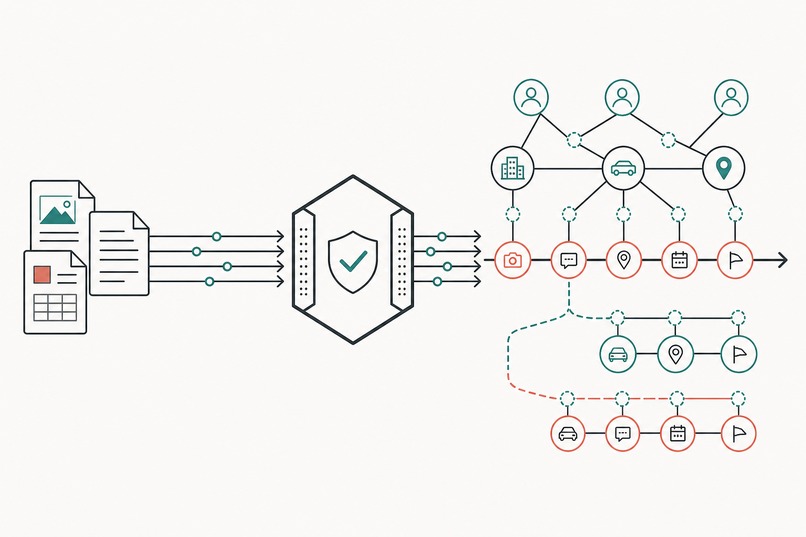
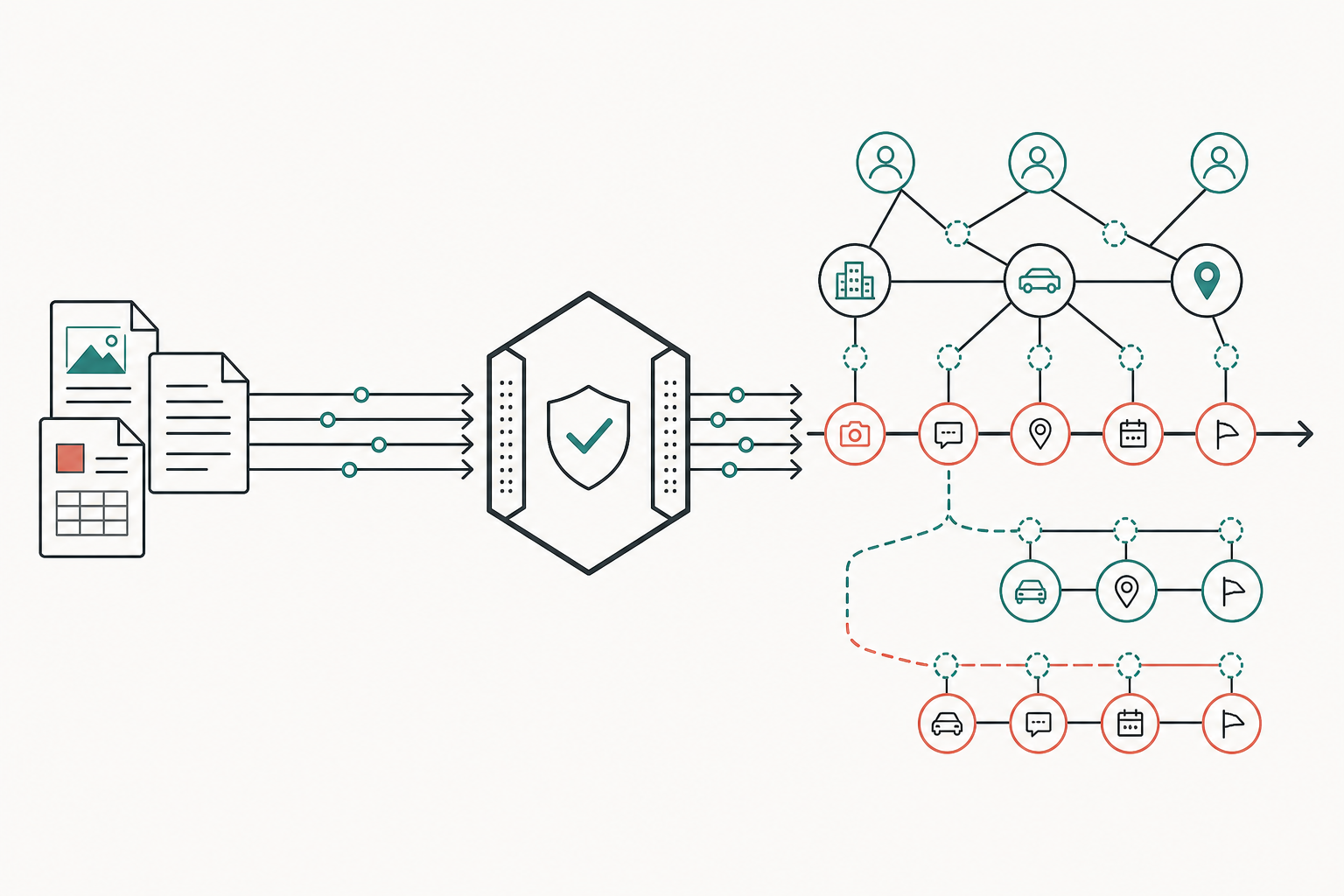
Evidence becomes a revisable world: subjects, states, transitions, and provenance.
Inspiration
Most AI systems treat text as a collection of passages to retrieve or summarize. But long-form text describes a world: subjects persist across chapters, names change, events alter states, sources conflict, and later evidence can revise what we thought was true.
RAG can answer which passage is relevant. We wanted to answer a harder question:
What world is this text describing, how did it reach its current state, and what is still uncertain?
What it does
Textual World Model reconstructs an evidence-backed world state from long-form text.
The Build Week prototype focuses on a bounded, closed narrative. It turns a selected corpus into a navigable reconstruction of:
- subjects and their aliases;
- events and temporal order;
- subject-relative states and state changes;
- competing interpretations when the text is ambiguous;
- contradictions and unresolved evidence;
- source spans supporting every reconstructed element;
- revisions produced after a human correction.
Instead of emitting one confident summary, the system maintains a set of candidate world hypotheses. Users can inspect why a state was proposed, see where alternatives remain, correct a mistaken identity or event, and replay the affected reconstruction.
Why it is different
Retrieval systems return documents. Knowledge graphs usually assume their entities and relations are already known. Textual World Model treats identity, state, and continuity as hypotheses that must be reconstructed from evidence.
The public prototype exposes the product behavior and audit trail. The deeper identity-resolution, ontology-promotion, candidate-generation, and ranking mechanisms remain private research.
How we built it
We used Codex with GPT-5.6 as a research and engineering collaborator across the project: exploring architecture, converting scientific questions into executable contracts, generating counterexamples, implementing validators, reviewing failures, and formalizing selected properties.
The prototype combines structured model outputs with deterministic evidence checks, versioned source cuts, replay receipts, and a proof-obligation layer. Selected bounded properties are expressed in Lean 4 so that compilation, empirical evaluation, and mathematical claims remain separate.
Our stack includes Codex, GPT-5.6, Python, Ruby, Lean 4, JSON Schema, and Git-based provenance.
Challenges we ran into
The hardest problem was not extracting more facts. It was deciding what counts as the same subject across distant text, what state belongs to which subject, and when ambiguity must remain unresolved.
We also had to prevent common shortcuts: treating a mention as a fact, collapsing conflicting perspectives, using future chapters to justify an earlier state, or presenting a passing test as proof of the entire system.
Accomplishments that we are proud of
- Defined an executable path from source evidence to competing world hypotheses.
- Made provenance, uncertainty, refusal, and revision first-class outputs.
- Built deterministic counterexample and replay checks around model-generated candidates.
- Used adversarial Codex review to discover apparently successful routes that were semantically invalid.
- Added machine-checked local properties without claiming that the full textual world model is already proven.
- Created a foundation that can share semantics across novels, enterprise documents, and interactive systems while keeping their completeness claims distinct.
What we learned
A useful world model is not the system that always produces one answer. It is the system that knows which differences matter, which claims the text actually supports, and when several worlds must remain possible.
The combination of generative exploration and deterministic verification was more valuable than either alone: GPT-5.6 and Codex proposed and attacked candidate structures, while explicit evidence and checking rules controlled what could be promoted.
What's next
The next milestone is expanding from the closed-narrative prototype to open documentary systems such as project archives, meeting records, and knowledge bases. These systems must revise their current world state as new documents arrive without rewriting history or hiding unresolved conflicts.
Longer term, Textual World Model will reconstruct past transitions, current state, causal explanations, and conditional future branches from text while keeping every result traceable, revisable, and appropriately uncertain.
Built With
- gpt-5.6


Log in or sign up for Devpost to join the conversation.