Inspiration
The inspiration for this project struck me during a conversation with a visually impaired friend who expressed frustration with the limited accessibility options for digital content. Witnessing their struggle ignited a passion within me to leverage technology for social good and address this pressing issue.
What it does
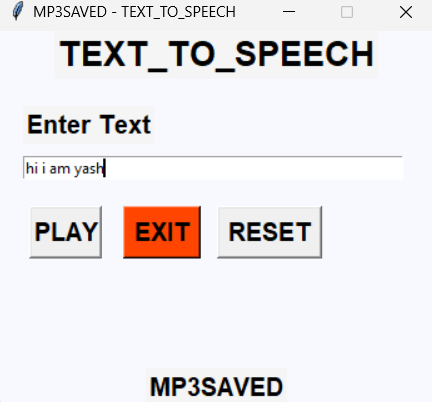
Text to speech is a Python program and can be used to read text. Currently it has English and Hindi language reading support via CLI arguments. For other language support you need to configure the code accordingly.
How we built it
Programming Language: Developed using Python due to its versatility and rich ecosystem of libraries. Libraries: Utilized pyttsx3 for text-to-speech synthesis and argparse for handling command-line arguments. User Interface: Designed a simple command-line interface (CLI) for ease of use and accessibility. Development Process: Employed an iterative approach, starting with basic functionality and gradually adding features based on user feedback and testing.
Challenges we ran into
Language Support: Configuring support for multiple languages posed challenges due to differences in pronunciation and character encoding. Accuracy: Ensuring accurate pronunciation of words, especially for proper nouns and technical terms, required fine-tuning of text processing algorithms. Platform Compatibility: Ensuring compatibility across different operating systems and environments required thorough testing and optimization. Performance: Optimizing the program's performance to handle large volumes of text efficiently without sacrificing quality presented technical hurdles.
Accomplishments that we're proud of
Multi-Language Support: Successfully implemented support for English and Hindi languages, providing accessibility to users from diverse linguistic backgrounds. User Feedback: Incorporated feedback from users to enhance the program's usability and functionality, resulting in a more intuitive and user-friendly experience. Robustness: Developed robust error handling mechanisms to gracefully handle edge cases and unexpected inputs, enhancing the program's reliability and stability.
What we learned
Accessibility: Deepened our understanding of accessibility principles and the importance of designing inclusive software solutions. Text Processing: Gained insights into text processing techniques and algorithms for tasks such as language detection and pronunciation. Community Engagement: Learned the value of engaging with users and incorporating their feedback to iteratively improve the program.
What's next for Text To Speech
Expanded Language Support: Plan to expand language support to include additional languages, leveraging language detection algorithms to dynamically switch between languages. Enhanced User Interface: Explore developing a graphical user interface (GUI) to provide a more interactive and visually appealing experience for users. Advanced Features: Investigate incorporating advanced features such as speech synthesis customization options and integration with voice assistants for hands-free operation. Community Collaboration: Foster a community around the Text To Speech project, encouraging contributions from developers and linguists to further enrich language support and feature set.
Built With
- cli
- python
- pytssx

Log in or sign up for Devpost to join the conversation.