-
-
Meet TextForge: The ultimate text and data manipulation toolkit
✨ Inspiration: The "One-Shot" Challenge
As a developer, my workflow is constantly interrupted by small, repetitive tasks: formatting a messy JSON snippet, converting a variable name to camelCase, or generating a quick UUID. I found myself juggling a dozen browser tabs for single-purpose online tools, which felt incredibly inefficient. This "death by a thousand paper cuts" sparked the idea for TextForge: a single, unified web app to house all these essential utilities.
But I wanted to add a twist. In the age of AI, could I build this entire application not by writing code line-by-line, but by architecting a single, perfect prompt? The challenge I set for myself was "one shot, one kill": to create a comprehensive, production-ready tool from one command. The inspiration wasn't just the app itself, but the modern, AI-driven process of its creation.
🚀 How I Built It: The Power of a Single Prompt
This project was built almost entirely using an AI code generation tool, bolt.new. Instead of spending hours writing boilerplate React code, my primary task was to become an architect—designing a detailed blueprint in the form of a single, comprehensive prompt.
My "one-shot" prompt was meticulously structured to include:
- Core App Concept: A responsive, multi-tool web app named "TextForge".
- Feature Breakdown: A complete list of all the tools, separated into categories:
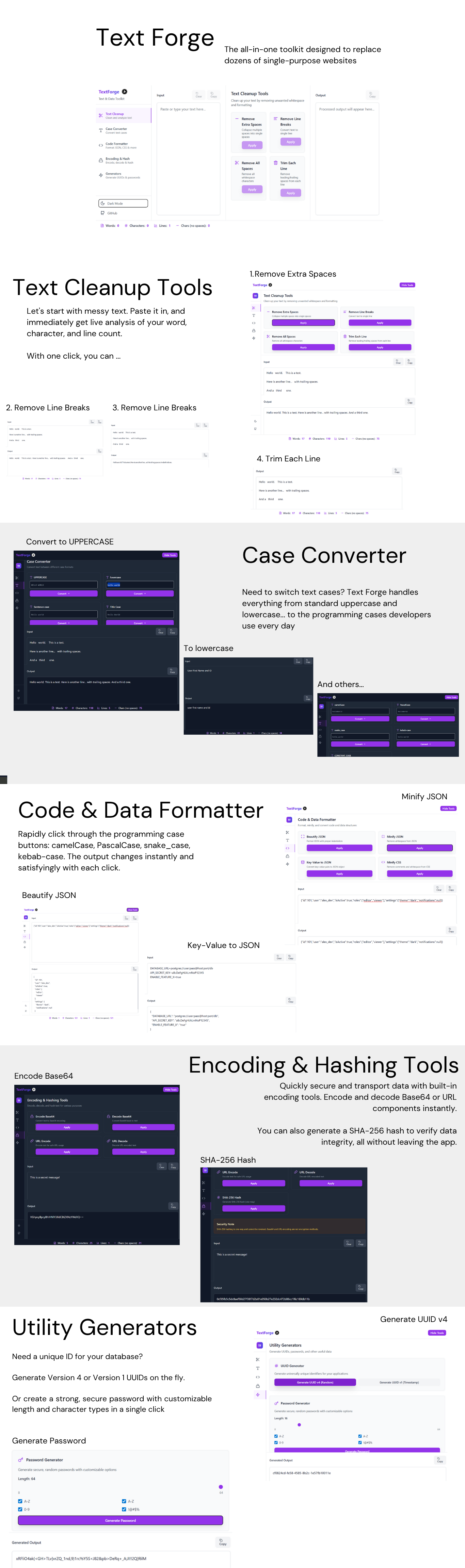
- - Text Cleanup: Remove Extra Spaces, Remove Line Breaks, and live analysis.
- - Case Converter: Standard and programming cases (snake_case, kebab-case, etc.).
- - Code Formatter: Beautify/Minify JSON, Key-Value to JSON, and a CSS Minifier.
- - Encoding & Hashing: Base64, URL Encode/Decode, and SHA-256.
- - Generators: UUID (v1 and v4) and a strong Password Generator.
- Implementation Details: I guided the AI by suggesting specific technologies and APIs, such as using the native crypto.subtle for hashing and the uuid library.
- UI/UX Specifications: I described the entire user experience, from the dual-pane layout that stacks on mobile to the exact hex codes for the purple-centric dark/light theme (#6D28D9, #1F2937).
With the prompt perfected, I executed the command. The AI generated the entire React application structure, the JavaScript logic for every tool, and the CSS for the responsive layout and theming. It was the ultimate "kill"—a complete, functional codebase born from a single, well-crafted thought.
🧗♀️ Challenges: Precision is Everything
The primary challenge of this project wasn't debugging code, but debugging my own language. The AI is incredibly powerful, but it's not a mind-reader.
- Fighting Ambiguity: A vague instruction like "make a text tool" would yield useless results. I had to be hyper-specific, defining not just what a tool should do, but how it should do it. For example, specifying input.replace(/\s+/g, ' ').trim() for removing extra spaces ensured the logic was robust.
- The "All or Nothing" Risk: The "one-shot" approach meant that if my prompt had a fundamental flaw, the entire generated codebase could be unusable. This put immense pressure on getting the initial architecture and instructions right the first time. I had to think like a systems architect from the very beginning.
- Guiding, Not Just Asking: The biggest challenge was embedding specific implementation hints without making the prompt too restrictive. Suggesting the use of btoa and atob for Base64 or crypto.randomUUID() for a simple UUID generator was key to getting code that used modern, efficient browser APIs.
🎓 What I Learned: From Coder to Architect
This project was a profound learning experience that shifted my perspective on development.
I learned that prompt engineering is a critical skill. It’s not just about asking questions; it's about structured, detailed, and unambiguous communication with a machine. It's a new form of "meta-programming" where the goal is to design the instructions that build the code.
Most importantly, I learned that the future of rapid development lies in having a crystal-clear vision. The AI can build almost anything, but only if you can describe it perfectly. This project forced me to think less like a line-by-line coder and more like an architect who directs an incredibly fast and capable team. The "one-shot, one-kill" approach was a success, and it demonstrated a powerful new way to bring ideas to life.
Built With
- css3
- dom-apis
- es6+)
- html5
- javascript
- netlify
- npm
- react.js
- uuid
- vite
- web-crypto-api

Log in or sign up for Devpost to join the conversation.