-
-
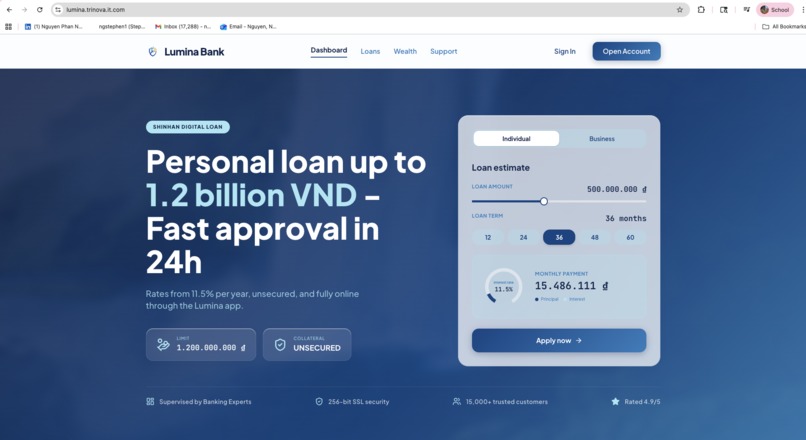
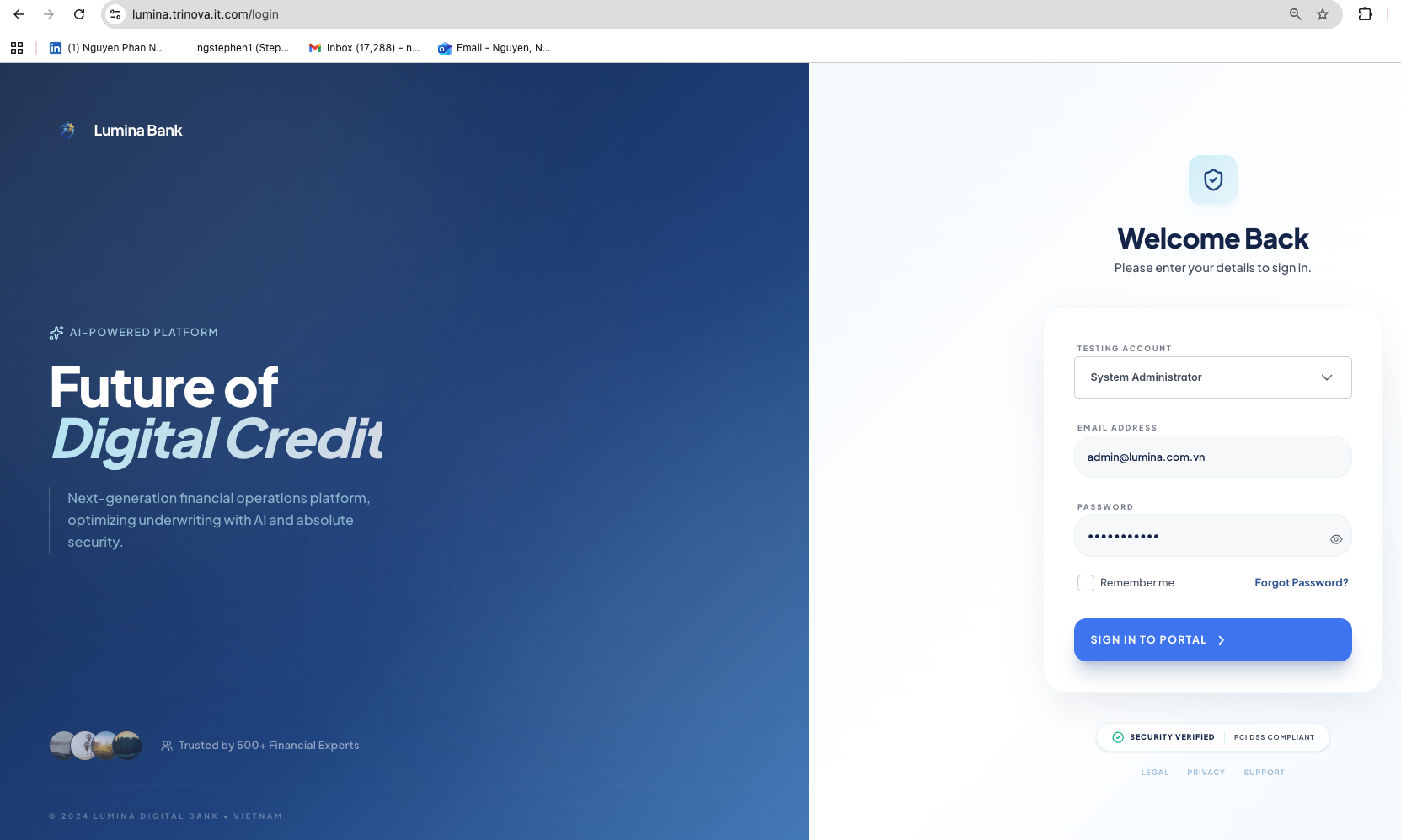
User side
-
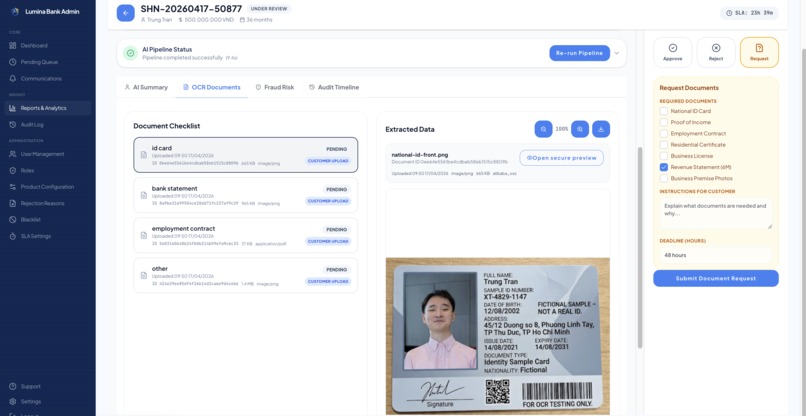
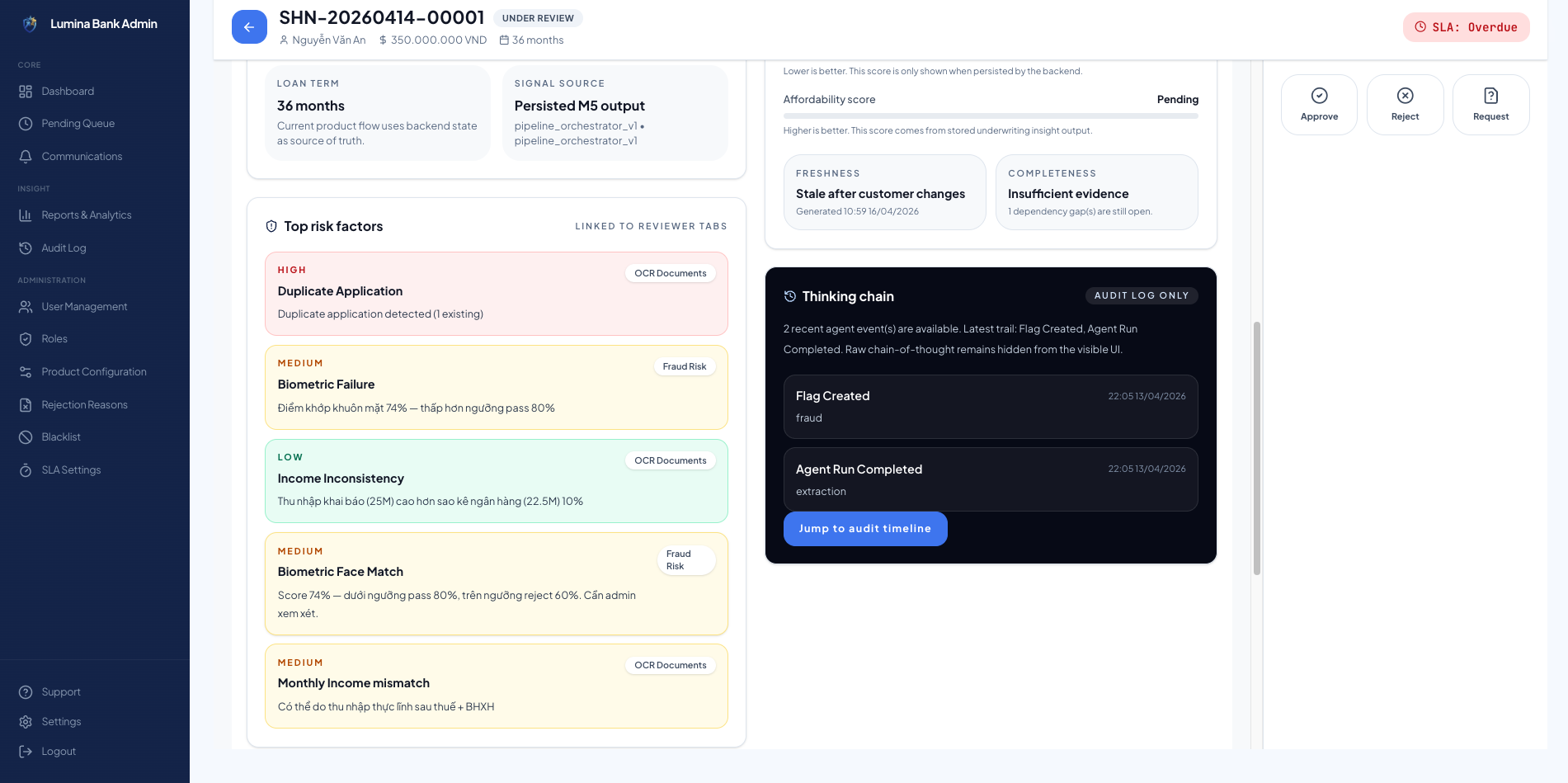
Bank Admin side
-
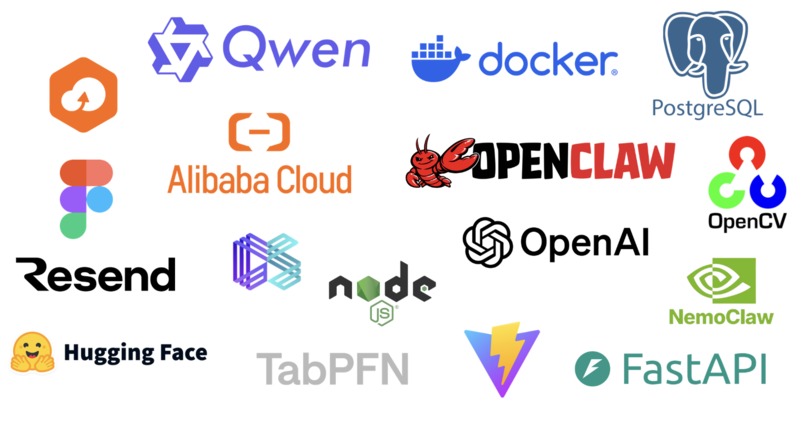
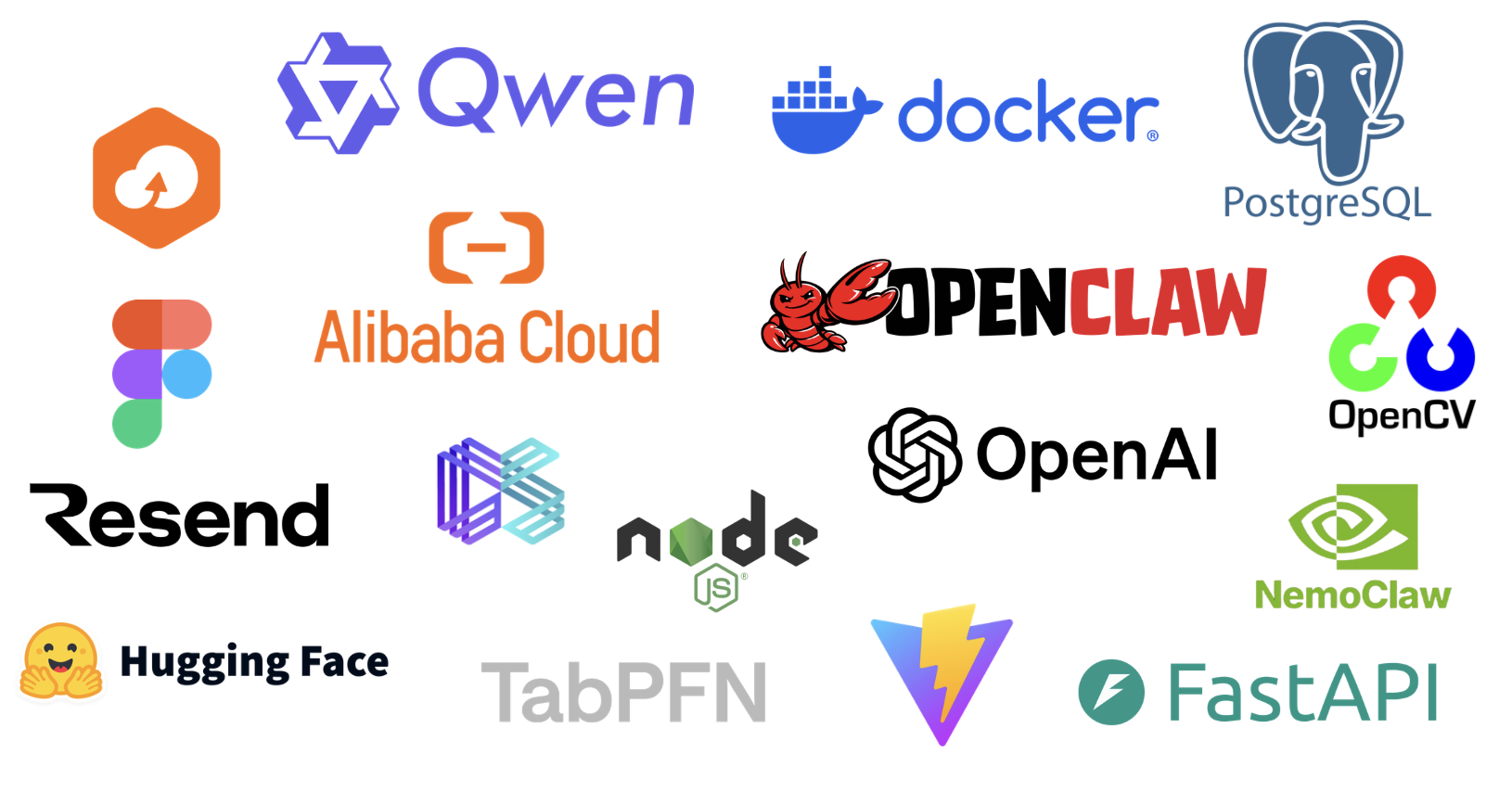
Tech Stack
-
-
-
-
-
-
-
-
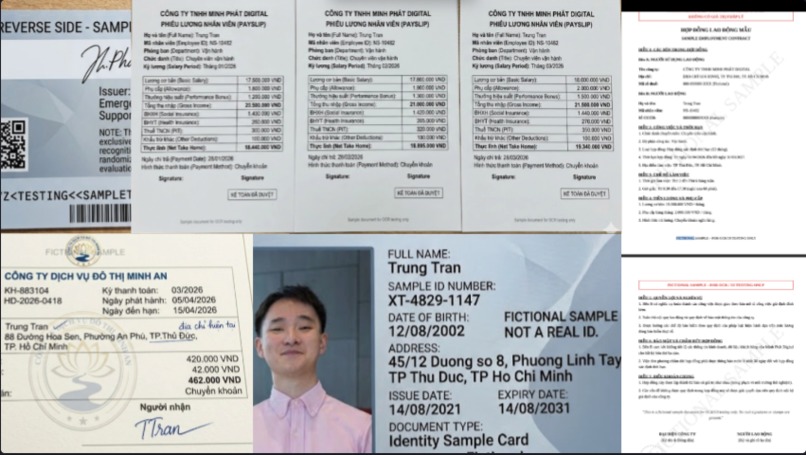
Our Data
-
-
-
-
-
-
-
-
-
-
-
-
-
-
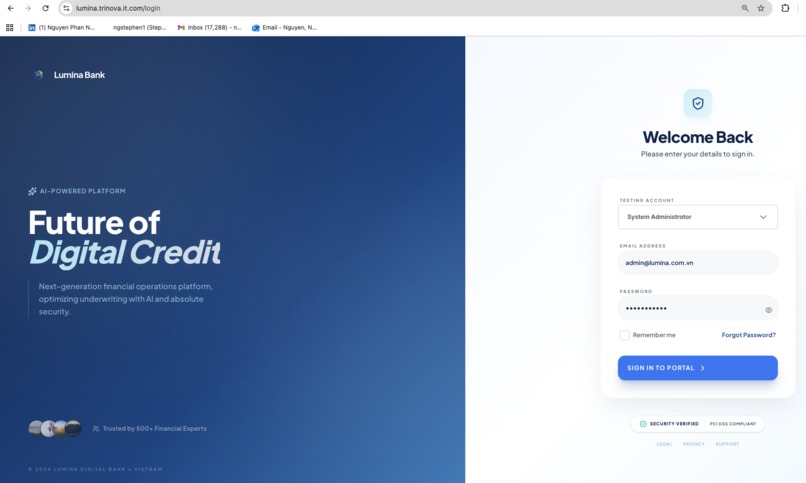
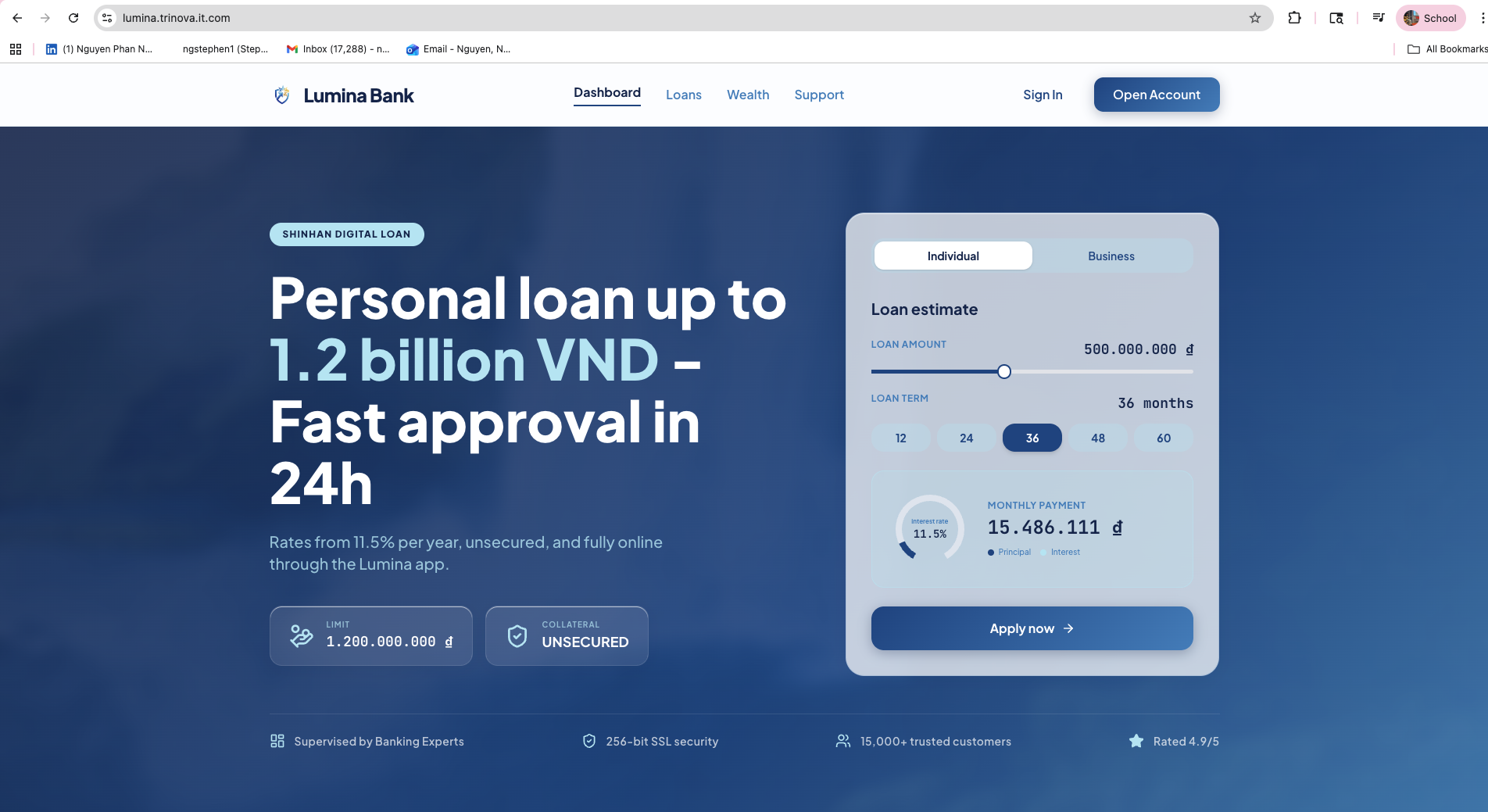
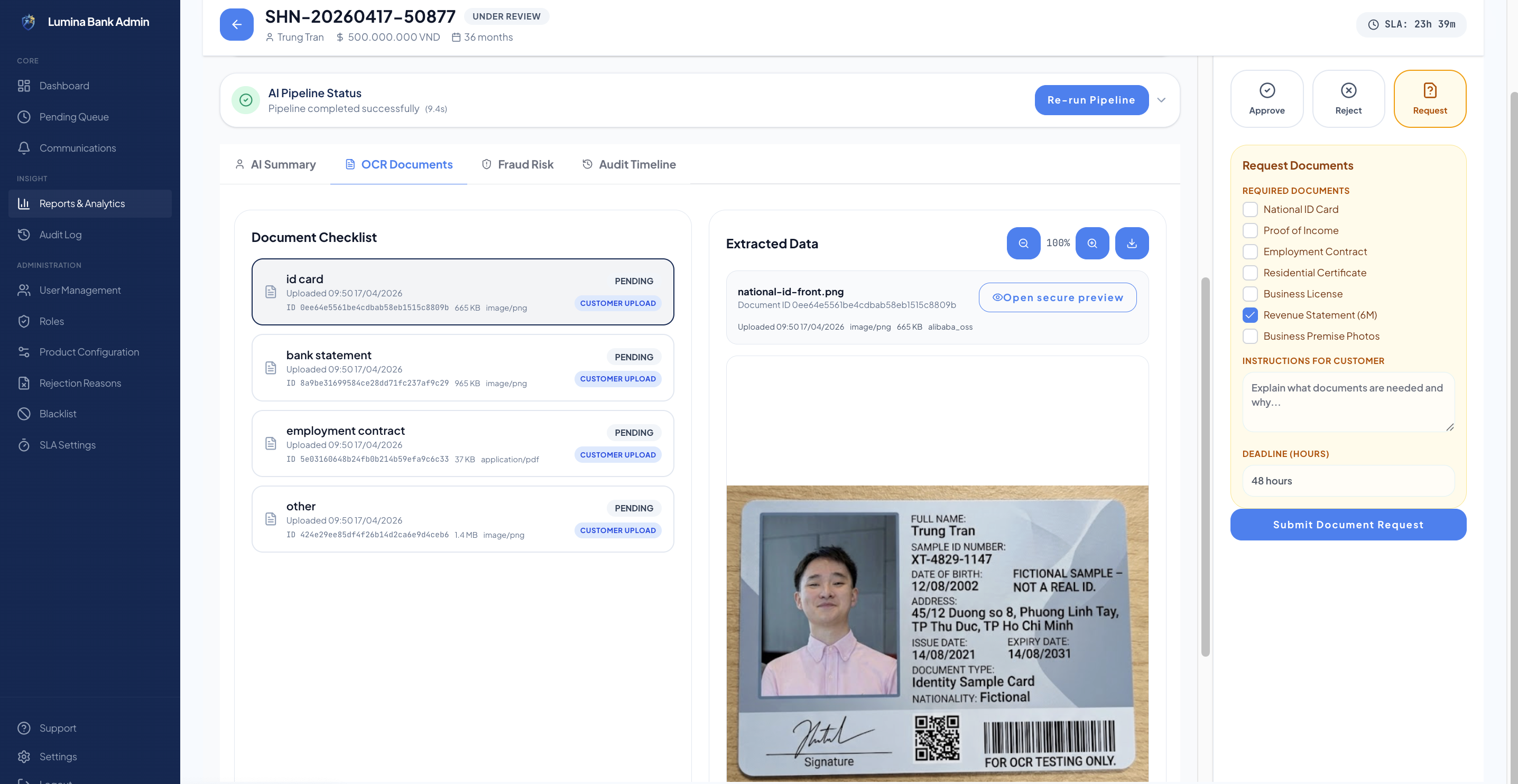
Lumina Bank
User: https://lumina.trinova.it.com
Bank Admin: https://lumina.trinova.it.com/admin_dashboard
[deployed on Alibaba ECS then took down to save maintenance cost]
Inspiration
| Shinhan signal | Why it mattered for this project |
|---|---|
| Global network in 20 countries with major presence in markets including South Korea, Vietnam, Japan, the U.S., and Indonesia | Suggested a real need for smoother cross-border document flow, stronger shared case visibility, and faster coordination across customer-facing and internal systems at global scale. |
| Global operations | Reinforced the need for structured, repeatable, document-heavy workflows that cannot rely only on manual review |
That led us to one core question:
What if customer-submitted loan documents could move from upload to OCR to underwriting support to admin review in one clean AI-assisted flow?
What it does
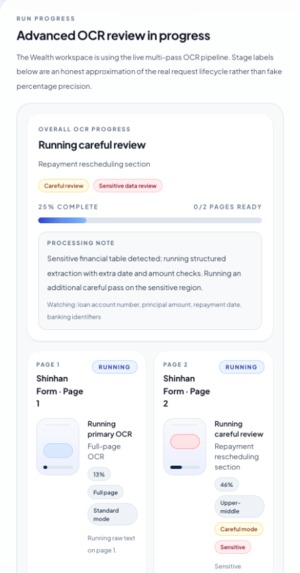
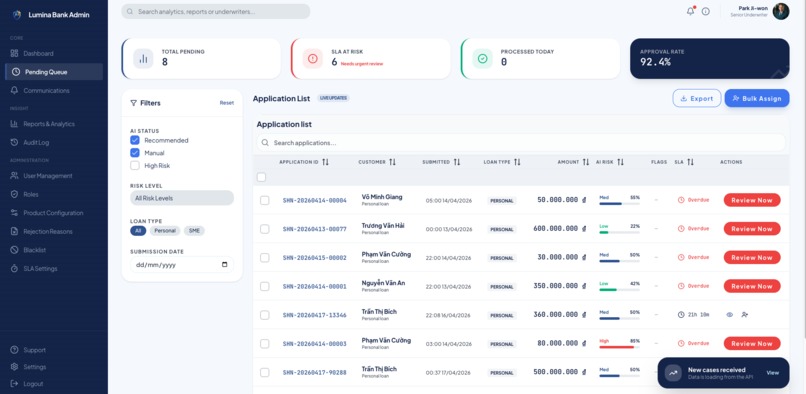
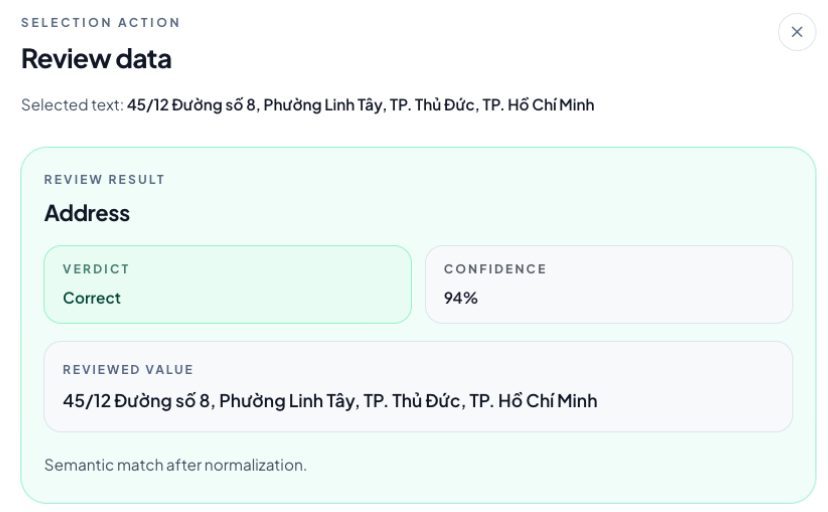
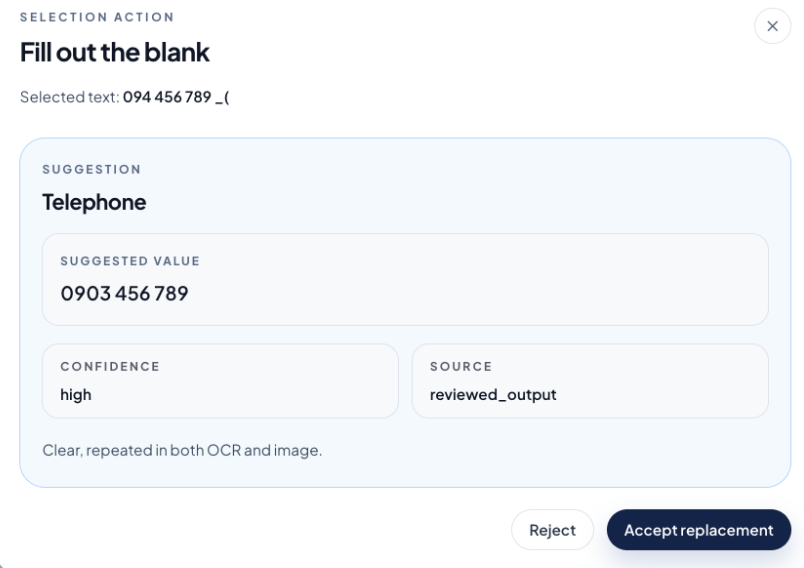
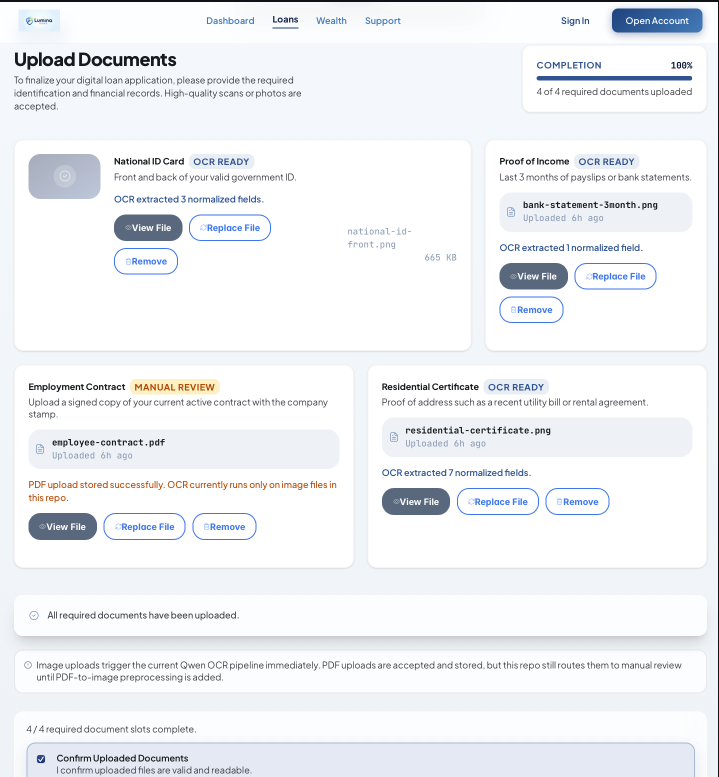
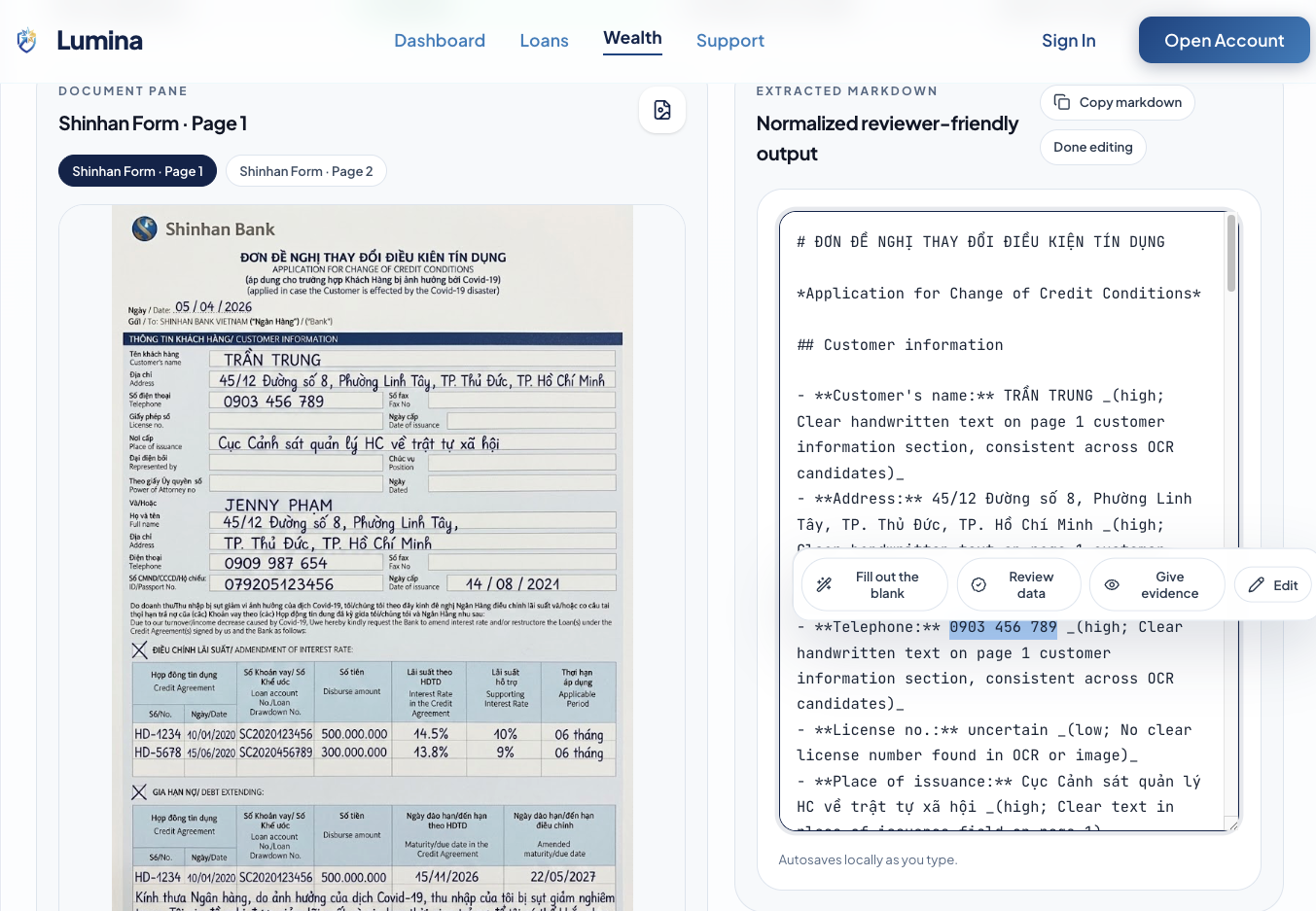
Lumina Bank is a multi-agent AI copilot for autonomous document processing and underwriting workflows.
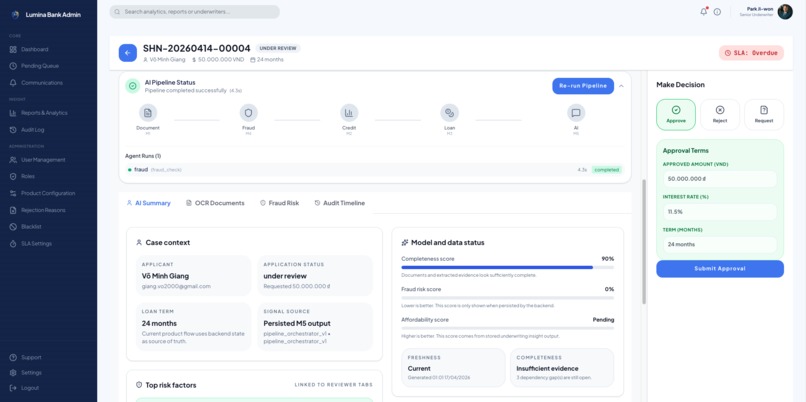
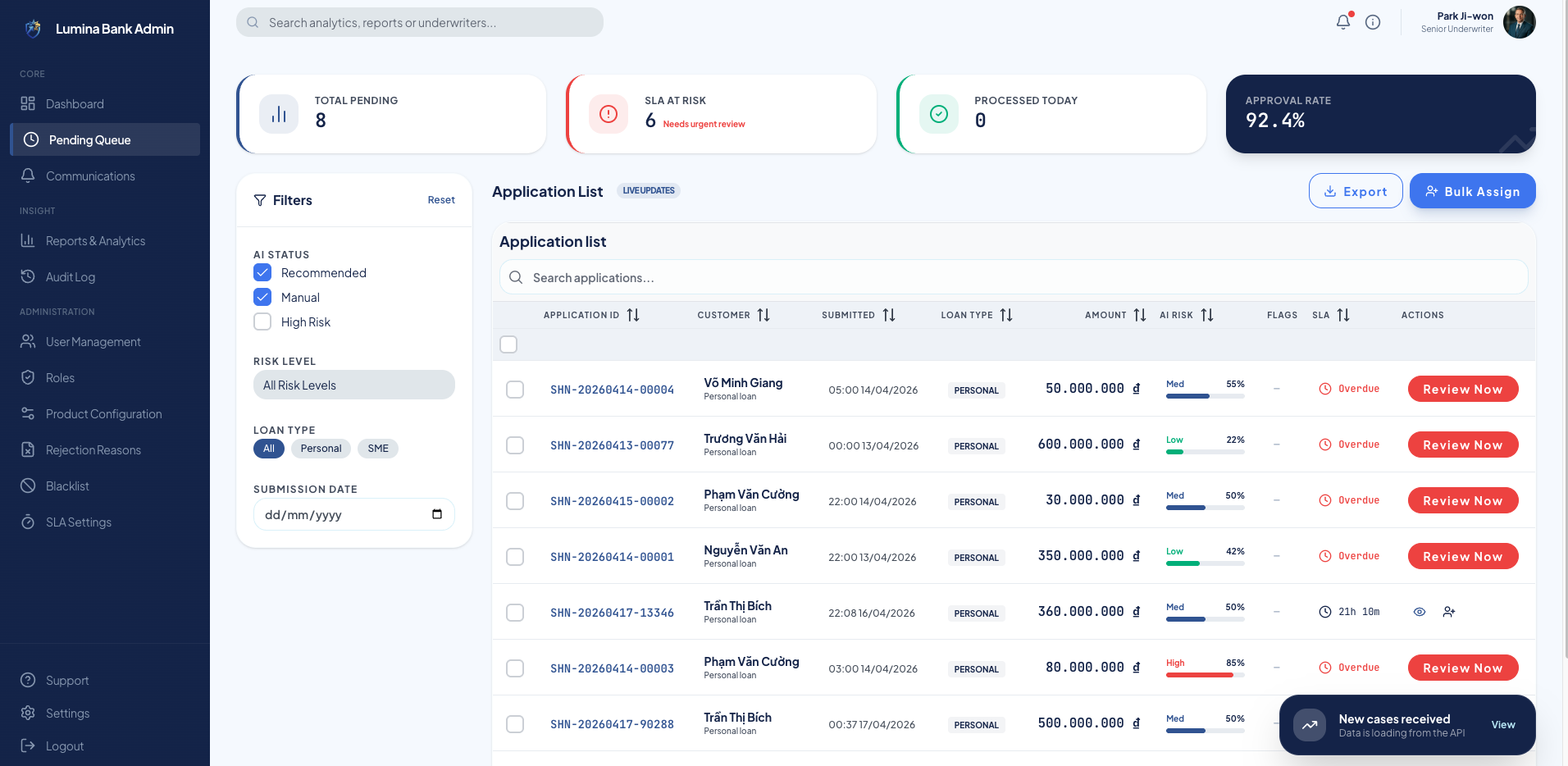
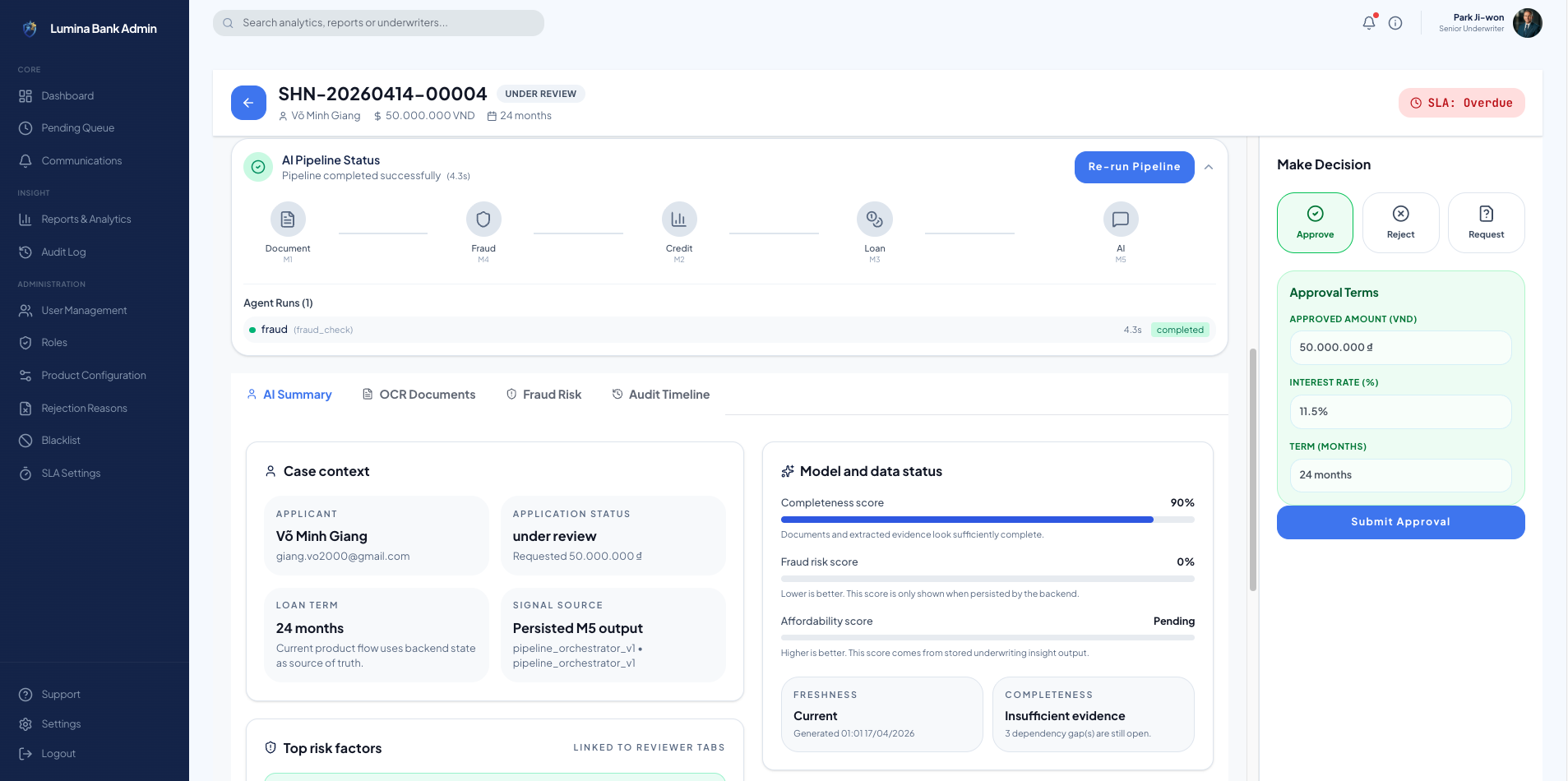
Designed as a financial-services AI product for Lumina Bank-style loan and credit operations, it acts as a reviewer-ready, human-in-the-loop copilot that helps teams intake documents, extract evidence, surface risk flags, route cases, and prepare cleaner underwriting decisions.
Pain points we targeted
| Pain point | How Lumina Bank helps |
|---|---|
| Manual document collection | Centralizes intake into one structured workflow |
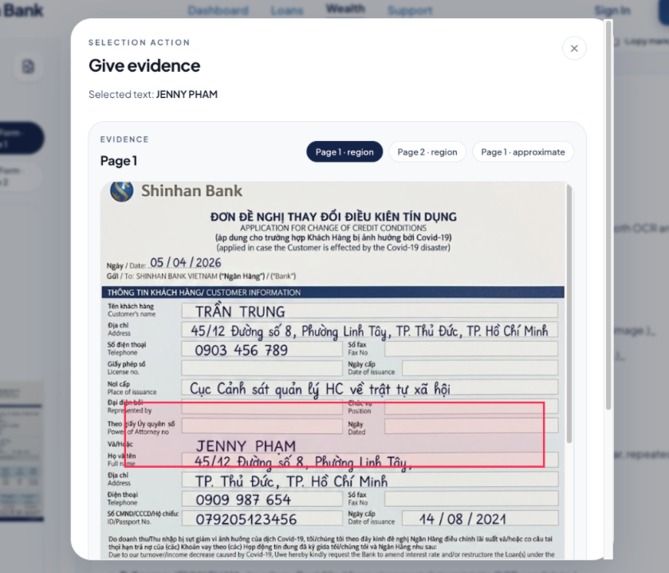
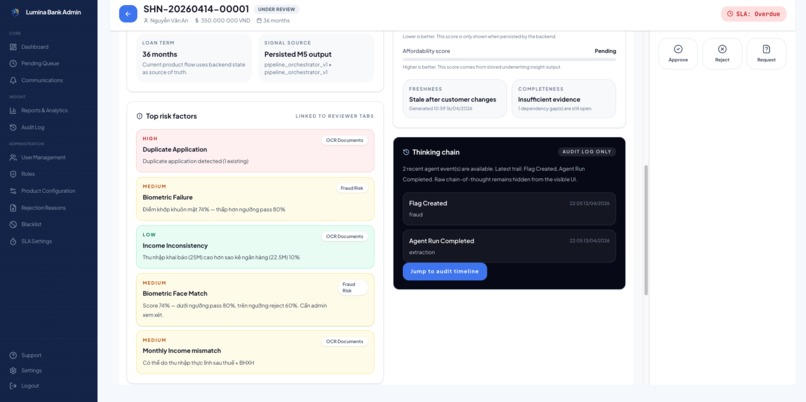
| Fragmented evidence checks | Pulls OCR, evidence, and risk signals into one review experience |
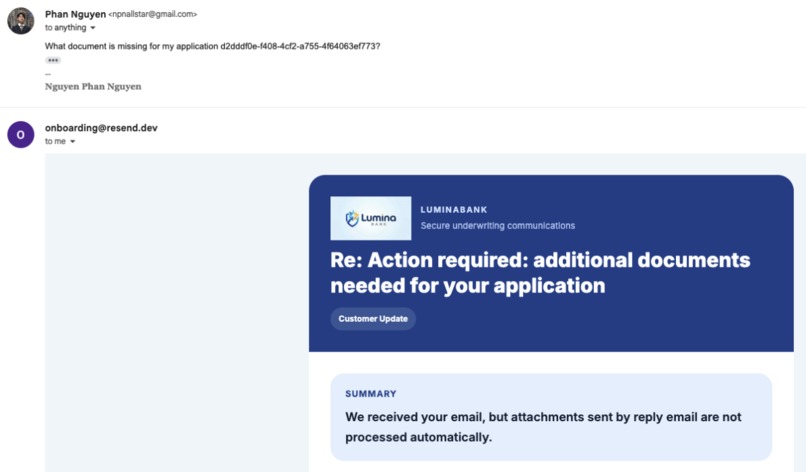
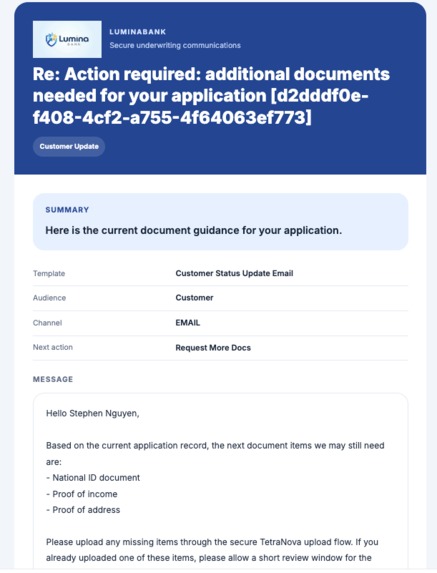
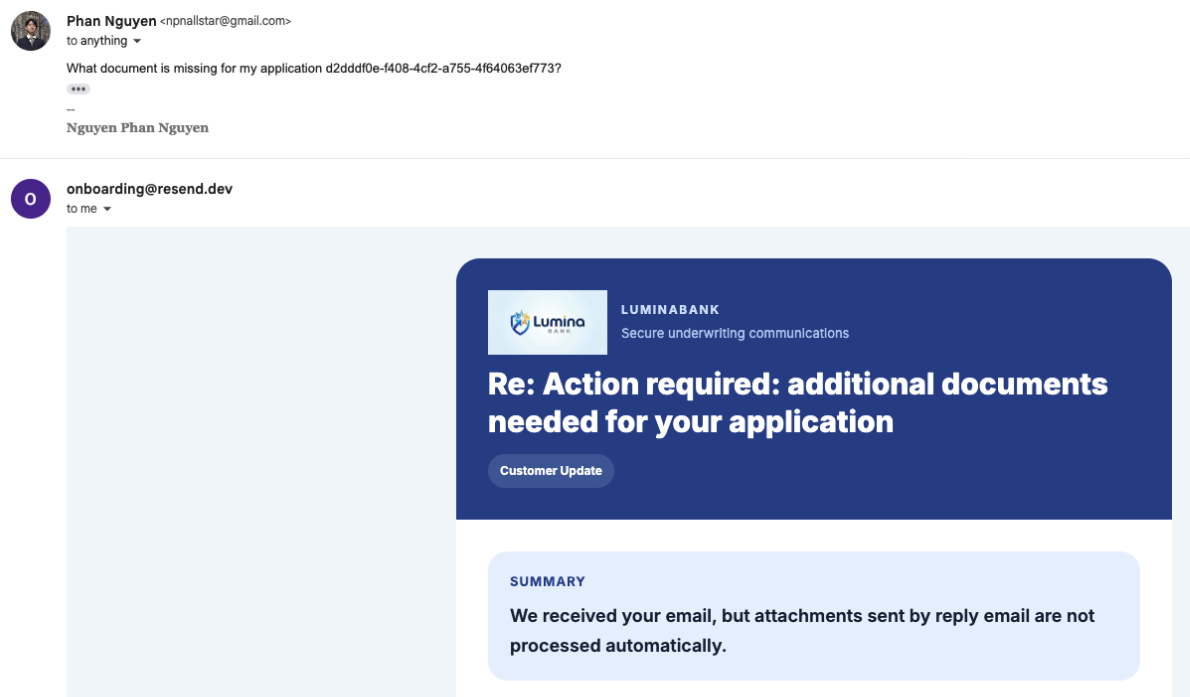
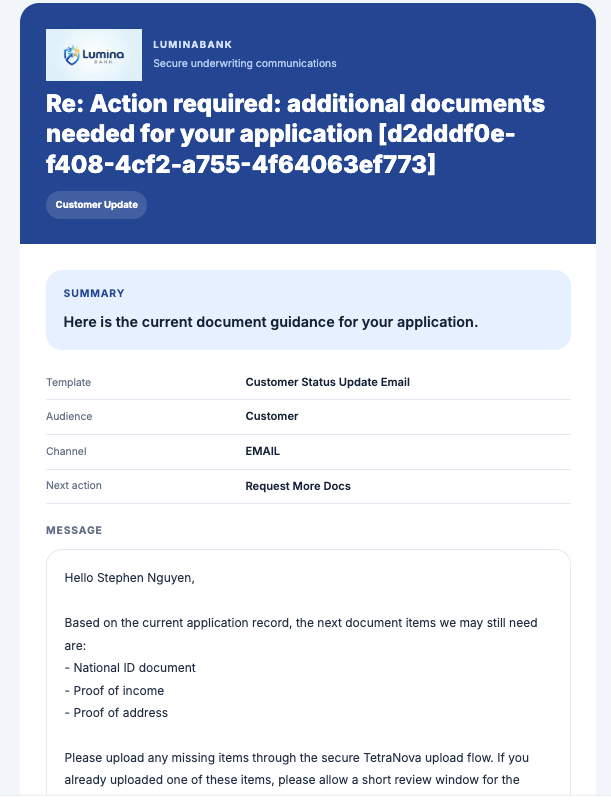
| Repetitive follow-ups | Supports clarification and re-upload loops |
| Hand-built case summaries | Generates reviewer-ready summaries and reports |
| Disconnected customer/admin workflows | Links customer uploads directly to admin review context |
What Lumina Bank supports
| Capability area | Support provided |
|---|---|
| Document intake | Customer upload and submission flow |
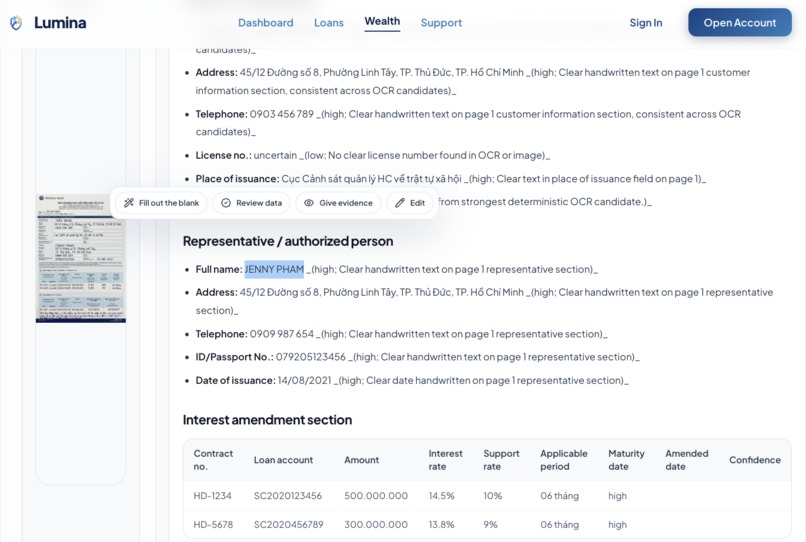
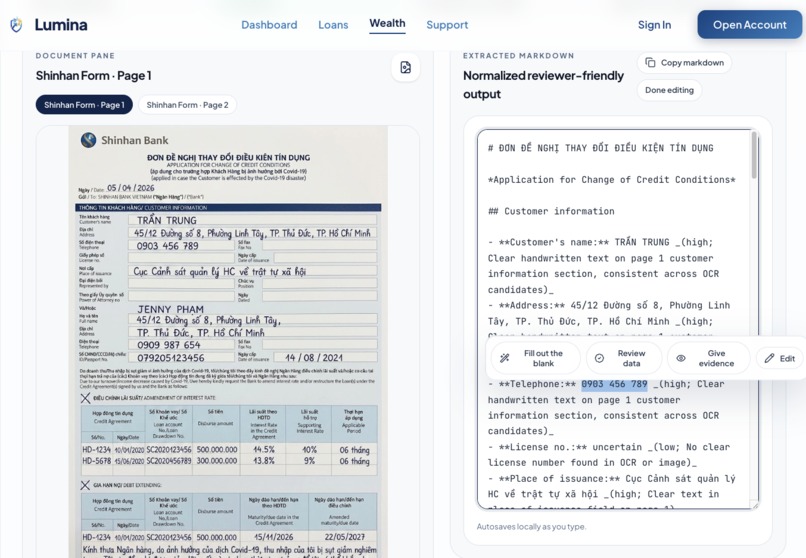
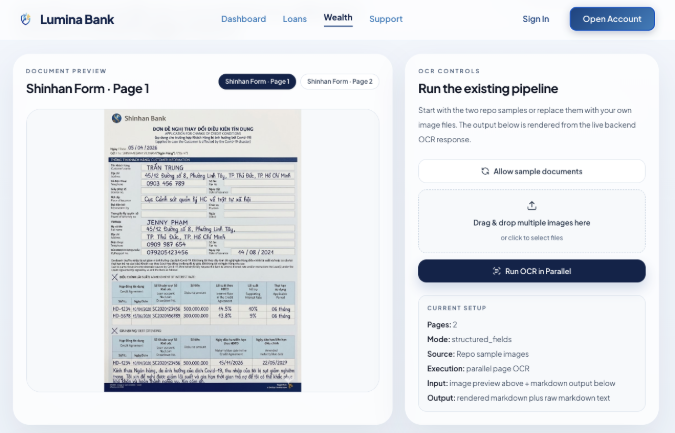
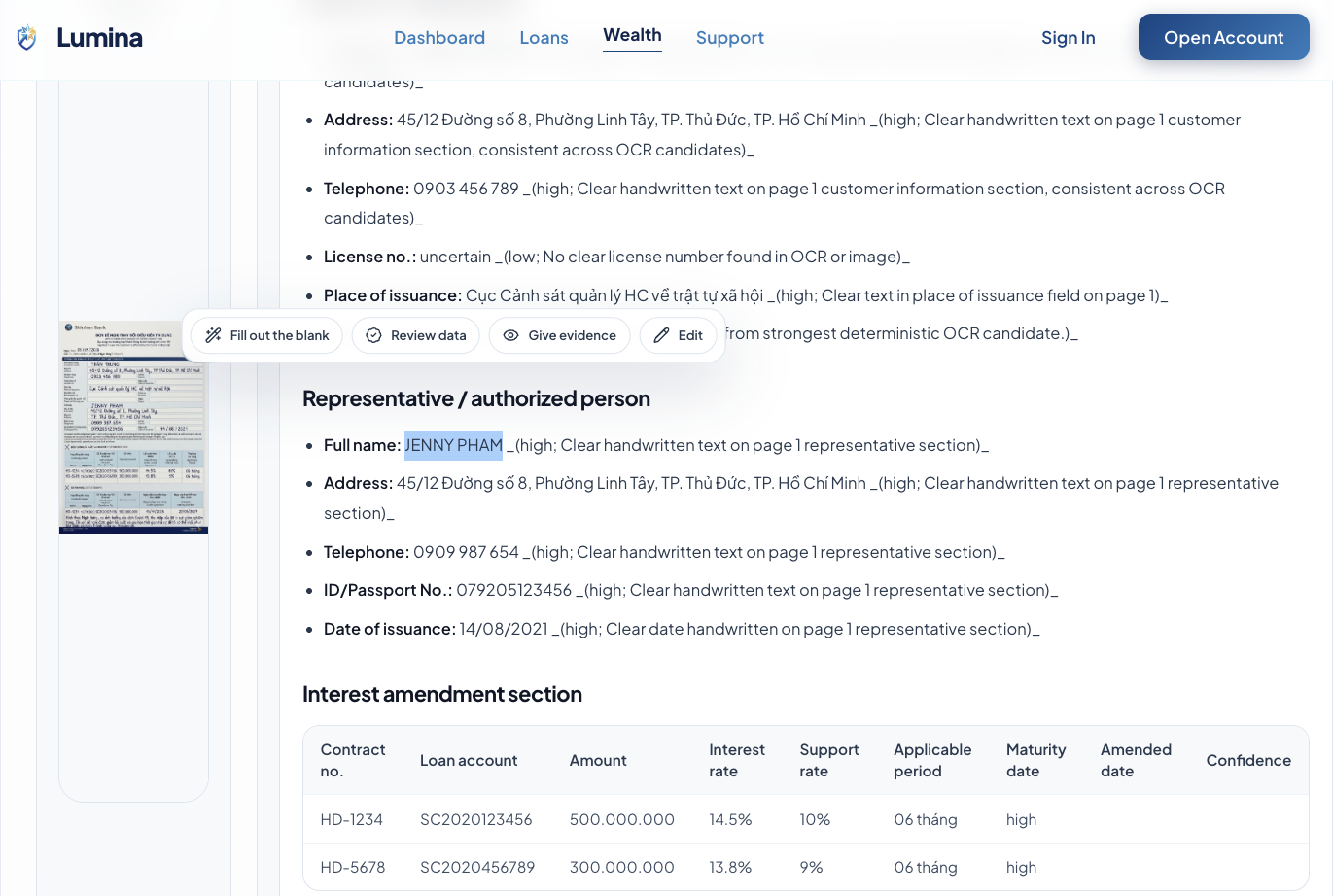
| OCR and structured extraction | Raw files converted into usable fields and evidence |
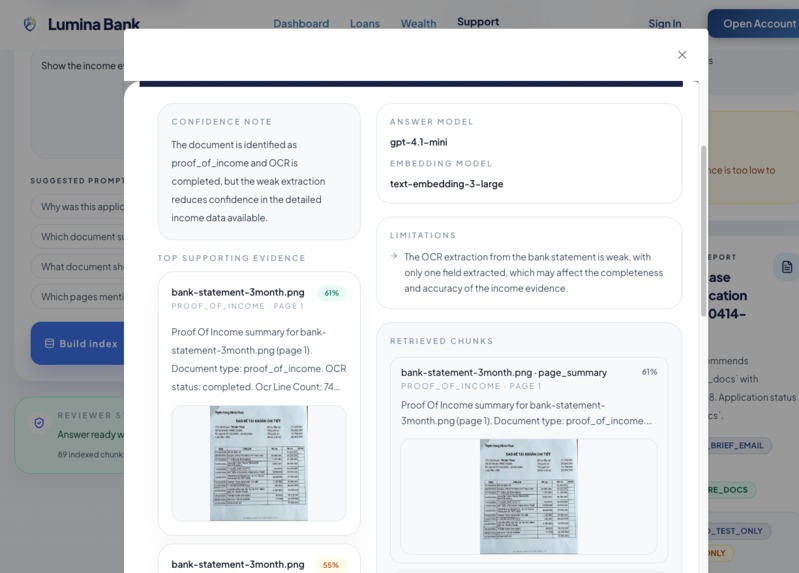
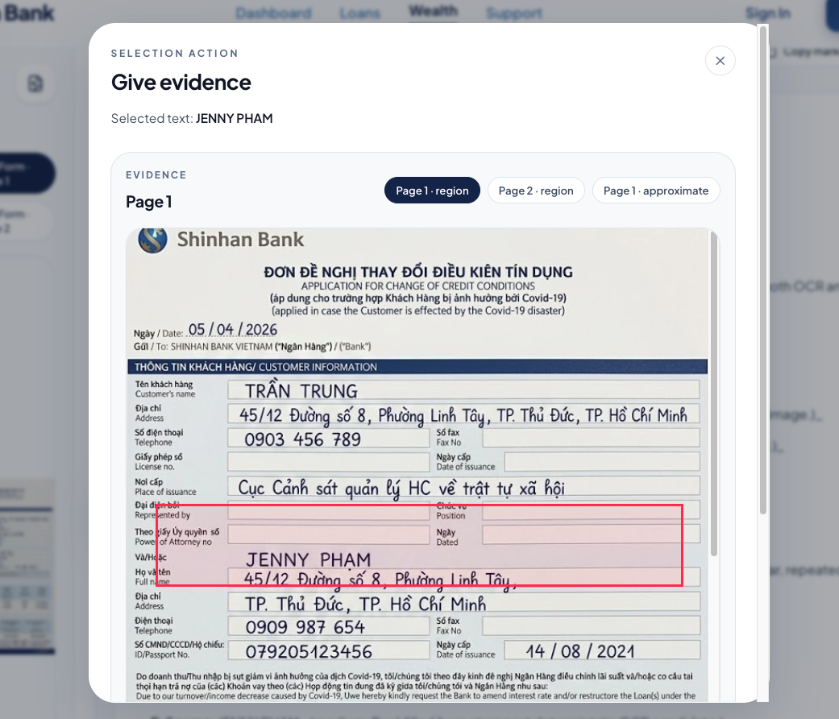
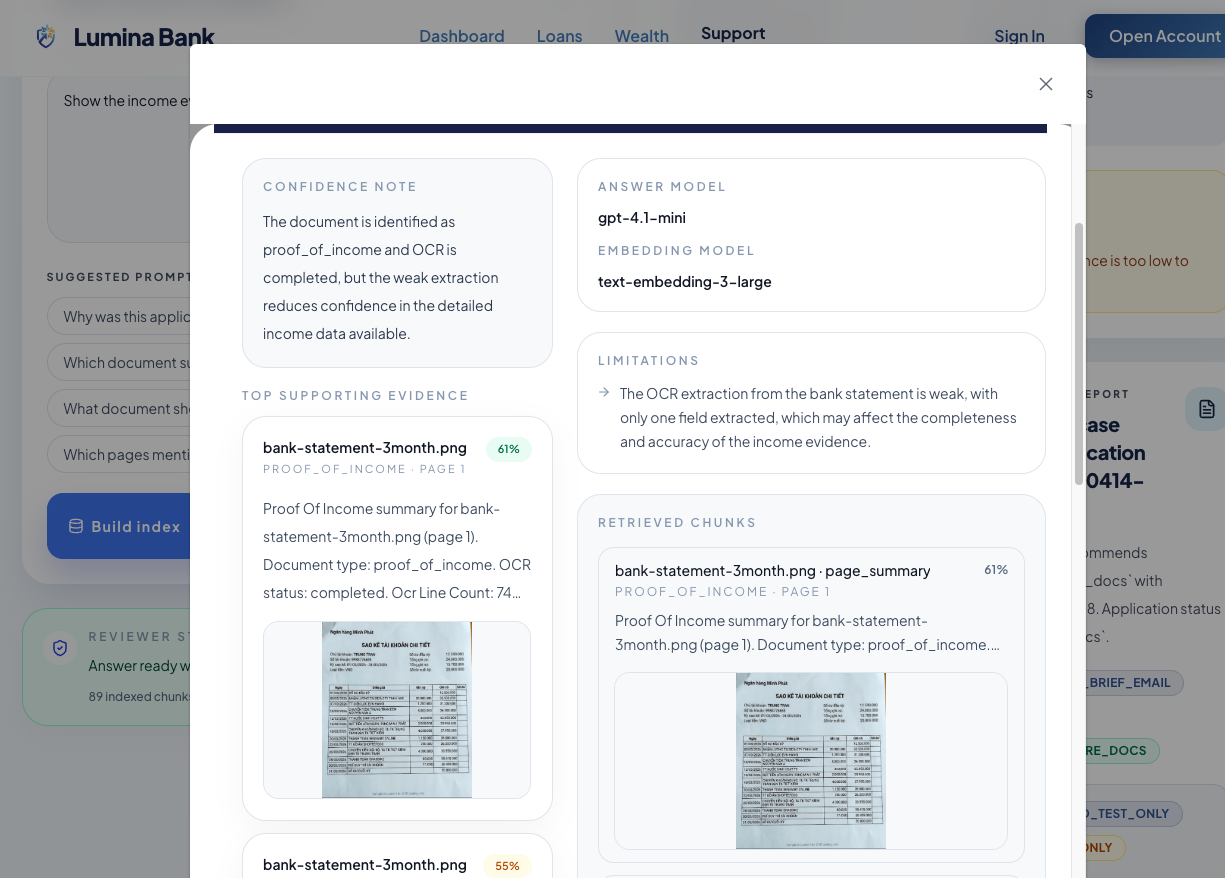
| Evidence retrieval | Search and retrieval across submitted content |
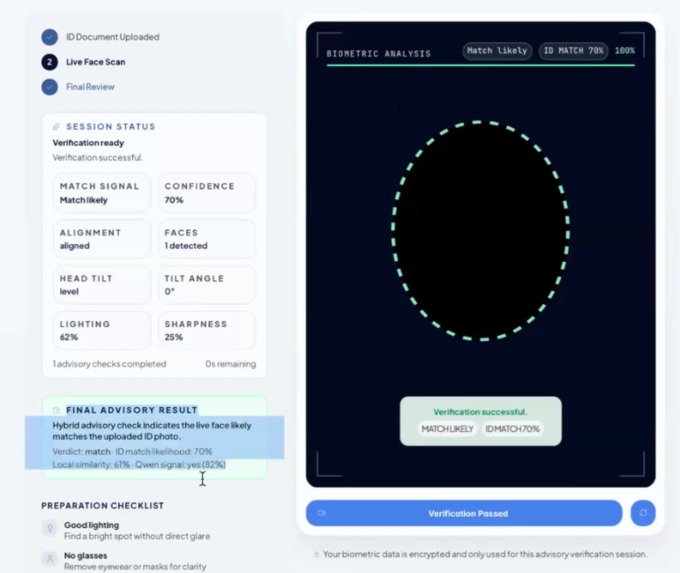
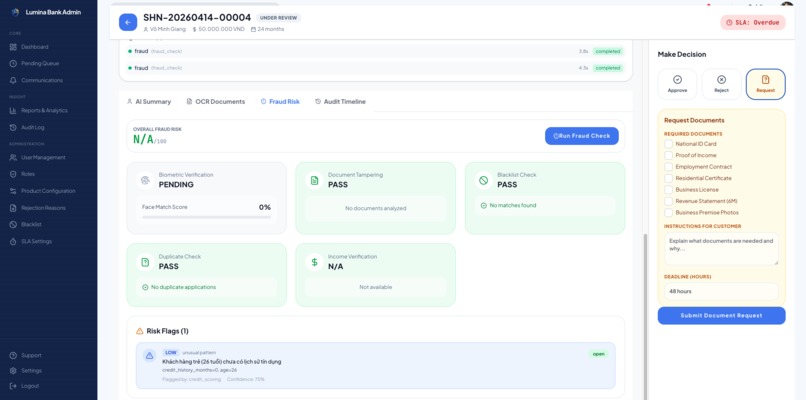
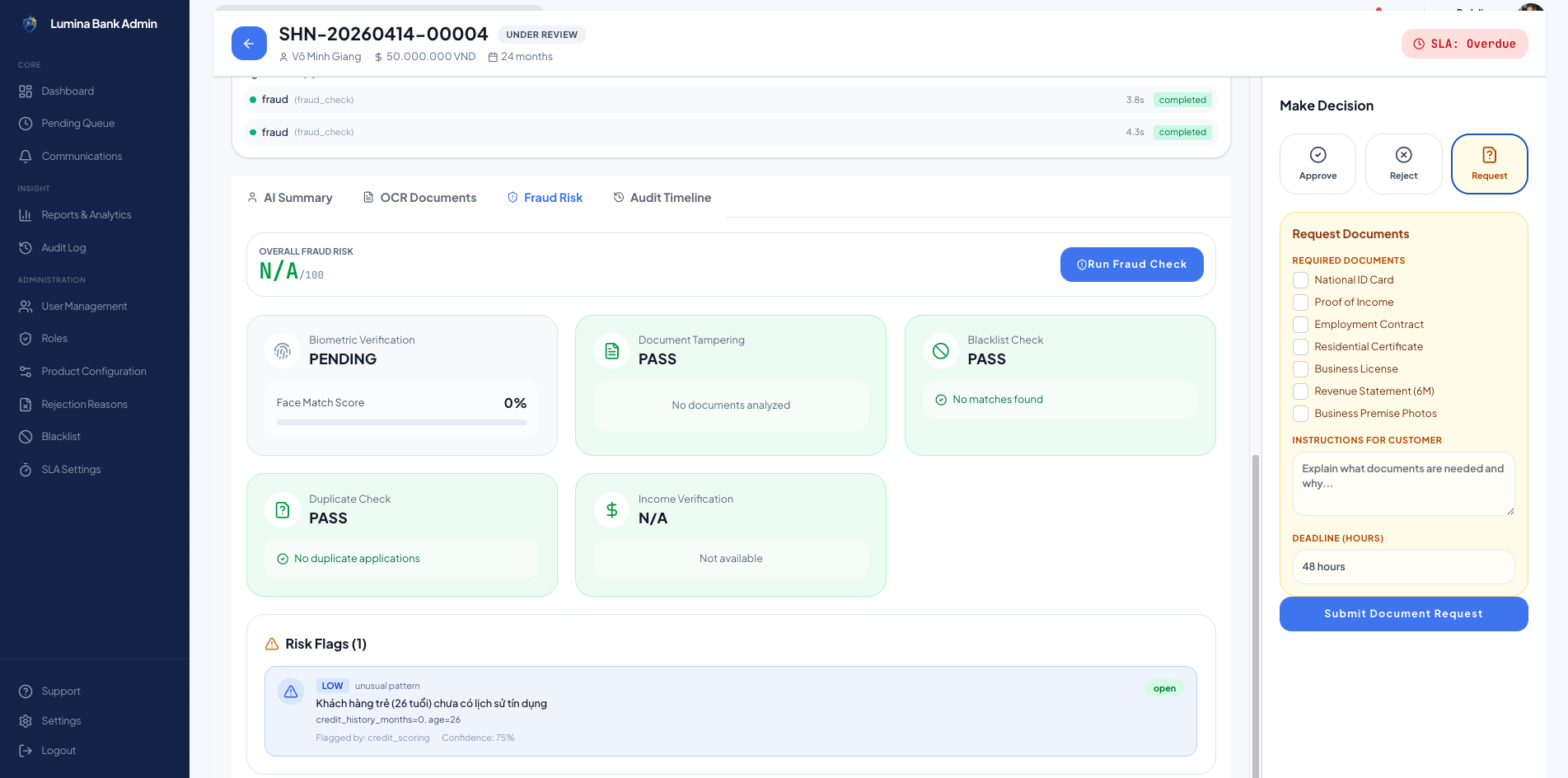
| Fraud and inconsistency checks | Flags mismatches and suspicious patterns |
| AI-assisted loan insights | Recommendation support and next-best actions |
| Admin visibility | Customer-uploaded documents visible in review flow |
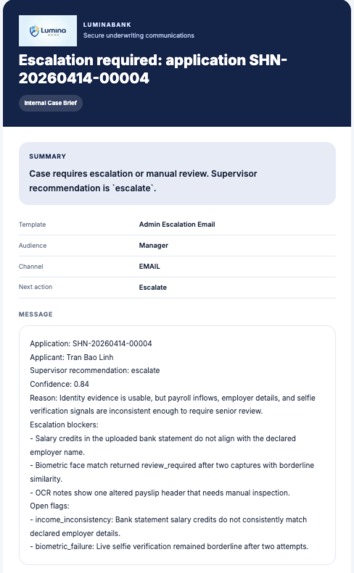
| Routing and review support | Queueing, escalation, and triage support |
| Human-in-the-loop approval | Final decision remains with the reviewer |
How we built it
We built Lumina Bank as a full-stack workflow prototype spanning both the customer portal and the admin portal.
Core stack
| Layer | Technology |
|---|---|
| Frontend | React, TypeScript |
| Backend | FastAPI, Python |
| Storage | Alibaba Cloud OSS |
| Persistence | Backend-managed document metadata and application linkage |
| AI / OCR | Qwen-based OCR and document analysis |
| Fallback model | OpenAI GPT-4.1 mini |
AI pipeline and workflow structure
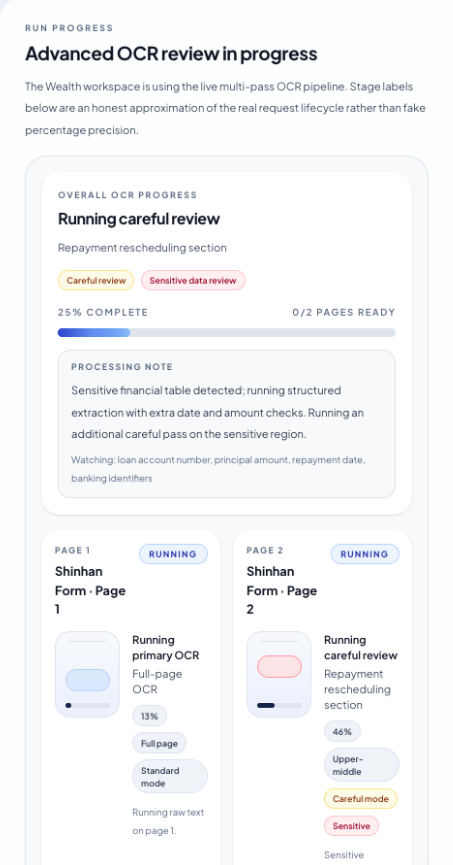
We designed the system as a staged workflow for:
- document upload and intake
- OCR extraction and normalization
- evidence retrieval
- fraud detection
- loan recommendation
- narrative generation
- admin review and decisioning
Security and architecture choices
| Choice | Why it matters |
|---|---|
| Backend-mediated uploads | Browser never receives permanent Alibaba credentials |
| Private OSS storage | Uploaded documents stay protected by default |
| Backend-managed metadata | Documents stay linked to applications and workflow state |
| Signed temporary URLs | Secure access without exposing the bucket publicly |
That let us build a flow that is both demo-ready and production-shaped.
OpenClaw and NemoClaw work
| Area | What we did |
|---|---|
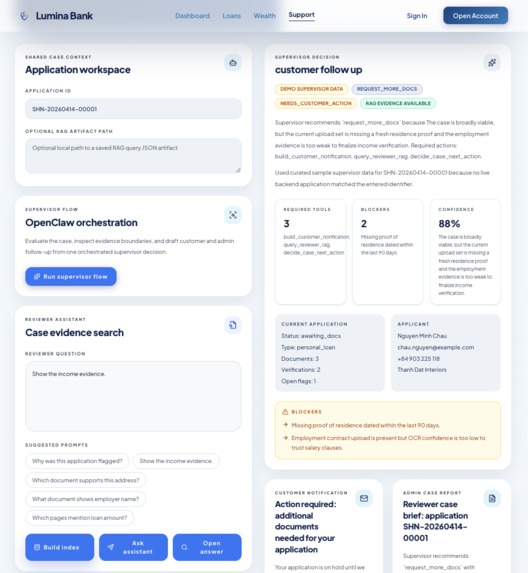
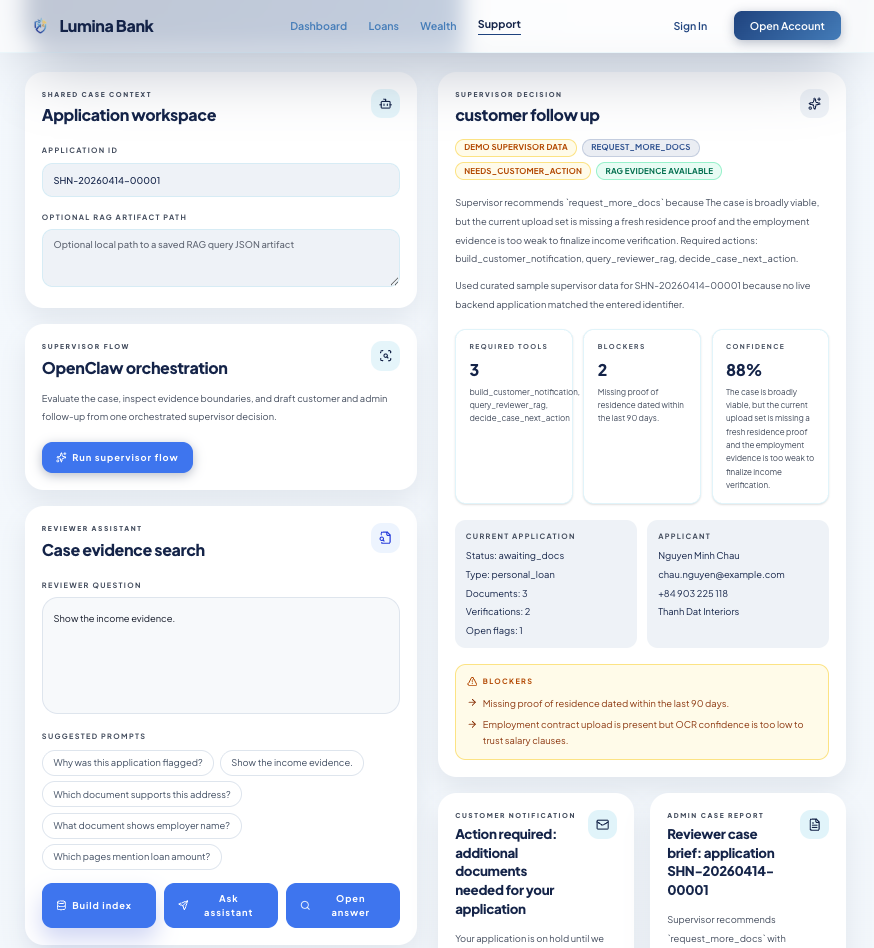
| OpenClaw product layer | Implemented an OpenClaw orchestration experience inside the Support tab, where one supervisor flow coordinates case context, evidence boundaries, customer follow-up drafts, and admin-facing summaries |
| NemoClaw / OpenShell runtime work | Performed real local bring-up work including Docker validation, gateway recovery, onboarding progress, and sandbox creation attempts |
| Outcome | Full local sandbox creation on macOS was blocked by a Docker Desktop/OpenShell build-stream incompatibility, but the work still informed the architecture and helped us distinguish app-level orchestration from sandboxed runtime paths |
Multi-agent architecture
| Agent | Responsibility |
|---|---|
| Intake agent | Document collection, quality checks, and intake completion |
| Extraction agent | OCR, normalization, and structured field generation |
| Evidence agent | Semantic search and source-grounded retrieval |
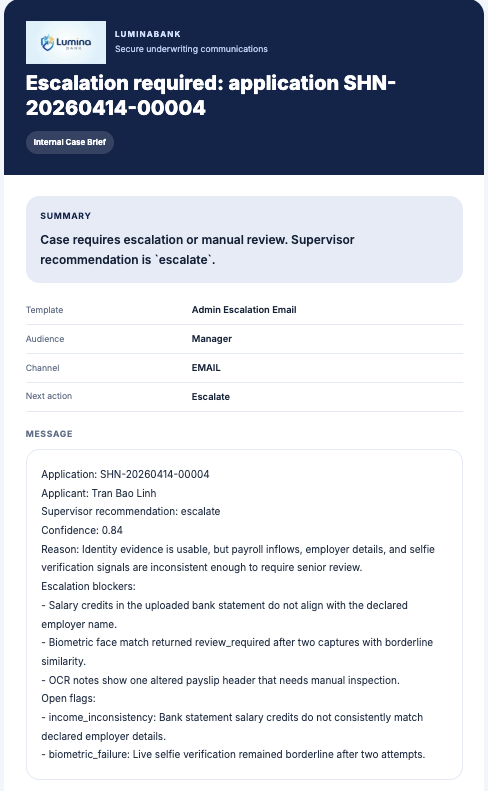
| Fraud agent | Inconsistency checks and explainable risk flagging |
| Insight agent | Underwriting support, recommendation logic, and next-best actions |
| Report agent | Case-brief generation and reviewer summaries |
| Routing agent | Queue assignment, escalation, and triage decisions |
| Notification agent | Clarification requests, follow-ups, and communication logging |
This architecture lets the product move beyond simple OCR and become a full underwriting workflow assistant.
Core features
| Feature | Description |
|---|---|
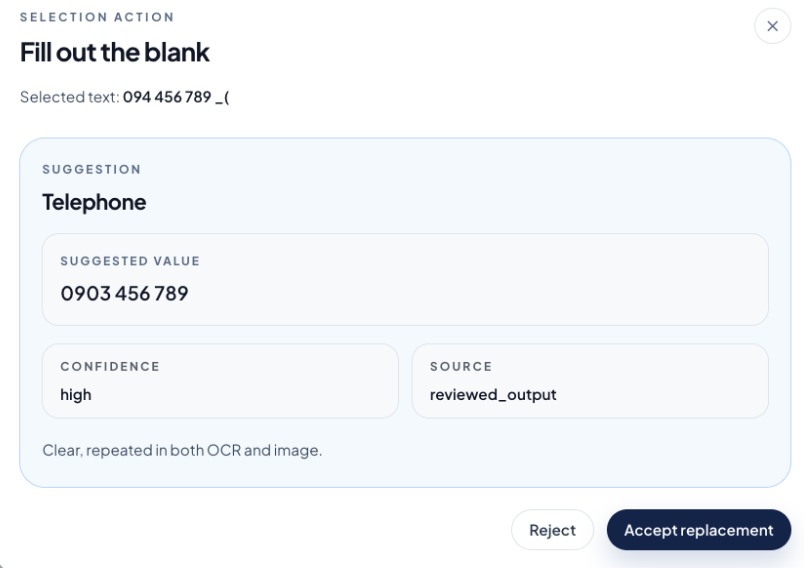
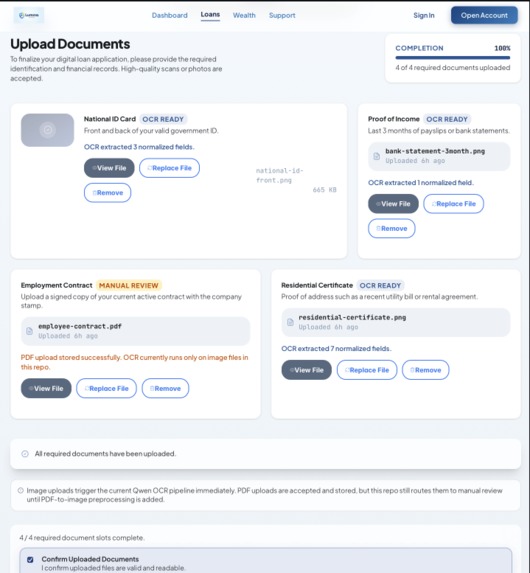
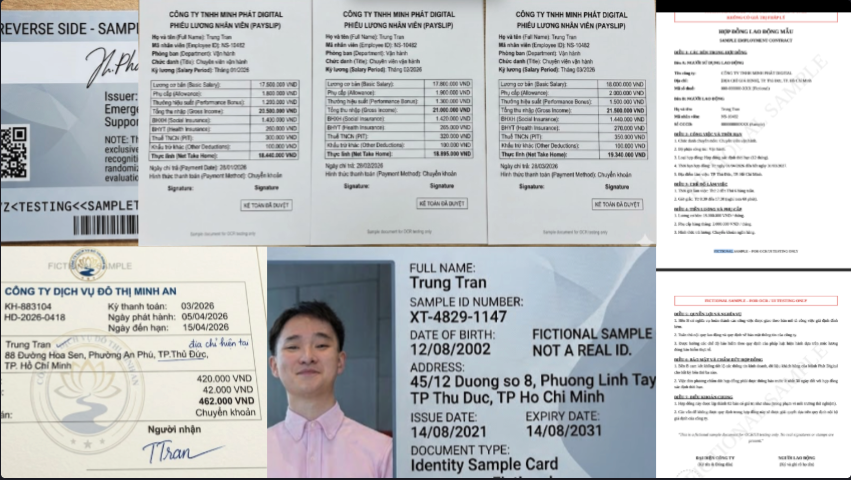
| Dual document ingestion | Accepts image and PDF uploads, with room for clarification or re-upload when documents are incomplete or unreadable |
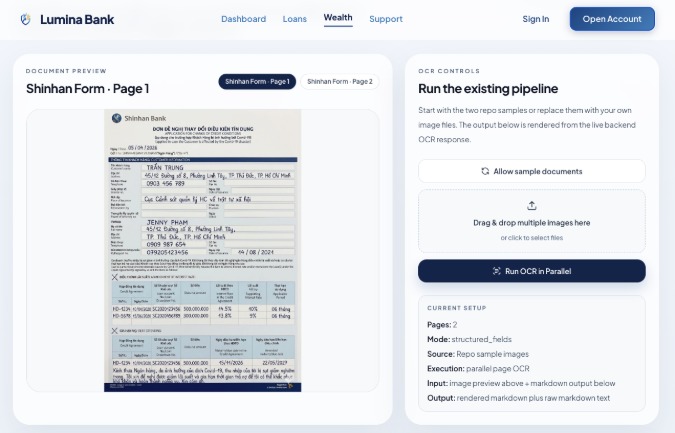
| Intelligent OCR & structured extraction | Converts raw files into normalized, reviewer-friendly fields and extracted evidence |
| Semantic search / evidence retrieval | Helps reviewers quickly find supporting details across a document set |
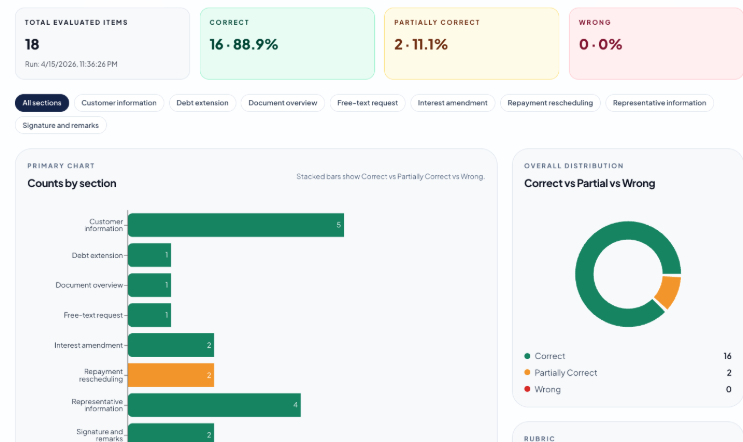
| Fraud and inconsistency detection | Surfaces explainable mismatches, missing evidence, suspicious patterns, and review-triggering anomalies |
| AI loan insights & recommendation | Produces suggested loan range, rationale, confidence cues, and next-best action guidance |
| Auto report generation | Packages findings into a reviewer-ready case brief |
| Autonomous workflow routing | Directs cases into approval, escalation, clarification, or manual review queues |
| Human-in-the-loop review | Keeps final judgment with reviewers and admins |
System workflow
Customer-side flow
| Step | Description |
|---|---|
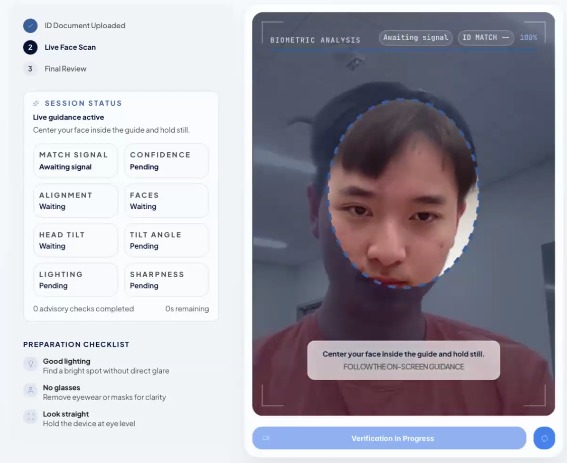
| 1 | Applicant submits supporting documents through upload or live capture |
| 2 | System validates file presence and quality |
| 3 | OCR and structured extraction convert documents into usable fields and evidence |
| 4 | If information is missing or unclear, the system can trigger a clarification or re-upload loop |
| 5 | A case package is assembled for underwriting review |
Reviewer / admin-side flow
| Step | Description |
|---|---|
| 1 | Underwriter or admin receives a triaged case in the dashboard or work queue |
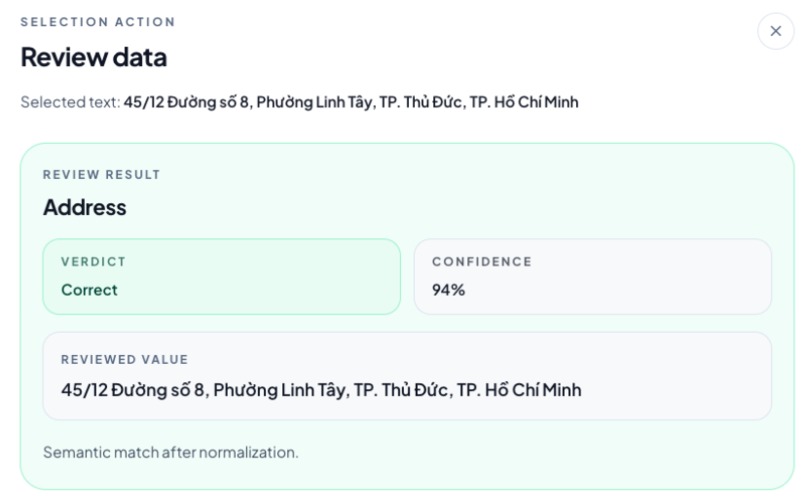
| 2 | Retrieved evidence, extracted fields, and explainable risk flags are reviewed together |
| 3 | System proposes loan insights, recommended ranges, and next-best actions |
| 4 | A reviewer-ready brief is generated for faster decisioning |
| 5 | Human reviewers approve, reject, escalate, or request more information while maintaining a communication trail |
Accomplishments that we're proud of
We are proud that this became much more than a static UI concept.
Workflow accomplishments
| Accomplishment |
|---|
| Built a real Loans page → backend → Alibaba OSS upload path |
| Linked uploaded customer documents to application context |
| Made customer-uploaded documents visible in the admin review flow |
| Created a true end-to-end journey from application submission to admin decision |
| Supported customer status tracking after submission |
AI and review accomplishments
| Accomplishment |
|---|
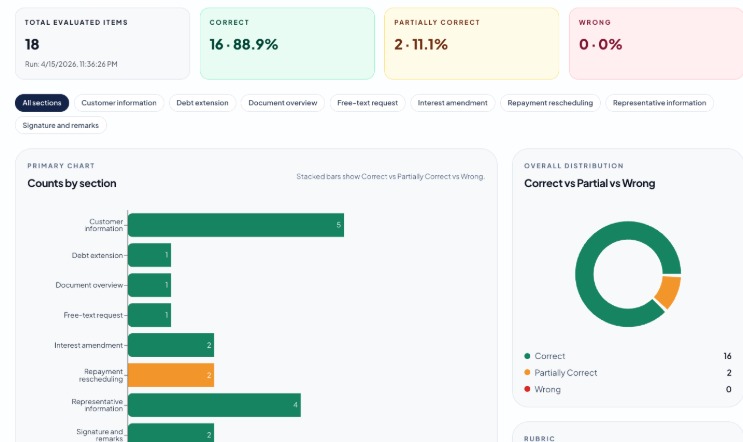
| Built a workflow covering OCR, fraud checks, loan recommendation, and narrative generation |
| Exposed OCR output in reviewable formats instead of hiding it behind a black box |
| Added fallback behavior so the system is more resilient in demos and testing |
| Kept the final decision with the human reviewer while still providing AI guidance |
Infrastructure accomplishments
| Accomplishment |
|---|
| Preserved private OSS bucket access |
| Implemented signed-URL retrieval instead of public file links |
| Exposed teammate-friendly metadata and retrieval endpoints |
| Kept the architecture practical enough for future extension |
Orchestration accomplishments
| Accomplishment |
|---|
| Built an OpenClaw orchestration flow in the Support tab |
| Connected supervisor-style outputs such as decision summaries, customer notification drafts, and admin case reports |
| Investigated real NemoClaw/OpenShell runtime onboarding instead of only describing it conceptually |
We are especially proud that Lumina Bank lands in a realistic middle ground:
not replacing the underwriter, but helping the underwriter work faster with better-organized inputs and stronger decision support.
Built for the following requirements
| Requirement area | How Lumina Bank addresses it |
|---|---|
| High-accuracy OCR & data extraction | OCR workflow and structured extraction pipeline |
| Loan analysis process automation | Multi-stage AI pipeline |
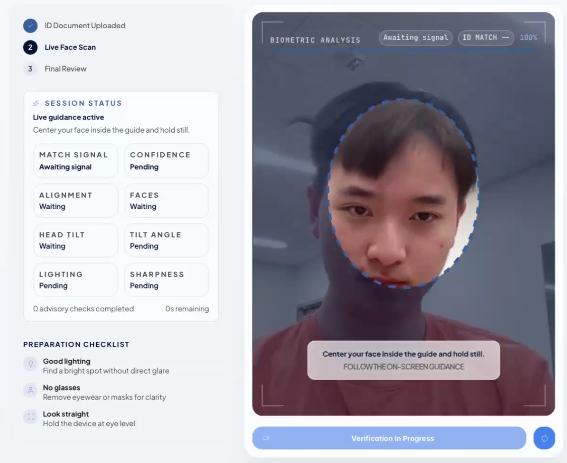
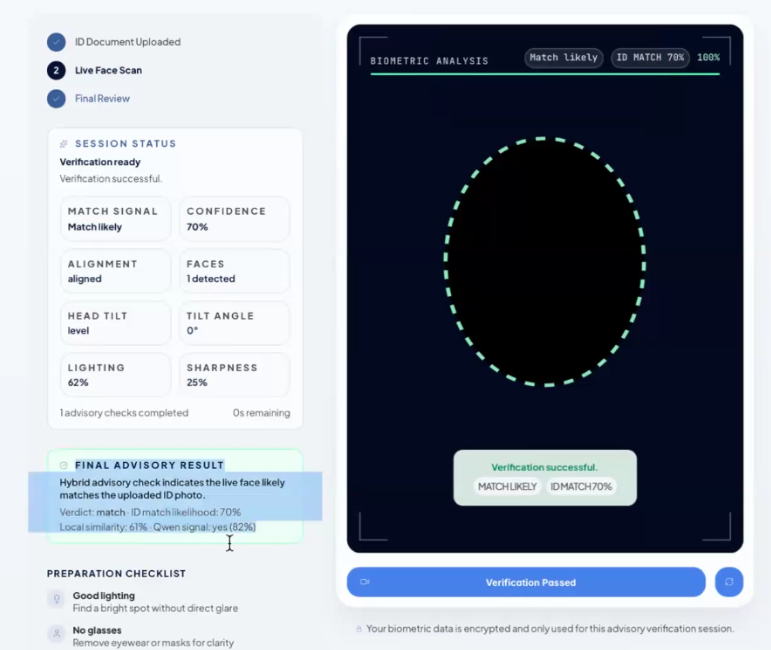
| Fraud detection | Biometric and rule-based checks |
| Loan insights recommendation | Narrative and recommendation layer |
| Loan amount recommendation | Range recommendation logic |
| Admin decision support | Review-ready summaries and evidence context |
| Customer-to-admin workflow continuity | Linked uploads, visibility, and case flow |
What's next for Lumina Bank
Near-term next steps
| Priority area | Next step |
|---|---|
| OCR quality | Richer structured extraction for financial forms and tables |
| Normalization | Better post-processing for dates, IDs, amounts, and rates |
| Reliability | Stronger multi-model review for low-confidence fields |
| Admin support | Deeper summarization and recommendation support |
| Reporting | Improved automated report generation for underwriting handoff |
| Auditability | Clearer tracking around extraction, fallback, and review behavior |
Longer-term vision
| Vision area | Goal |
|---|---|
| Underwriting workspace | Stronger AI-assisted review environment |
| Deployment | More robust production patterns for storage, preview, and access control |
| Customer workflow | Better document re-upload and clarification loops |
| Scale | Review tooling across multiple financial products and internal teams |
| Orchestration/runtime | Continued OpenClaw/NemoClaw evolution in a more reliable sandbox/runtime environment |
Longer term, we see Lumina Bank as an AI-assisted loan operations platform that helps Shinhan-style financial workflows move faster while still keeping humans in control.
Tech stack
| Category | Stack |
|---|---|
| Frontend | React, TypeScript |
| Backend | FastAPI, Python |
| Storage | Alibaba Cloud OSS |
| AI / OCR | Qwen-based document analysis workflows |
| Fallback model path | OpenAI GPT-4.1 mini |
| Orchestration layer | OpenClaw-inspired supervisor flow |
| Runtime investigation | NemoClaw / OpenShell bring-up and sandbox research |
| Database / metadata | Backend-linked application and document persistence |
Built With
- ai-agents
- alibabacloud
- docker
- gpt5.4
- openclaw
- postgresql
- qwen
- tabfpn


Log in or sign up for Devpost to join the conversation.