-
-
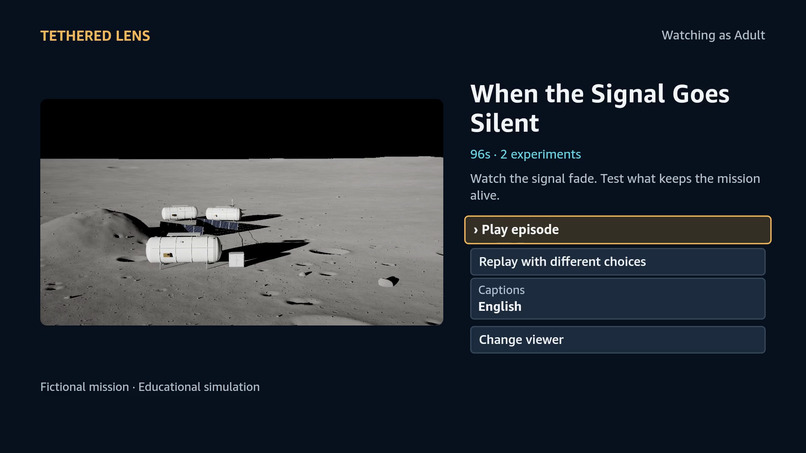
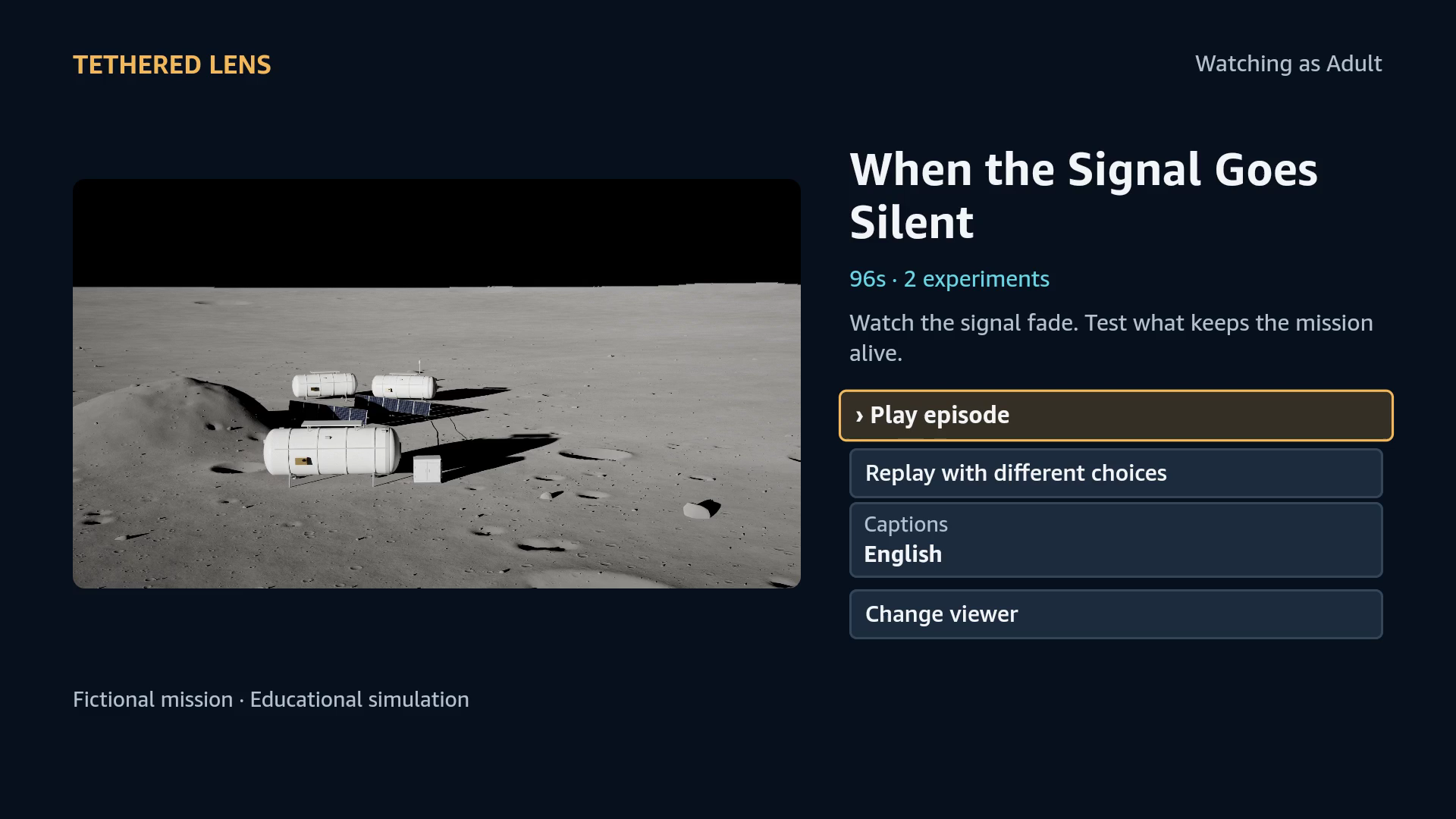
Choose a viewer profile and start the 96-second interactive space documentary.
-
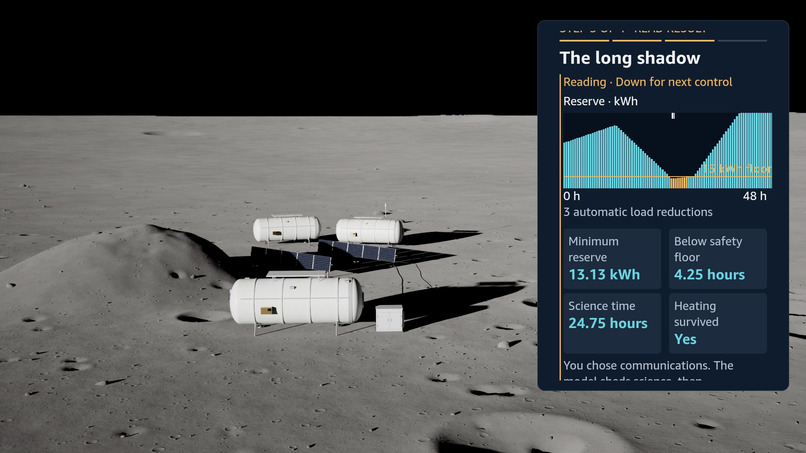
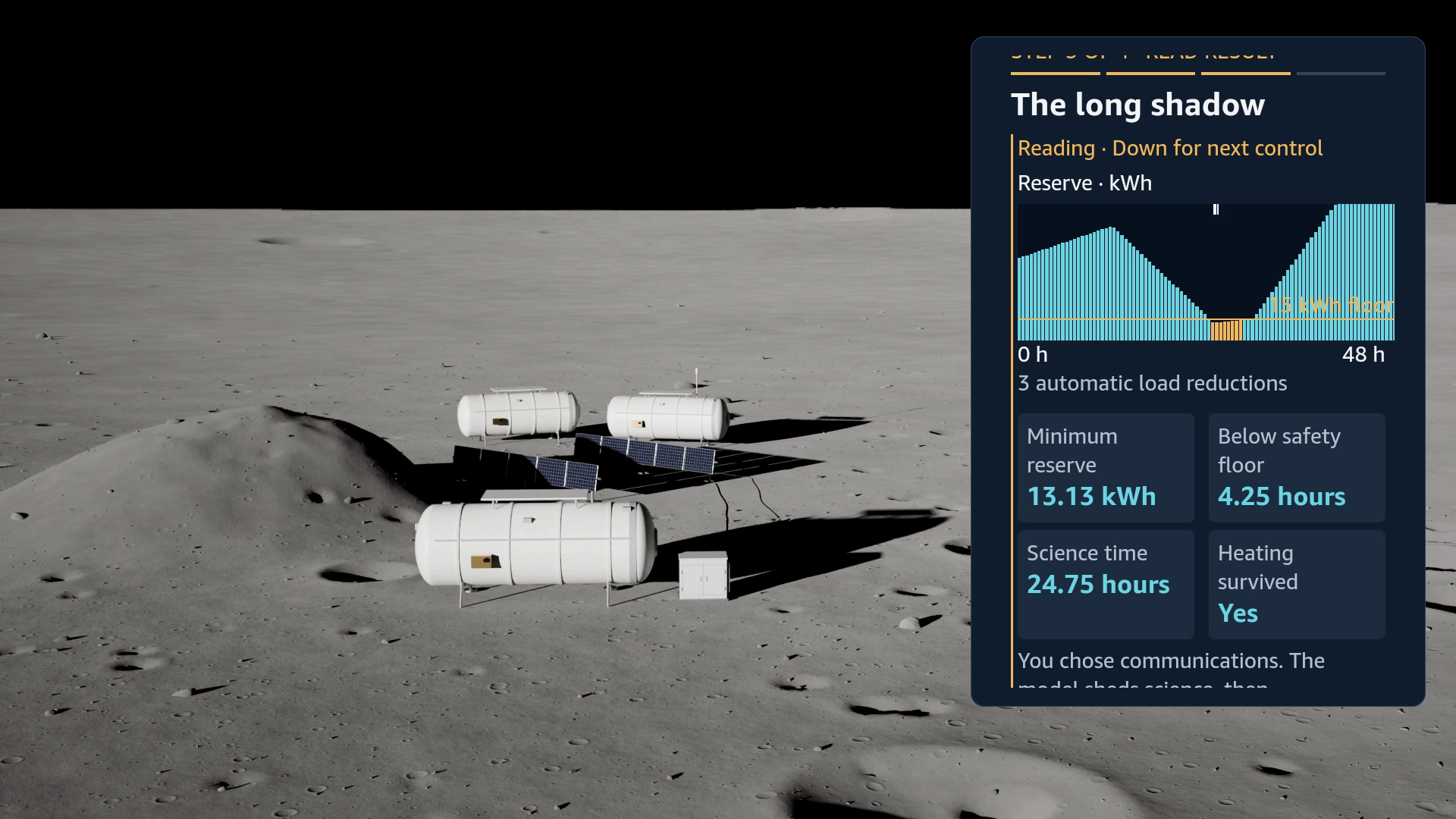
Lunar Energy Budget: inspect the simulated reserve curve, safety floor and science tradeoffs after changing the loads.
-
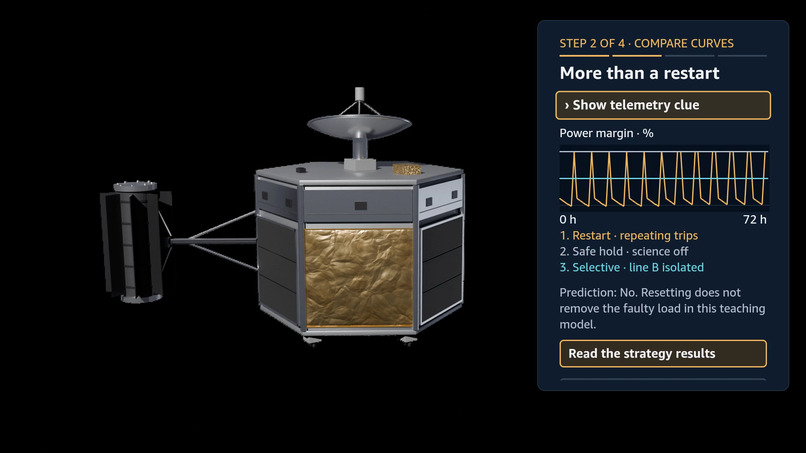
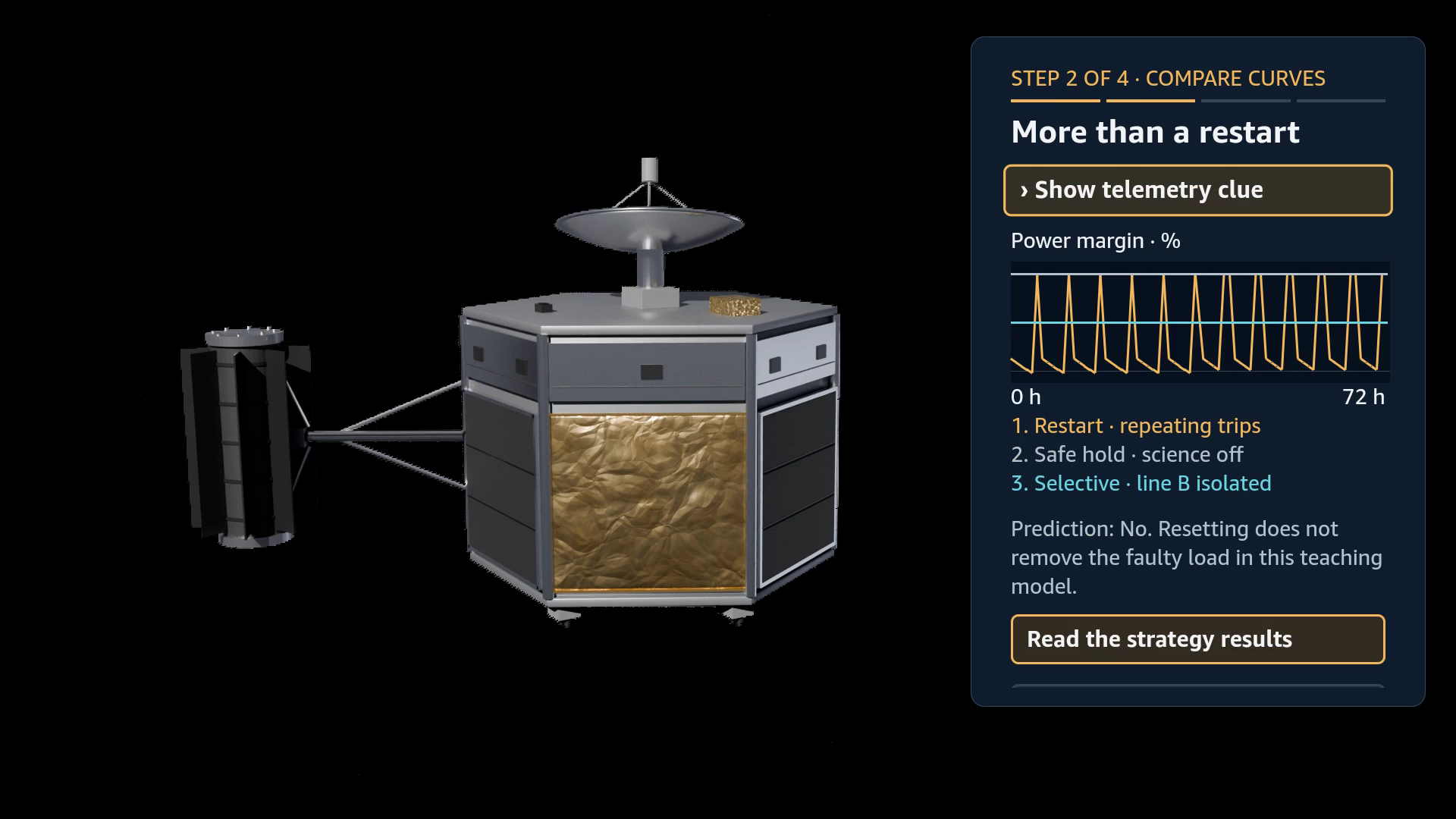
DeepRepair Twin: compare reboot-only, safe-hold and selective isolation over 72 simulated hours.
Inspiration
Families watch science documentaries together on the TV — and that is exactly where the learning stops. You can't ask the film "what if?". Tethered Lens makes the film stop and hand you the remote.
What it does
When the Signal Goes Silent is a 96-second original fictional space documentary that pauses at two turning points on Fire TV (Vega OS):
- Lunar Energy Budget (at 30 s): predict which equipment you would protect, change the terrain shadow and the loads with the D-pad, run 48 simulated hours and read the reserve curve against the safety floor.
- DeepRepair Twin (at 62 s): predict whether a reboot alone is enough, then compare reboot-only, safe-hold and selective isolation from the same initial state.
After each run a result-aware tutor explains the numbers you actually produced and speaks them aloud; a final recap ties your predictions to your results. Viewer profiles (Explorer / Teen / Adult) and EN/ZH captions are built in. In this v1 the tutor is a clearly labeled deterministic mock with local speech synthesis — the provider interface for a generative tutor is in place but not demonstrated.
How we built it
React Native for Vega OS, using the Vega W3C Media API (@amazon-devices/react-native-w3cmedia): the film's video is split without re-encoding at IDR boundaries into three segments, each anchor is the ended event of a segment, the next segment is pre-buffered, and a pre-extracted still holds the scene under the experiment panel. Simulations are deterministic TypeScript running on the device, with unit tests. A small FastAPI server serves media and the tutor contract; local speech is delivered as AAC in fragmented MP4.
We started from Amazon's react-native-multi-tv-app-sample, developed with Amazon Devices Builder Tools through its CLI documentation bridge and Vega documentation/workflow resources inside our coding agent, and tested and recorded the complete native episode on the Vega Virtual Device (Vega SDK 0.24) on Apple Silicon. The repository includes setup and reviewer instructions for the local backend.
Accomplishments
A complete native episode — film, two experiments, tutor, speech, recap — running end to end on the Vega Virtual Device, built in the submission window from original footage. We also built a reusable cue engine and manifest format for authoring "pause-and-experiment" episodes, with deterministic simulation and cue tests. The native demo includes both complete spoken tutor explanations.
Challenges and what we learned
Native media transport failed on the direct-URL path while the same content played through MediaSource; native MP3 speech failed while AAC in fragmented MP4 worked. Both reproductions, the workarounds and 14 friction-log entries are in the repository. Vega W3C Media API, Vega Virtual Device and Amazon Devices Builder Tools were central to developing and validating this native TV experience.
What's next
Chapter 3 "Catch the Window" (an integrative third experiment), reactive scenes and three endings chosen from your results, a Bedrock + Polly tutor, more episodes through the open manifest, and family learning evaluations. Extension assets are prepared for future integration; these features are not part of the submitted v1. The models are fictional teaching scenarios, not spacecraft telemetry.
Built With
- amazon-devices-builder-tools
- fastapi
- ffmpeg
- python
- react-native
- react-native-for-vega
- typescript
- vega-os
- vega-virtual-device
- vega-w3c-media-api

Log in or sign up for Devpost to join the conversation.