Tether: Every claim, tethered to proof
Inspiration
Every application season, students are told to "quantify your impact," and many end up rounding up, guessing, or claiming things they can't document. Reviewers can't easily tell what's solid, and students often don't realize which of their own claims would fall apart under one follow-up question. We wanted a spell check for claims: a tool that lets a student find the weak spots before a reviewer does, and helps them fix them honestly.
What it does
Tether checks the factual claims in a scholarship essay, resume, or project proposal against the evidence a student provides. You paste your draft and upload proof such as PDFs, documents, and screenshots. Tether then:
- Extracts the checkable claims from your draft
- Matches each one to the most relevant evidence snippets
- Uses NVIDIA Nemotron to judge how well the evidence actually supports the claim
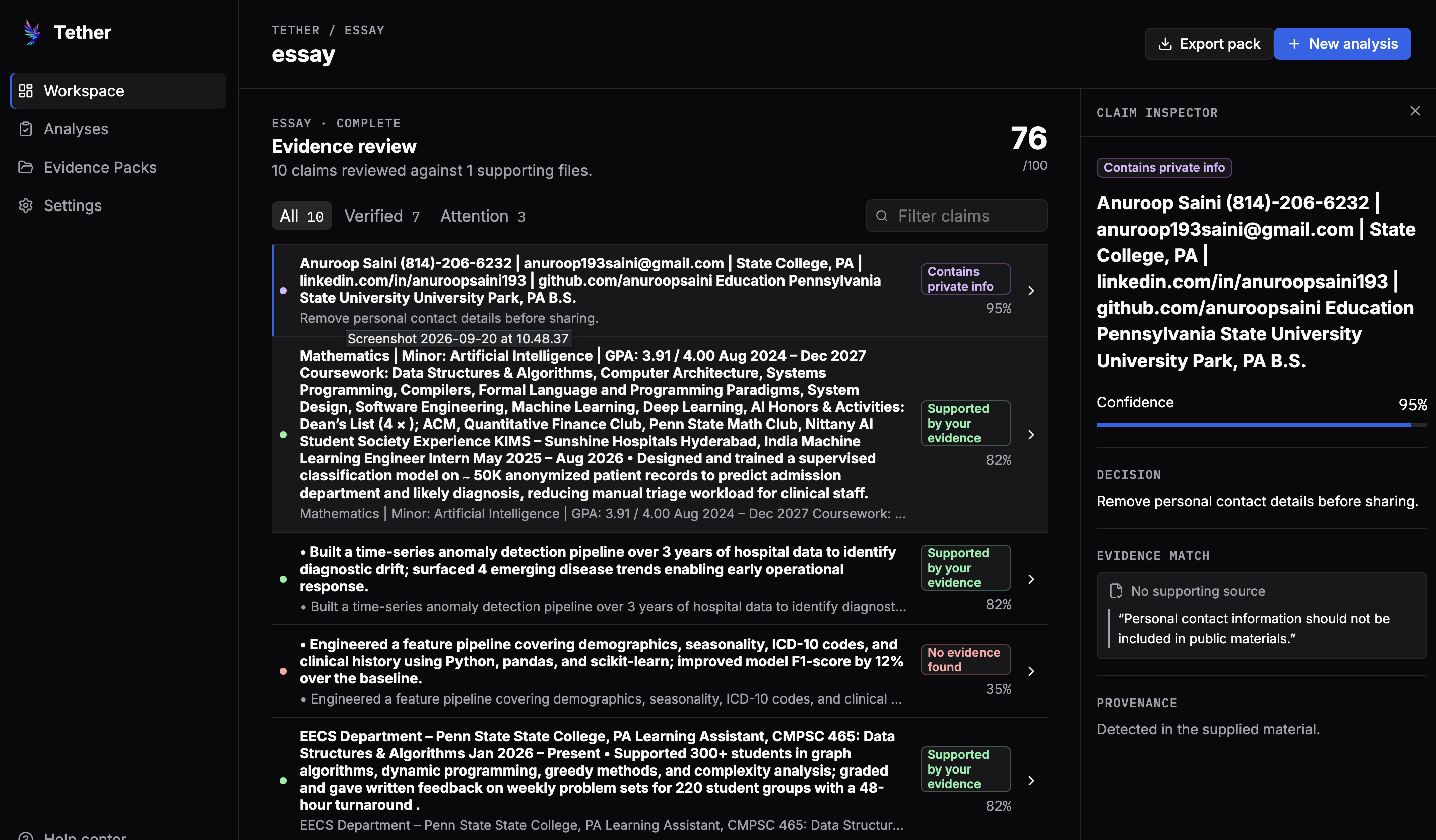
- Builds a color-coded Trust Map: green (supported), yellow (partially supported), red (no evidence), and purple (contains private information)
- Suggests a safer rewrite for each weak claim, with the source shown alongside it
- Flags contradictions between claims and sensitive personal details
- Exports an Evidence Pack with the supported claims, their wording, and their sources
How we built it
- Backend: FastAPI with a pipeline that extracts text from uploaded evidence, chunks it into snippets, and retrieves candidate evidence for each claim using deterministic matching (numbers, entities, keyword overlap).
- AI: NVIDIA Nemotron acts as the structured decision engine in two passes: claim extraction, then evidence judgment. Outputs are validated against a strict schema, with a corrective retry when the JSON is invalid.
- Guardrails in code, not prompts: the model only sees candidate snippets, evidence IDs it returns are checked against that set, and a claim can't be marked publishable without a validated snippet. Trust scores are computed in code so they're stable and explainable.
- Streaming progress: analyses run in the background and report progress through server-sent events, so the UI shows real steps.
- Frontend: a React/Vite workspace with a dark-mode product UI for the Trust Map, claim review, and Evidence Packs.
- Demo safety: a deterministic mock mode with a sample scenario keeps the demo reliable if an API call fails.
Challenges we ran into
- Making the model judge exact support. A snippet that "sounds related" isn't proof. The difference between $3,000 and $2,847 is the whole point, so we had to design the pipeline around exact-match judgment rather than similarity.
- Keeping the model honest. We validate evidence IDs and block "publish" verdicts without a real snippet, so the model can't invent support.
- Frontend and backend drift. Building both in parallel meant the API contract kept shifting, and we had to audit and realign the two.
- Messy inputs. PDFs, screenshots, and OCR produce noisy text, which affects matching quality.
- Careful wording. We deliberately avoided claiming that Tether "verifies" anything, and rewrote copy so the product never overstates what it can do.
Accomplishments that we're proud of
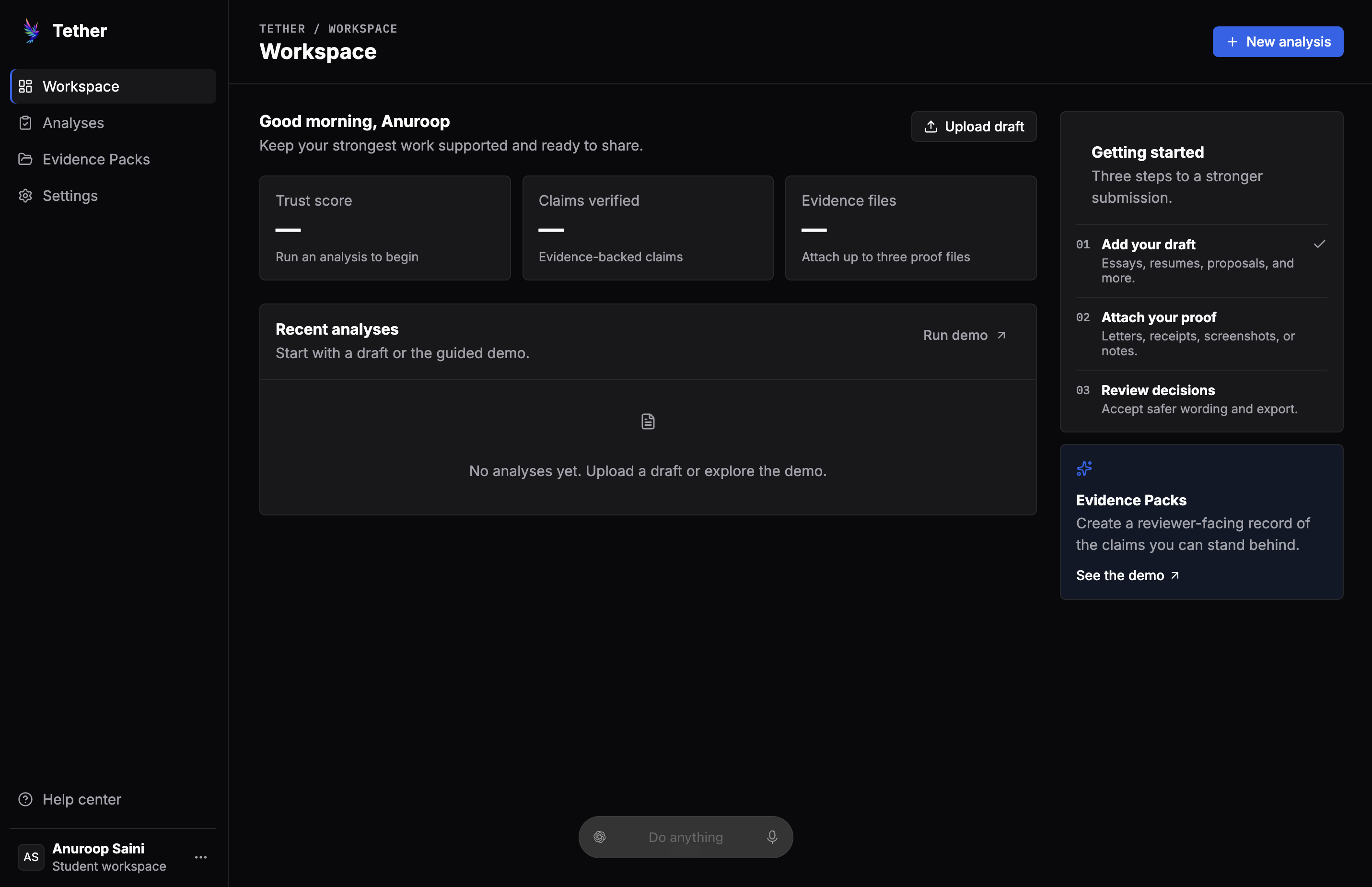
- A complete loop from pasted draft to evidence-backed Trust Map to an exportable Evidence Pack
- Guardrails that keep the AI grounded in retrieved evidence rather than trusting its output blindly
- A demo scenario that shows green, yellow, red, and purple verdicts in a single run
- An API with real-time progress, automated tests, and a reliable fallback mode
- A product that helps students fix weak claims instead of only flagging them
What we learned
- Structured, schema-validated output plus code-level checks is far more reliable than trusting a model's free-form judgment.
- What a product refuses to claim matters as much as what it does. Saying "matched against your evidence" instead of "verified" builds more trust.
- Retrieval quality drives verdict quality: better evidence selection did more for accuracy than prompt tweaks.
- Agreeing on the API contract early saves a lot of pain when the frontend and backend are built in parallel.
What's next for Tether
- "How to prove it" guidance for every weak claim, such as which document, screenshot, or confirmation email would back it up
- A narrative mode for essays that checks factual statements and leaves reflective writing alone
- Third-party evidence support, with signed letters and official dashboard links labeled as such
- Stronger privacy: redaction before anything reaches the model, clear consent, and automatic deletion
- Voice-preserving rewrites with multiple options and highlighted changes
- A focused launch with scholarship and college applications first, then resumes, grants, and startup pitch decks
Built With
- javascript
- nemetron
- python
- typescript

Log in or sign up for Devpost to join the conversation.