-
-
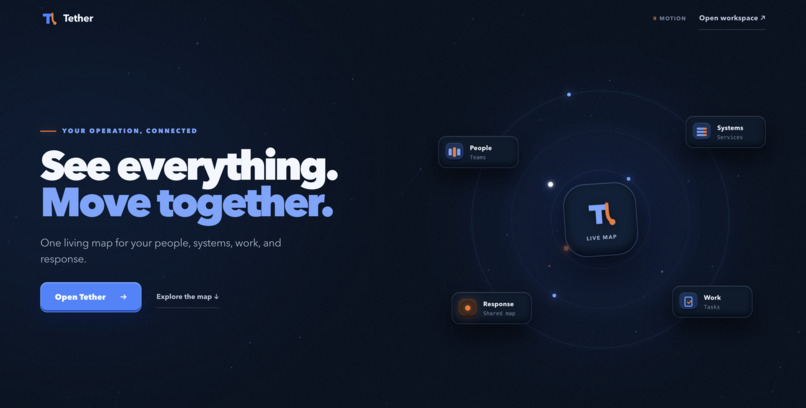
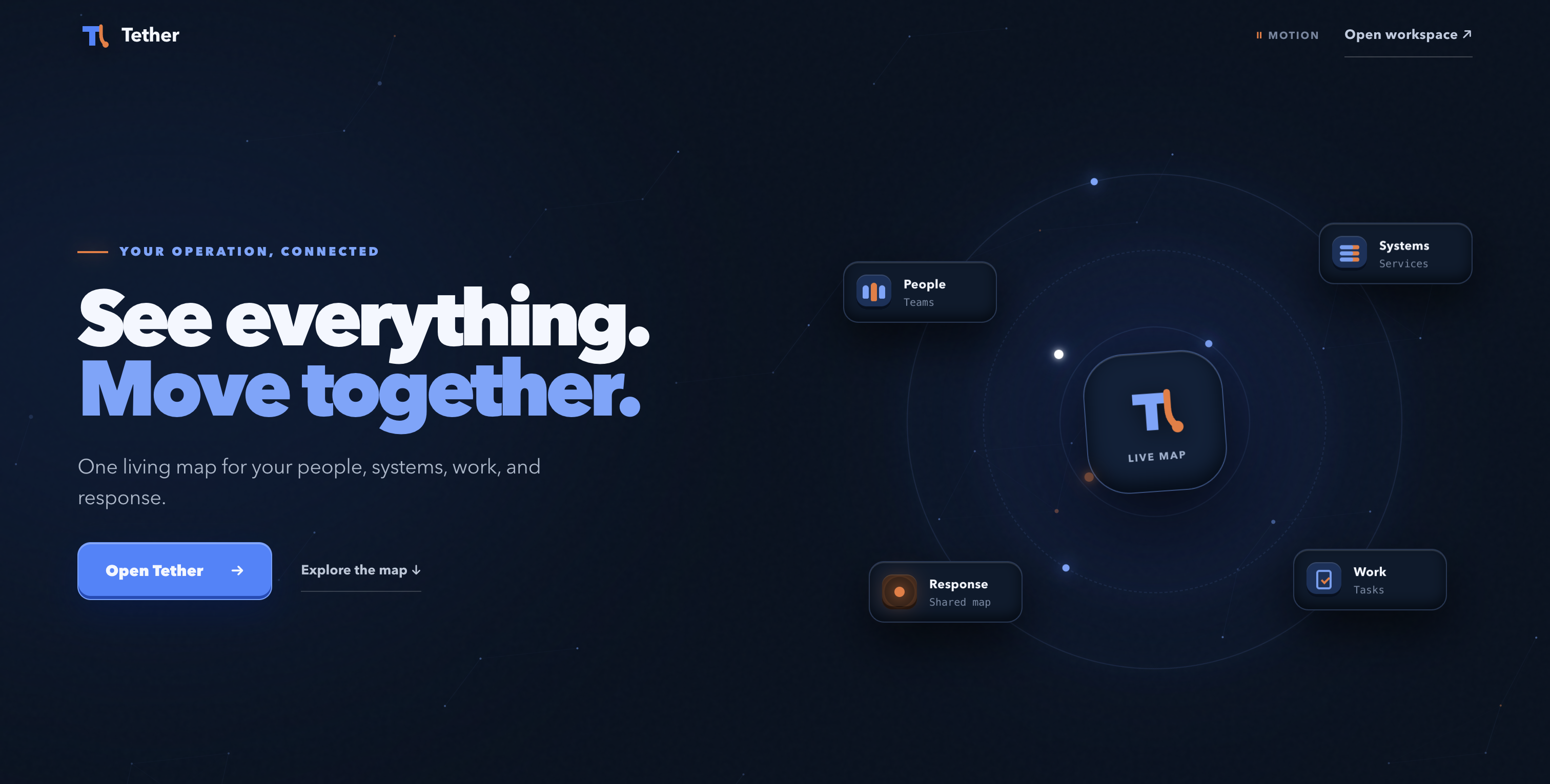
Hero page
-
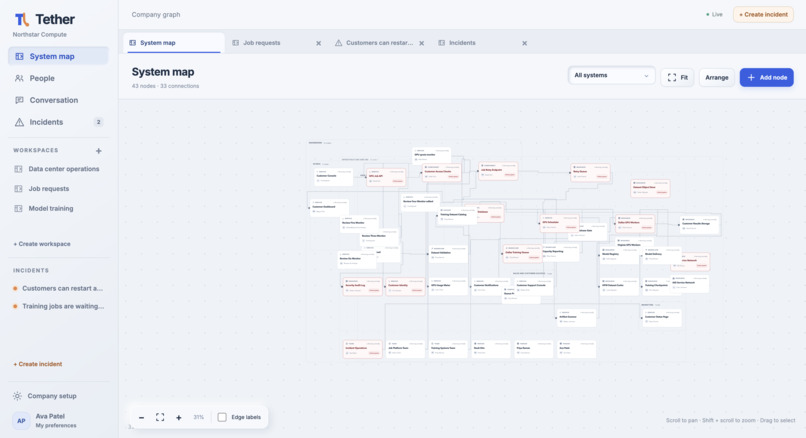
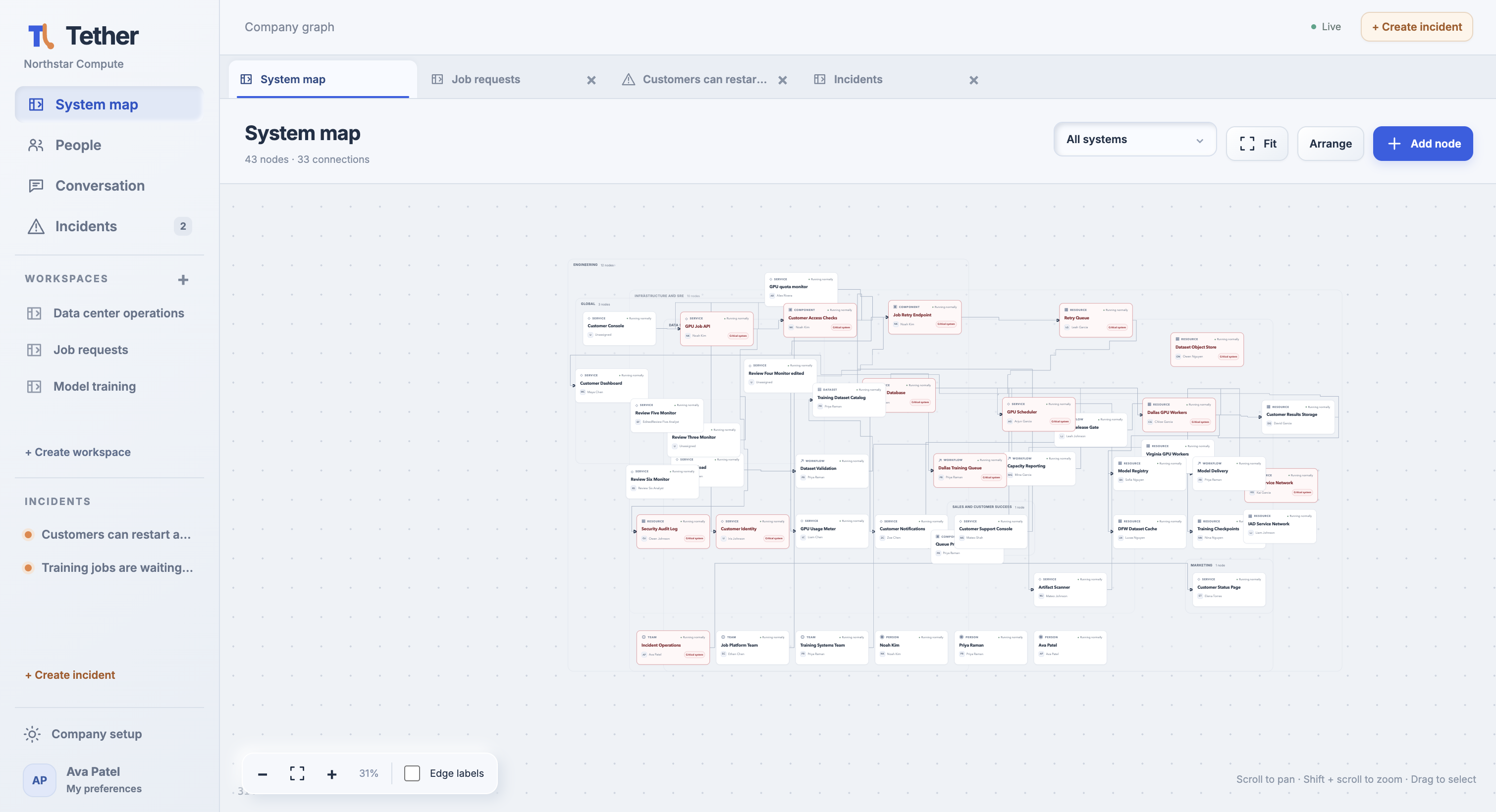
System map
-
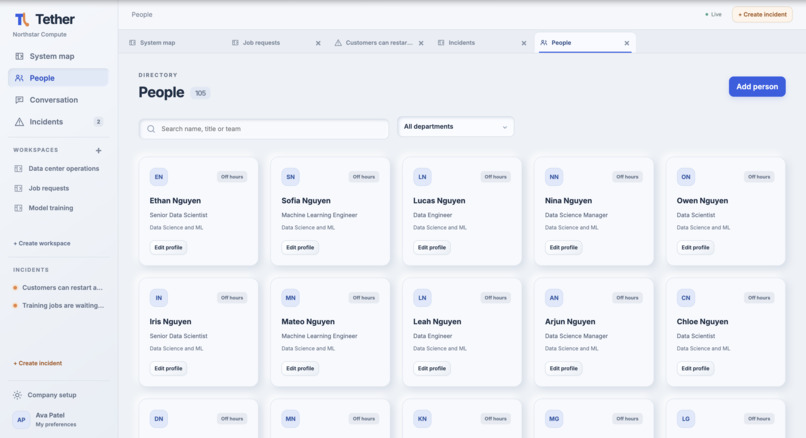
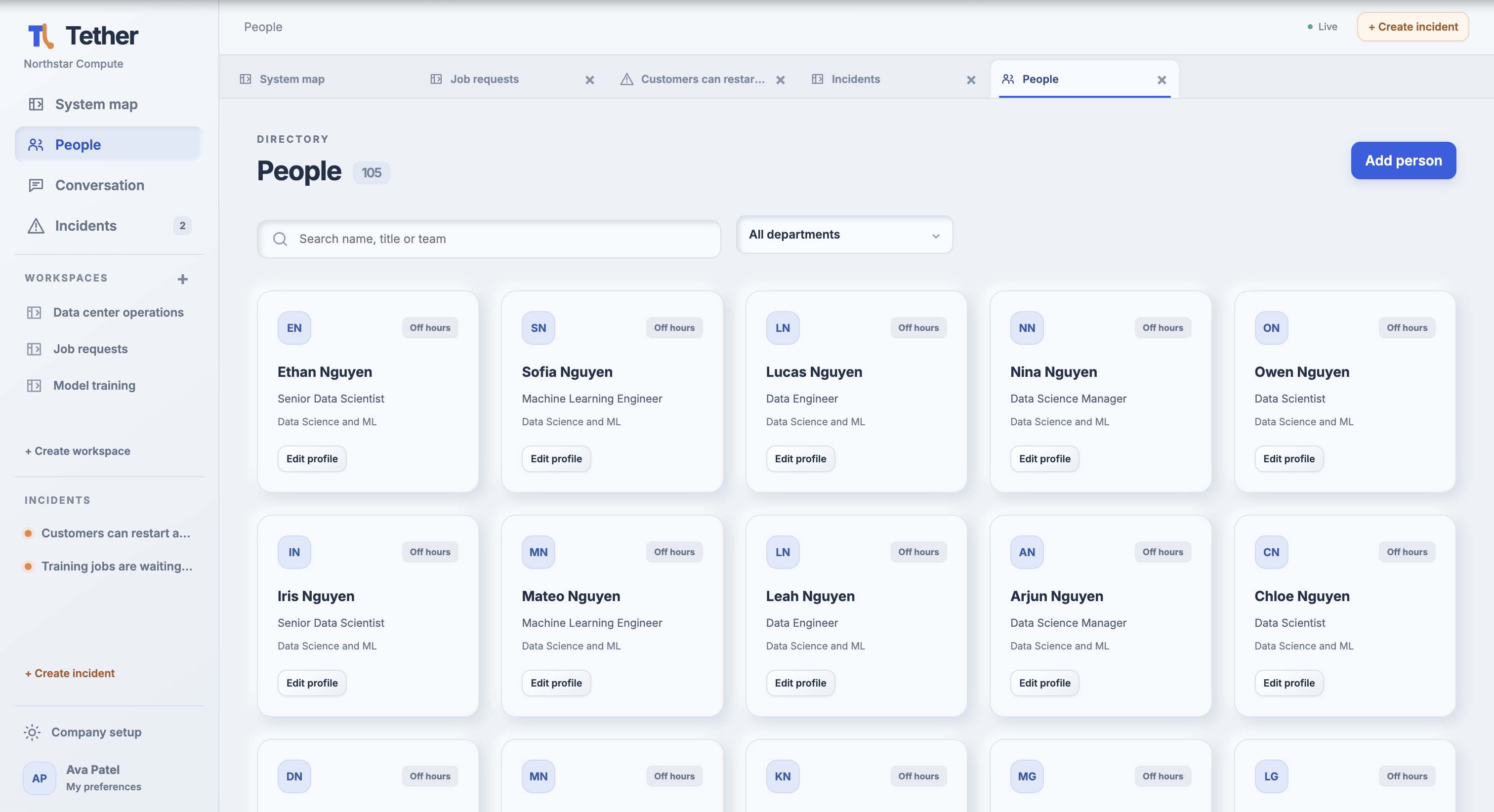
Employee list
-
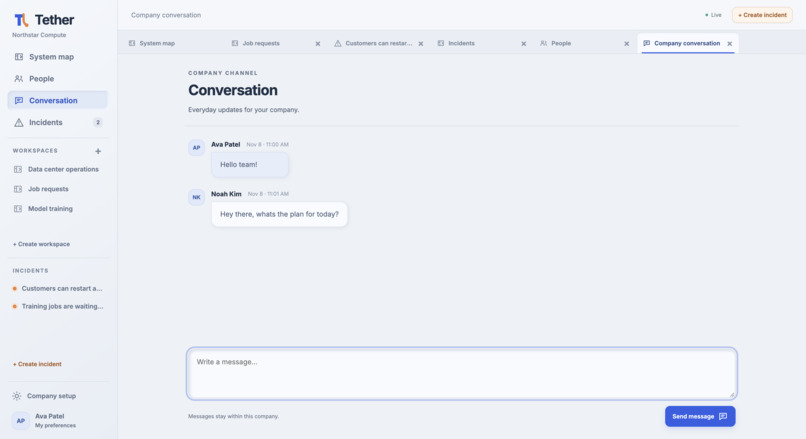
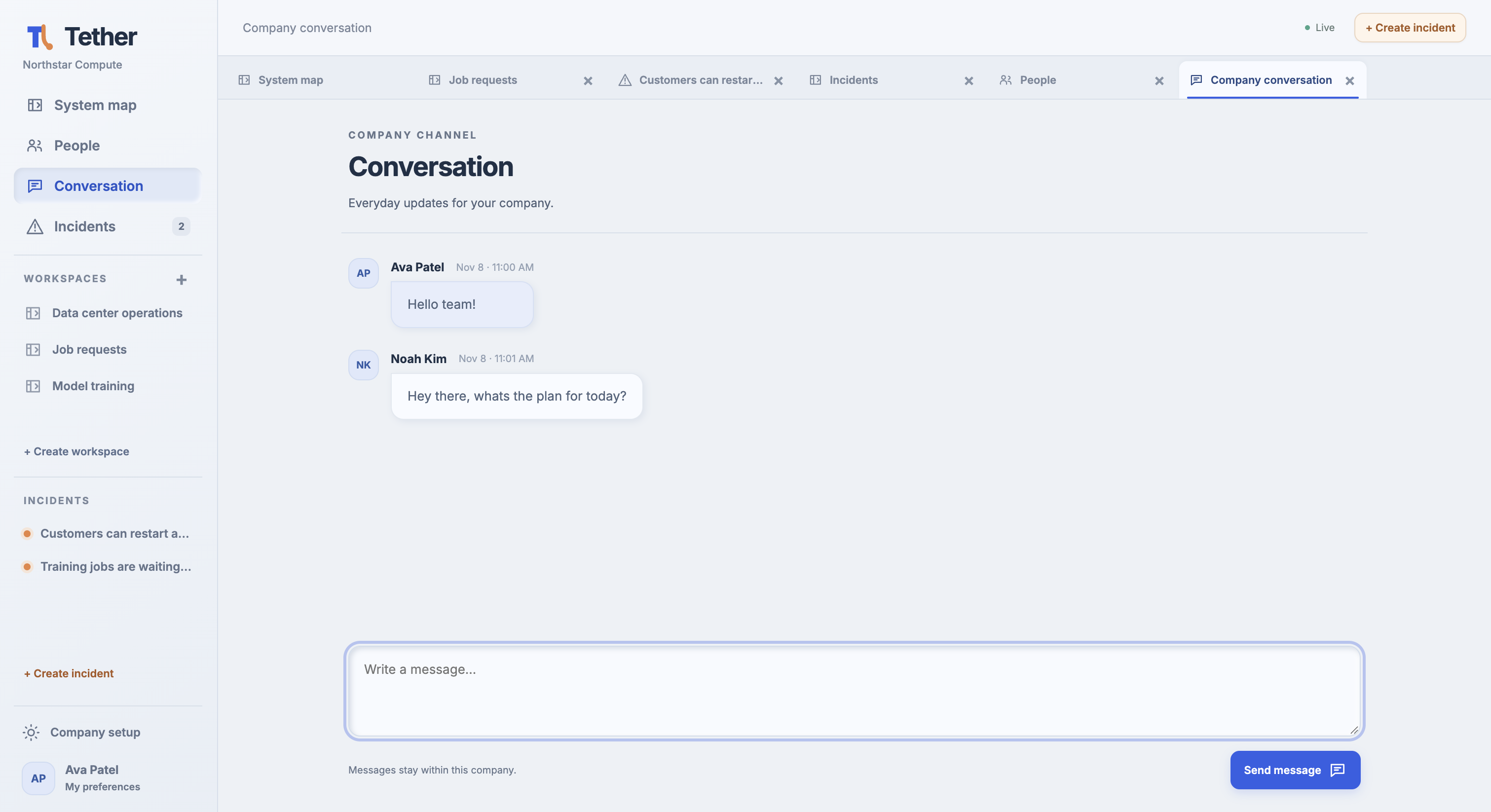
Chat feature
-
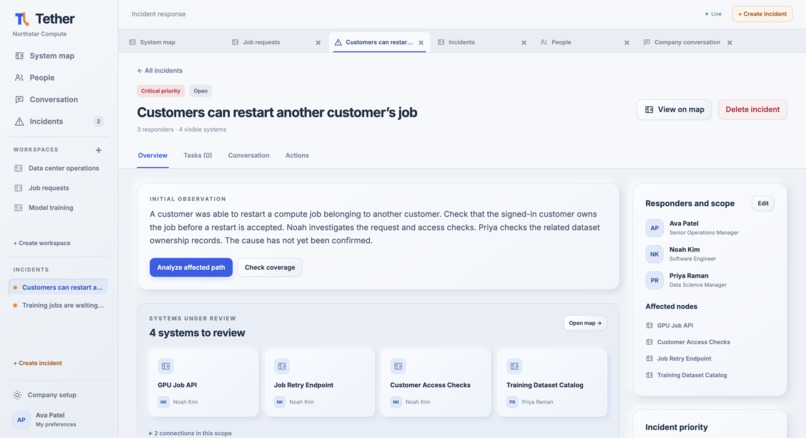
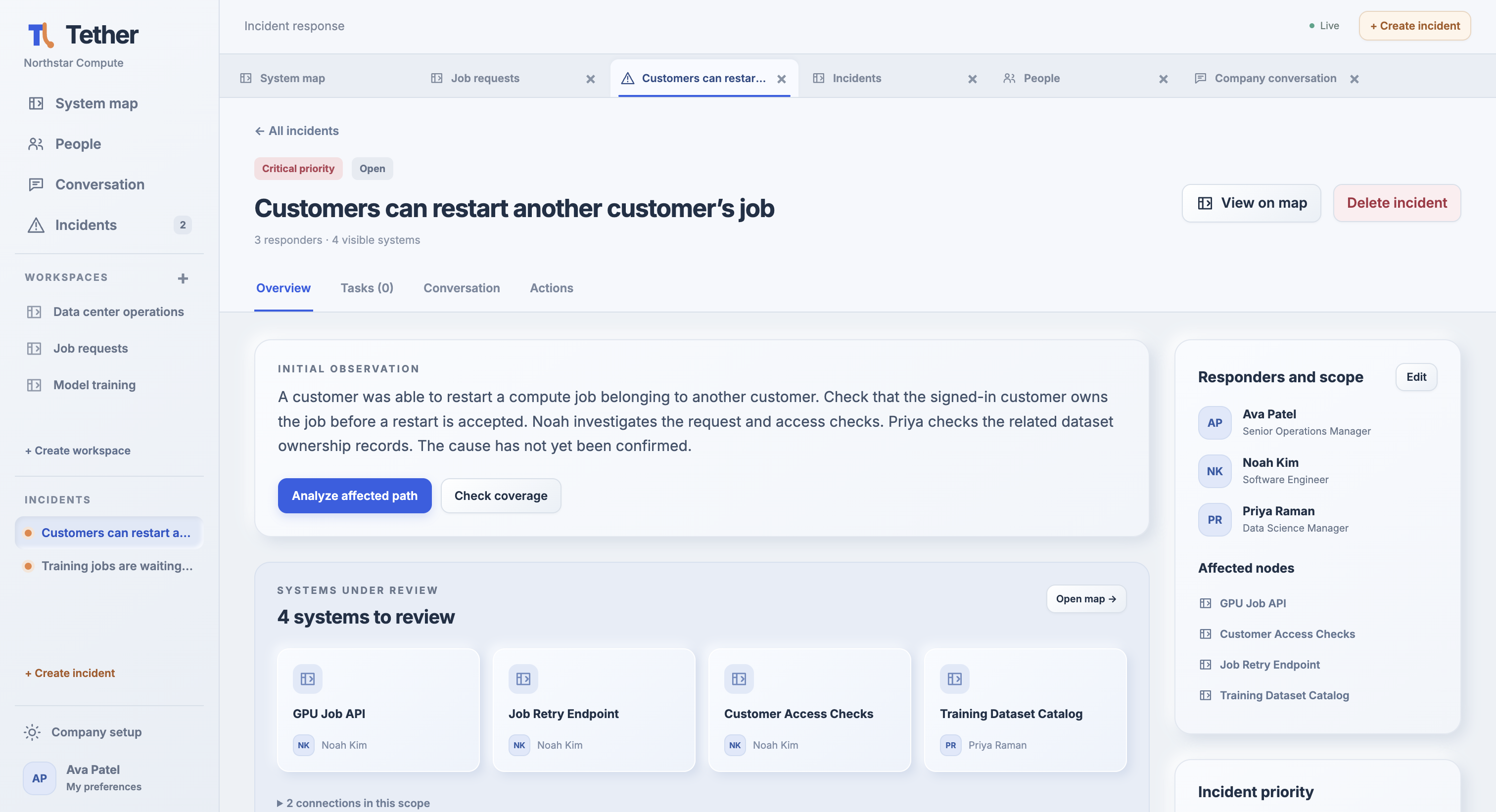
Incident response panel
Inspiration
- During an incident, the useful context is often scattered across service maps, repositories, team directories, chat, and access systems.
- A warning can be visible while the right responder still lacks the context or permission to act safely.
- Tether began with a simple human question: what if the company map people already understand could become the place where they coordinate a response?
What it does
- Provides an editable infinite canvas for systems, people, teams, dependencies, and ownership.
- Keeps three saved workspaces for ordinary operations: Job requests, Model training, and Data center operations.
- Supports node, person, and connection editing, searchable multi-select controls, workspace chat, repository references, incident chat, and response tasks.
- Includes 100 synthetic employee profiles with working hours, availability, notification preferences, and explicit on-call consent.
- Uses four authenticated role views for a senior manager, engineer, data-science manager, and marketing partner.
- Focuses the company graph on two incident rooms: the critical-priority Customers can restart another customer’s job and the medium-priority Training jobs are waiting too long.
- Gives authorized responders a full incident view while sending marketing a minimal in-app notice that protects private incident details.
- Lets responders join a specific response for one hour, so availability and after-hours consent remain explicit.
- Uses Nemotron through scoped MCP tools to read permitted context, propose per-person work, and prepare separate coding prompts in parallel.
- Lets a manager review and apply the plan once. Tether then persists tasks, prompts, and in-app notices for each recipient.
- Rejects stale plans and prevents duplicate delivery when a reviewed plan is applied again.
- Keeps infrastructure authority separate from model output. A manager can approve an exact allowlisted action against a disposable local service, and the server verifies the result independently.
How I built it
- TypeScript, Node.js, HTML, CSS, and JavaScript for the desktop-first browser experience.
- Local SQLite for authenticated accounts, company data, workspaces, incidents, conversations, tasks, notices, and audit state.
- Model Context Protocol for bounded read and simulation tools with no shell, raw SQL, or infrastructure control.
- NVIDIA Nemotron 3 Nano served with vLLM on an NVIDIA Brev A100 through a private SSH forward.
- A bounded assignment dispatcher with up to two parallel prompt writers and a maximum of six assignments.
- Server-side checks for current roles, resource grants, repository paths, working hours, availability, consent, and plan revisions.
- A separate trusted authority path for exact-action approval and verified local response.
- Server-Sent Events for authenticated live updates across role sessions.
- A separate encrypted A-to-B-to-C protocol proof across three local processes, with durable queues, signed acknowledgments, replay rejection, and relay restart recovery.
Challenges I ran into
- Making the model useful without allowing it to grant permission or execute infrastructure changes.
- Sharing enough context for each responder while protecting another person’s private incident and repository scope.
- Preserving user-positioned canvas layouts while focused incident maps highlighted only the relevant systems.
- Binding reviewed plans to changing evidence, permissions, availability, and source mappings.
- Keeping the experience understandable when live model inference is slow or unavailable, with a clearly labeled rule-based fallback.
Accomplishments I am proud of
- Built a working company graph with 100 employee profiles, 43 connected nodes, three saved workspaces, and four isolated role views.
- Connected a browser-triggered Nemotron workflow to scoped MCP tools and visible provider provenance.
- Delivered reviewed assignments with different recipient-scoped prompts, persisted tasks, and privacy-aware in-app notices.
- Verified that stale plans fail, repeated apply does not duplicate work, and private task details stay role-scoped.
- Verified a disposable local response that blocks an unsafe cross-customer restart while the protected path still accepts the correct customer.
- Passed 94 automated checks and typecheck, then completed browser walkthroughs for setup, workspaces, incidents, assignments, notices, deletion, reload persistence, and recovery.
What I learned
- Agent workflows need narrow context, current authorization, clear provenance, and deterministic validation around every model result.
- A useful coding prompt needs evidence, permitted repository paths, unknowns, tests, and acceptance criteria for one recipient.
- Canvas state is operational data. Preserving the layout people created matters as much as saving the nodes themselves.
- Recorded checks can explain a response when they are clearly labeled as replay and never presented as live execution.
What is next
- Connect maintained identity, HR, repository, and incident sources.
- Add managed encrypted persistence and production notification channels.
- Expand the allowlisted response adapters while preserving independent approval and verification.
- Test the resilient peer protocol across separate physical devices and networks.
- Continue refining portrait and mobile layouts after the desktop workflow.
Built with
- TypeScript
- Node.js
- SQLite
- HTML, CSS, and JavaScript
- Model Context Protocol
- NVIDIA Nemotron 3 Nano
- NVIDIA Brev
- vLLM
- SSH port forwarding
- libsodium
- Server-Sent Events
Built With
- brev
- css
- html
- javascript
- libsodium
- mcp
- nemotron
- node.js
- nvidia
- sqlite
- sse
- ssh
- typescript
- vllm
