Inspiration
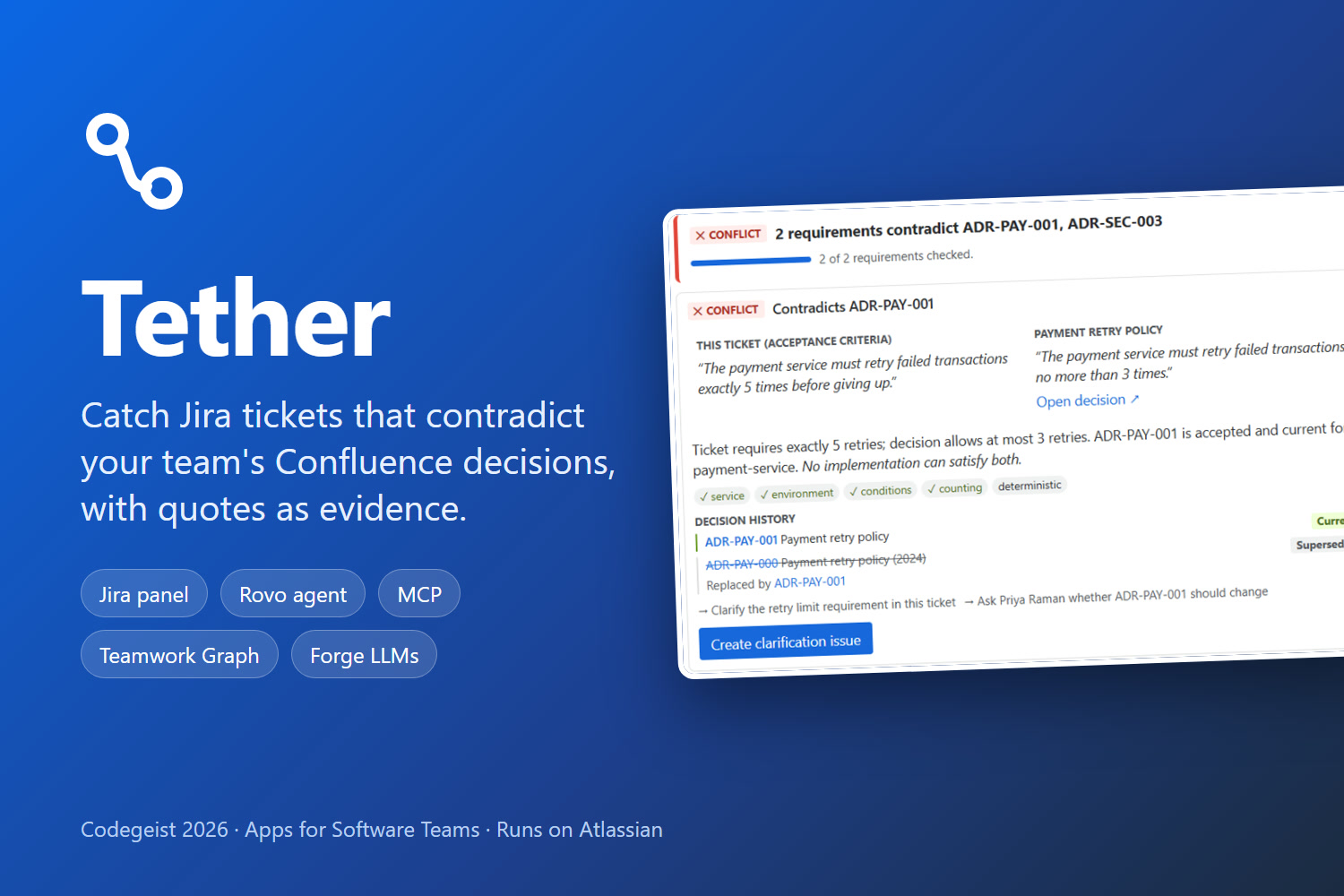
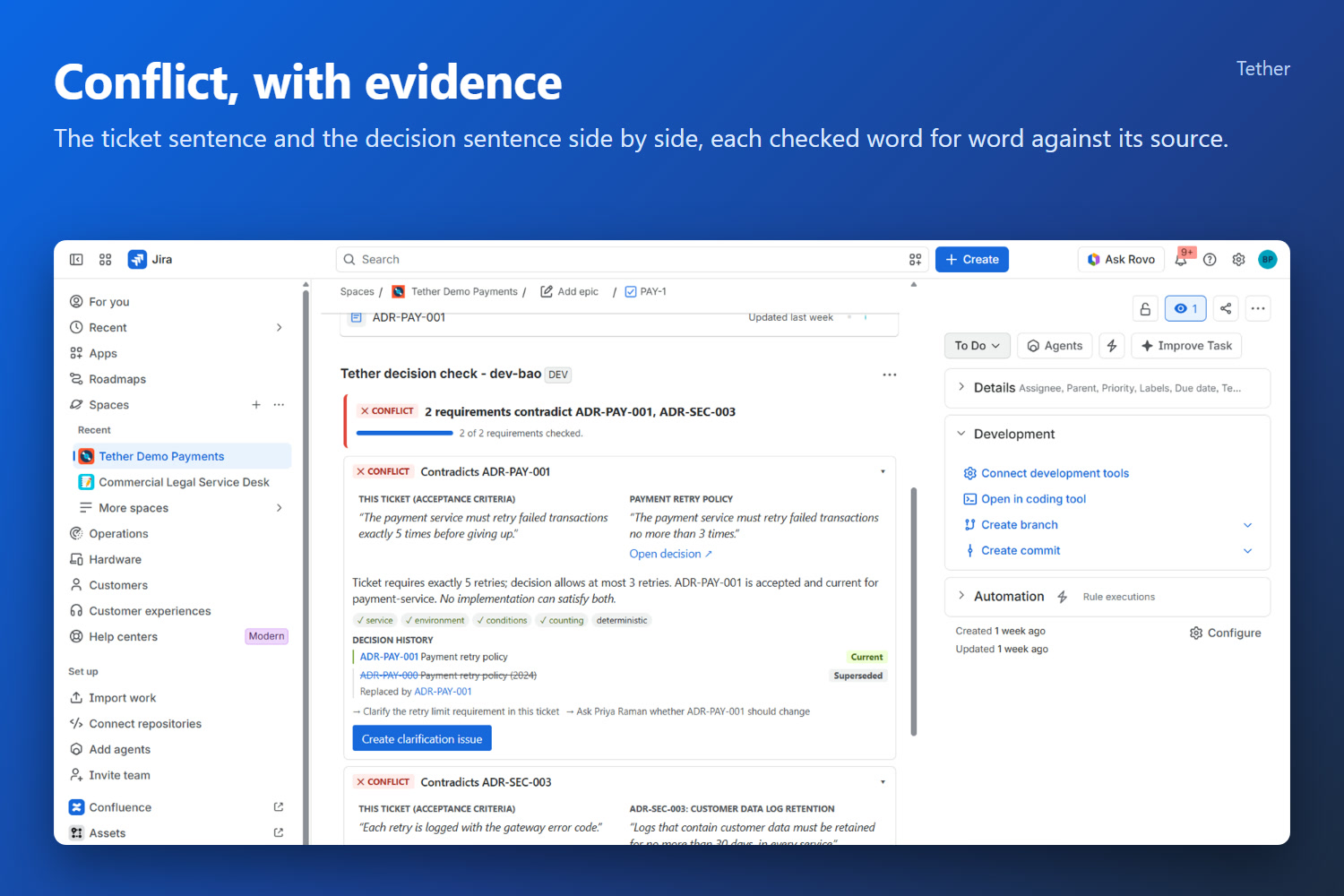
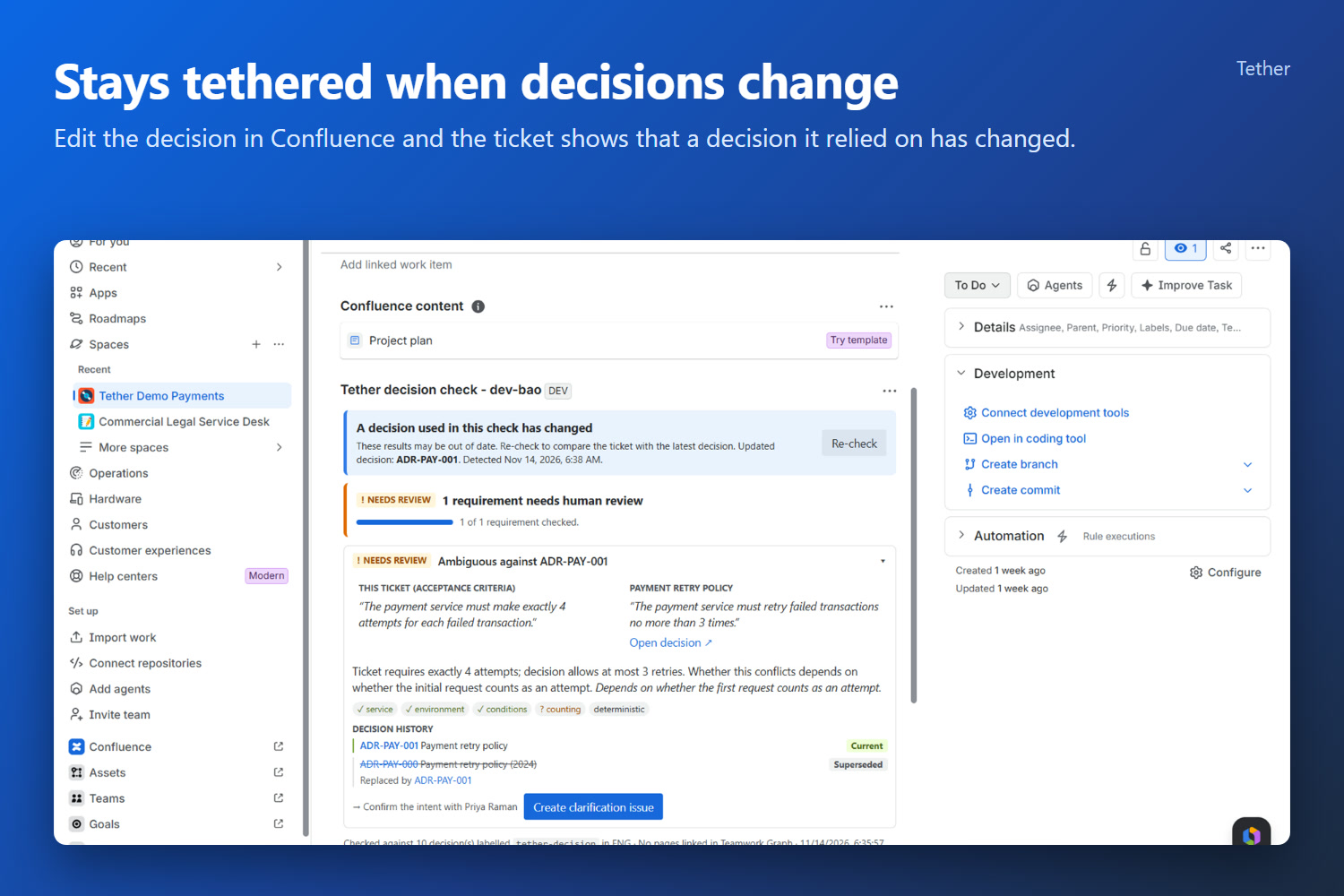
Teams write architecture decision records (ADRs) in Confluence and tickets in Jira, and the two drift apart. A ticket asks for "retry exactly 5 times" while the accepted decision says "no more than 3 times". Nobody connects the two until code review, or production. We wanted a check that sits on the ticket, finds the decisions that apply, and shows the exact evidence, without pretending to be more certain than it is.
What it does
Open a Jira issue, open the Tether decision check panel and click Check implementation context. Tether:
- extracts the ticket's technical requirements;
- finds the decision pages that apply: labelled pages in the configured Confluence spaces, plus pages linked to the issue through Teamwork Graph;
- checks each decision's status, supersession history and scope (service, environment);
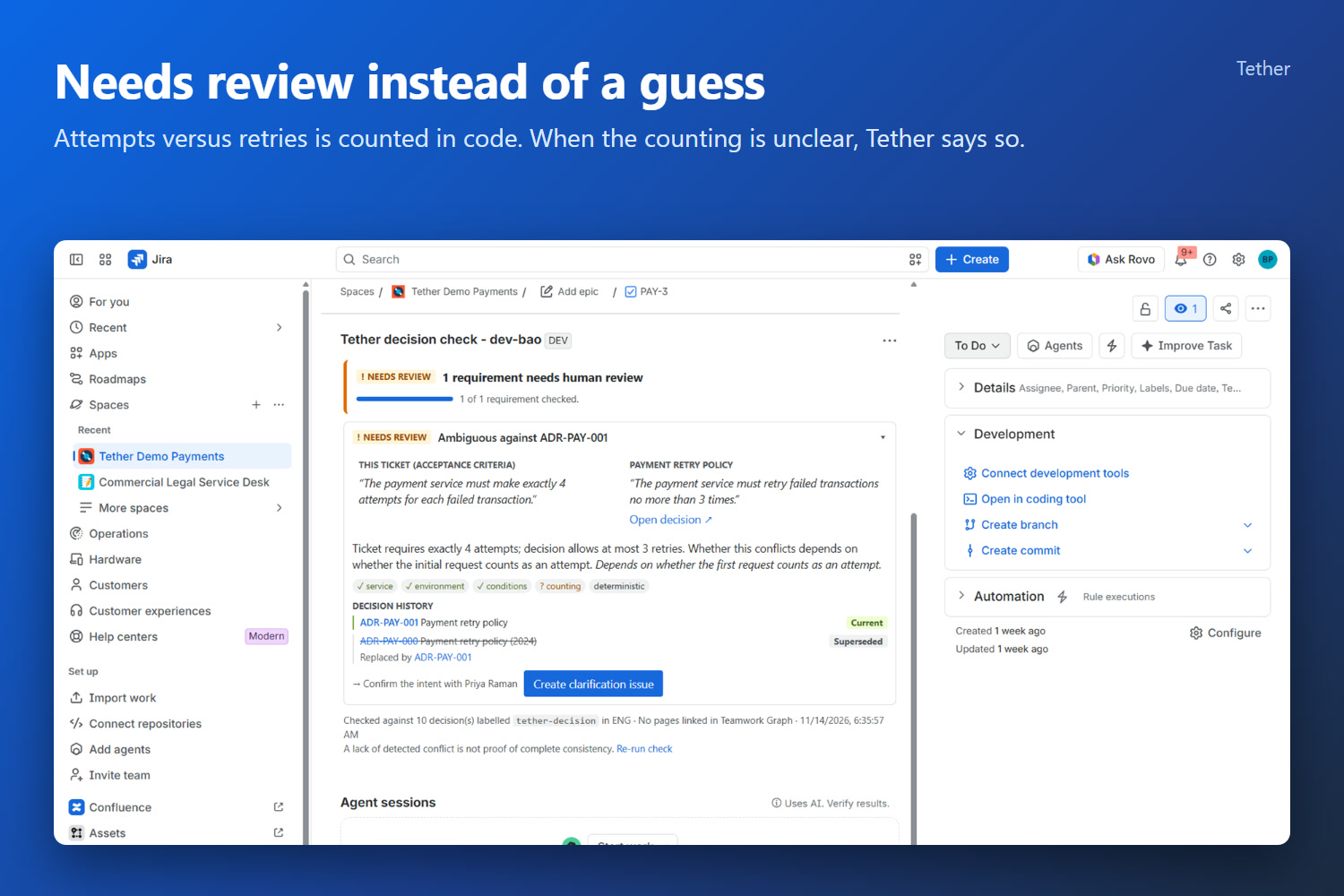
- compares each requirement with each applicable decision and returns one of four outcomes: Conflict, Needs review, No conflict found or Insufficient evidence, with a coverage line such as "1 of 2 requirements checked";
- shows the ticket sentence next to the decision sentence, both checked word for word against their sources, with a link to the page.
From a finding you can Create clarification issue: Tether drafts it, you edit and confirm, and it is created as you, linked to the ticket and the decision page. Tether never edits the ticket or the decision.
When a decision page changes, a ticket checked against it shows "A decision used in this check has changed" with a Re-check button.
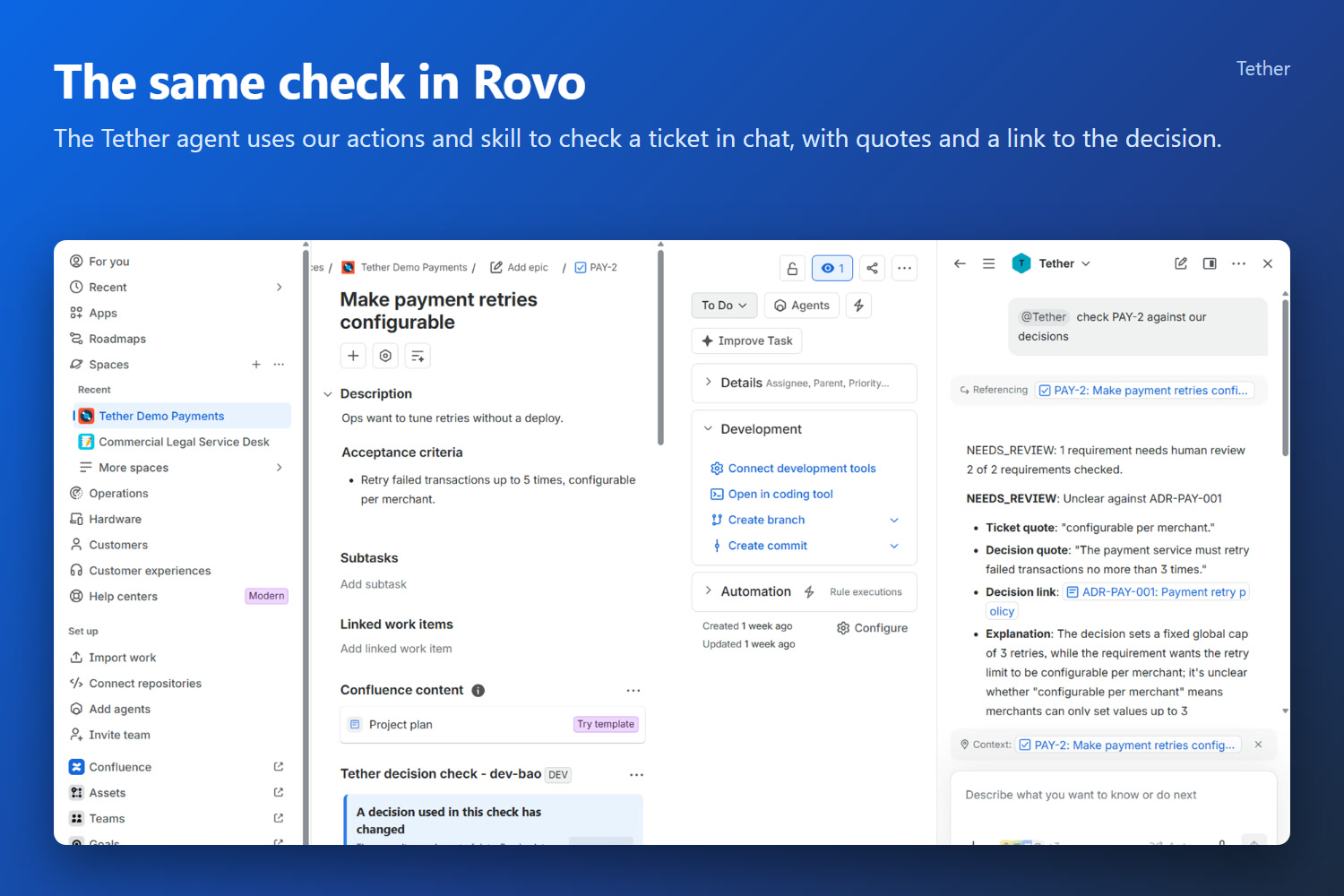
The same engine is available in Rovo (the Tether agent, with three actions and the
decision-consistency skill) and to MCP clients such as Claude Code
(check-issue-consistency, find-decisions).
What makes it different from asking a chatbot to review a ticket:
- Deterministic where it matters. "Up to 5" against "at most 3" is compatible if the implementation stays within 3 retries; "at most 4 attempts including the first" equals "at most 3 retries"; "15000 ms" against "at most 10 s" is a conflict. Interval maths, units, attempts-versus-retries and supersession are code, not prompts. The language model extracts requirements and constraints, with a semantic fallback when the deterministic rules cannot decide.
- Honest uncertainty. Needs review instead of guessing; Insufficient evidence instead of a silent pass. A failed retrieval or model call is never shown as "no conflict".
- Verified evidence. A quote that cannot be found in its source downgrades the finding to Needs review.
How we built it
Everything runs on Forge, with no external services (no permissions.external). The
production build is eligible for Runs on Atlassian.
| Product | How Tether uses it |
|---|---|
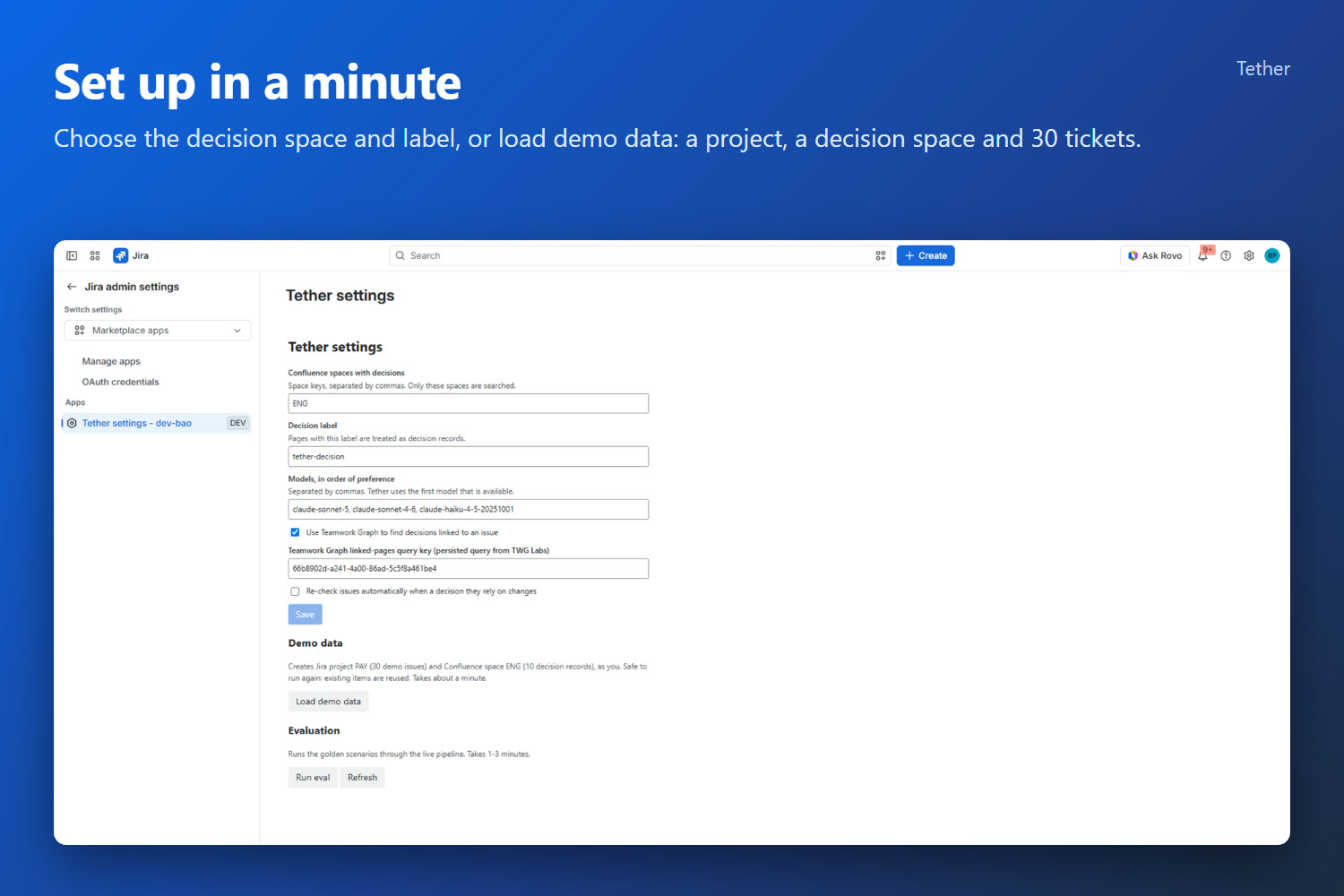
| Forge | Custom UI issue panel and admin page (React + Vite), resolvers (25 s) that only enqueue work, a queue consumer (900 s) that runs the analysis, Forge KVS for jobs, reports, the per-page-version constraint cache and settings, triggers for Jira issue updates and Confluence page updates, and Forge LLMs (Claude models, ordered fallback list) for extraction. |
| Jira | Issue panel and admin page; reads the issue as the user (permission check); creates the clarification issue as the user, with an issue link and a remote link to the decision page; the in-app "Load demo data" creates the demo project and issues. |
| Confluence | Decision records are ordinary pages with a label (tether-decision) and a Page Properties table (status, service, environments, supersedes). Pages are found with CQL; pages the requesting user cannot read are dropped. Drift: a report compares each decision page's version with the current one when it is read. |
| Rovo | Three actions (GET check, GET find, CREATE follow-up), a rovo:agent named Tether with conversation starters, and a rovo:skill (skills/decision-consistency/SKILL.md) that tells agents how to report outcomes without upgrading them. |
| MCP | rovo:mcp exposes check-issue-consistency and find-decisions to external MCP clients at https://mcp.atlassian.com/forge/07520459-db83-4ab5-b000-09c3c8095691. A stored report is returned at once; a stale one comes back with a note and starts a background re-check, because MCP clients give up quickly. |
| Teamwork Graph | A persisted Cypher query (customQuery) follows the issue's remote links to the Confluence pages they point to, so a decision linked to the ticket is found even without the label. Failures are reported in the panel and Tether falls back to Jira remote links. |
MATCH (item:JiraWorkItem {ari: $workItemId})
      -[:jira_work_item_links_jira_work_item_remote_link]->(link:JiraWorkItemRemoteLink)
RETURN link
The engine (src/engine/) is pure TypeScript with no Forge imports, enforced by a test,
so it is unit-tested offline against the same golden scenarios that feed the UI fixtures,
the demo data and the in-Forge evaluation.
Evaluation
30 team-written scenarios (eval/scenarios.json) cover conflicts, compatible bounds,
unit conversion, attempts versus retries, superseded and proposed decisions, competing
decisions, scope mismatches and non-technical tickets. In Tether settings → Run eval, the
analysis pipeline using real Forge LLM extraction on fixture tickets and decision statements
passed 30 of 30 (0 missed conflicts, 0 false
conflicts, 0 false "no conflict"), on the shared development site and on a clean judge
site. The scenarios were written and used by the team during development. These numbers
show the prototype handles its intended cases; they are not a claim of real-world
precision or recall.
Challenges we ran into
- Two installations, two stores. Without multi-product compatibility, the Jira and Confluence parts of a Forge app are separate installations with separate storage, so a Confluence page trigger could not see the index written by the Jira panel. We switched to pull-based drift: when a report is read, Tether compares the stored decision versions with the current ones in one CQL search.
- Confluence v1 through Forge. Several v1 content endpoints answer 410 Gone; we moved page reads to CQL and page creation to the v2 API.
- Long analyses, short limits. Resolvers have 25 s and Rovo actions 55 s, so the work runs in a queue consumer and the UI polls.
- Scopes. Creating a Jira project needs
manage:jira-configuration, notmanage:jira-project; the wrong scope showed up as an endless consent prompt on a clean site. - Extraction drift. The same retention limit came back under different attribute names in different runs; we canonicalise equivalent keys before comparing.
Accomplishments that we're proud of
- A judge can install the app, click Load demo data, and see a real Conflict with evidence on PAY-1 within a few minutes, with no API token or terminal.
- One engine, four surfaces: issue panel, Rovo agent, Rovo skill and MCP.
- Outcomes that say when they don't know.
What we learned
Forge's platform pieces (queues, KVS, LLMs, Rovo actions, MCP) fit together well when the core logic is a pure function; most of our debugging time went into product boundaries (installations, scopes, API versions), so testing on a clean site early mattered.
What's next for Tether
- Multi-product compatibility, so the panel and Rovo/MCP share one store and settings.
- Owner and team context from Teamwork Graph ("who decided this").
- A decision badge in Confluence listing the tickets that rely on a page.
- A Marketplace listing (submitted separately, see below).
Built With
- confluence
- forge
- forge-llm
- jira
- mcp
- react
- rovo
- teamwork-graph
- typescript
- vite
- zod


