Inspiration
A fifteen-year-old wants to buy headphones online. Her parent can hand over a card and hope, or say no to everything. We wanted to know how big each side of that problem is, and found five.
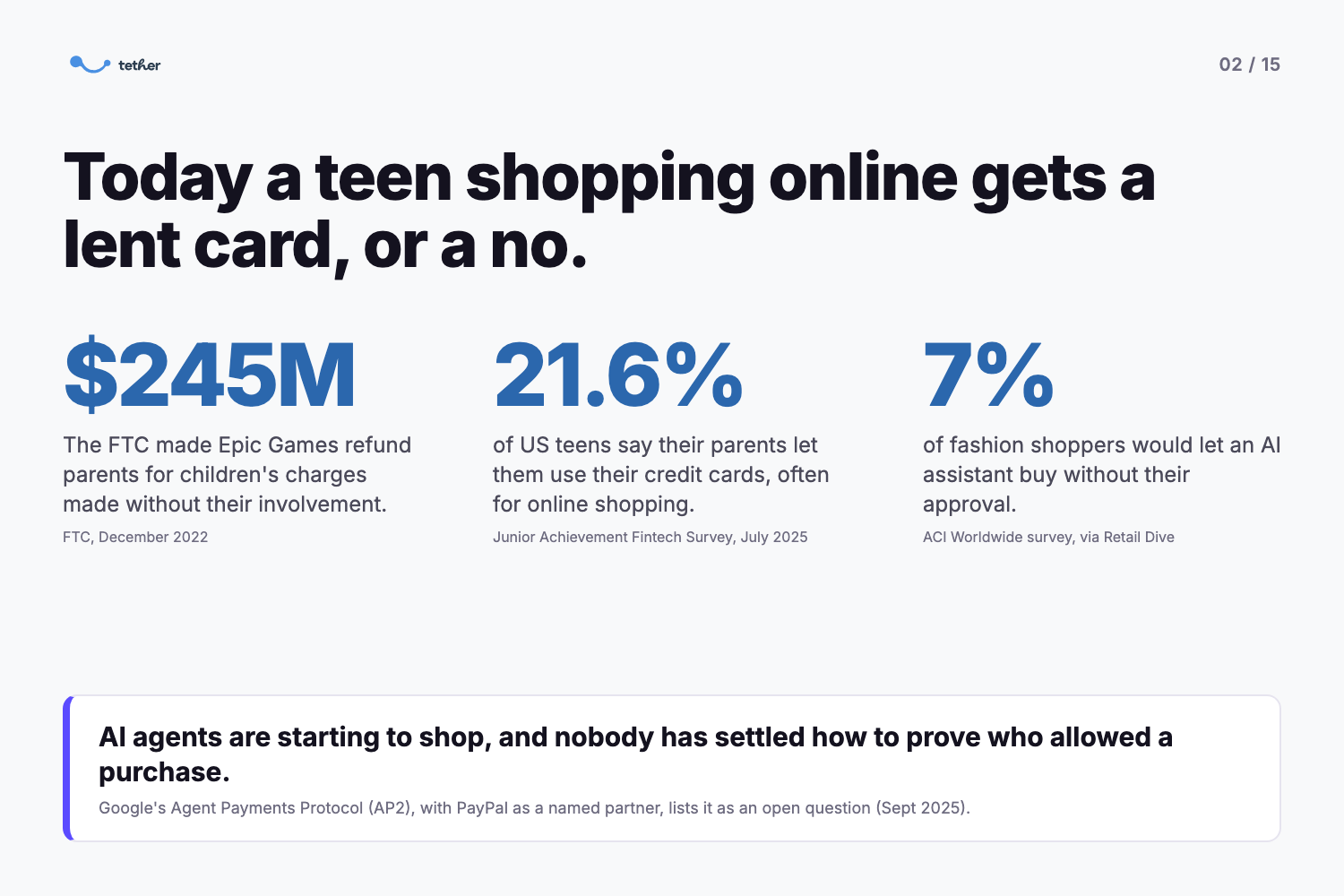
Parents lend cards because nothing better exists. The FTC has made Apple (at least $32.5M, 2014), Google (at least $19M, 2014), Amazon (more than $70M in charges made eligible for refunds, 2017) and Epic Games ($245M, 2022) refund parents for charges their kids made without permission. Epic, the FTC said, "ignored more than one million user complaints." Families lend the card anyway: in a July 2025 survey of 1,000 US teens aged 13 to 18, 21.6% said their parents let them use their credit cards, "often for ... online shopping" (Junior Achievement Fintech Survey, Wakefield Research, analysed by the MissionSquare Research Institute).
Teens want autonomy, and classes barely change what they do with money. In Schwab's October 2025 survey of 1,000 teens and 1,000 parents, 64% of teens wanted their parents to have "only a little control" over their investing, while 50% of parents wanted to be "heavily involved" (Schwab sells a teen investing account). A meta-analysis of 201 studies found financial-education classes explain "only 0.1% of the variance in financial behaviors," with negligible effects 20 months later; the authors see a role for "just in time" education tied to a real decision (Fernandes, Lynch & Netemeyer, Management Science, 2014). And only 35% of the Class of 2026 had to take a personal-finance course to graduate (NGPF, April 2026).
Most teens don't save for later. In a February 2025 survey of 1,000 US teens aged 13 to 18, only 36% said they put part of the money they receive aside for their future (Junior Achievement and MissionSquare Foundation, Wakefield Research; MissionSquare is a retirement-plan firm). The evidence on what helps comes mostly from adults. Committing in advance lifted employees' saving rates from 3.5% to 13.6% over 40 months (Thaler & Benartzi's Save More Tomorrow, 2004), and reminders that named a saver's own goal raised saving where the same reminder without the goal did not (Karlan, McConnell, Mullainathan & Zinman, 2016). The one randomised savings-commitment trial with children we found, in Ugandan primary schools, had them saving more under a soft commitment than under a strict lock (Karlan & Linden, Journal of Development Economics, 2025). Tether's savings promise is a soft pledge like that. Its weeks-to-goal number and earned freedom are design choices based on this evidence; nobody has proven them for teens.
Teens want to invest and know little about it. In Schwab's survey, 70% of teens aged 13 to 17 were very or extremely interested in investing, but only 14% said they know a lot about it. Among US Gen Z investors aged 18 to 25, 82% started before 21 and 44% started with crypto (FINRA Foundation and CFA Institute, 2023). Investing as a child is becoming federal policy too: the IRS's new Trump Accounts give children born from 2025 to 2028 a $1,000 starting contribution.
Nobody has settled how a shopping agent proves it was allowed to buy. Google's Agent Payments Protocol (AP2), with PayPal as a named partner, lists two open questions: "Proving that a user gave an agent the specific authority to make a particular purchase" and "Determining accountability if a fraudulent or incorrect transaction occurs." Morgan Stanley puts AI shopping agents at $190B to $385B of US online sales by 2030. Shoppers aren't ready to let go, though. In an ACI Worldwide survey of more than 3,300 US and UK shoppers, only 7% of fashion shoppers would let an AI assistant buy without approval (reported by Retail Dive; ACI sells payments software). Teens sit outside all of it: PayPal accounts are for people 18 and over, and none of the agent-payment announcements we read covers a parent authorising an agent for a child.
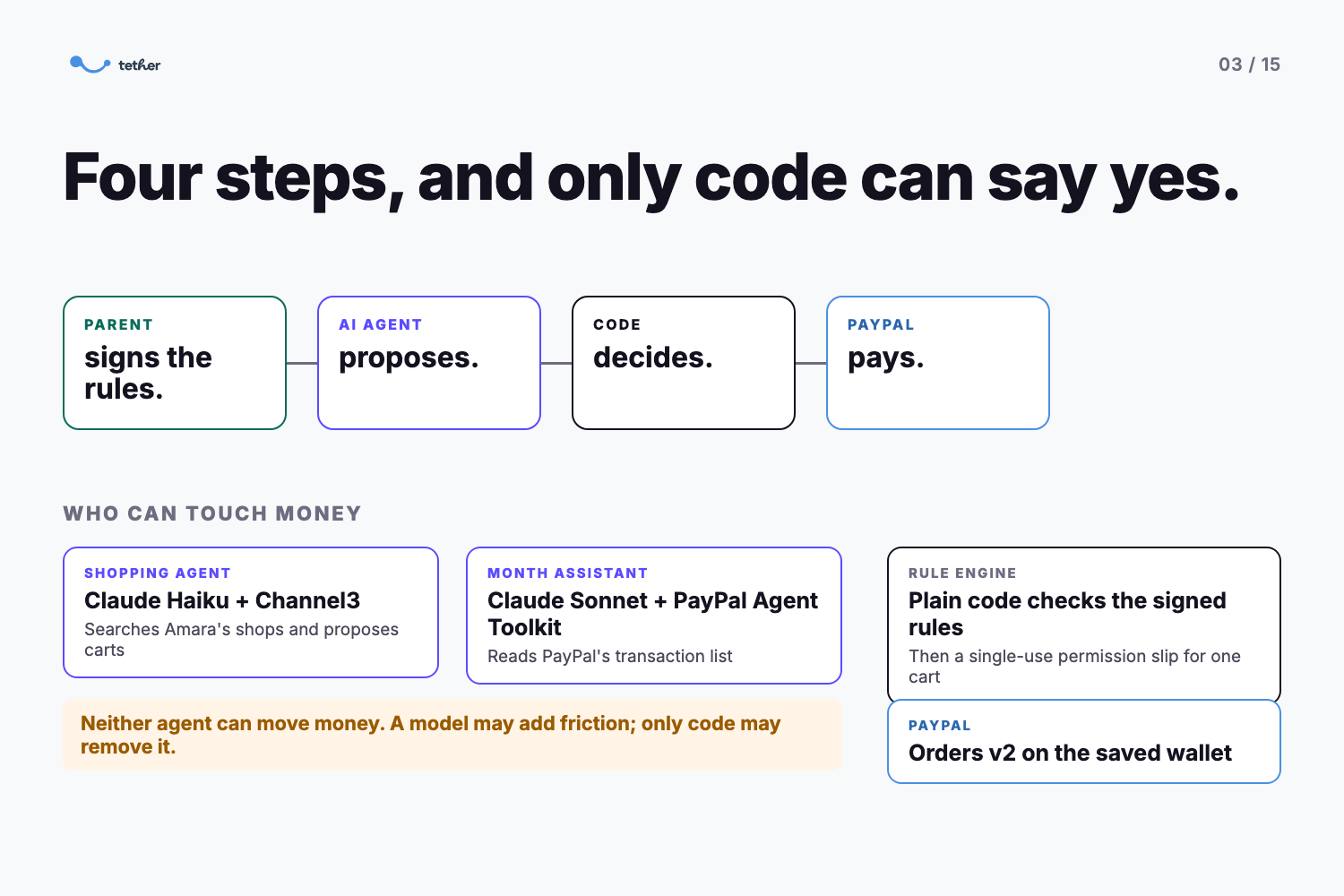
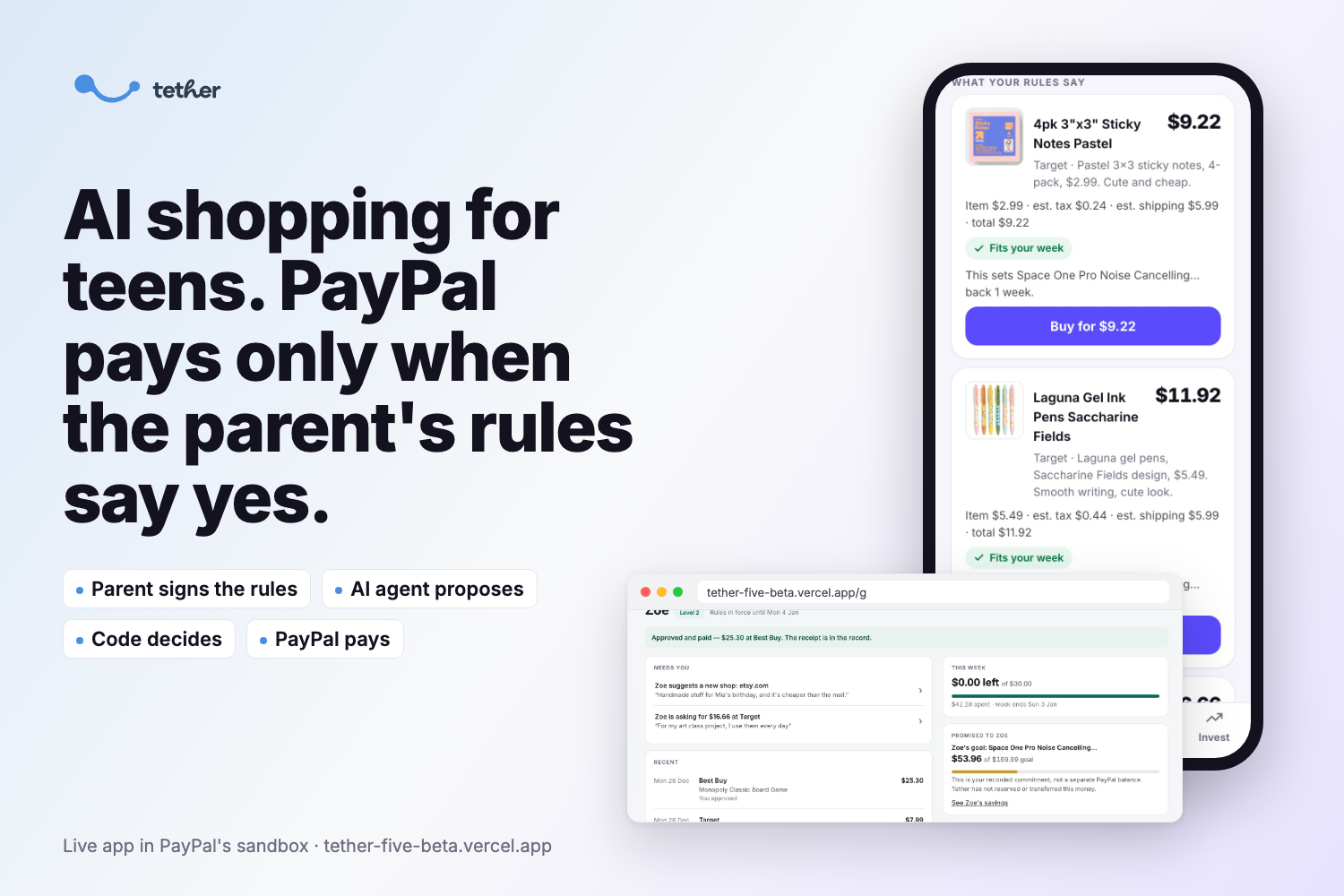
Tether is our answer to all five. The parent signs the rules, an agent proposes, plain code decides, and PayPal pays.
What it does
Tether lets a teen shop online with an AI agent, inside rules her parent signs, paid from the parent's PayPal. In the demo the parent is Amara and her daughter is Zoe.
For the parent
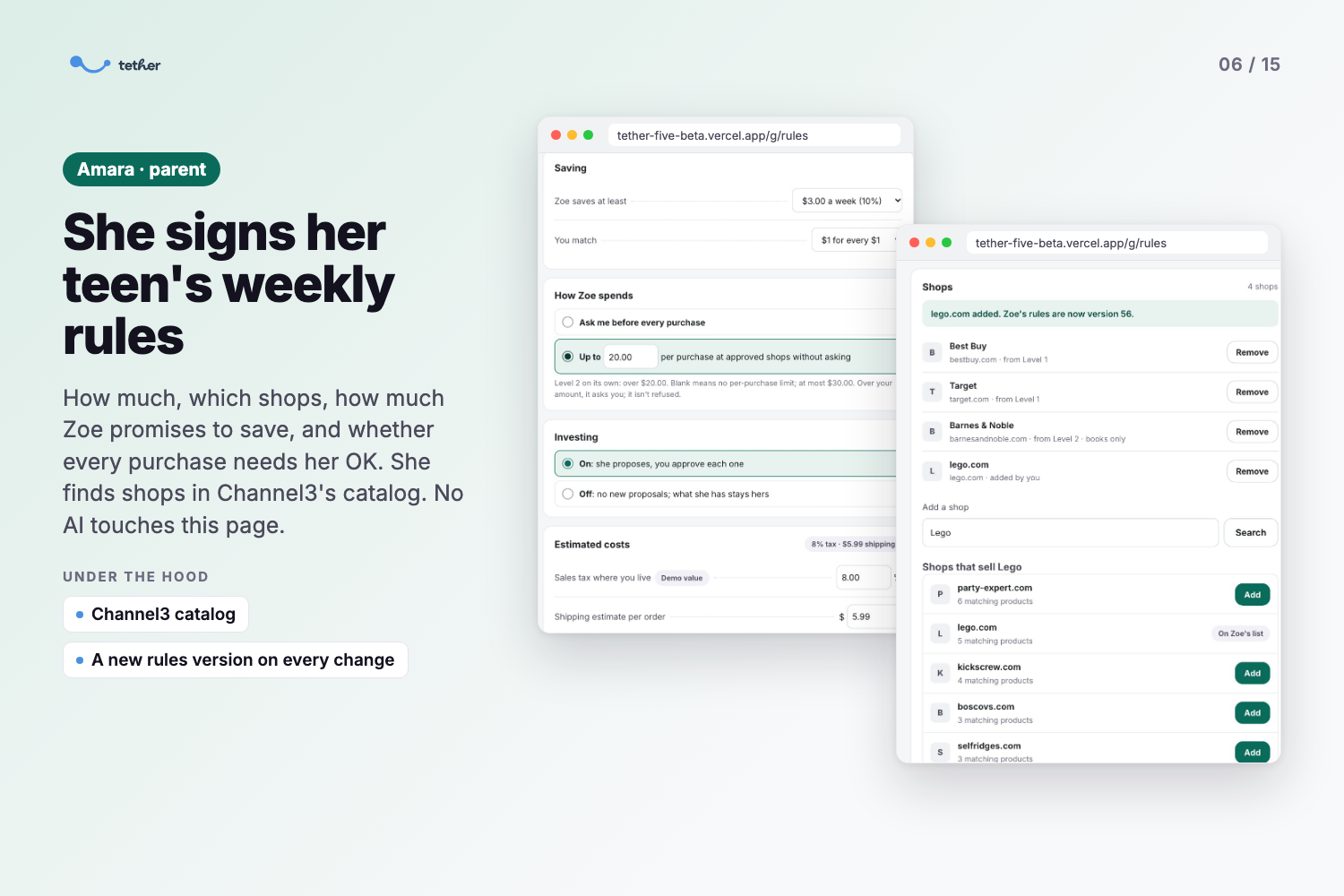
Amara signs weekly rules that read like a contract: how much Zoe can spend, which shops, whether every purchase needs her OK or anything under an amount she picks can go through, her sales tax and shipping estimate, and how much Zoe promises to save. No AI touches the rules. Every change makes a new version, a new weekly amount starts the next week, and moving up a level never loosens what she chose.
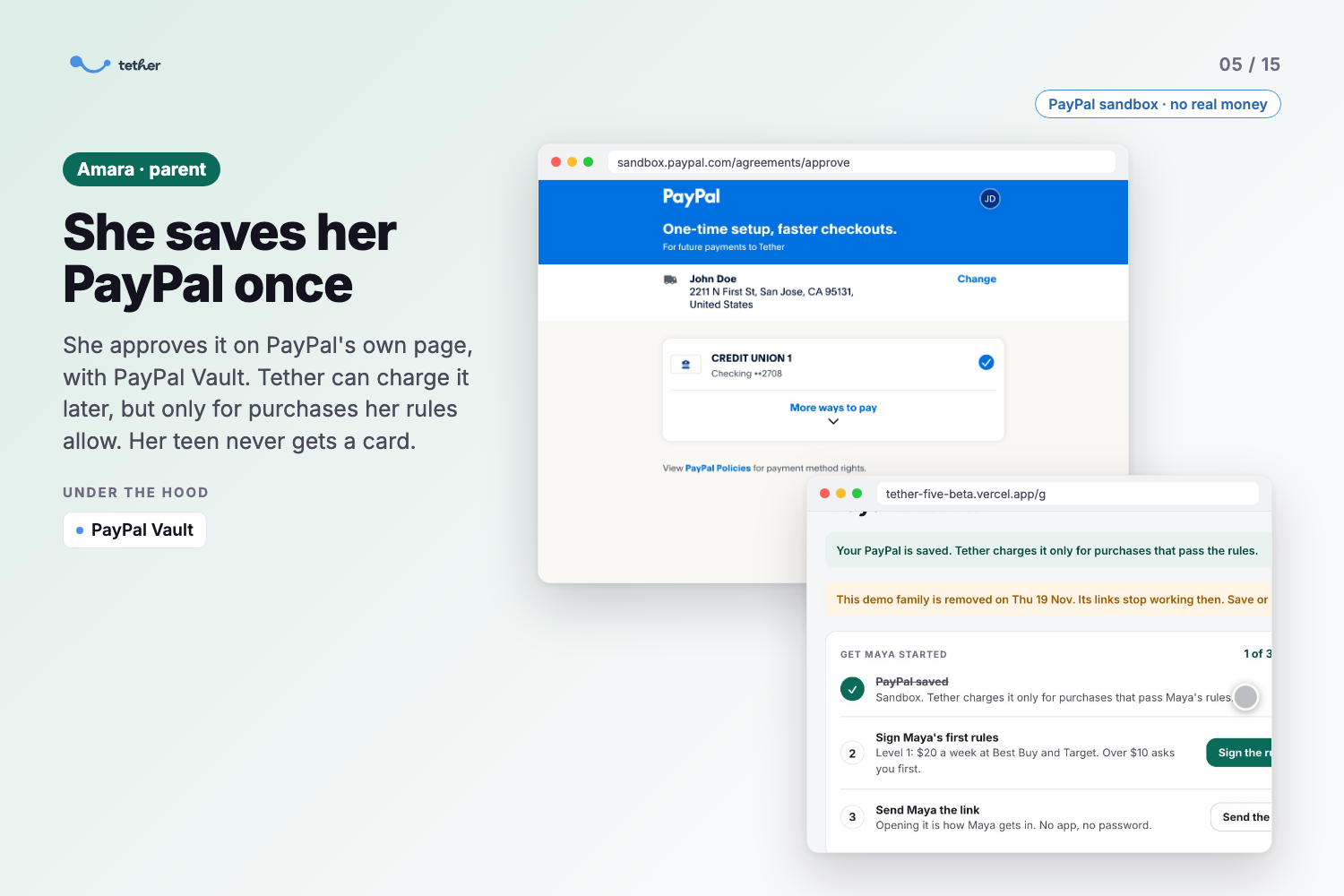
She saves her PayPal once, on PayPal's own approval page (PayPal Vault). Zoe never gets a PayPal account or a card.
She picks the shops by searching any store through Channel3, then adding or removing it with one confirm. The change applies at once as a new rules version. Zoe can search for a shop and ask for it.
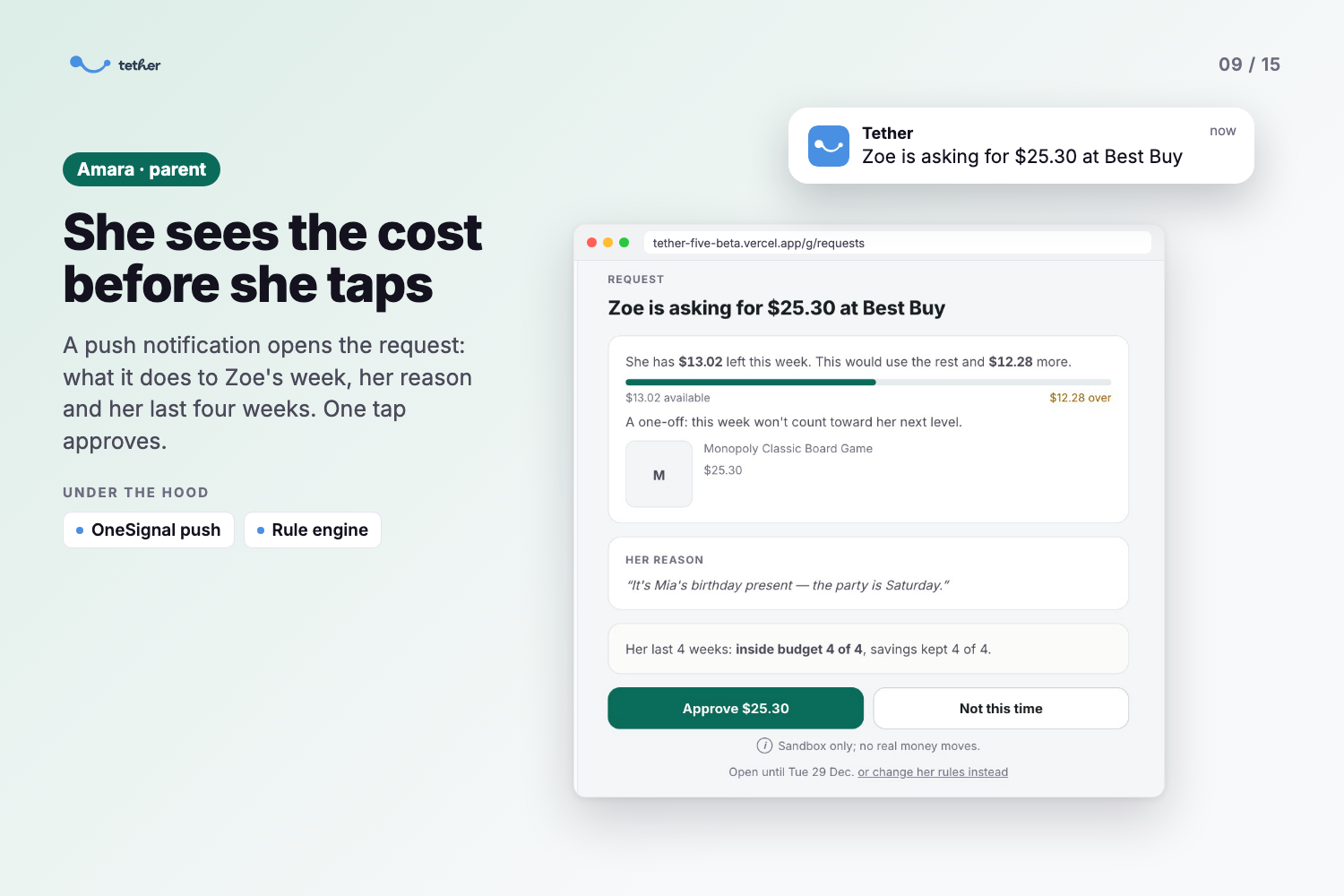
When Zoe asks for something, Amara gets one push notification. Tapping it opens the request with the effect on Zoe's budget first, and one more tap approves and pays. She can also approve a one-off purchase over Zoe's weekly budget, for that exact cart and amount.
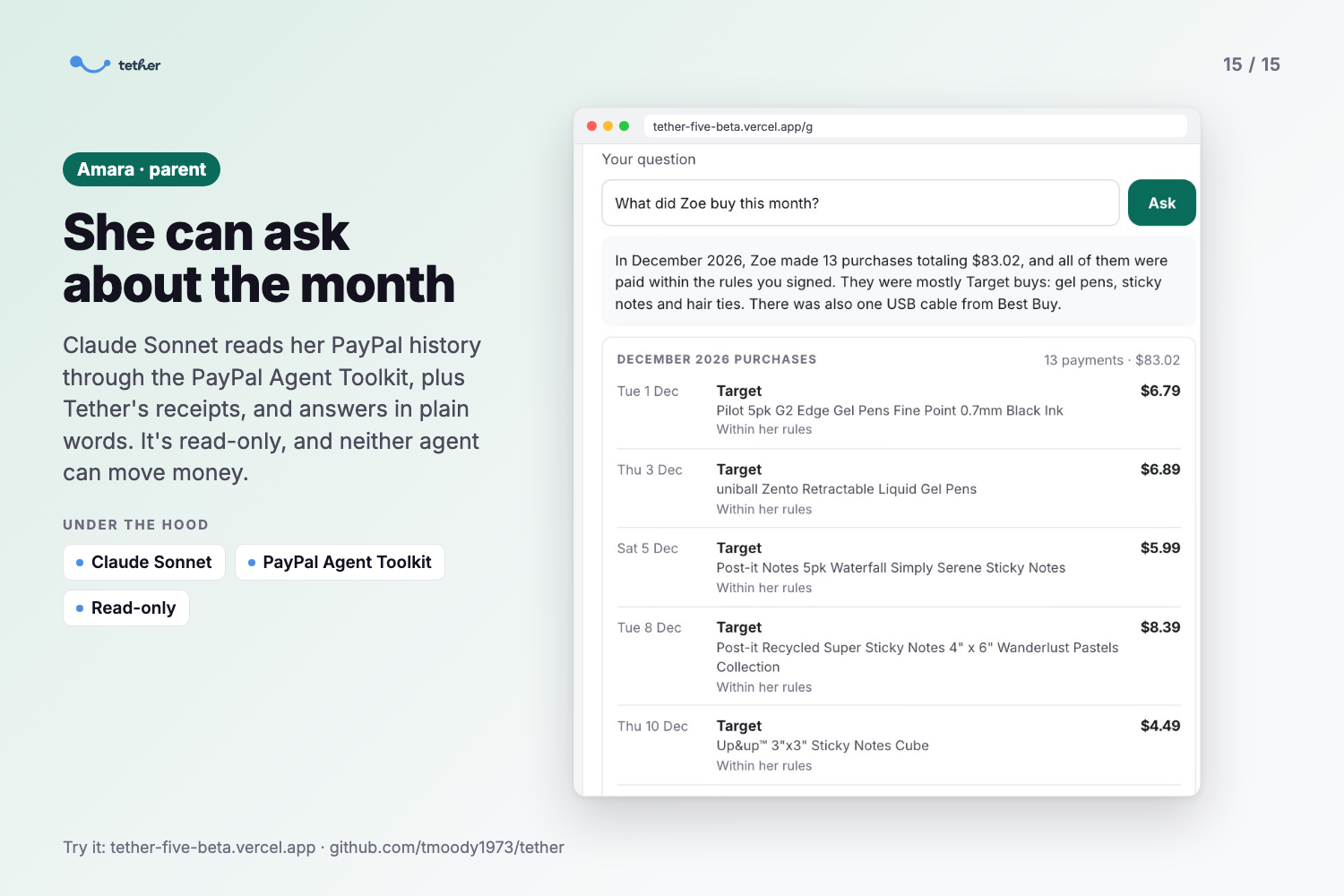
She can ask about the month in plain English from her Home screen: what Zoe bought, how Zoe's investments are doing, what's inside a fund, or news about a company on her list or inside her funds. The assistant is read-only. It answers from PayPal's transaction list (through the PayPal Agent Toolkit), Tether's receipts, Zoe's investments and market data. News shows up only here, only when Amara asks, and never on Zoe's screens.
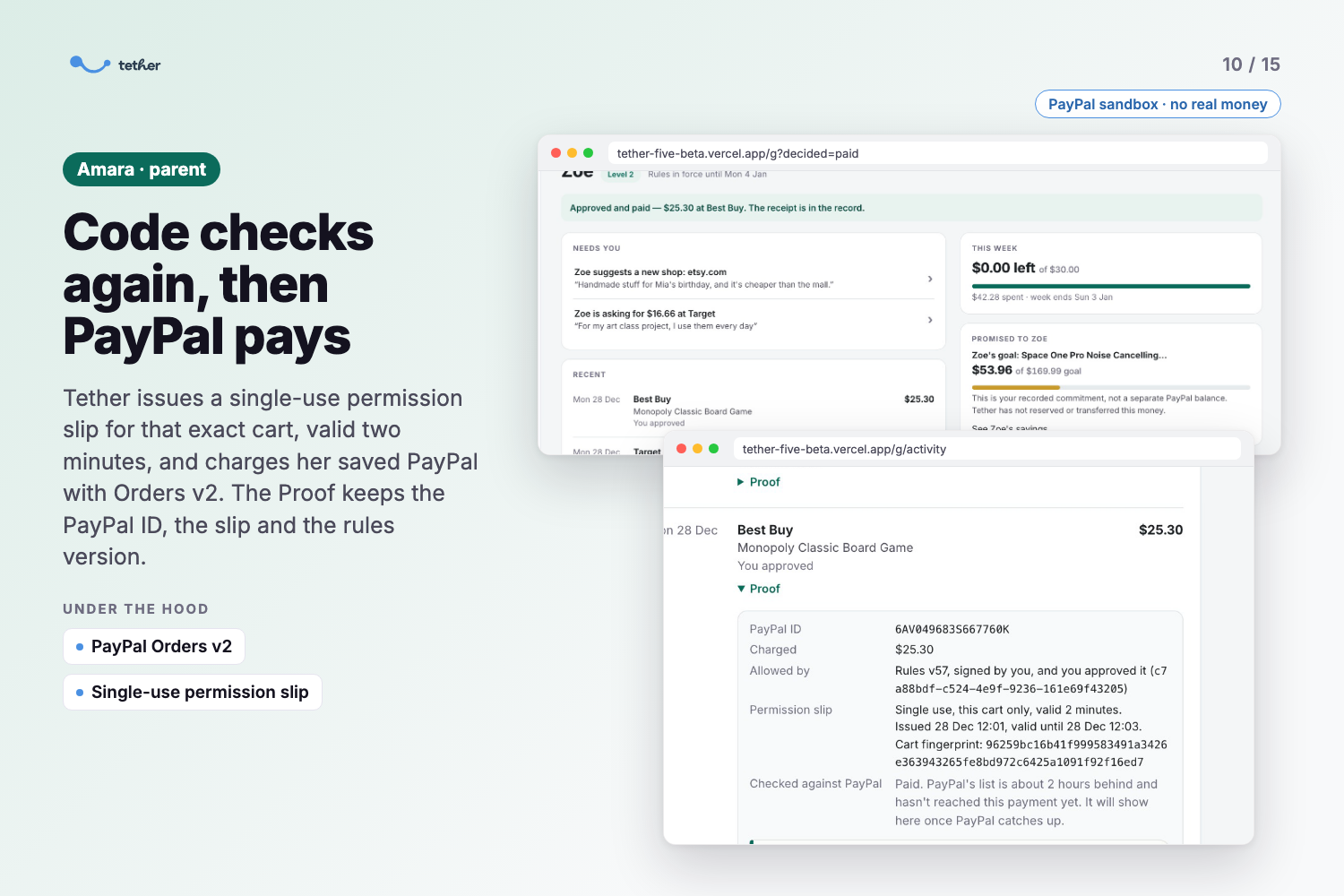
Each payment carries its proof one tap away: the PayPal ID, the rules version that allowed it, the permission slip, and whether PayPal's own records match. If a store refunds a purchase, the money comes back exactly once, into Zoe's week, or into what Amara has promised her if the week has closed.
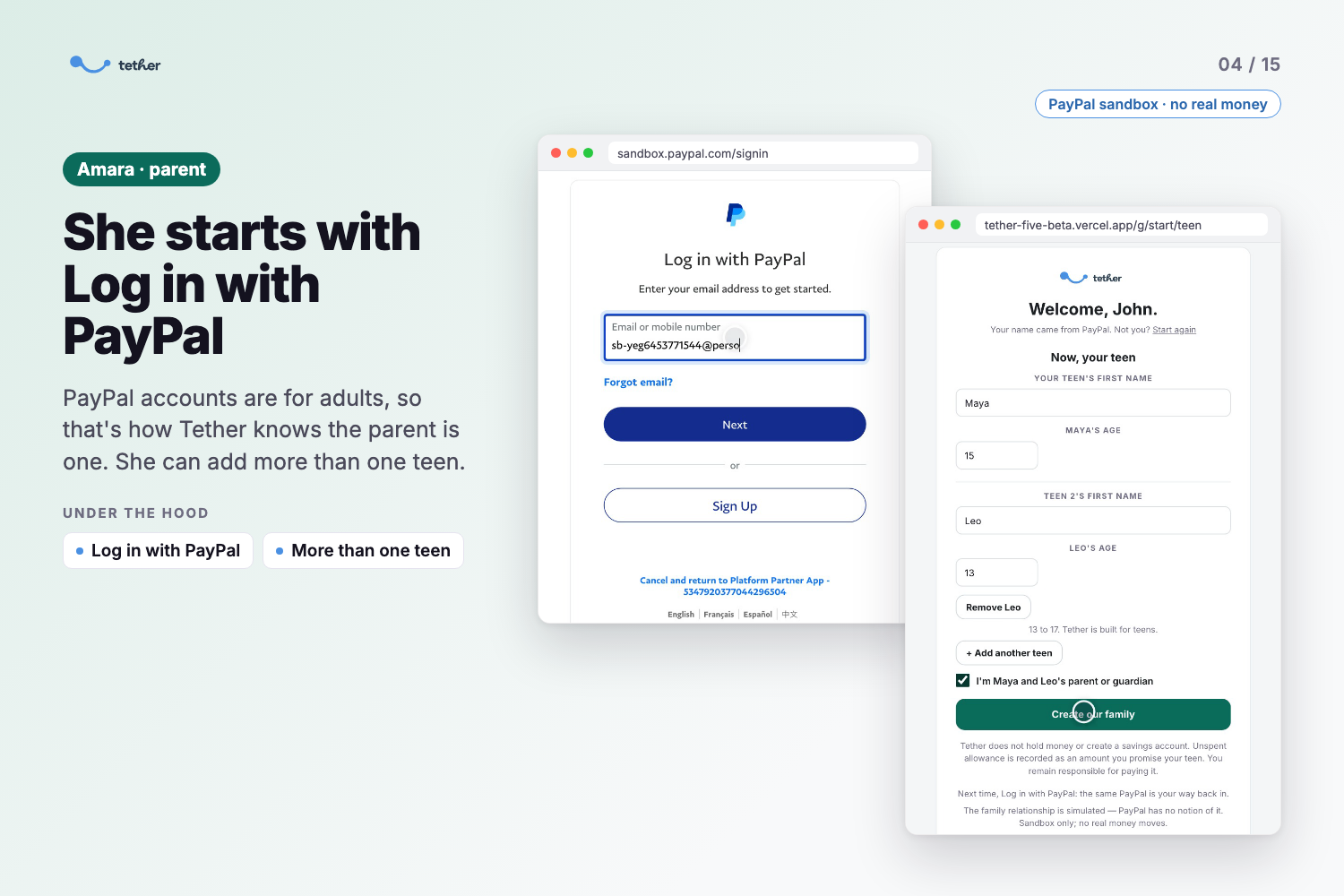
She can add more than one teen, at sign-up or later. Each teen gets their own rules, budget, link and record, and a switcher shows which one has something waiting for her.
She can pause or stop. Pause makes every purchase wait for her yes until she resumes. Stop ends the rules and disconnects her saved PayPal, while what Zoe didn't spend that week still counts as promised. A closing statement shows exactly what she owes Zoe.
For the teen
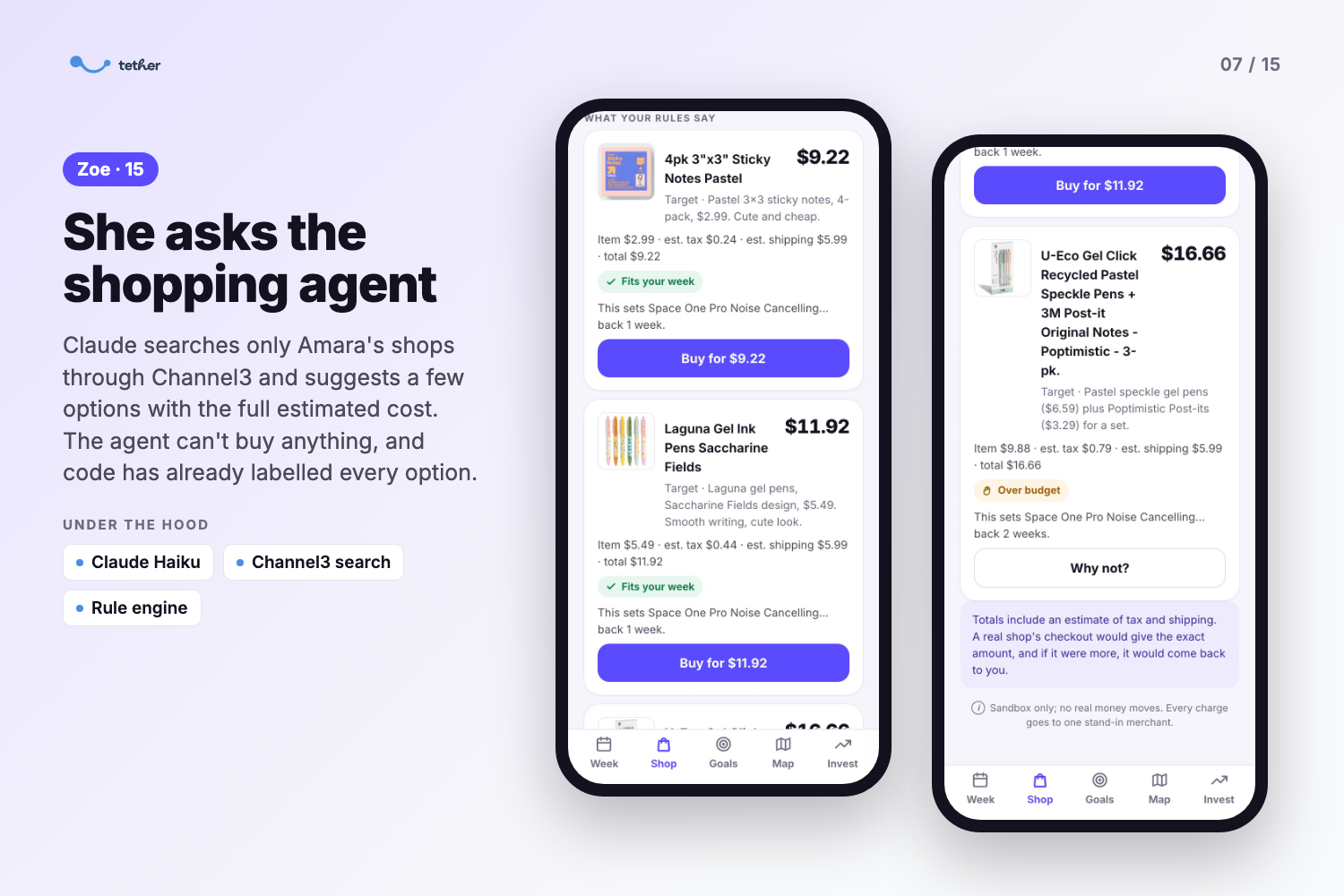
Zoe shops with an AI agent that searches only Amara's allowed shops (through Channel3) and proposes two or three options. It can't buy anything. Each option shows a photo, its full estimated cost (price, tax and shipping) and how far it would set her goal back.
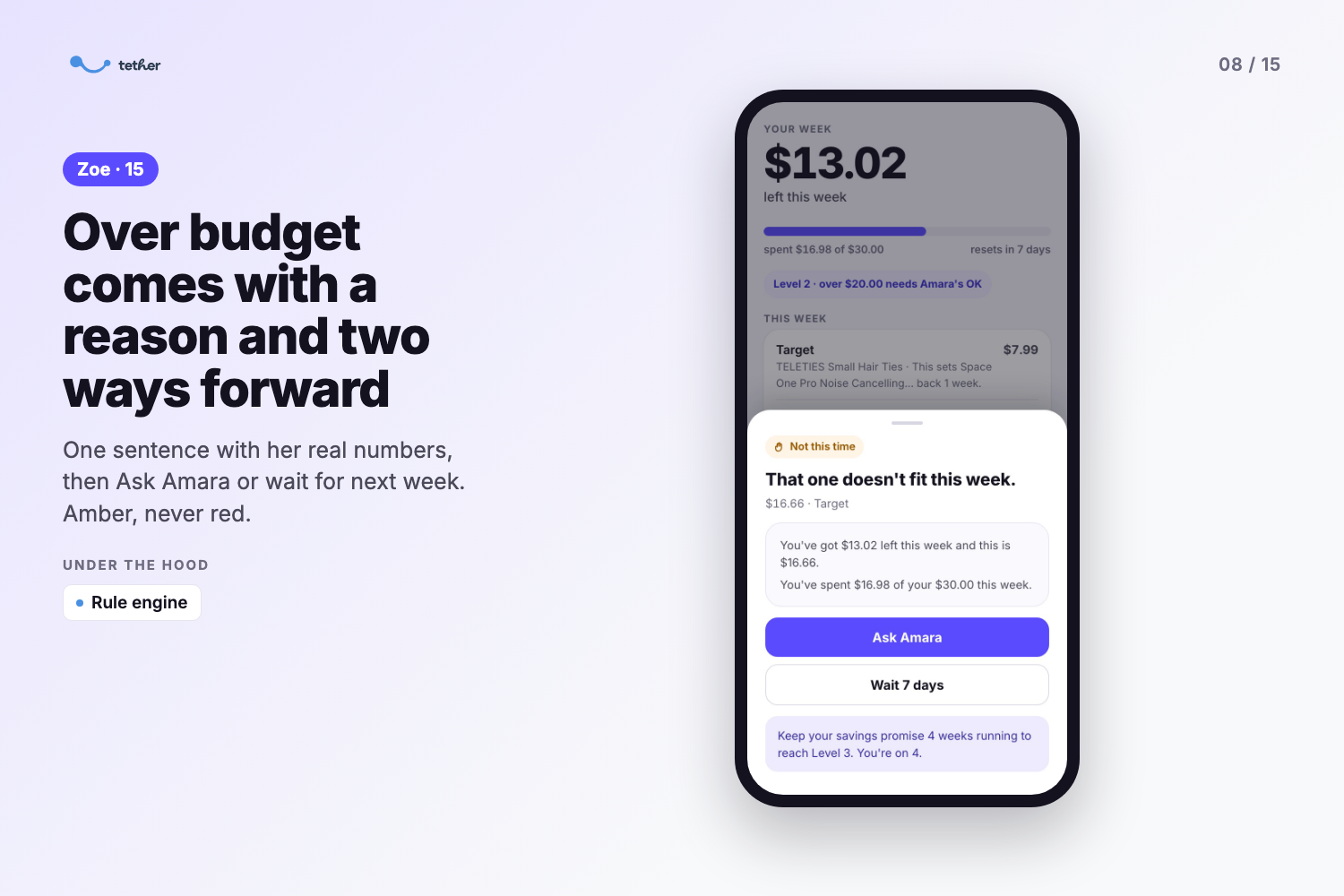
When the answer is no, she gets one sentence with her real numbers and two ways forward: ask Amara, or wait the few days until it fits. The message is amber, never red.
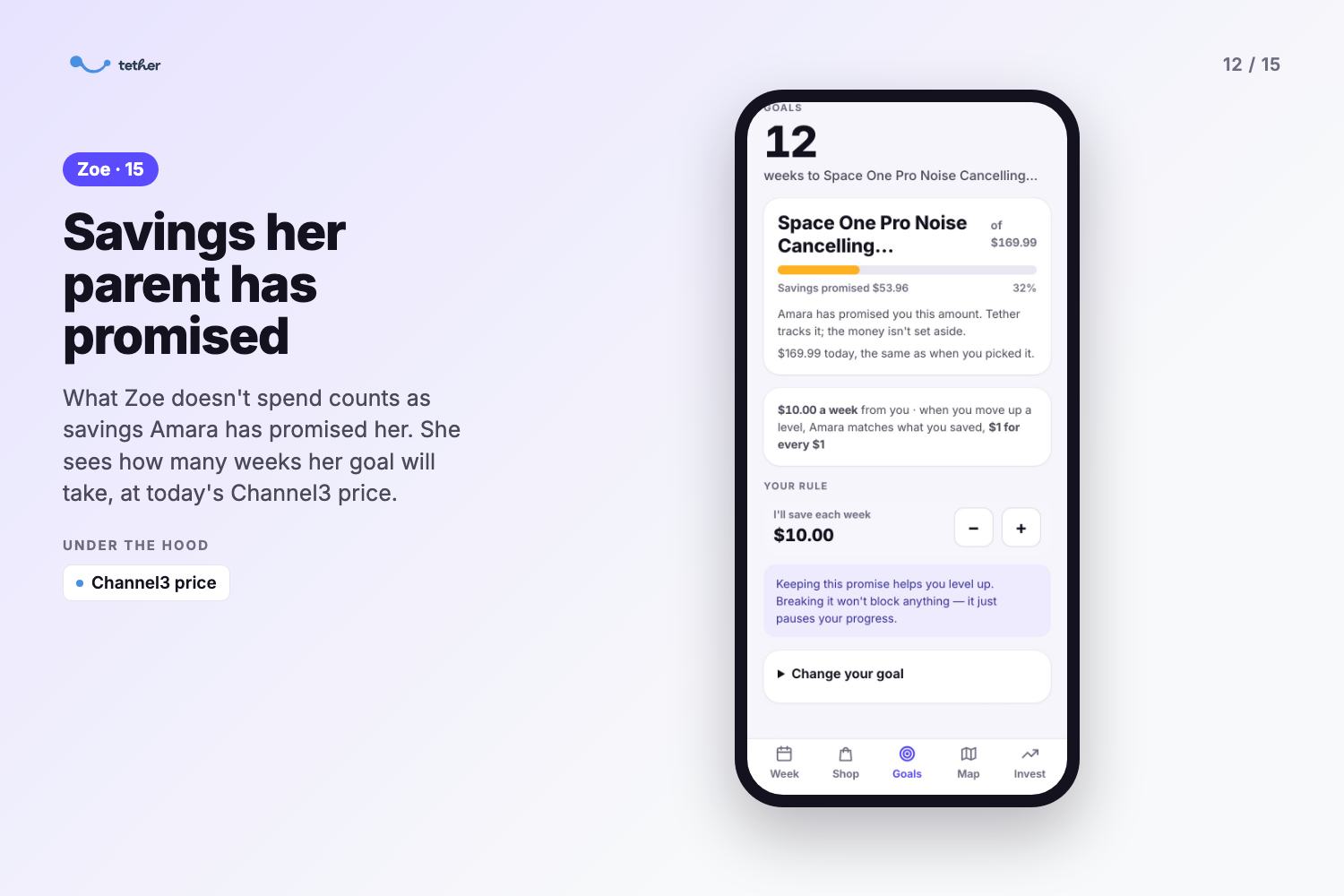
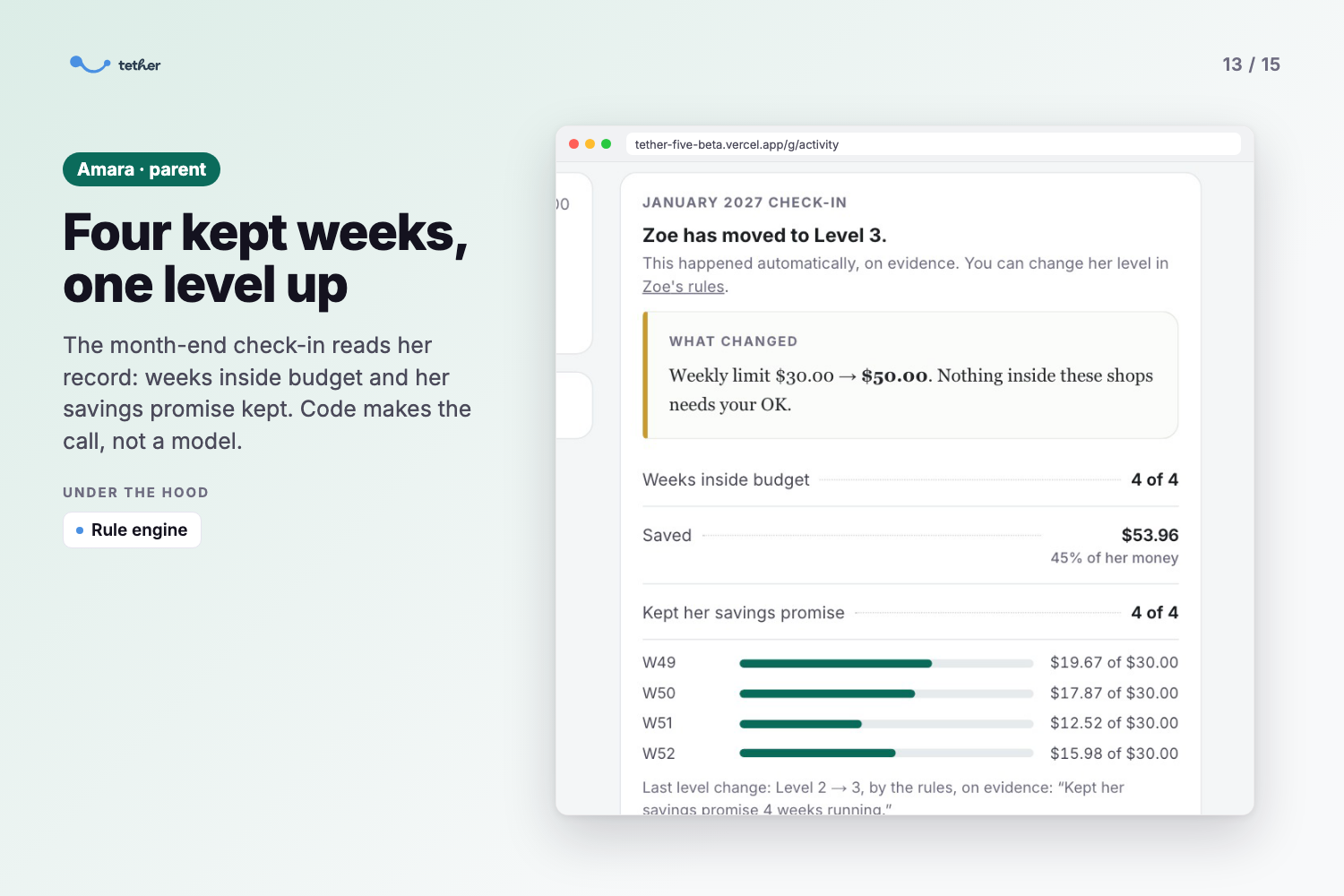
What she doesn't spend is recorded as savings Amara has promised her; Tether doesn't hold or set aside money. Zoe sets her own weekly savings promise (nothing is locked; it's scored when the week ends), names a goal, and sees one number: weeks to get there, at the goal's price today from Channel3. If she keeps her promise four weeks in a row, she moves up a level, with more money and more shops. At the month-end check-in Amara pays Zoe what she saved plus a match, and records the payment.
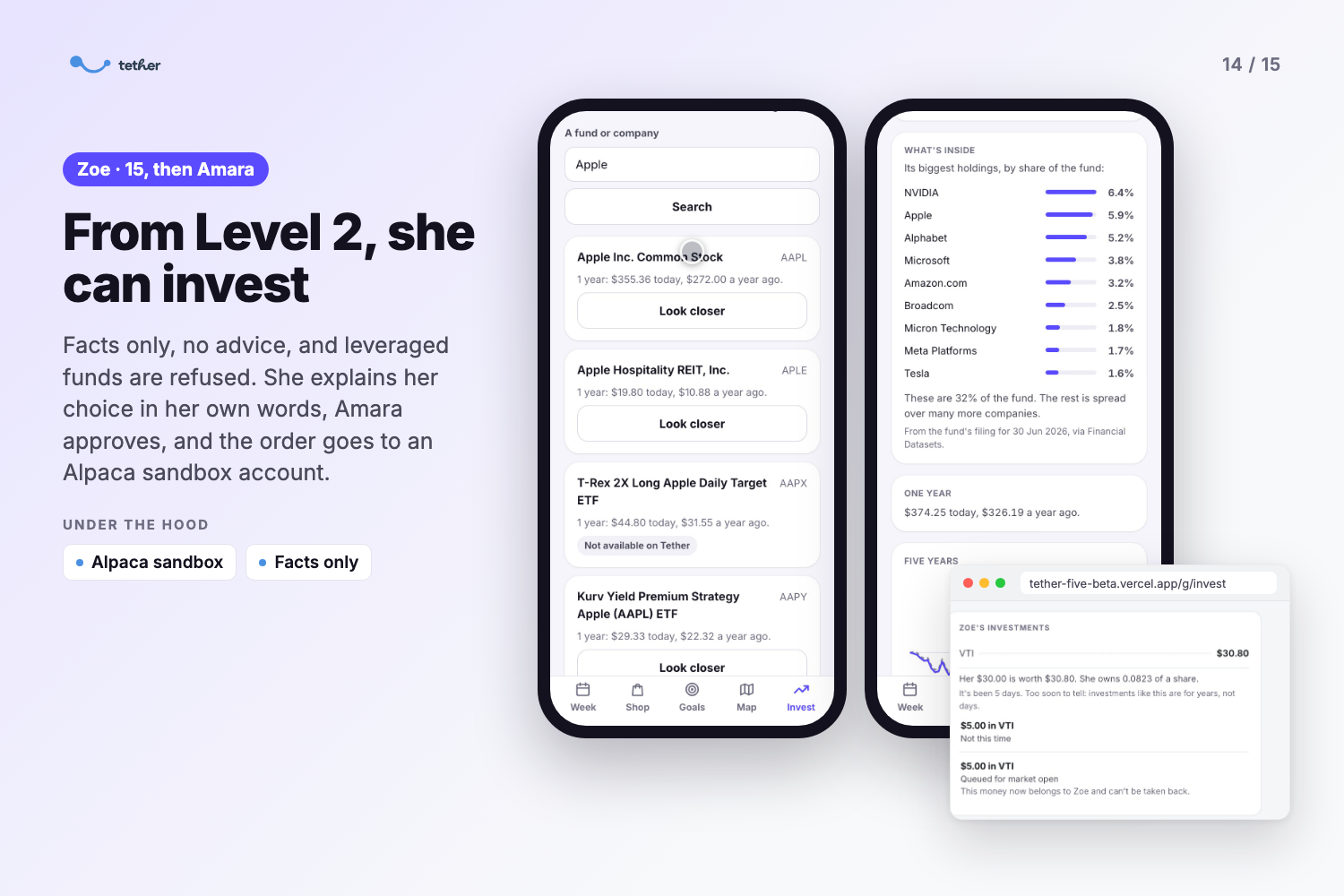
From Level 2 she can invest in funds and single stocks. She searches the whole market and reads a facts-only page: "What's inside" for a fund (its biggest holdings), "About the company" for a stock (sector, industry, where it's based). Tether recommends nothing and refuses leveraged and inverse products by name. To propose an investment she answers three questions in her own words. Amara approves each one, and Tether places the order.
How a purchase is decided and paid
Every cart passes two gates. Gate 1 is a deterministic rule engine. Gate 2 is an AI check for what code can't judge ("is this really a book?"), and it can only make the answer stricter. Our rule: a model may add friction, and only code may remove it.
An approved cart is paid with a single-use permission slip, a signed token that's valid for two minutes and bound to that exact cart, and then charged to Amara's saved PayPal. The slip's id travels inside the PayPal order. Right before the charge, Tether asks Channel3 for each item's price again. If an item is gone, the purchase is refused. If a price changed, the cart no longer matches its slip and nothing is charged.
Starting a family
On the landing page, a parent clicks Log in with PayPal, names their teen, and follows three steps on Home: save your PayPal, sign the first rules, and send the teen the link (copy it or scan a QR code). Log in with PayPal is also how they get back in. Judges can also open the shared demo family in one click, as Amara or as Zoe.
How we built it
Tether runs on Next.js 16 and TypeScript, with Postgres on Neon (PGlite locally and in tests) and Drizzle. It deploys to Vercel from a protected main branch, with CI on every pull request. The repo has 947 unit and integration tests, 64 browser tests, and a live end-to-end suite that runs against the deployed site with real sandbox calls to PayPal, Channel3, Anthropic and Alpaca.
We built it task by task, with an independent code review after every task and a whole-system review at the end. Thirty-one plain-English decision records explain the choices and what each one cost.
PayPal holds identity, consent, payment and proof
- Identity: a parent starts a family and comes back to it with Log in with PayPal. Tether keeps only the PayPal account ids, the email and a first name to greet them by, and the wallet it saves must be the PayPal account they logged in with.
- Consent: Amara authorises Tether on PayPal's own page (Vault,
usage_type: MERCHANT). Tether never sees her password and never gives Zoe a card. PayPal accounts are for adults, so charging the parent's wallet is the route PayPal's terms allow. - Payment: each approved cart is a merchant-initiated charge on the vaulted wallet (Orders v2 with
vault_id), sent with aPayPal-Request-Idso a retry can't charge twice. - Proof: each order's
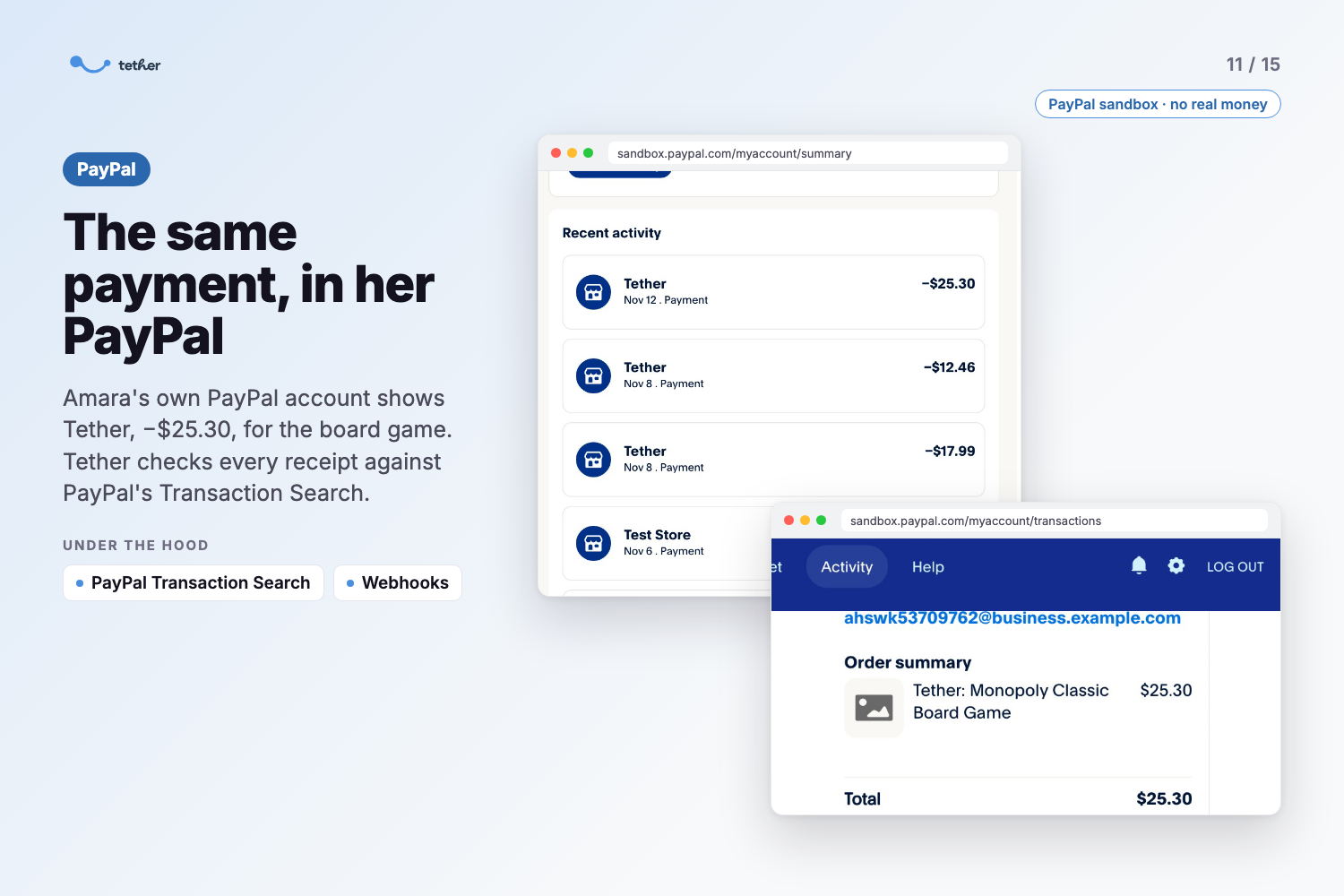
custom_idis the permission slip's id. Tether reconciles its receipts against PayPal Transaction Search using PayPal's transaction event codes (T-codes) and verifies signed webhooks. "This payment was allowed by rules v5" can be checked against PayPal's ledger, not only ours. - PayPal's own AI tool: Amara's month assistant reads her PayPal history through the PayPal Agent Toolkit (
list_transactions), wrapped so it sees only her family's payments and only the date, amount and status.
We call PayPal's REST API directly for charges. The Agent Toolkit doesn't cover charging a vaulted wallet, and we wanted it that way anyway: no model in Tether has a tool that moves money.
The signed weekly rules plus the per-cart permission slip have the same shape as AP2's "mandates", applied to the most supervised case there is, a parent and a teen. Tether doesn't implement the AP2 protocol itself.
Challenges we ran into
- A PayPal timeout doesn't mean nothing was spent. Tether keeps that purchase "confirming" and asks PayPal again with the same request id. PayPal remembers that id for only 6 hours, so Tether re-sends only within 5, and after that it only looks the payment up.
- Our first reconciliation marked every payment "Refunded in PayPal". The negative rows were PayPal's automatic sweep to a partner account (T-code T2002). Tether now classifies rows by PayPal's event codes, not by whether the amount is negative.
- One PayPal account receives every family's payments. Every sandbox charge lands in the same merchant account, so the assistant and the reconciliation had to be filtered to each family's own payments by permission-slip id.
- Every judge signs in with the same shared PayPal sandbox account. If one PayPal account owned one family, every judge after the first would have landed in the first judge's family. Tether now treats that login per browser: each browser gets its own family, and nobody sees anyone else's.
- Log in with PayPal's reply wasn't the shape the docs suggested. PayPal's guides name two different addresses for "who is this person", and the sandbox's reply carried
user_idand a fullnamebut no first name, so new parents were greeted as "Parent". Tether now accepts either id and greets by the first word of the full name, checked live in the sandbox. - Payouts to a teen's Venmo worked in the sandbox, but PayPal's production rules refuse youth accounts. We designed around it, and the money stays with the parent.
Accomplishments that we're proud of
- The AI can't loosen a decision or move money, and the tests prove it.
- Every payment has its signed rules and permission slip behind it, checked against PayPal's own ledger.
- A refusal always comes with a way forward, and the teen earns more freedom with her own record, up to investing she has to explain in her own words.
- The teen never gets a card. Teen money apps mostly hand over a card with limits and show the parent the spending afterwards. With Tether the money stays in the parent's PayPal, an agent shops inside rules the parent signed, each charge carries a single-use permission bound to one cart, and freedom grows with the teen's track record instead of a parent raising a limit.
What we learned
- We stopped trusting test names. Our first rule engine passed all 15 of its checks, then refused the second of two ordinary purchases in the same week. The test called "a replayed grant cannot authorise a second charge" had used two different purchases, so the bug passed as correct behaviour. Before building on "all tests pass", we now run the one scenario the product depends on most.
- The live site finds what local tests can't. With more than 400 tests passing, our first deploy returned a 404 on every page, because Vercel had registered the project as a generic site rather than a Next.js app. A 5-second anti-spam rule also refused a judge's very first search, because the demo's own reset looked like a recent search. We now run the live suite after every deploy.
- A sandbox success shows that an API call works. It doesn't show that the real-world flow works. The Venmo payout taught us to check PayPal's production error list for every money movement and ask whose balance it comes out of.
- News belongs with the parent. We planned to show Zoe a fund's news next to its holdings. Financial Datasets has no news for funds ("No news found for VTI"), and Apple's three latest headlines were political stories and clickbait, nothing a 15-year-old could use to decide anything. A teen choosing a fund needs to see what's inside it, so news goes to Amara, when she asks.
What's next for Tether
- Real store checkout, PayPal first, in stages. Possible today: hand off to the store's own checkout through Channel3's tracked link, with the parent paying there with PayPal. Next: PayPal's agentic commerce services (Store Sync and Agent Ready merchants), through a partnership with PayPal. Later: card-network agent tokens in the PayPal wallet (Mastercard Agent Pay, which PayPal is integrating), with Channel3's coming checkout or Crossmint's Agent Checkout for other stores. Either would replace Tether's shipping and tax estimates with each store's real total. At every stage the parent's approved total stays the hard spending cap, and the rules check stays where it is.
- Giving, through PayPal Giving Fund. The teen picks a cause, the parent approves, and PayPal Giving Fund's Charity Search API supplies over a million vetted charities. A donation would follow the same path as a purchase (rules check, the parent's OK, a single-use permission slip, a PayPal order marked as a donation), and the parent stays the donor of record. Spend, Save and Invest work today, and Give is next.
- Commissions that grow the teen's savings. If Tether earns a commission on a teen's purchase, we want it to go to that teen: "You bought headphones; $1.20 went to your savings." The agent would never rank products by commission. Tether earns no commission today, because Channel3 pays it on sales through its tracked store links and Tether pays through the parent's PayPal instead.
- Size and color. From Level 3 the teen can shop clothing and sneakers. Channel3 returns each product's variants, so the agent could ask "which size?" before it proposes a cart.
- A real custodial investing account, passkeys for the teen instead of a private link, OneSignal identity verification, email notifications, and a gentler lock-screen wording option ("Zoe has a request for you").
Why PayPal should want Tether
A fifteen-year-old can't open a PayPal account, so today she shops on a lent card. In a July 2025 survey of 1,000 US teens, 21.6% said their parents let them use their credit cards. Tether moves that spending onto the parent's PayPal. She saves her wallet once, every purchase her teen makes is a PayPal payment she can see in her own account, and the teen's first years of online shopping happen on PayPal.
PayPal's agent products will need what Tether builds. PayPal's agentic commerce services and Agent Ready already cover an AI assistant shopping for the person who pays. Tether covers the case where the shopper and the payer are different people. In ACI Worldwide's survey, only 7% of fashion shoppers would let an AI assistant buy without approval, and Google's AP2, with PayPal as a named partner, still lists "proving that a user gave an agent the specific authority to make a particular purchase" as an open question. Tether's answer is a set of rules the payer signs, plus a single-use permission slip for one cart whose id travels inside the PayPal order. A parent and a teen is the strictest version of that problem, and an employee buying on a company account has the same shape.
Each step that needs trust runs on PayPal: Log in with PayPal for who the parent is, Vault for her consent, Orders v2 for the charge, Transaction Search to check every receipt, and the Agent Toolkit so her assistant reads her own payment history. No model in Tether has a tool that moves money.
Built With
- alpaca
- anthropic
- channel3
- claude
- drizzle
- financial-datasets
- github-actions
- log-in-with-paypal
- neon
- next.js
- onesignal
- paypal
- paypal-agent-toolkit
- paypal-orders-v2
- paypal-transaction-search
- paypal-vault
- paypal-webhooks
- pglite
- playwright
- postgresql
- react
- typescript
- vercel
- vercel-ai-sdk
- vitest