-
-
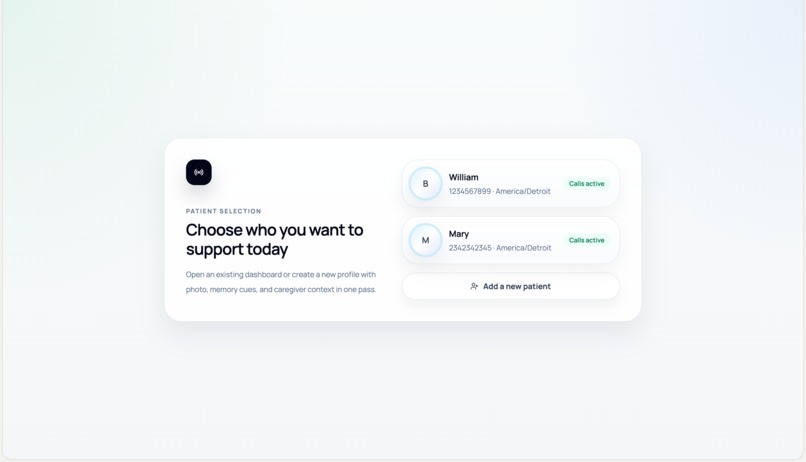
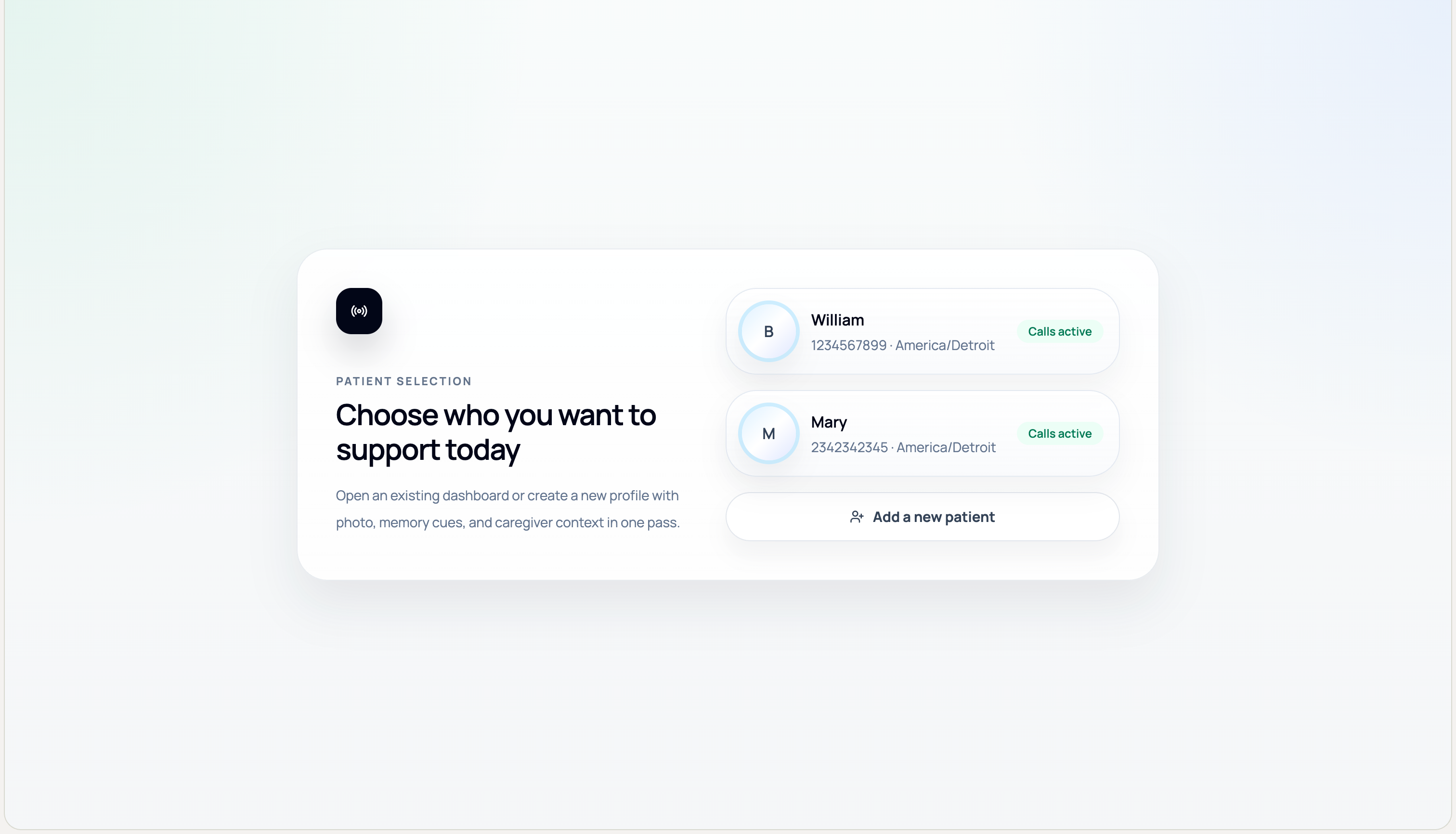
Patient Selection Screen
-
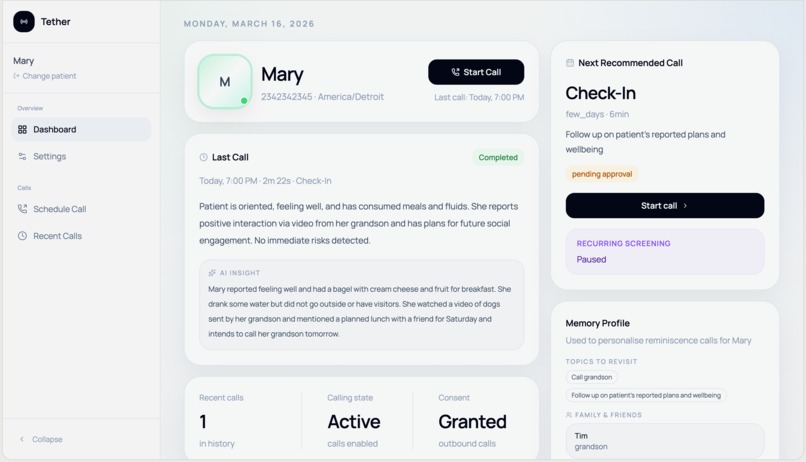
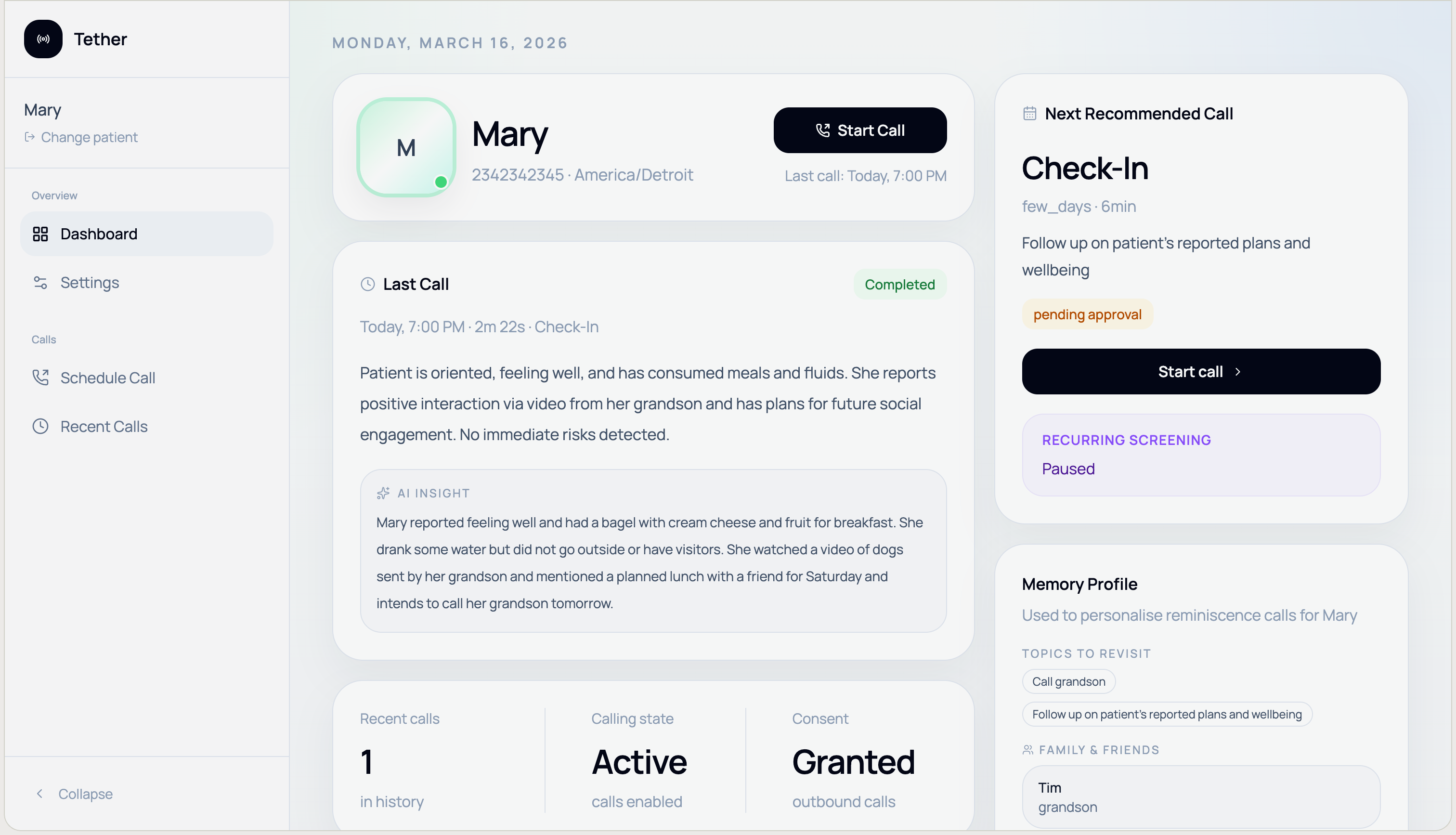
Patient Dashboard
-
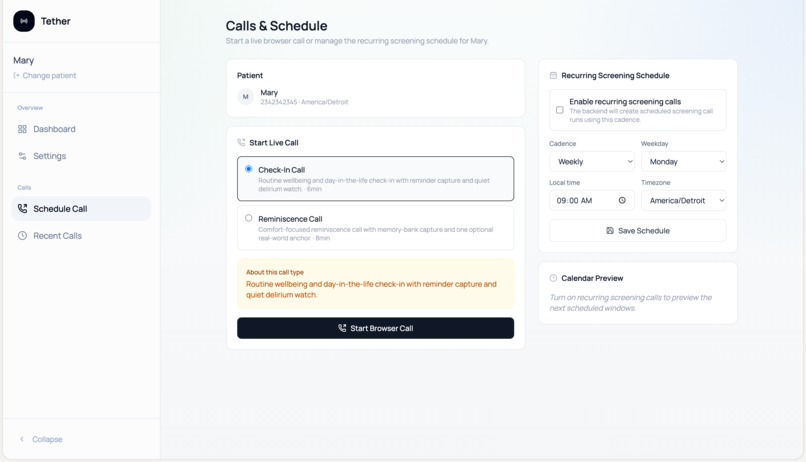
Schedule Call
-
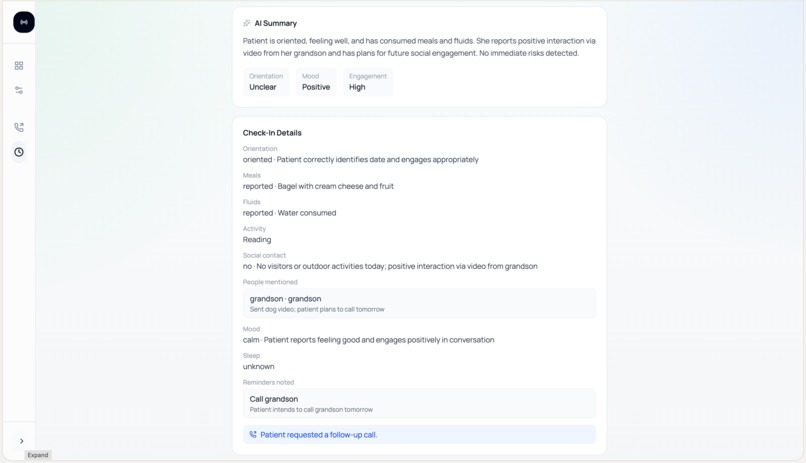
Post-Call Analysis
-
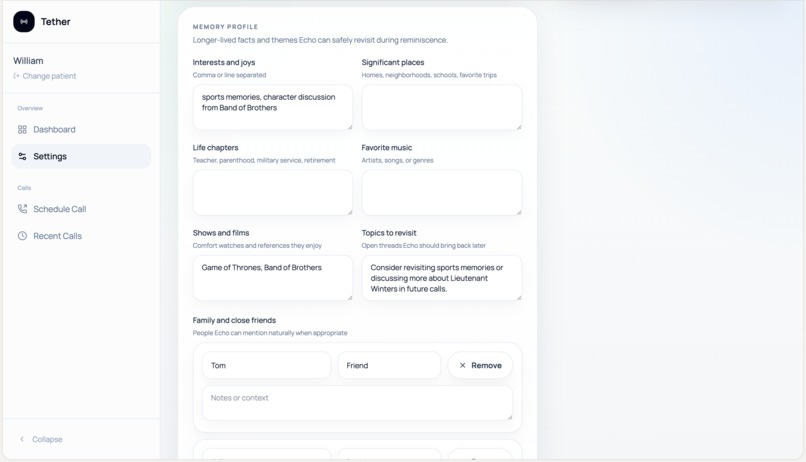
Settings
-
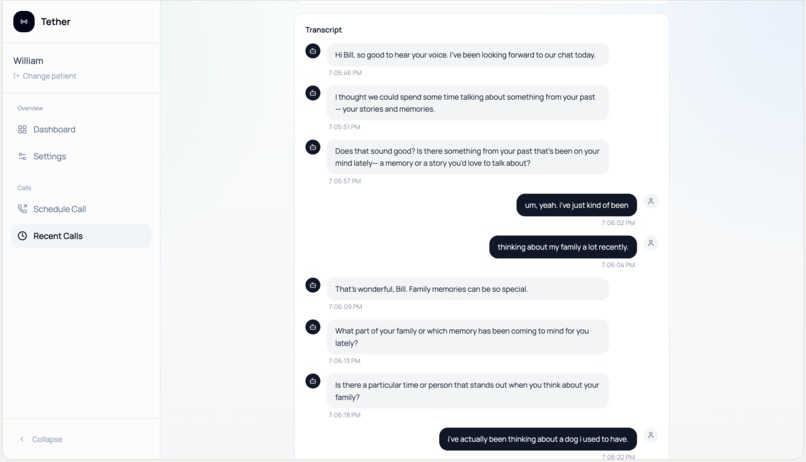
Transcript
Tether
Keeping people connected to their memories, their routines, and the people who love them.
Inspiration
Dementia is not an abstract problem for our team. Personal proximity to people living with the disease shaped how we see the gap between what dementia patients need and what currently exists.
Over 55 million people worldwide live with dementia. The burden of daily care falls disproportionately on informal caregivers. Globally, 70% of those caregivers are women, rising to 77% in low-income countries. Despite this scale, more than half of all nations lack any system to monitor the quality of care dementia patients receive. Patients living alone face particular risk: cognitive decline is gradual, invisible, and easy to miss between quarterly doctor appointments.
We wanted to use our skills in technology to address that gap. Not to replace doctors or caregivers, but to fill the space between visits with something warm, consistent, and clinically useful. That idea became Tether.
What It Does
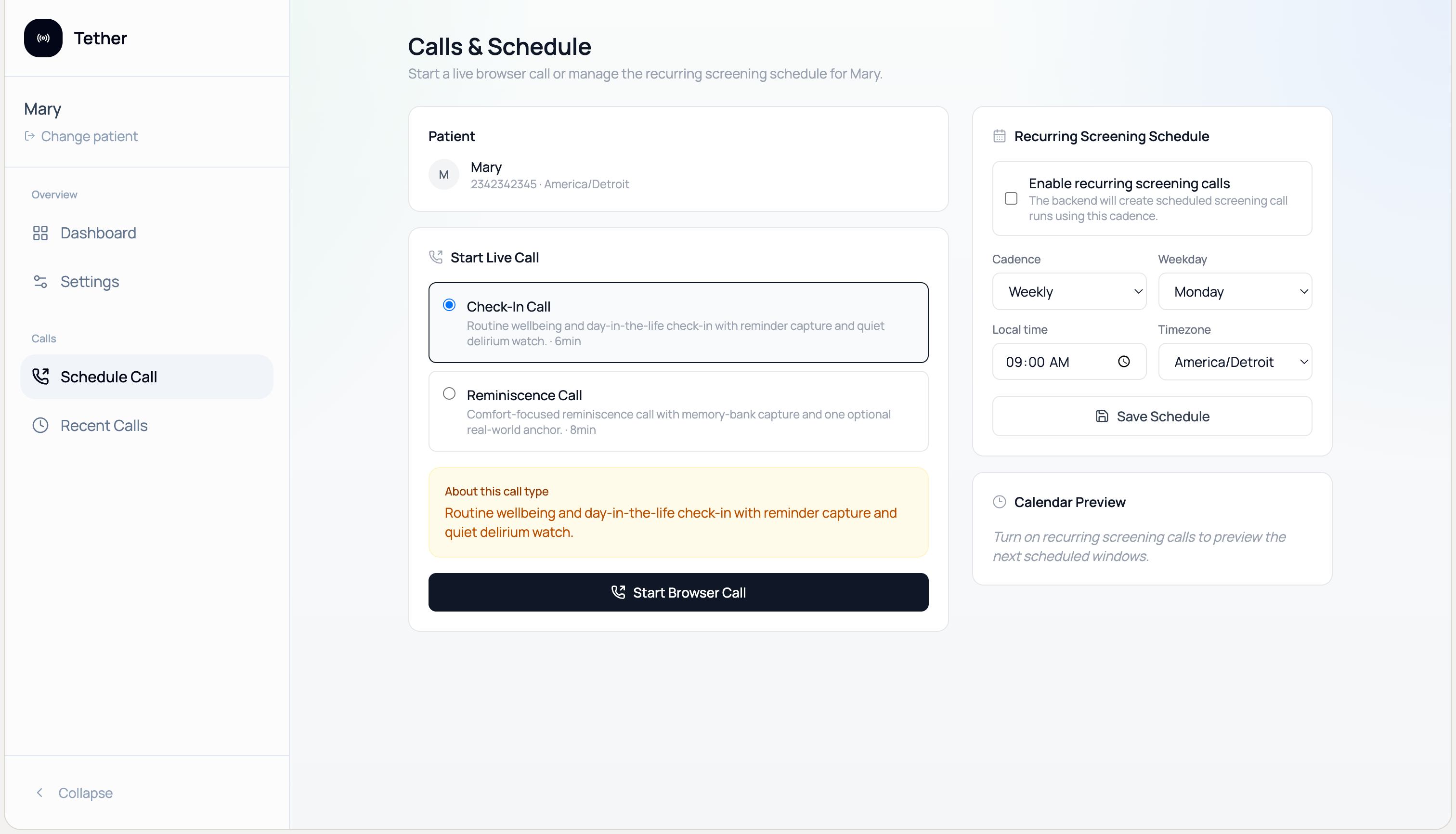
Tether is a voice AI companion that calls patients on a set schedule. There are two types of calls.
Check-in Calls
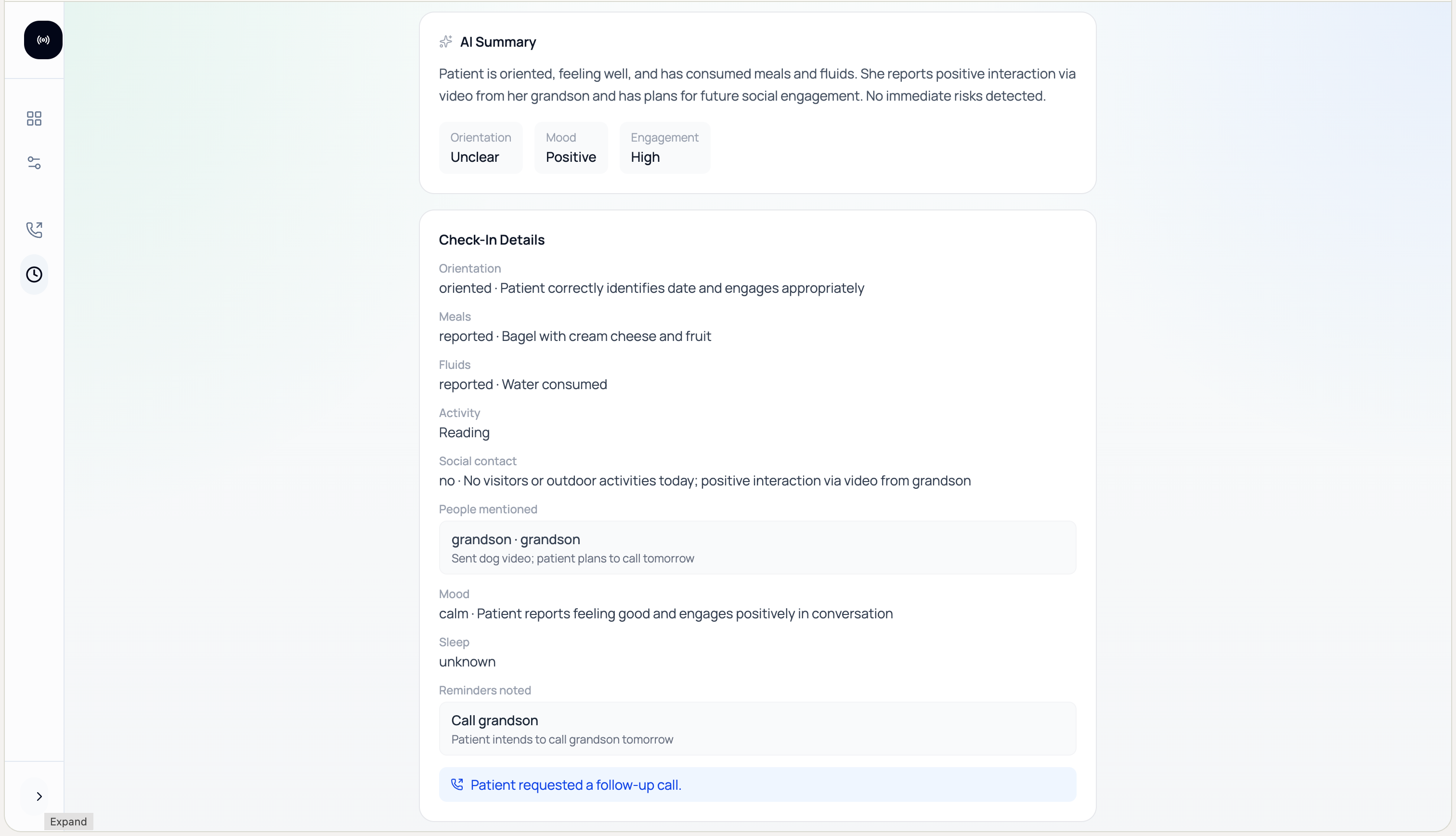
Daily check-in calls ask patients about their recent activities, meals, hydration, sleep, mood, and upcoming plans. The AI listens for signs of cognitive change as a passive observer of patterns over time. It gently offers wellness nudges around exercise, reading, mindfulness, and social connection, and helps patients set reminders for anything they want to remember.
After each call, a structured clinical summary is generated for caregivers and physicians. This includes a reminders log and a passive delirium watch flag drawn from ICD-10 indicators.
The check-in prompt is grounded in the 4 Rs of dementia care: Reassure, Routine, Reminisce, and Redirect. It is designed to treat every patient with dignity. It is never clinical in tone, never alarming, and always warm.
Reminisce Calls
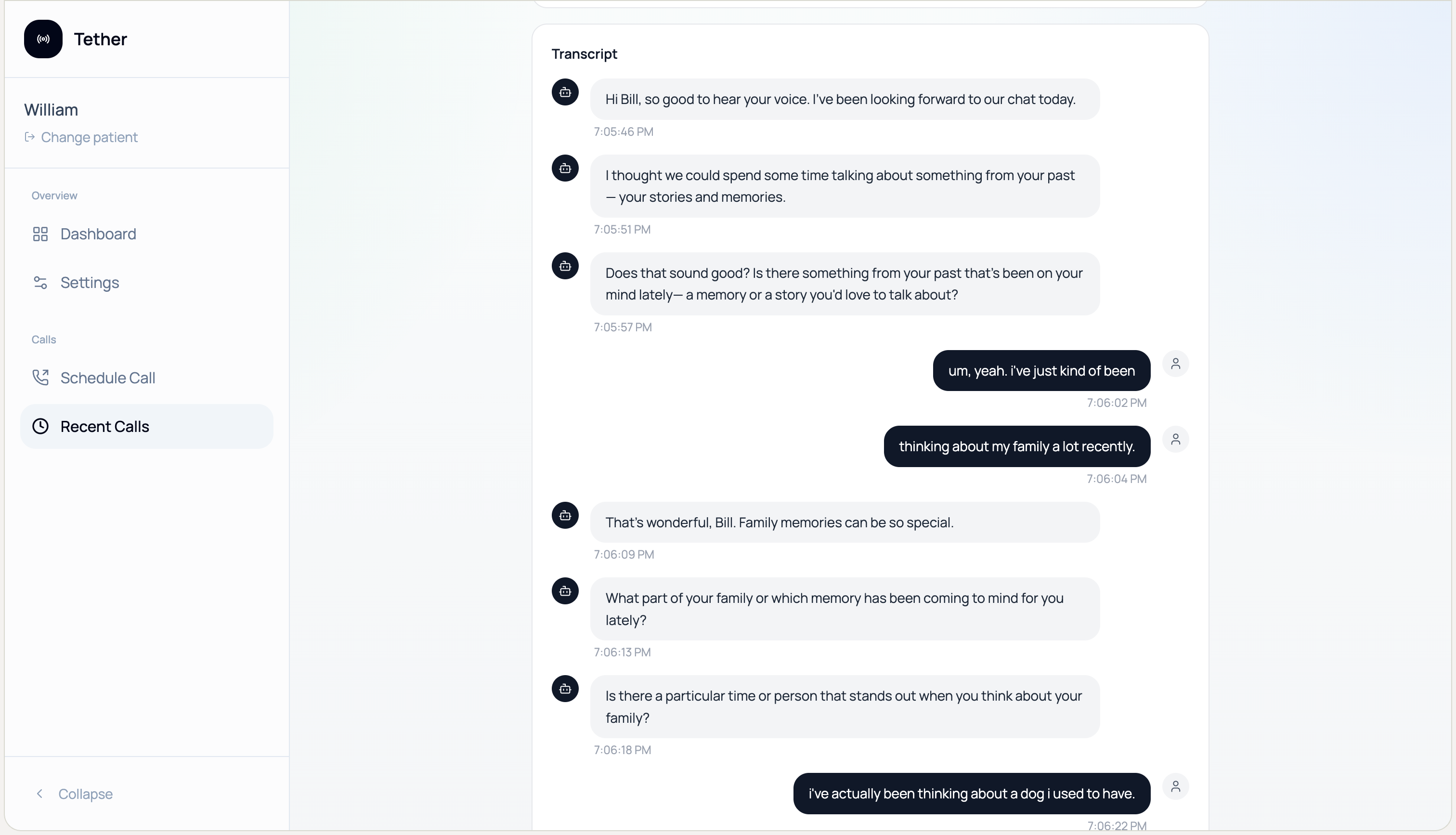
Reminisce calls give patients a dedicated space to explore and share memories from their past. The AI acts as a curious conversational companion. It follows the patient's lead, deepens stories naturally, and never rushes.
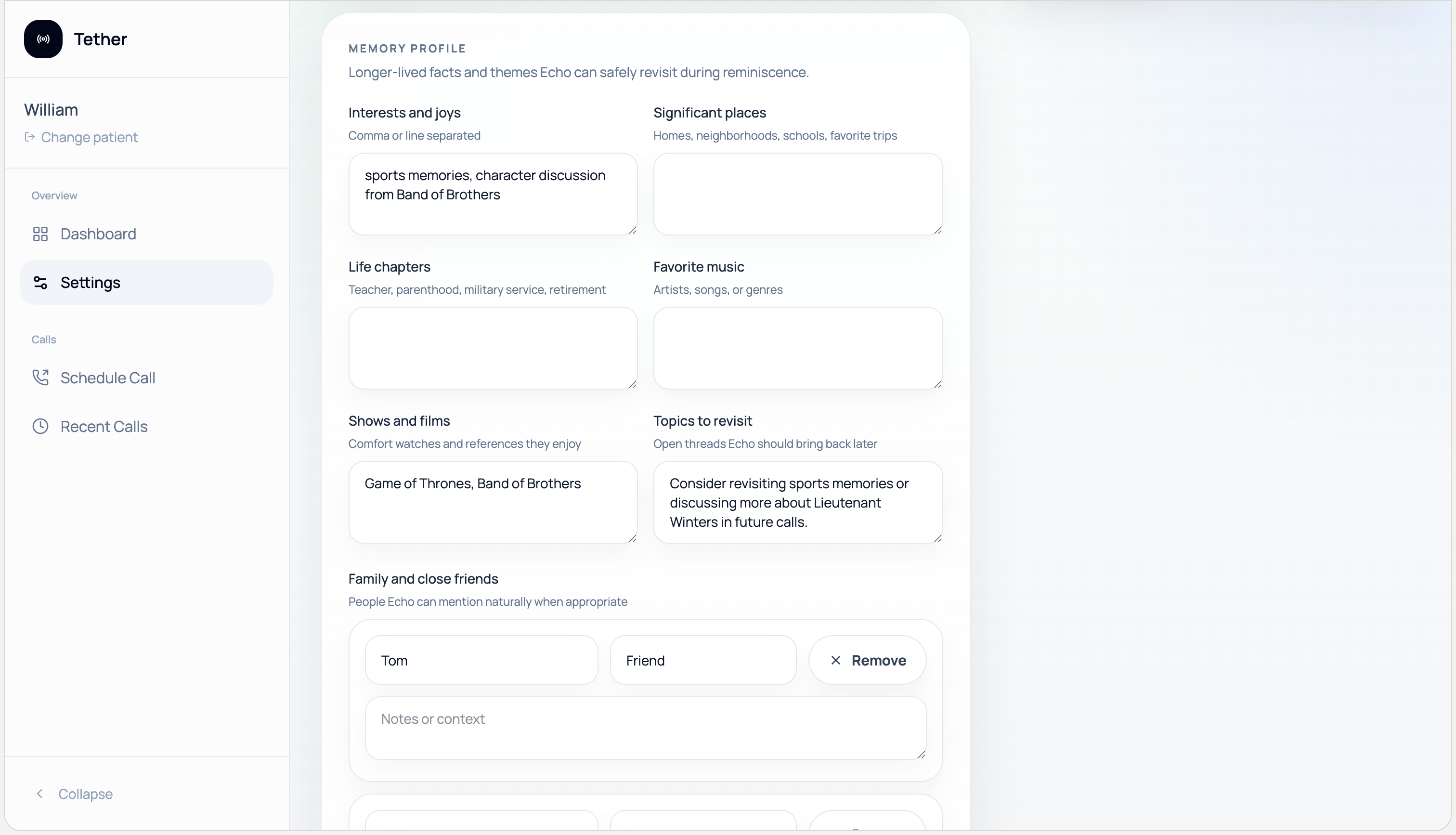
Each call closes with a personalized reflection on what was shared. The AI then offers a gentle real-world anchor: a reminder to call someone, listen to a song, watch a show, or write a few lines about the memory.
After each reminisce call, a structured memory log is added to the patient's memory bank. It captures key names, places, emotional tone, and threads worth revisiting. A people log tracks every person mentioned across calls. It includes a safety-critical field that prevents the AI from ever suggesting a call with someone whose status is unknown, protecting against the risk of naming someone who has passed away.
Together, these two call types build a longitudinal picture of a patient's life, functioning, and wellbeing that grows richer with every conversation.
How We Built It
Tether is a full-stack web application. The core stack is:
- Frontend: TypeScript, React, Vite, Tailwind CSS
- Backend: Go
- Database: PostgreSQL
- Voice AI: AWS Bedrock with Amazon Nova Sonic
- Real-time calls: WebSockets
Calls are managed through a multi-agent workflow. One agent handles the live conversation in real time. A second agent performs post-call analysis on the transcript, extracting structured data, generating clinical summaries, updating the memory bank, and flagging anything that warrants caregiver attention. This separation keeps the live call experience responsive while ensuring the clinical output is thorough and structured.
The prompts driving both call types were developed iteratively and grounded in clinical literature. Sources include ICD-10 delirium criteria, the 4 Rs of dementia care, NIA living-alone guidelines, and reminiscence therapy research. Each prompt went through multiple rounds of testing and refinement to balance clinical rigour with genuine human warmth.
Challenges We Ran Into
Multi-agent Workflow
Designing a workflow where one agent handles a live voice conversation and a second handles post-call analysis required careful orchestration. Passing transcript context reliably between agents, ensuring the analysis agent had enough information to generate meaningful clinical output, and maintaining call-to-call memory across sessions were all non-trivial engineering challenges.
Voice Turn Detection Tuning
Amazon Nova Sonic required significant tuning to handle the conversational patterns of early-stage dementia patients. These include longer pauses, slower speech, occasional repetition, and mid-sentence trailing off. Getting interruption handling and pause length right so the AI never cut off a patient mid-thought took careful iteration.
Threading the Needle on Clinical Responsibility
The deepest challenge was not technical. It was ethical. Tether operates in a space where it can genuinely affect patient wellbeing, but must never overstate its role. Every design decision required careful thought about where the line sits between a helpful tool and an inappropriate clinical actor. We consulted research extensively and built hard limits into every prompt to protect that boundary.
Accomplishments We're Proud Of
- A multi-agent workflow that handles live calls and post-call analysis with call-to-call memory, producing clinical summaries, reminders logs, and memory bank entries that grow richer over time
- A people log with safety-critical relationship status fields that prevent the AI from ever suggesting a call with someone who may have passed away
- Prompt design that is warm enough for a vulnerable patient and structured enough for a clinical dashboard
- A tool with genuine dual value: clinical utility for caregivers and physicians, and emotional value for patients and families
- Grounding every feature in published research, and being willing to revise our own prior decisions when the evidence did not support them
What We Learned
Technical
We learned how to architect and integrate multi-agent AI workflows. This meant separating real-time conversational agents from analytical agents and passing state reliably between them. Working with Amazon Nova Sonic gave us hands-on experience with voice AI, including the subtle but critical challenge of tuning turn detection for non-standard conversational patterns.
Clinical and Ethical
We learned that the gap in dementia care is not primarily a technology gap. It is an equity gap. Women, low-income communities, and under-resourced health systems bear a disproportionate share of the burden. Any tool that does not actively consider those populations risks widening the gap rather than closing it.
We also learned how to apply formal clinical frameworks, including ICD-10, the 4 Rs, and CDR staging, to product design in a way that is rigorous without being cold.
Human
We learned that caregivers and family members who carry the informal burden of dementia care are themselves underserved. They are often unsupported, sometimes stigmatised, and rarely equipped with tools to monitor a loved one's wellbeing between clinical visits. Tether is as much for them as it is for patients.
We also learned that applying our University of Michigan education to a real problem with real stakes changes how you think about what technology is for.
What's Next for Tether
- Transition from WebSocket-based calls to real phone calls, enabling Tether to reach patients on any device without requiring an internet connection or app
- Expand call types, including potential cognitive assessment calls grounded in validated instruments like the MMSE and CDR, designed to track change over time rather than replace clinical evaluation
- Build out the caregiver and clinician dashboard, making the reminders log, memory bank, and clinical summaries queryable and visualisable over time
- Explore equity-focused deployment pathways for low-resource settings where formal dementia care infrastructure is limited
- Work toward dementia-inclusive community features that support not just individual patients but the broader goals of reducing stigma, improving public knowledge, and promoting early diagnosis
Built with care at the University of Michigan
Built With
- aws-bedrock-(amazon-nova-sonic)
- bun
- go
- postgresql
- react
- tailwind
- typescript
- vite


Log in or sign up for Devpost to join the conversation.