-
-
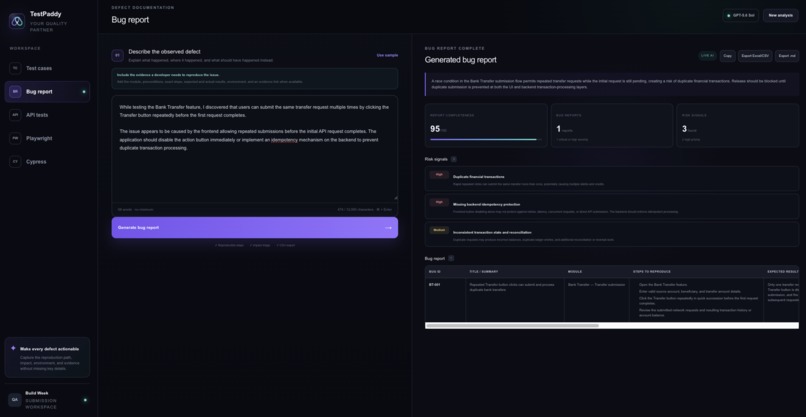
Generated Bug Report
-
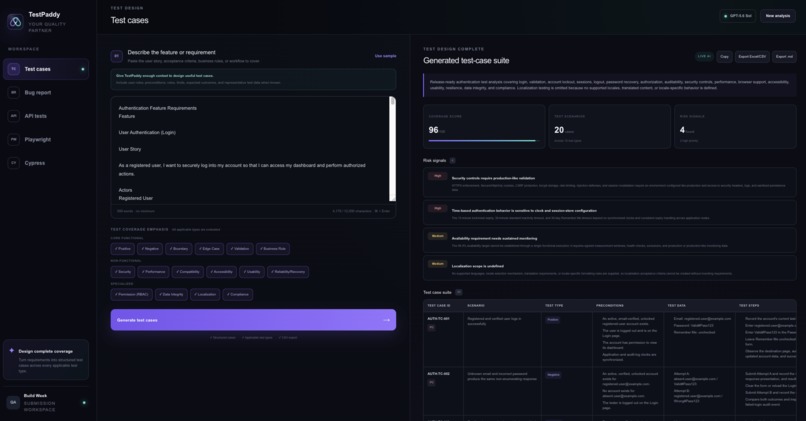
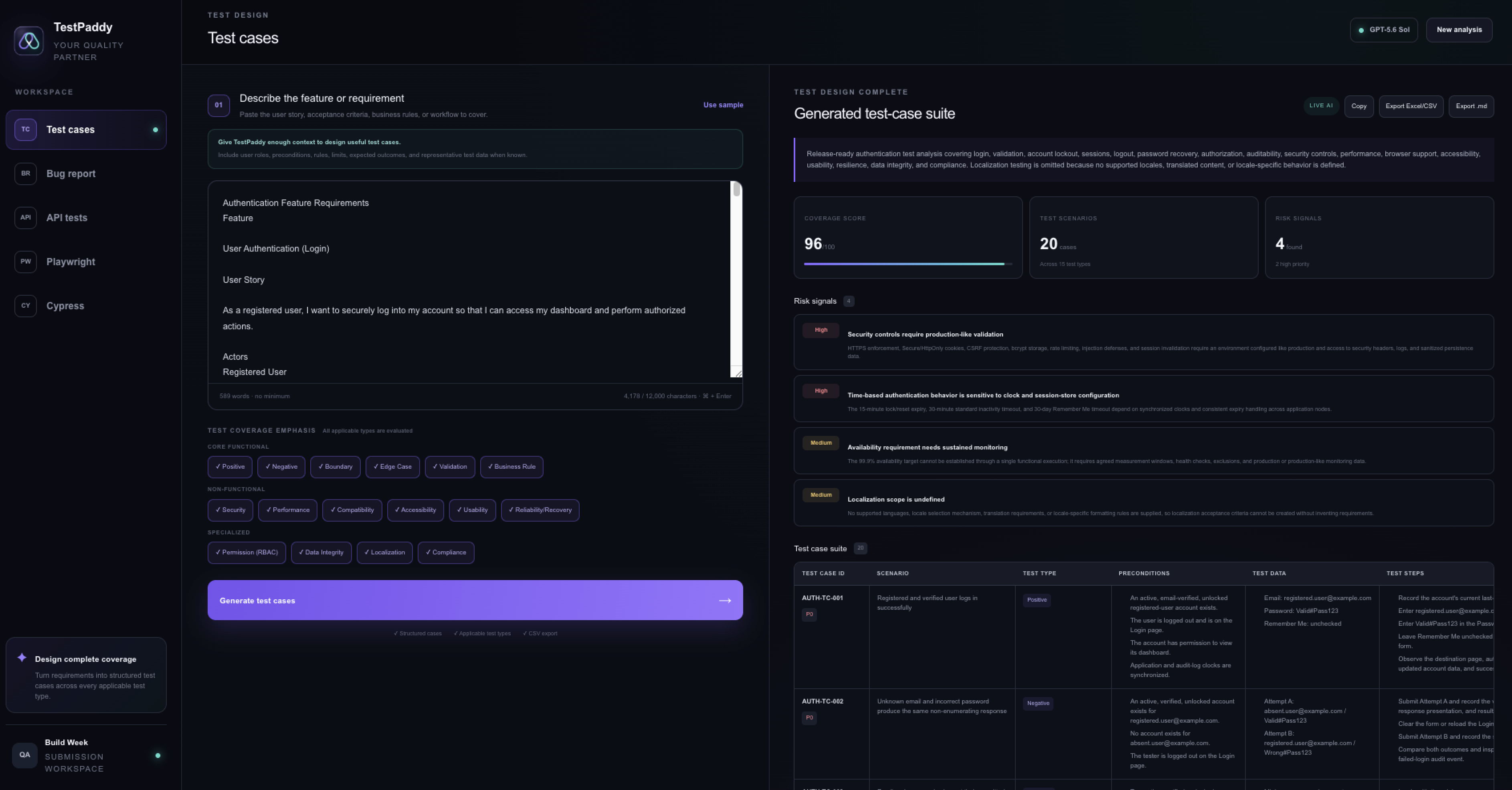
Generated Test Cases Suite
-
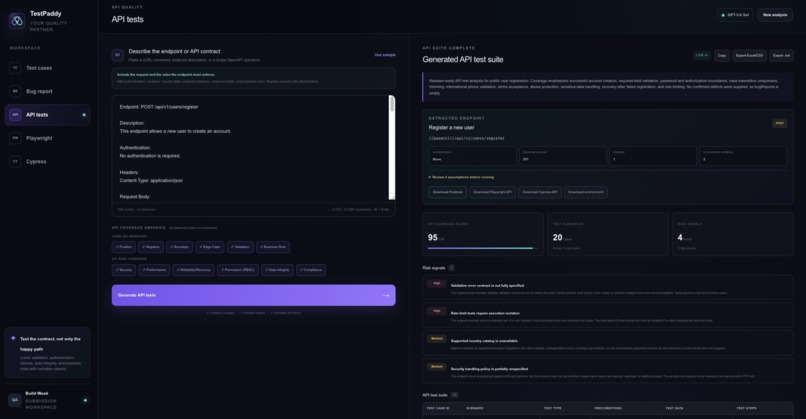
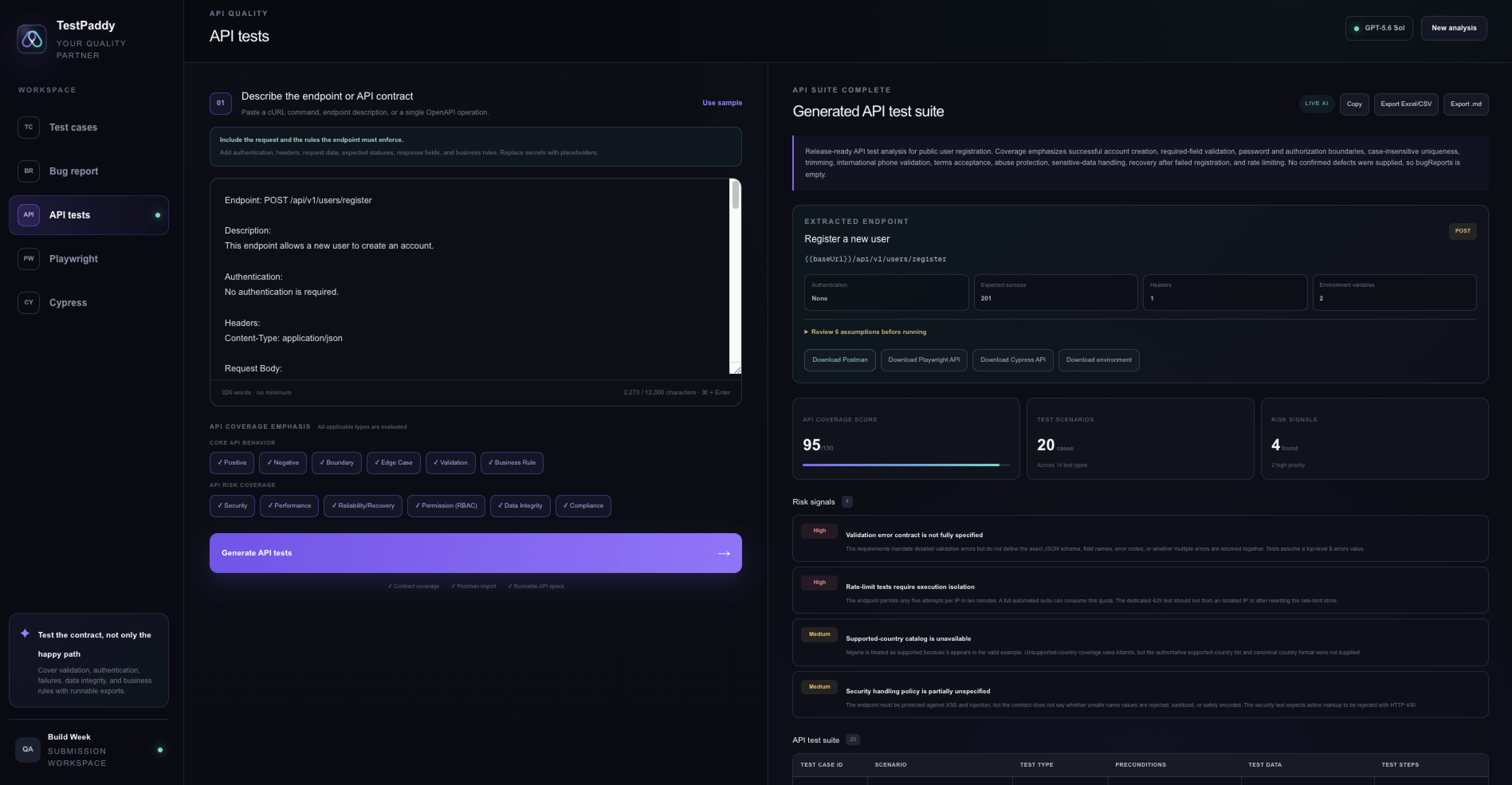
Generated API Test Suite
Inspiration
Software testers spend countless hours converting user stories, product requirements, API documentation, and defect reports into structured QA deliverables. While general-purpose AI assistants can generate text, they often lack the domain-specific reasoning required to produce testing artifacts that are practical, complete, and aligned with professional QA workflows. As a QA Engineer, I experience these challenges firsthand. TestPaddy was born from the idea that AI should work the way software testers work, not the other way around. Instead of replacing tester expertise, TestPaddy acts as an AI quality partner that accelerates repetitive work while keeping testers in control of every decision.
What it does
TestPaddy is an AI-powered QA engineering workspace that transforms raw testing inputs into professional, reviewable QA assets.
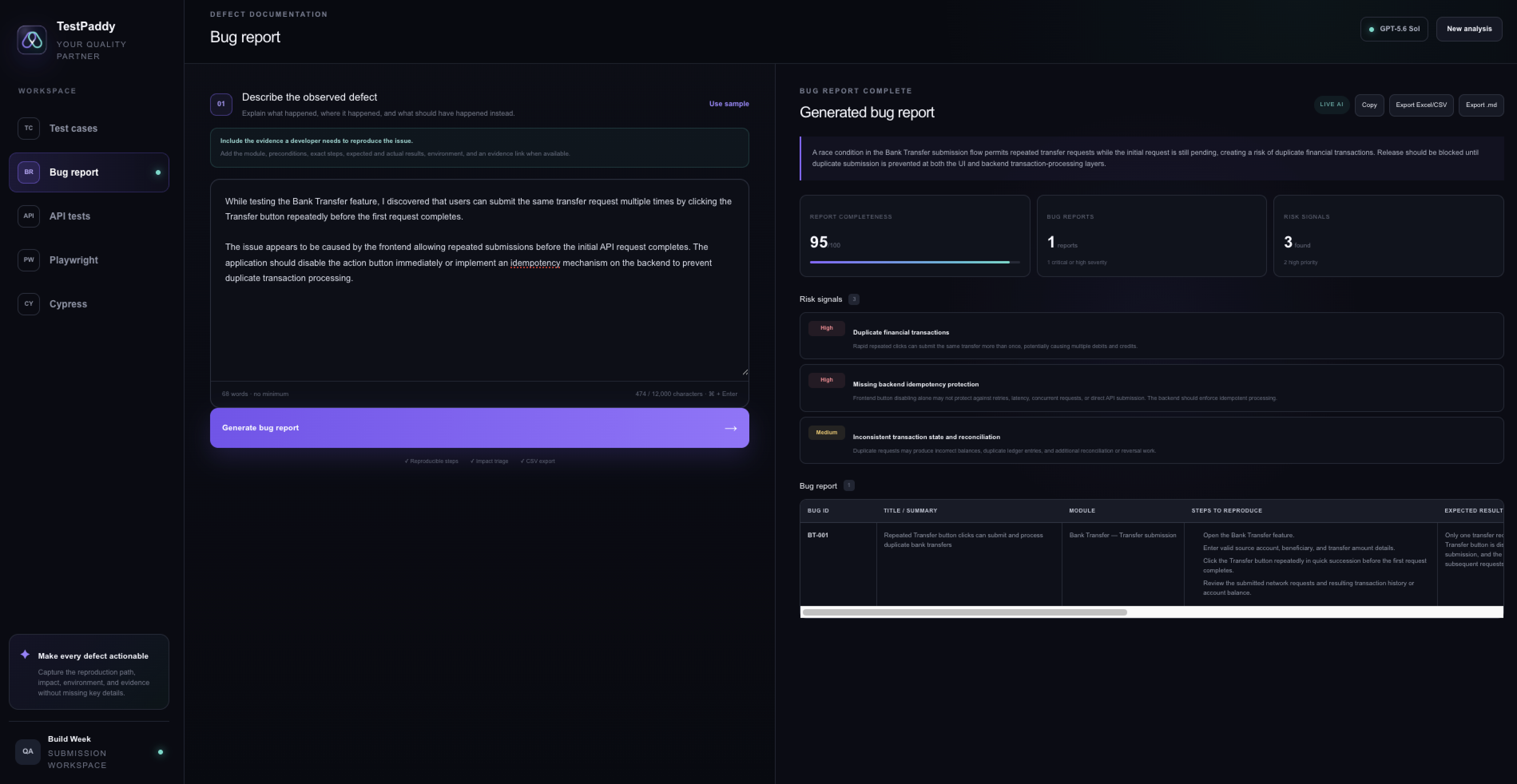
It currently provides five specialized workspaces: Test Cases: Generates comprehensive test cases from requirements, user stories, acceptance criteria, business rules, and workflows. Bug Reports: Converts rough issue descriptions into structured bug reports with severity, priority, reproduction steps, expected and actual results, and supporting evidence. API Tests: Generates API test cases, Postman collections, Playwright API tests, Cypress API tests, and environment templates from cURL commands, endpoint documentation, or OpenAPI operations. Playwright Generator: Produces complete downloadable TypeScript Playwright starter projects with Page Object Models, test specifications, configuration, documentation, and GitHub Actions. Cypress Generator: Creates complete Cypress TypeScript starter projects with reusable action helpers, isolated specifications, fixtures, configuration, documentation, and CI workflows.
Rather than simply generating text, TestPaddy analyzes risk, determines the most appropriate testing coverage, and produces structured outputs that software testers can immediately review and adapt.
How I built it
TestPaddy was built using Next.js, React, TypeScript, and the OpenAI Responses API powered by GPT-5.6. The application uses structured JSON outputs to ensure every generated artifact follows a predictable, professional format. AI requests are processed securely on the server so API credentials never reach the browser. When an API key is unavailable, TestPaddy automatically switches to a deterministic demo mode, allowing users and judges to explore the complete workflow without requiring API access. Throughout development, I used Codex as an engineering collaborator to accelerate implementation, refine the architecture, strengthen testing workflows, improve the user experience, and iterate faster while remaining responsible for the product vision, QA domain expertise, engineering decisions, and final implementation.
Challenges I ran into
The biggest challenge was ensuring TestPaddy generated QA artifacts instead of generic AI responses. Software testing requires structured reasoning, not just text generation. The application needed to determine which testing techniques were actually applicable, separate assumptions from confirmed information, generate framework-specific automation projects, and produce outputs that testers could confidently review and use. Another challenge was balancing flexibility with consistency. Users should be able to provide incomplete requirements while still receiving structured, reliable outputs that follow QA best practices. Achieving that required carefully designed prompts, strict output schemas, and multiple iterations of the generation workflows.
Accomplishments that I am proud of
I am most proud that TestPaddy solves a real problem experienced by software testers every day. Instead of being another general-purpose AI assistant, TestPaddy provides dedicated workflows tailored to QA engineering. It produces practical outputs that extend beyond text generation by creating downloadable Postman collections, Playwright and Cypress starter projects, structured bug reports, professional test cases, and exportable QA documentation. I am also proud that the application remains usable even without an OpenAI API key through its deterministic demo mode, making the complete experience accessible for demonstrations and evaluations.
What I learned
Building TestPaddy reinforced that the greatest value of AI comes from deep domain specialization rather than broad generalization. I learned that combining AI reasoning with structured workflows produces outputs that are significantly more useful than unconstrained text generation. I also gained valuable experience designing AI systems that keep humans in control by encouraging review, exposing assumptions, and generating artifacts that integrate naturally into existing QA processes.
What's next for TestPaddy
The vision is to make TestPaddy the AI workspace software testers rely on throughout the software development lifecycle.
Future development includes:
- Direct OpenAPI specification imports.
- Integrations with Jira, Azure DevOps, TestRail, and other QA platforms.
- AI-assisted regression impact analysis.
- Visual regression testing support.
- Performance testing scaffolding.
- Team collaboration and shared workspaces.
- Browser extensions for capturing bugs directly from live web applications.
- Additional AI-powered workflows that help QA engineers plan, execute, and automate software testing more effectively.
As TestPaddy evolves, the focus will remain the same: helping software testers spend less time creating documentation and more time improving software quality.
Built With
- actions
- ai
- api
- cloudflare
- codex
- cypress
- developertools
- github
- gpt-5.6
- markdown
- next.js
- node.js
- openai
- playwright
- postman
- react
- responses
- typescript


Log in or sign up for Devpost to join the conversation.