-
-
Bantuanku's Logo
-
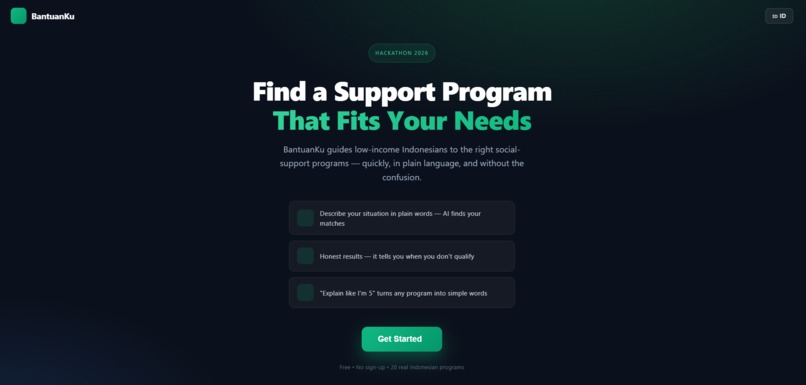
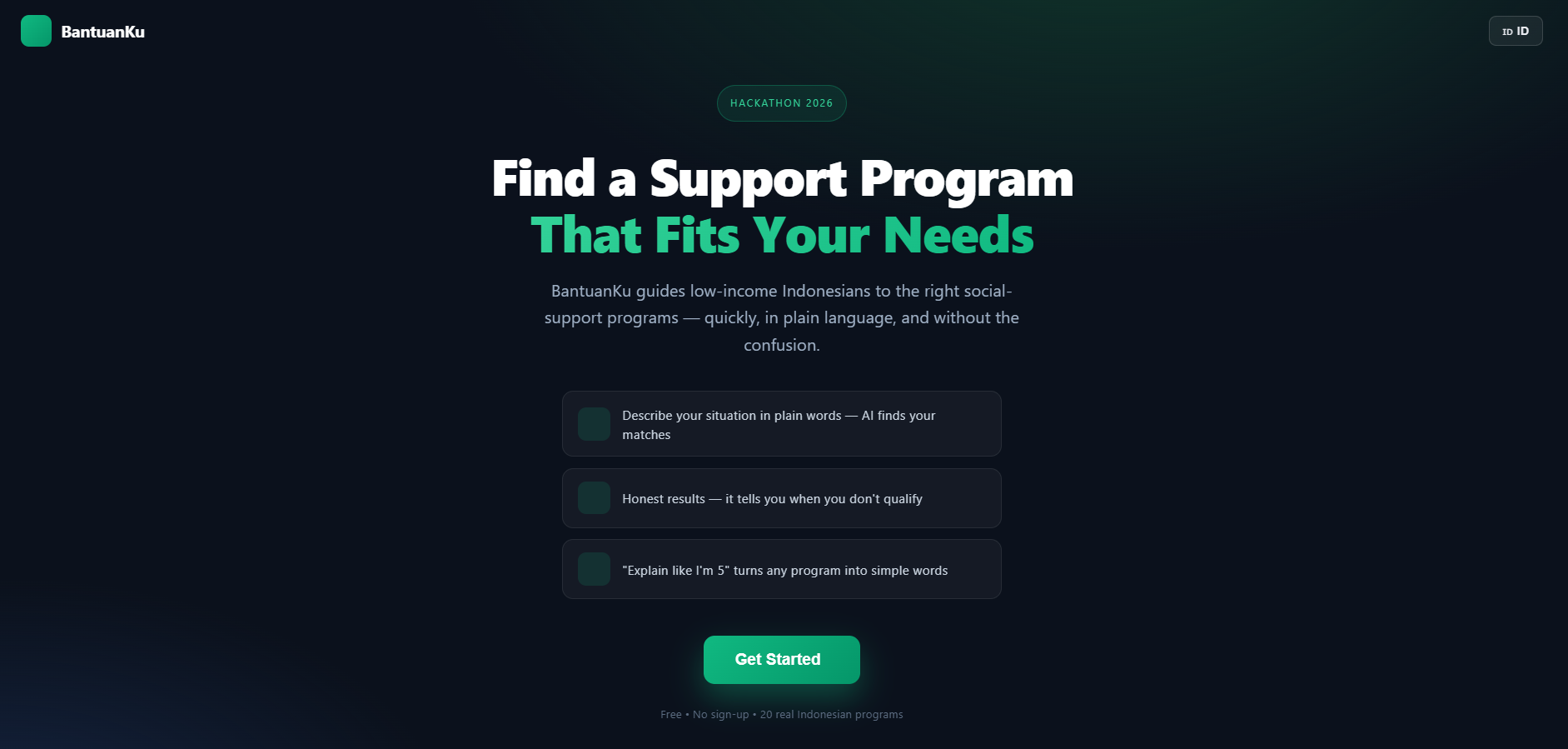
Bantuanku's Website Homepage
-
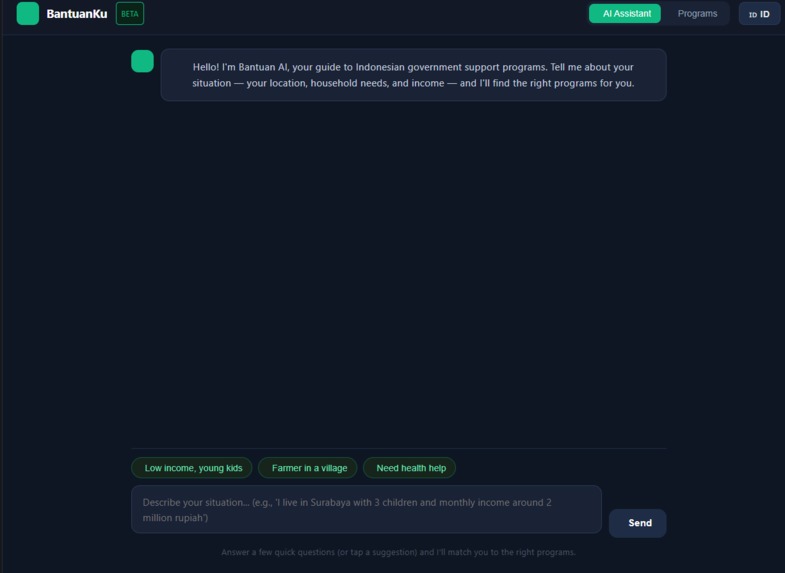
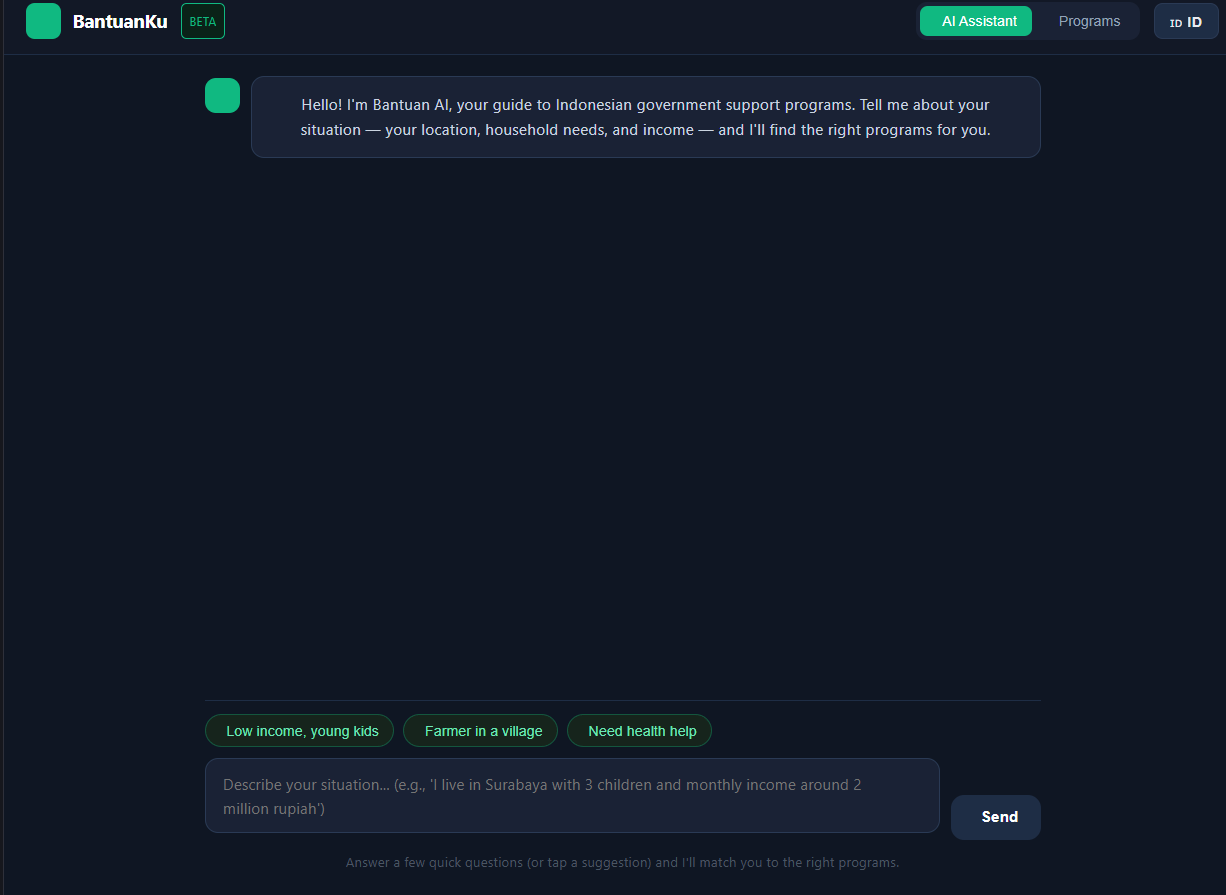
Bantuanku's AI chatbot
-
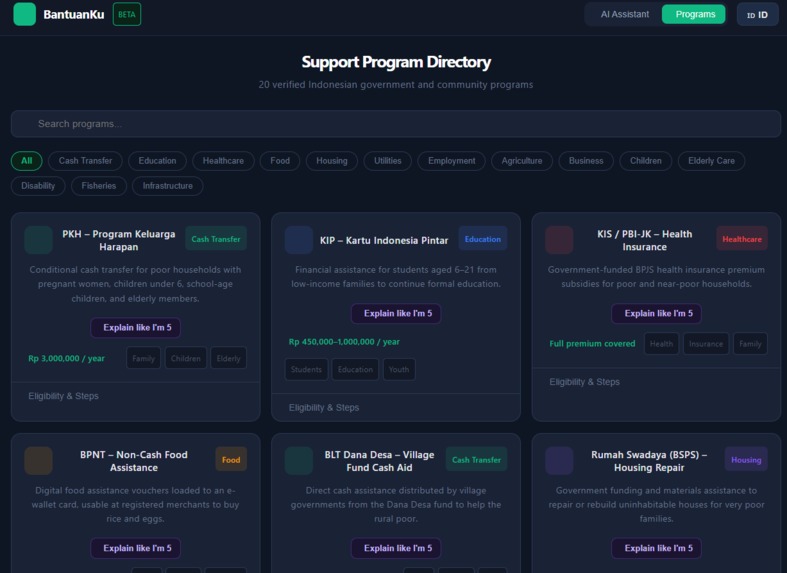
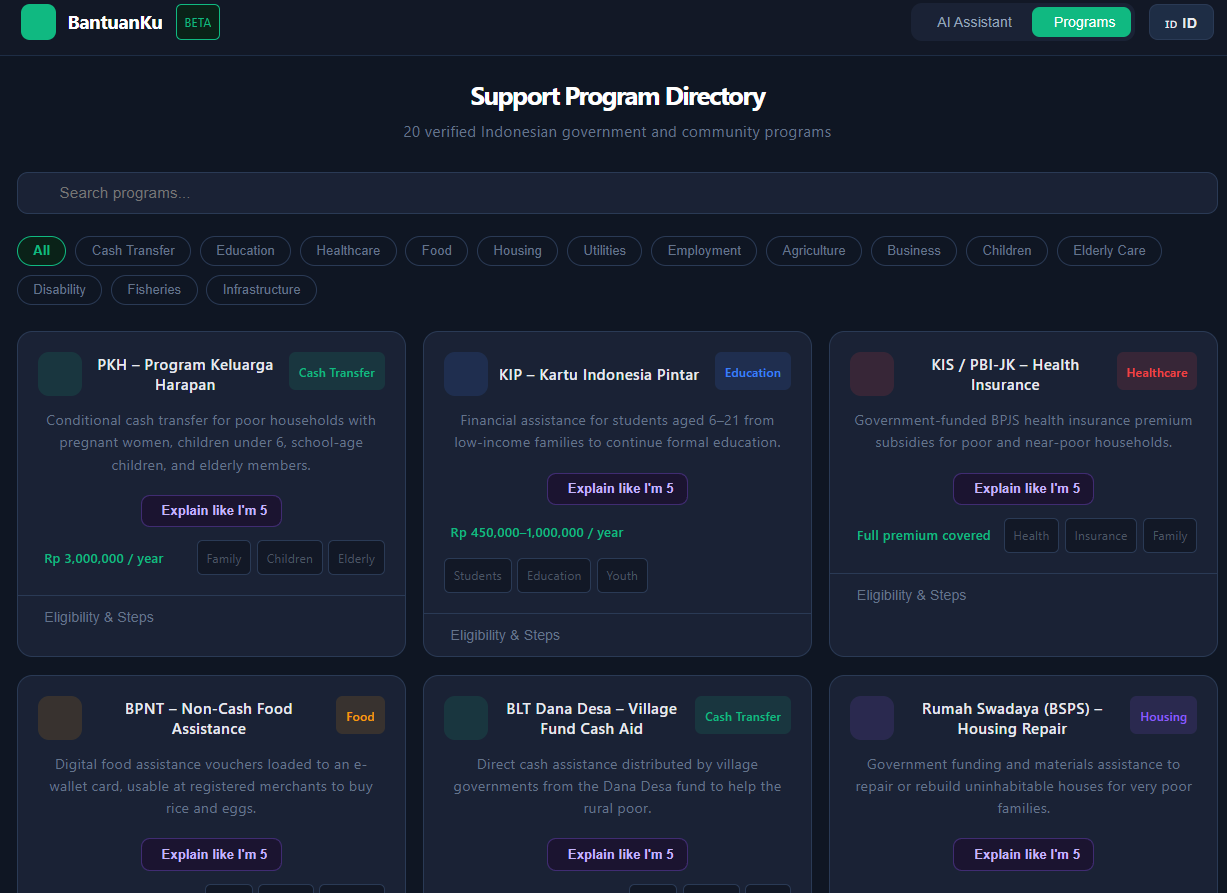
Bantuanku's Program Directory
Inspiration
Millions of low-income Indonesians in underserved communities rely on government assistance, nonprofit initiatives, and humanitarian aid to access essential services like healthcare, education and financial support. In 2024 alone, Indonesia's Family Hope Program (PKH) and Non-Cash Food Assistance Program (BPNT) supported approximately 10 million and 18.8 million beneficiary families respectively. As we looked deeper into the issue, we realized that the problem was often not the absence of support, but the difficulty of accessing and finding information about it. Many assistance programs already exist, yet people may not know where to find them, whether they qualify, or how to apply.
We imagined situations like a parent who recently lost their job and needs food or cash assistance, but does not know which programs they can apply for. Or a student from a rural area who needs scholarship support, but struggles to find clear information. These kinds of situations made us realize that the challenge is not only whether help exists, but whether people can actually find and understand it.
We were inspired by a simple problem: help often exists, but finding it is difficult. Many people struggle to identify programs they qualify for, understand eligibility requirements, and navigate application procedures. BantuanKu (MyAid) was created to simplify this journey and connect people with the support they need through a single, accessible platform.
What it does
BantuanKu (MyAid) is an AI-powered platform that helps Indonesians in underserved communities discover and access relevant support programs. Users describe their situation through text, such as their financial circumstances, location, or specific needs related to healthcare, employment, and education.
The platform uses natural language processing and recommendation systems to match users with relevant government assistance, nonprofit initiatives, and humanitarian aid opportunities. It provides personalized recommendations, eligibility requirements, and step-by-step guidance on how to access each program. To improve reliability, BantuanKu uses a confidence score system in a case where the AI is uncertain about a recommendation on its relevance with what the user is looking for, it asks follow-up questions before providing results. This helps ensure recommendations are as accurate and relevant as possible.
If users are unsatisfied with the AI's recommendations, they can browse a comprehensive directory of available support programs. This allows them to independently explore opportunities, compare options, and discover assistance that may better suit their needs, ensuring they are not limited solely to the AI's suggestions.
How we built it
BantuanKu was developed as an AI-assisted web application using HTML, JavaScript, and the Gemini API. We used AI-assisted development tools, including Claude Code and Cursor, to rapidly prototype, improve, and implement features throughout the development process.
The frontend was built to provide an accessible and user-friendly experience, while the Gemini API was integrated to power the platform's Natural Language Processing and recommendation capabilities. Through continuous testing and iteration/improvements, we refined the user experience and AI workflow to create a reliable platform for connecting users with relevant support programs.
We implemented a confidence score system using the AI's own assessment of how certain it is about a recommendation. When user information is incomplete, ambiguous, or insufficient to make a reliable recommendation, the AI assigns a lower confidence level and generates follow-up questions to gather additional context. Once the user provides more information, the recommendation is reassessed and refined before being presented.
Challenges we ran into
- Ensuring Recommendation Accuracy One of our biggest challenges was reducing the risk of the AI recommending programs that were not relevant to a user's situation. We addressed this by implementing a confidence score system that allows the AI to ask follow-up questions whenever it lacks sufficient information before providing recommendations.
- Balancing Simplicity and User Control While AI recommendations can make finding support easier, users may not always agree with the suggested results. To address this, we included a searchable directory of available programs, allowing users to independently explore alternative options and make informed decisions.
- Difficulty Understanding Technology and Support Programs Many low-income Indonesians in underserved communities may have limited experience with digital platforms or find support program information difficult to understand due to complex language and requirements. To counter this, we added an "Explain Like I'm 5" button that rewrites information in simple language, making it easier for users to understand program requirements, benefits, and application steps.
- Limited Access to Technology and Internet Many low-income Indonesians in underserved communities may have limited access to devices, internet connectivity, or digital services, making it more difficult to access online support platforms. To fix this, we removed unnecessary barriers by allowing users to access BantuanKu without creating an account or signing in. By centralizing support information into a single platform, users no longer need to visit multiple websites or organizations to find assistance.
- How do we differentiate our solution from a regular AI like chatgpt or even a fixed decision tree? A fixed decision tree felt too rigid because users may not explain their situation in a clear or structured way. A general AI tool like ChatGPT can answer questions, but it does not guide users through a focused directory of Indonesian support programs. BantuanKu combines both by using AI to understand users’ situations, ask follow-up questions when needed, and connect them to specific programs, eligibility requirements, and step by step instructions to help them actually access the support they need.
Accomplishments that we're proud of
One of our key accomplishments was implementing the confidence score system to improve the reliability of AI recommendations. Instead of always giving immediate answers, the system evaluates how complete and clear a user’s input is. When confidence is low, the AI asks follow-up questions before generating results. This helps reduce inaccurate or irrelevant recommendations and makes the system more thoughtful and responsive to real user needs.
We are also proud of building the “Explain Like I’m 5” feature, which makes complex information much easier to understand. Many support programs use formal language that can be difficult for some users to interpret, so this feature rewrites content in simple, clear terms. By breaking down eligibility requirements, benefits, and steps into plain language, we made the platform more accessible to users with different levels of education and digital literacy.
Unlike general-purpose AI tools such as ChatGPT, BantuanKu is specifically designed and constrained for humanitarian support discovery in Indonesia. Instead of providing broad, open-ended answers, it uses structured recommendation logic focused only on verified assistance programs, eligibility matching, and step-by-step application guidance. This makes the output more targeted, relevant, and safer for users who need actionable support rather than general information.
Finally, we are proud of building a working AI-powered platform that brings everything together into one system. We connected user input, AI recommendations using the Gemini API, the confidence score feature, and the program directory into a single functional web app. Using tools like Cursor and Claude Code helped us build and improve the platform faster, allowing us to turn our idea into a working product.
What we learned
We learned how to develop an AI-powered system that takes unclear, real-world user input and turns it into useful recommendations and simple explanations. Throughout the process, we gained experience working with APIs like Gemini, improving how we structure prompts, and building features such as confidence scoring and easy-language rewriting. It also showed us how different parts of a system need to work together to turn an idea into something functional and usable.
We also saw that even high school students like us can still contribute meaningful solutions to real problems when they focus on practical needs around them. Even with the limited time and resources, we were able to build a platform that helps users access support more easily. For us, it highlighted how using accessible tools like AI development platforms can make it possible to build real, working solutions even at our level.
Through this project, we also learned the value and importance of simplifying and turning confusing or stressful information into something clearer and more actionable. It influenced how we designed the outputs by the AI, especially in simplifying program details and breaking them into steps users can actually follow. Instead of our AI just presenting information, we structured it in a way that naturally leads users toward what they can do next. From this, we developed a stronger ability to structure information in a user-focused way, ensuring that outputs are not just informative but also practical and easy to act on.
What's next for BantuanKu (MyAid)
From this project onwards, Bantuanku aims to expand the range of support platforms it connects to. Currently, the system primarily sources information from larger, more established organisations to ensure reliability. Moving forward, we plan to include additional support channels from trusted but more niche community programmes and initiatives, as well as social media-based resources where relevant. This would allow the platform to offer a wider and more diverse range of available support, making it easier for users to discover help that is both accessible and closer to their specific needs.
Moving forward, we also plan to collaborate with local Indonesian campaigns and community initiatives to help promote Bantuanku and make it more widely known. By working with organisations that already have strong connections within communities, we hope to reach more users who may benefit from the platform but are not yet aware of it.
Built With
- claudecode
- css
- cursor
- geminiapi-key
- html
- javascript
- netlify


Log in or sign up for Devpost to join the conversation.