-
-

Header: Kevin sure looks excited
-
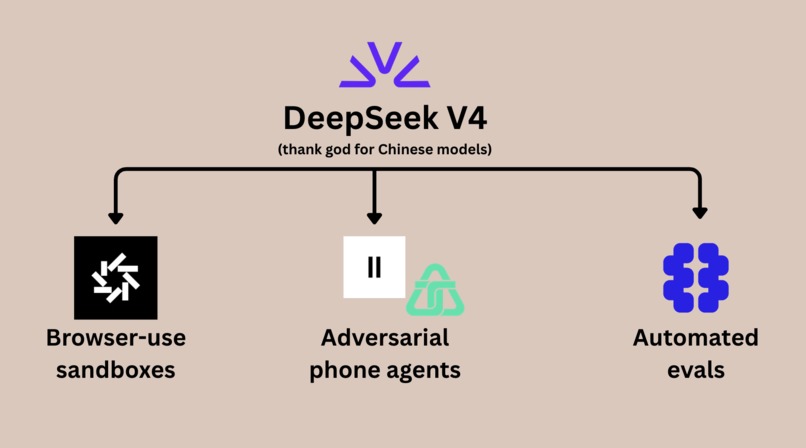
Architecture: (very rough) sketch
-
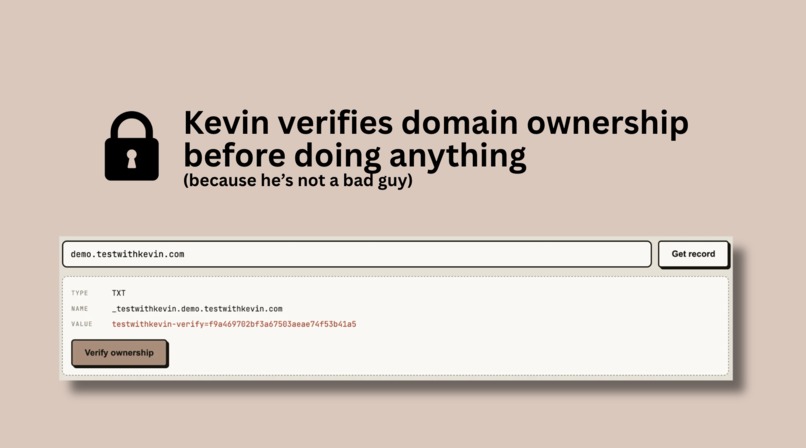
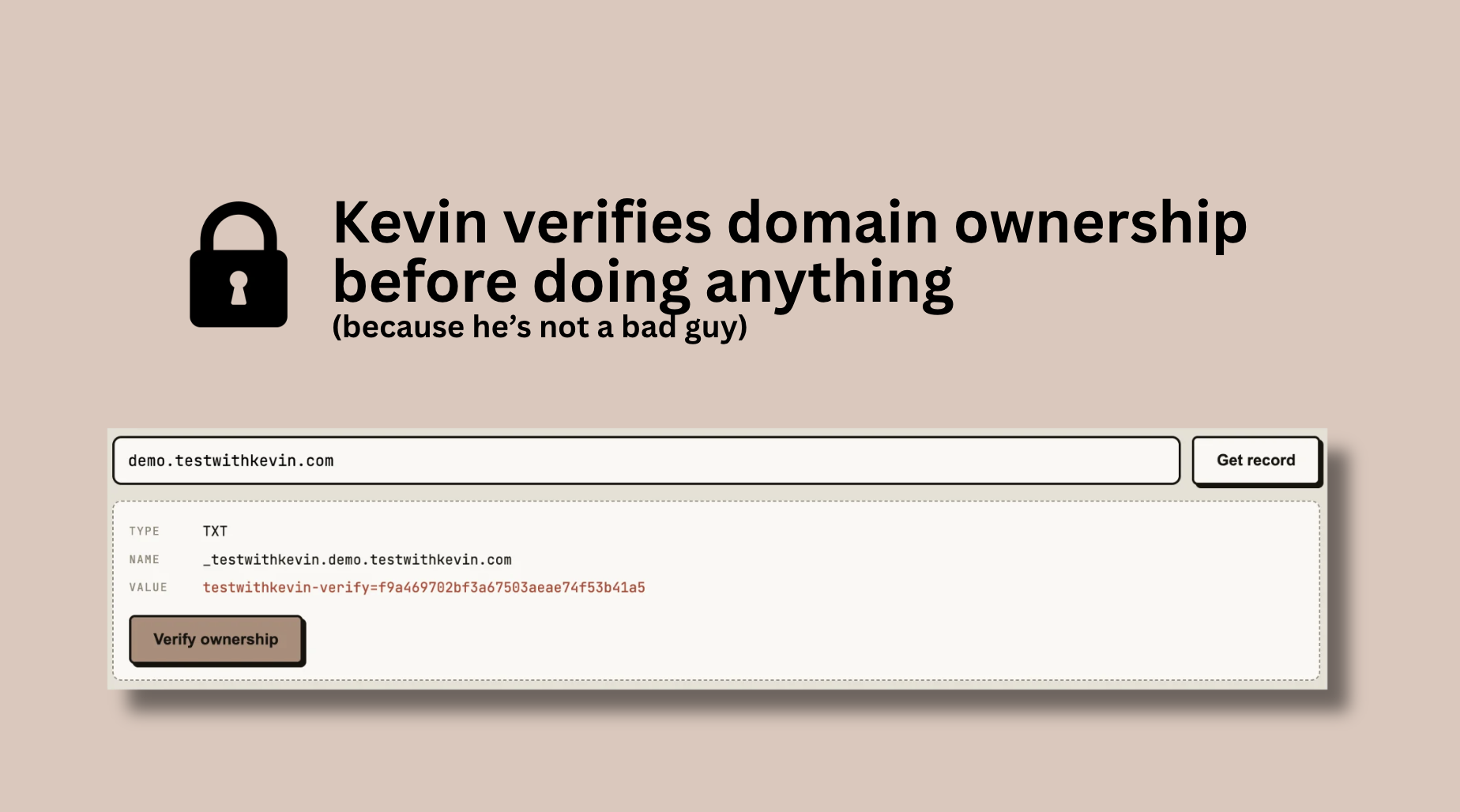
Security: Kevin doesn't do anything without DNS verification
-
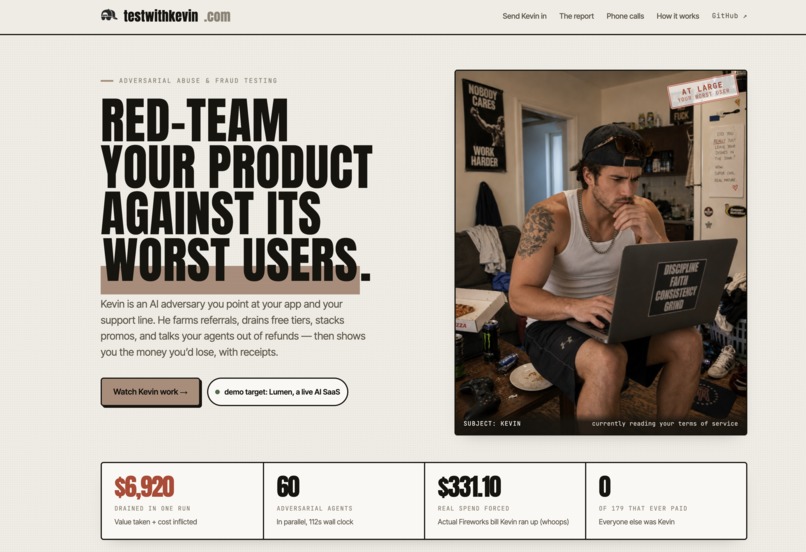
Landing Page

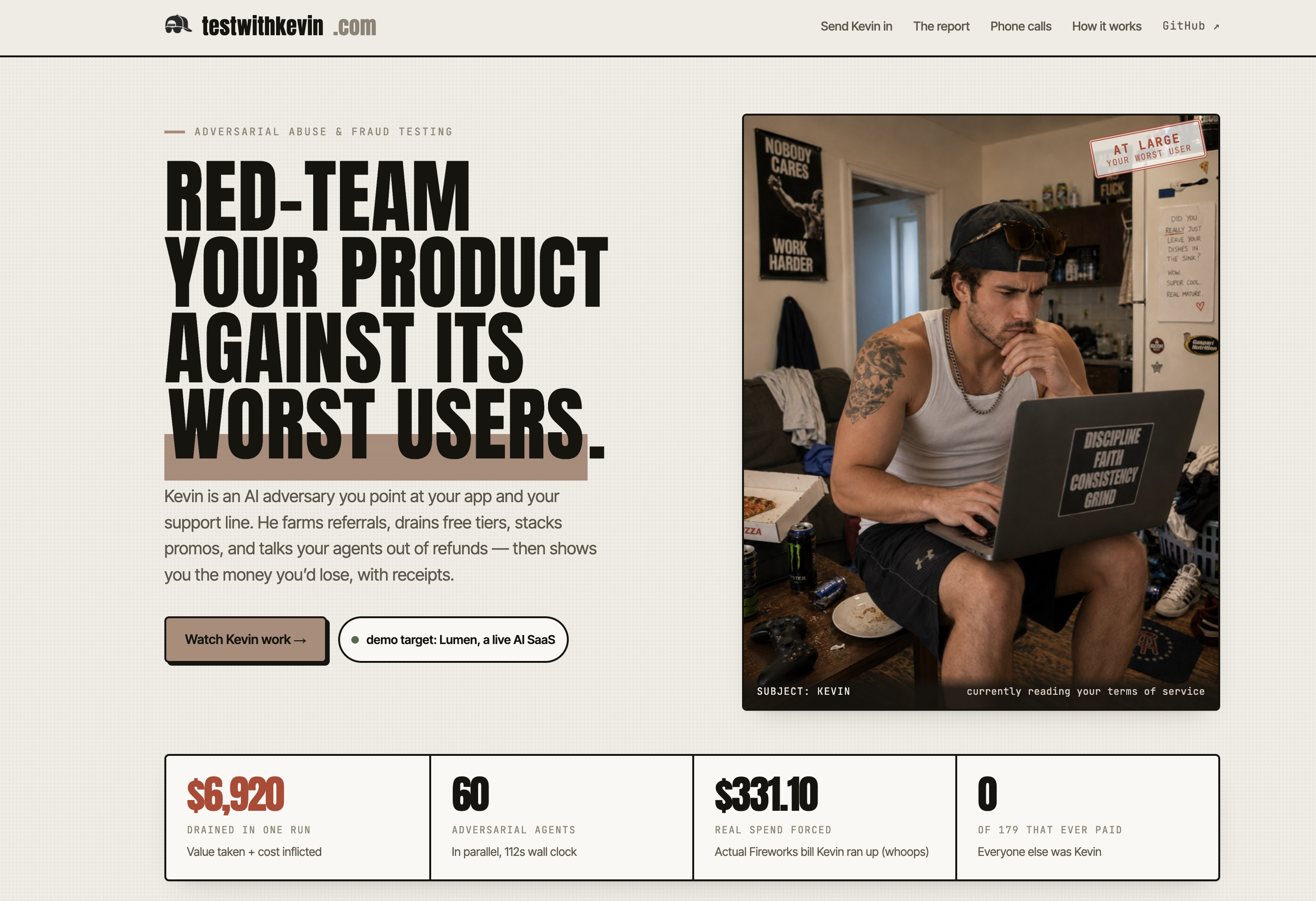
testwithkevin.com
Point Kevin at your app before your users do.
Kevin is your worst thousand users on day one. He signs up, clicks around, and hunts the economic exploits that quietly bleed a business (self-referral farms, denial-of-wallet, promo stacking, trial farming, balance manipulation) then hands you the bill he ran up. He also picks up the phone and red-teams your voice agents.
What we built
A self-serve adversarial red-teaming platform that finds economic vulnerabilities, instead security bugs. You prove you own a domain, send Kevin in, and he runs a real audit against your app.
To prove it end-to-end I vibesloped Lumen, a real, deployed AI-generation SaaS (free credits, referrals, promo codes, paid plans) with an instrumented economic ledger underneath.
Why it matters
Securing your app from a technical standpoint is relatively straightforward. Exploits are patched quickly, and Claude Code + CodeRabbit + ... does a better job than whatever I could cook up in a day. The neglected aspect here is actual user behavior under differentiated incentives. What if all your users had the worst intentions?
How it works (because we're not being idiots about this)
- Authorize. You can only audit a domain you control. Kevin issues a
testwithkevin-verifyTXT DNS challenge and confirms it over DNS before any audit runs. Kevin is a security tool, not a weapon. - Send Kevin in. LLM agents drive the target's real API/UI and discover and execute economic exploits. A live "Send Kevin in" button streams the damage climbing in real time.
- Prove it. Because the target books every credit and cost server-side, "Kevin drained $X" is pure accounting: value granted to accounts that never paid and share a fraud signal (shared IP, device, or disposable email). Reproducible; resets to a clean seed each run.
- Call it. Kevin has a real phone number and places real red-team calls to voice agents, holding a turn-based adversarial conversation.
Architecture
  verify domain (TXT DNS)  ──►  SEND KEVIN IN  ──►  live audit streams damage
        │                            │                       │
   authorization gate          Kevin = LLM agents      server-side ledger
                                (Fireworks DeepSeek)    = provable $ damage
                                     │
              ┌──────────────────────┼───────────────────────┐
        Daytona sandboxes      Braintrust scoring       Telnyx phone calls
        (isolated, parallel)   (per-exploit, per-$)     + ElevenLabs voice
| Service | Role in the system |
|---|---|
| Daytona | Isolates every Kevin agent in its own sandbox and runs the fleet in parallel against the live target (Chromium available in-sandbox for browser agents). |
| Fireworks AI | DeepSeek V4 is Kevin's brain — it decides every move — and the cost the target pays per generation, so denial-of-wallet burns the sponsor's own meter for real. |
| Braintrust | Logs and scores every attack session by exploit class, persona, and dollar impact — "which exploit pays best" is a filter, not a rerun. |
| ElevenLabs | Renders Kevin's voice for the phone / voice-agent red-teaming surface. |
| Telnyx | Gives Kevin a real phone number to place real turn-based red-team calls. |
| Brevo | Real transactional email for genuine signups on the target app. |
| Cloudflare + Railway | DNS + domain verification, and deployment of both the target (Lumen) and the report site. |
Try it
→ testwithkevin.com — send Kevin in and watch the damage climb live.
→ Repo: github.com/gereonelvers/daytona-hacksprint
Load testing tells you if your app survives success. Kevin tells you if it survives your users.
Built With
- braintrust
- brevo
- cloudflare
- elevenlabs
- fireworks
- railway
- telnyx


Log in or sign up for Devpost to join the conversation.