-
-
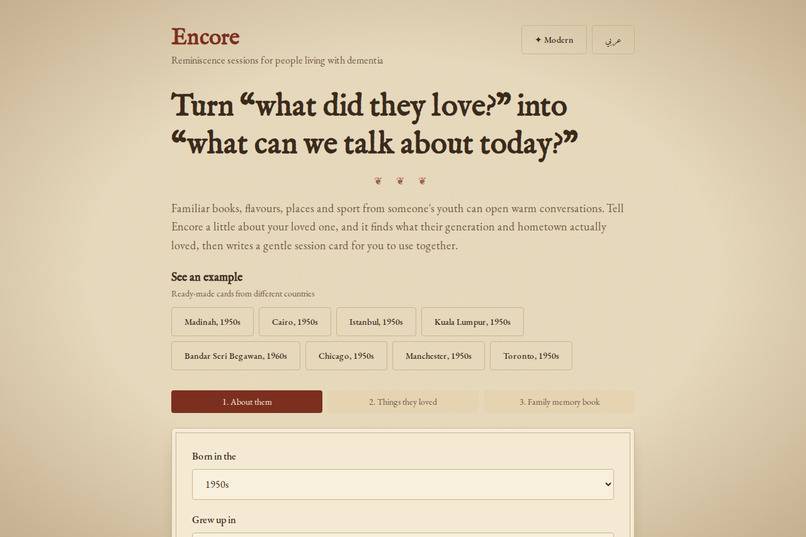
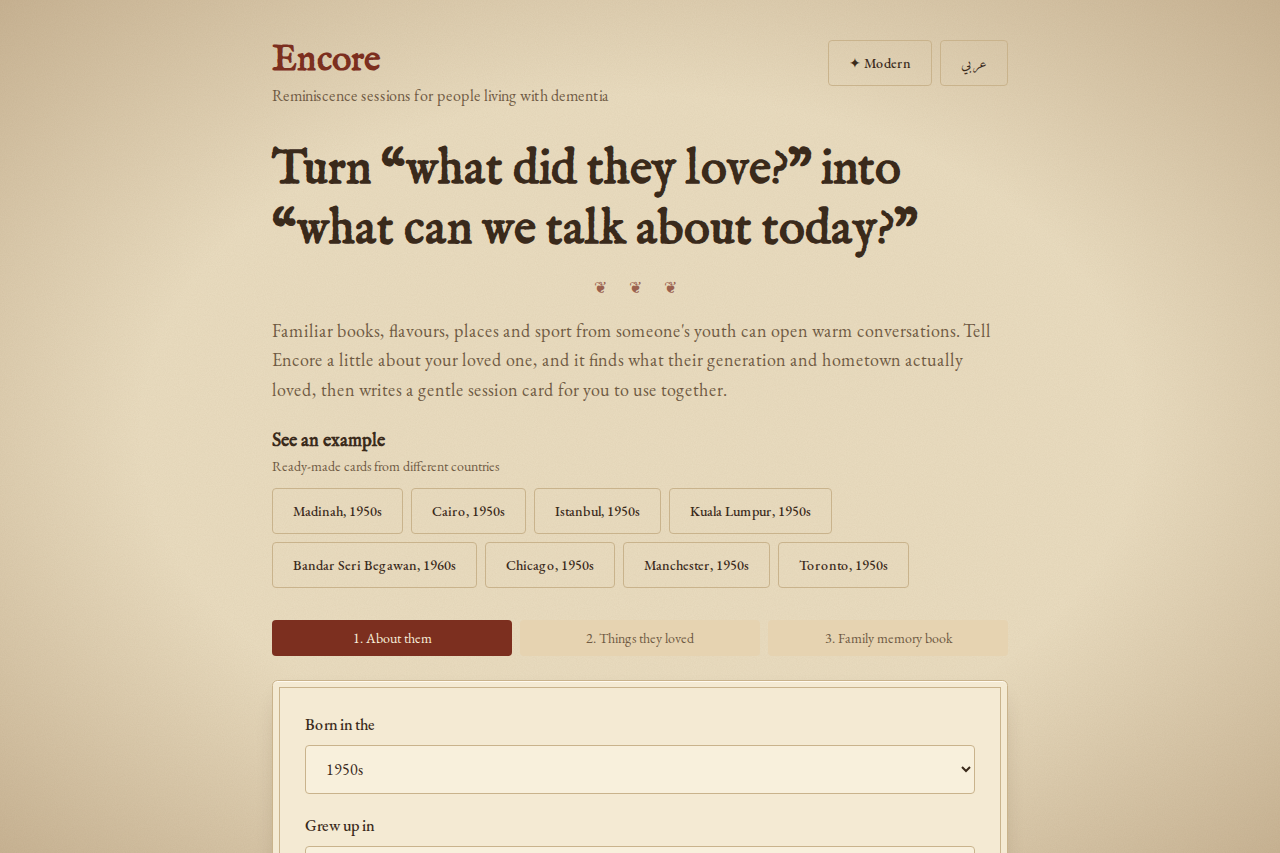
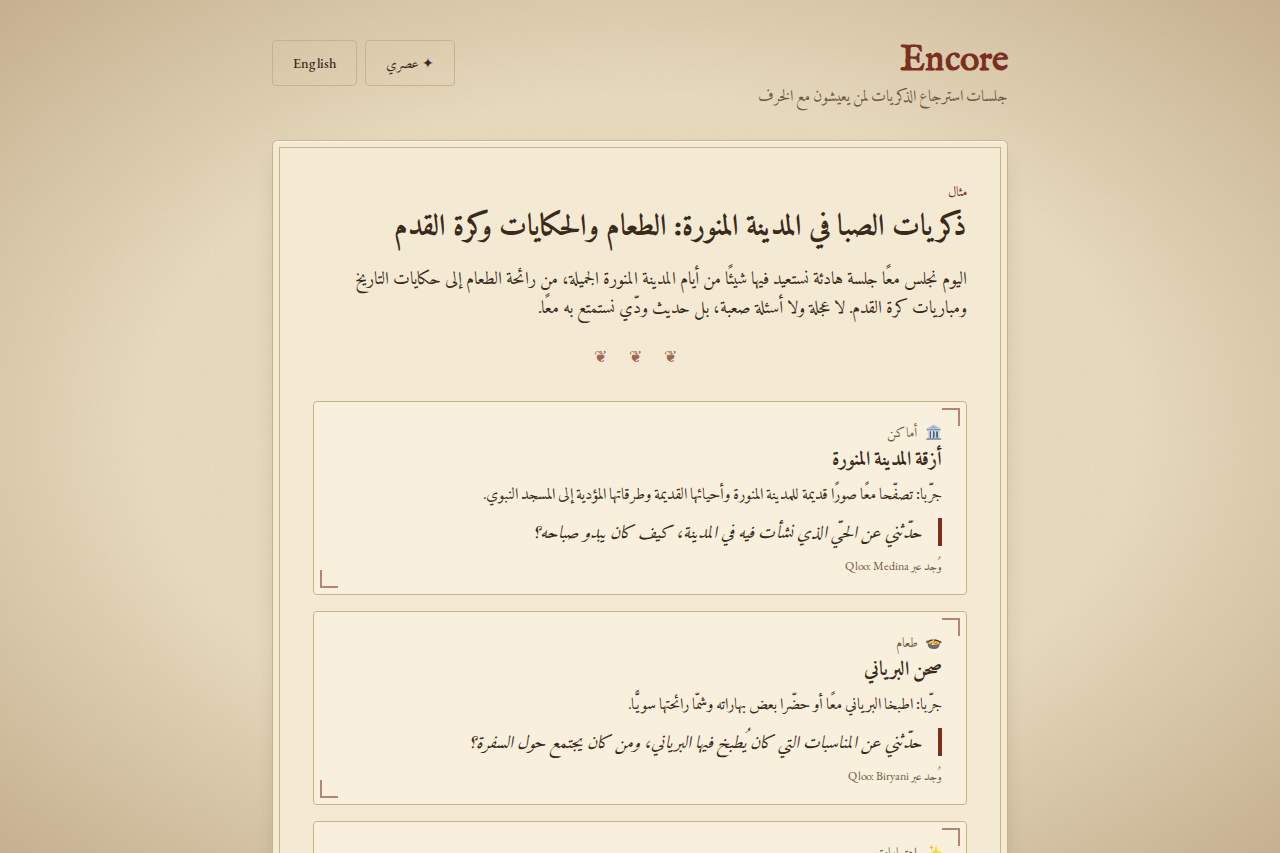
Antique theme: a keepsake look for reminiscence sessions
-
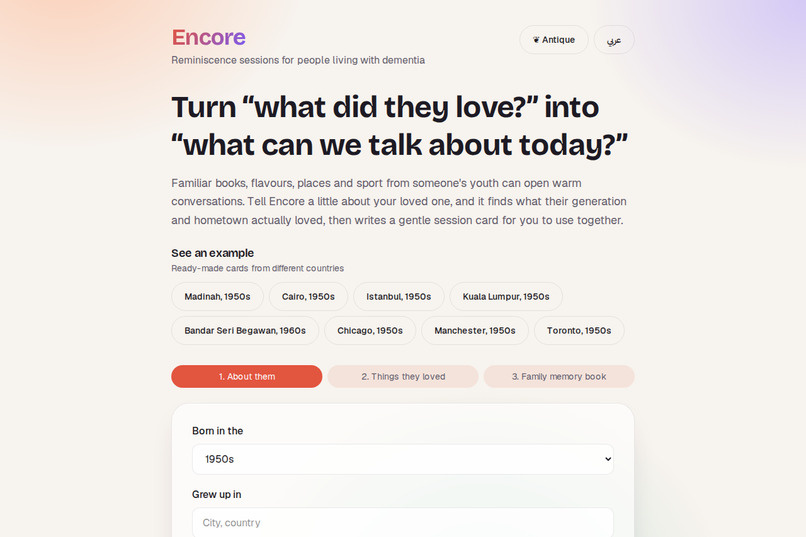
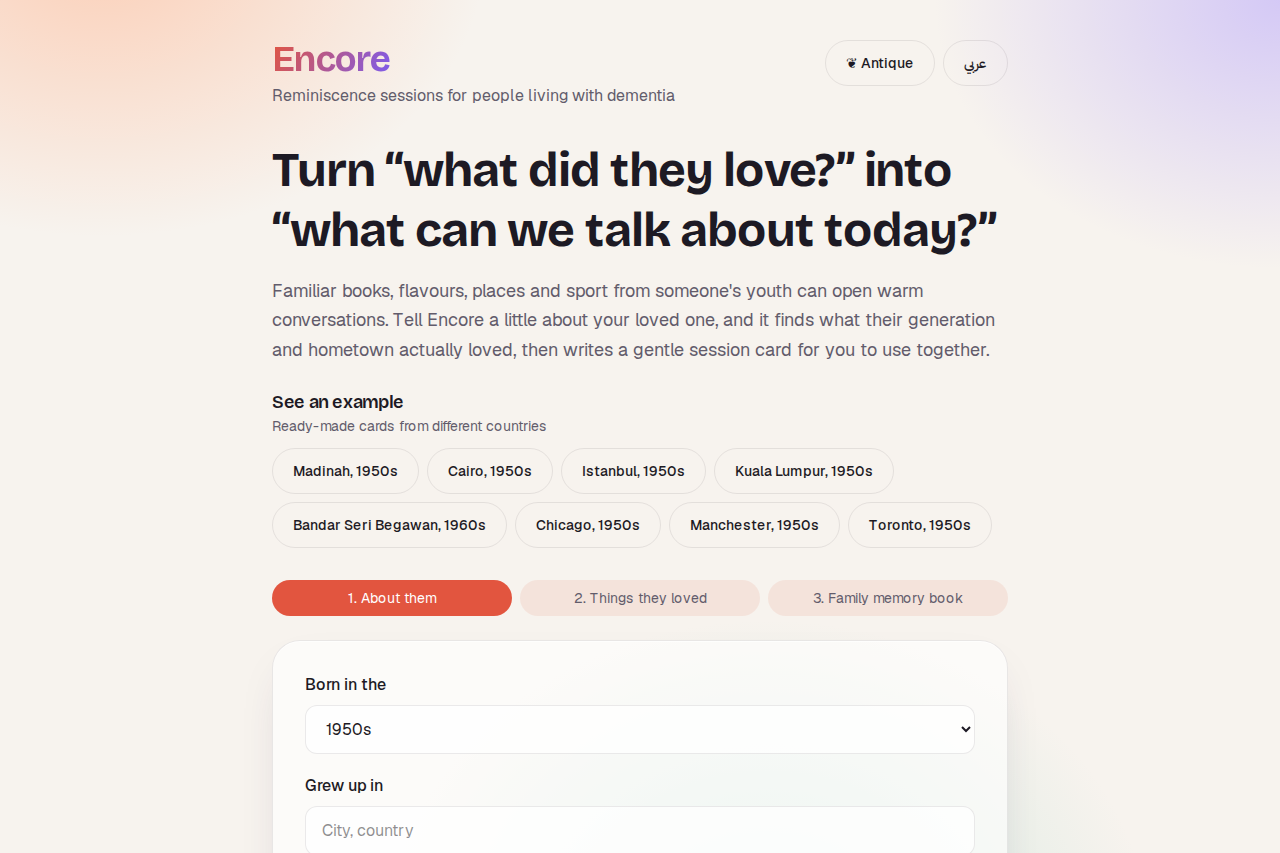
Encore: turn "what did they love?" into "what can we talk about today?"
-
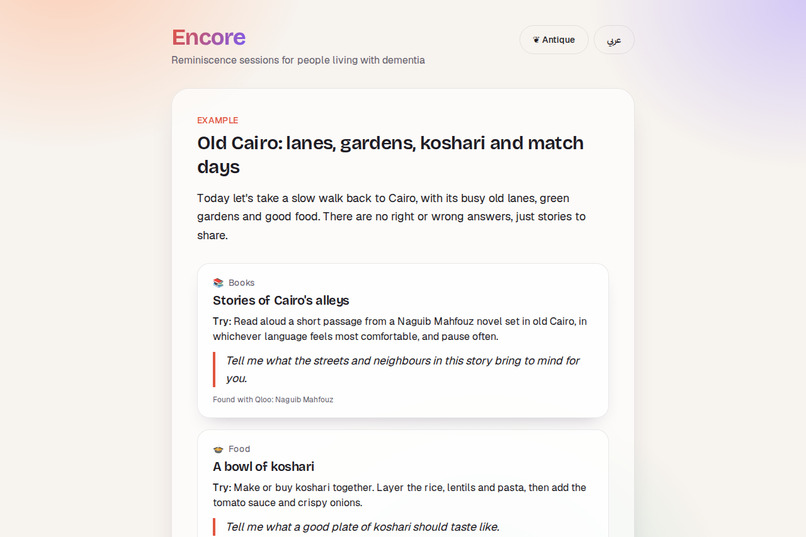
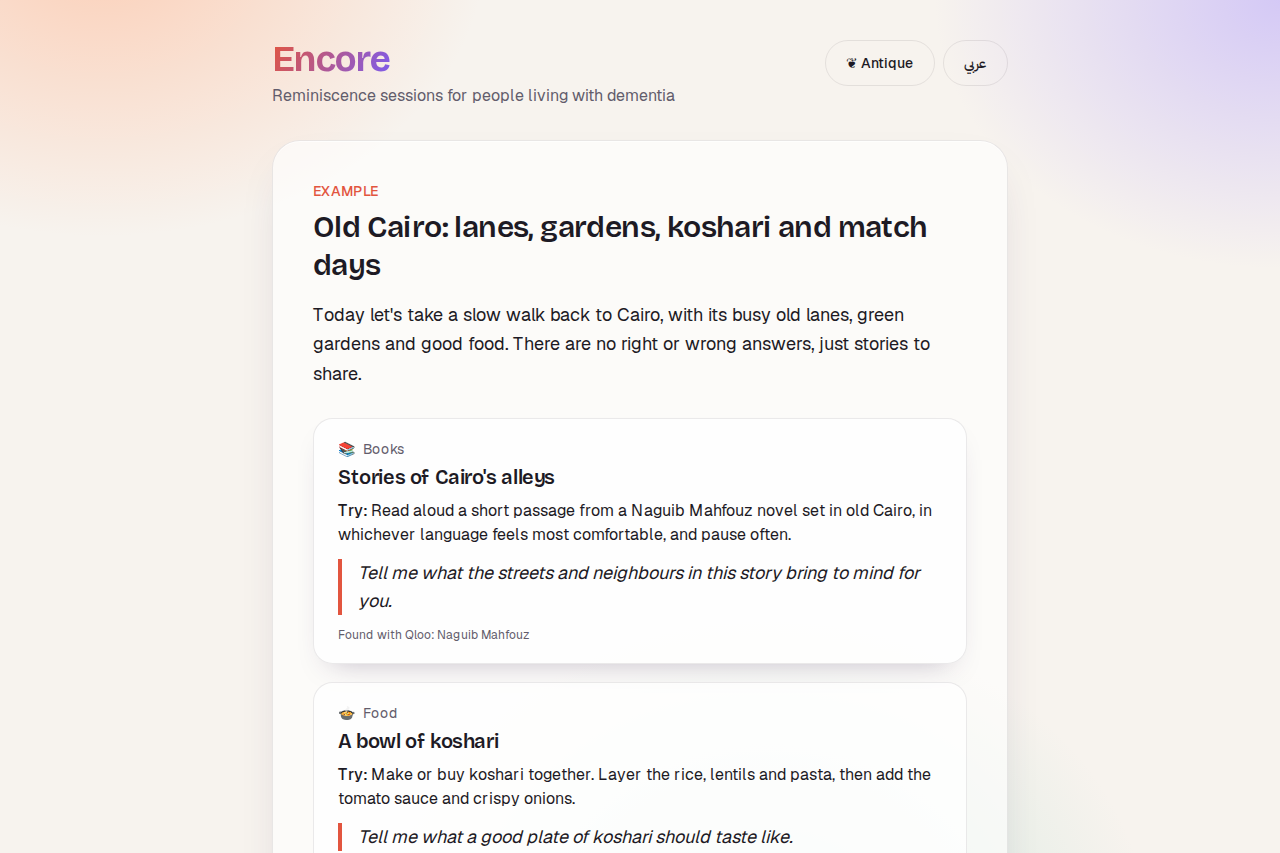
A session card for someone who grew up in 1950s Cairo
-
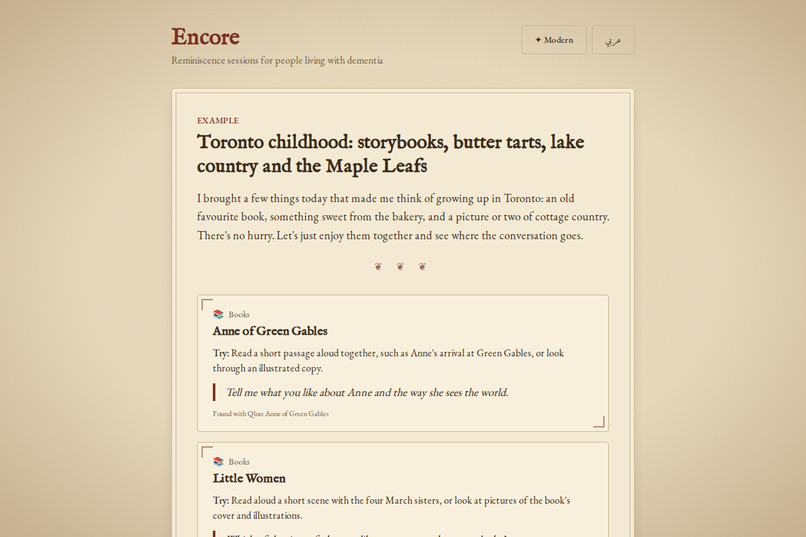
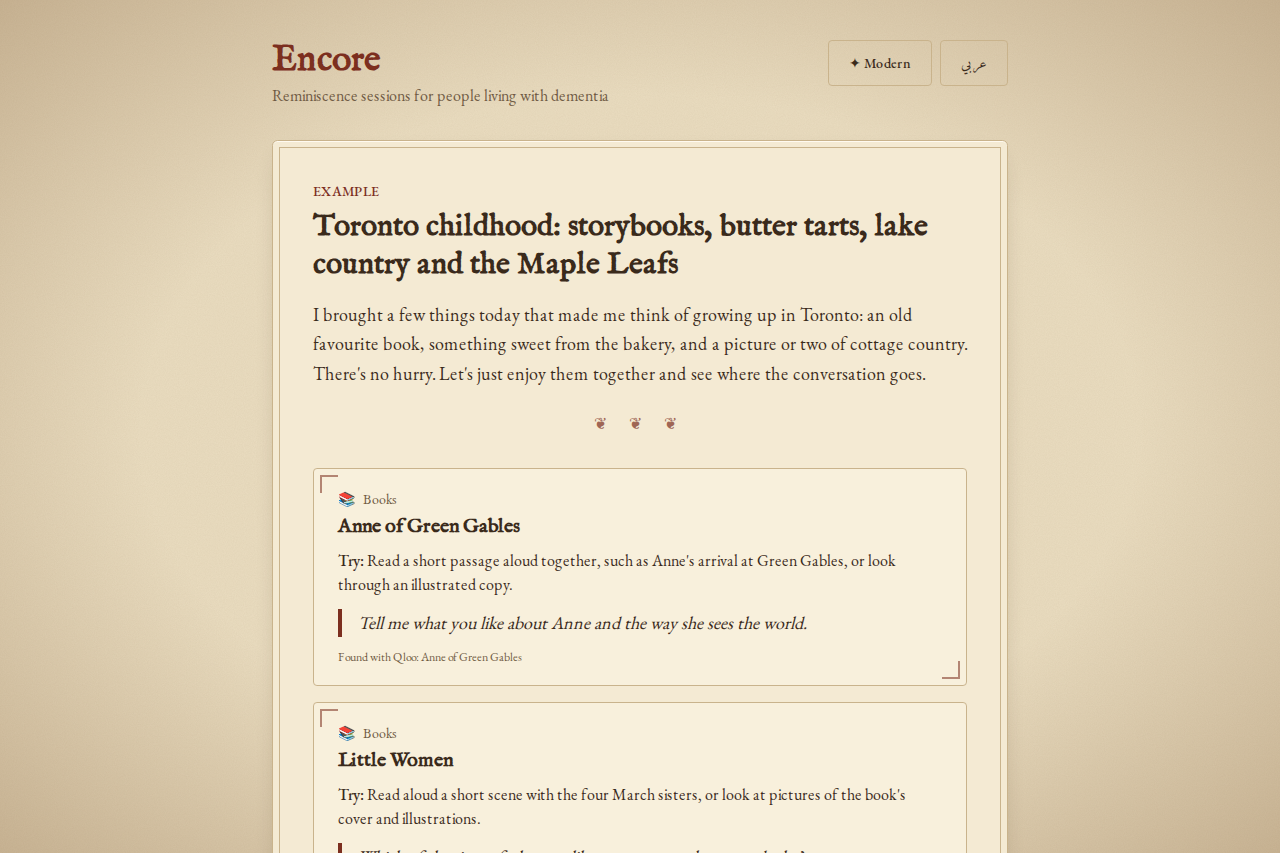
Toronto, 1950s: each prompt names the Qloo entity it came from
-
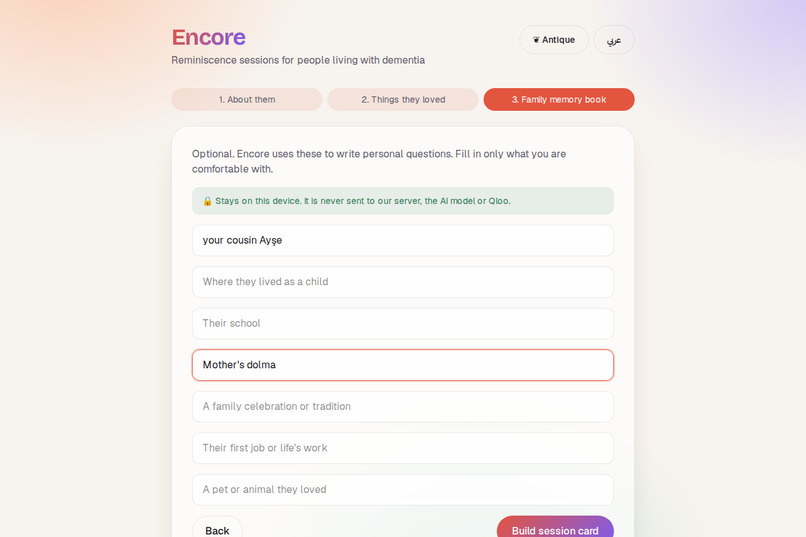
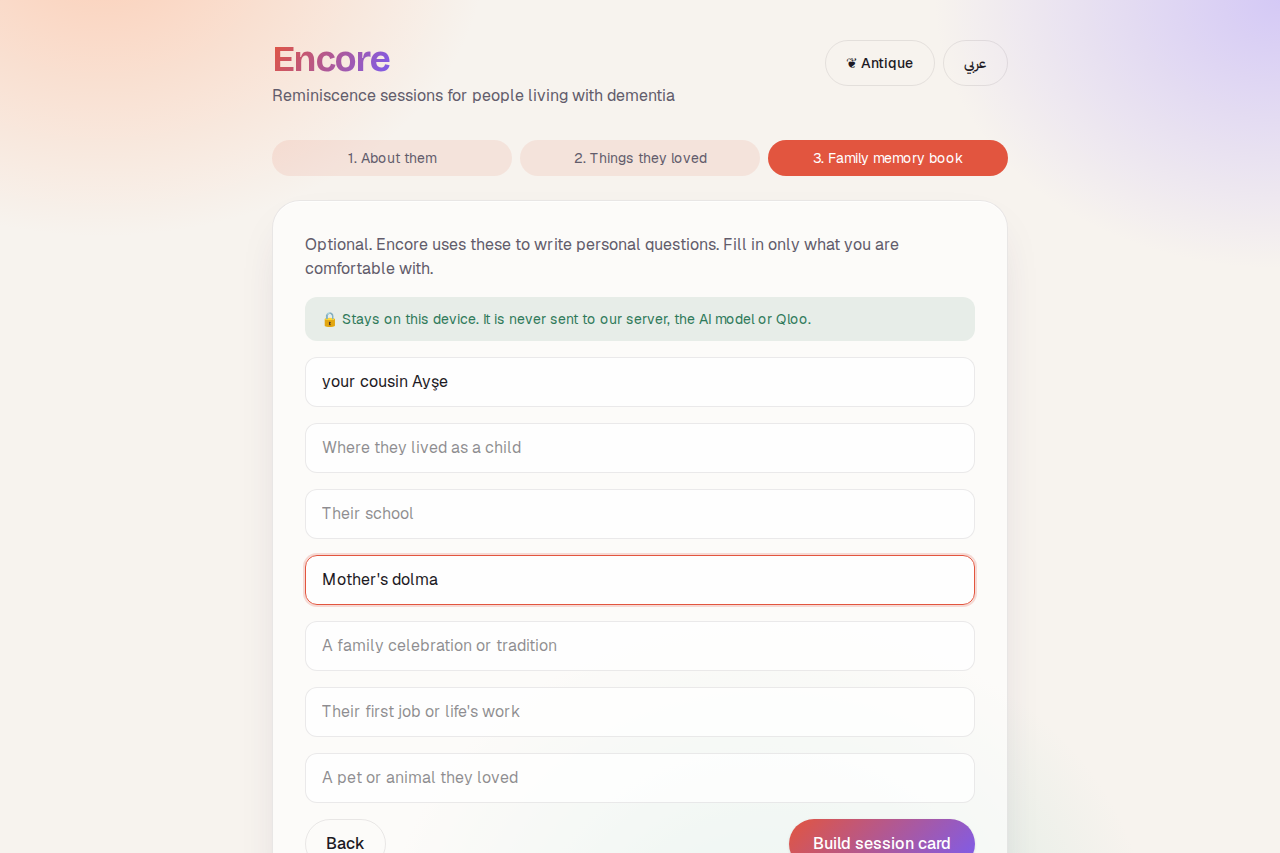
The family memory book stays in the browser and never reaches the server, the AI model or Qloo
-
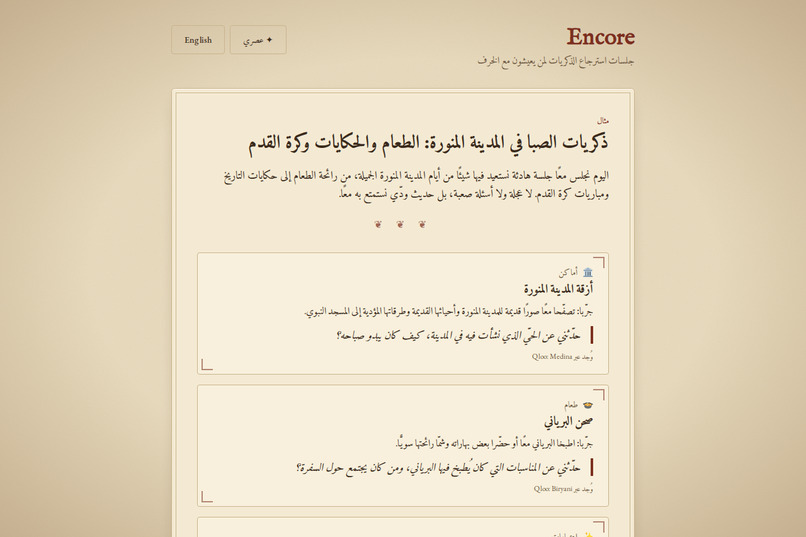
Full Arabic support: a Madinah session card, right to left
-
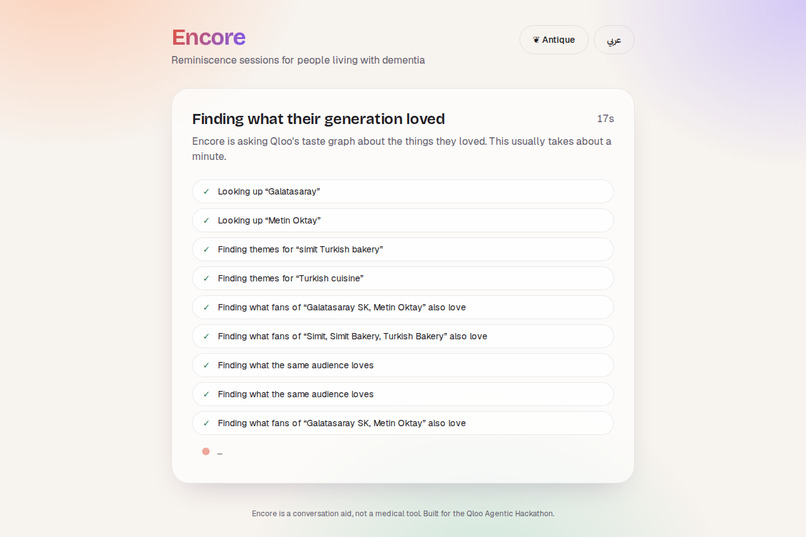
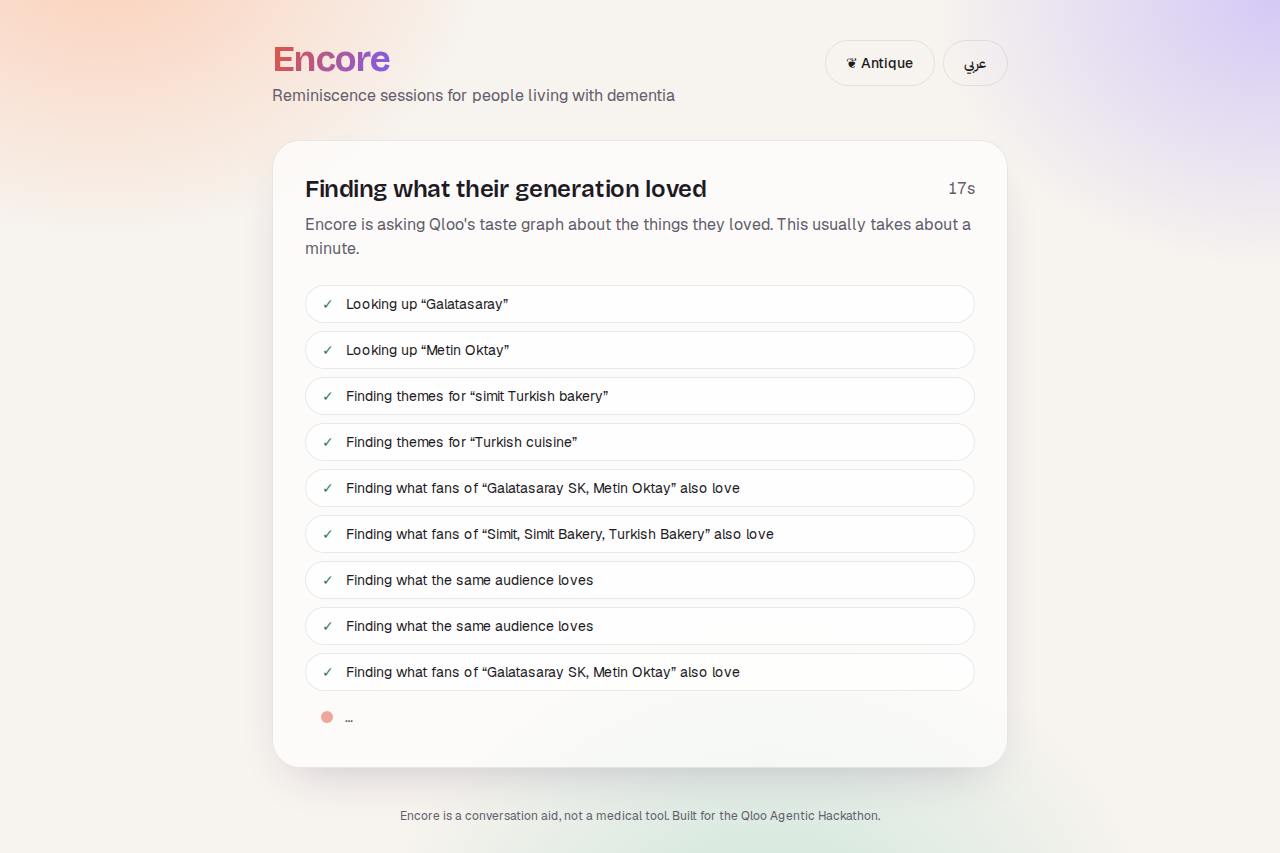
Live view of the agent's real Qloo calls while the card is built
-
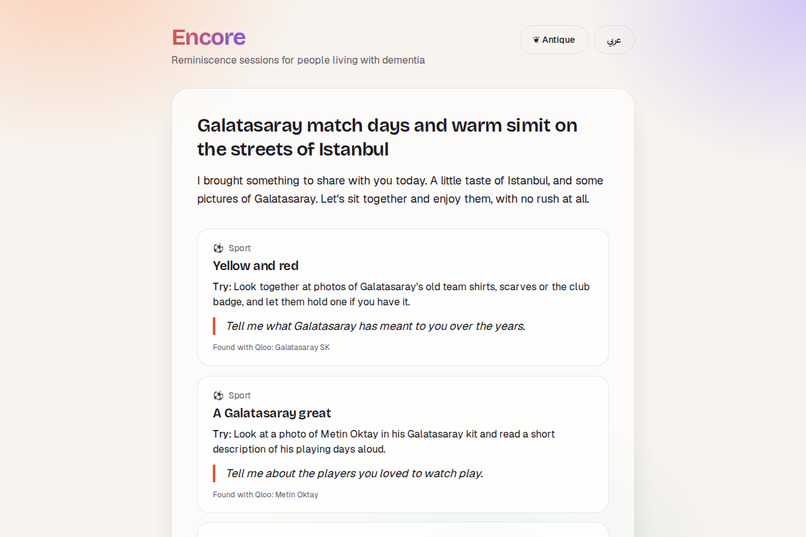
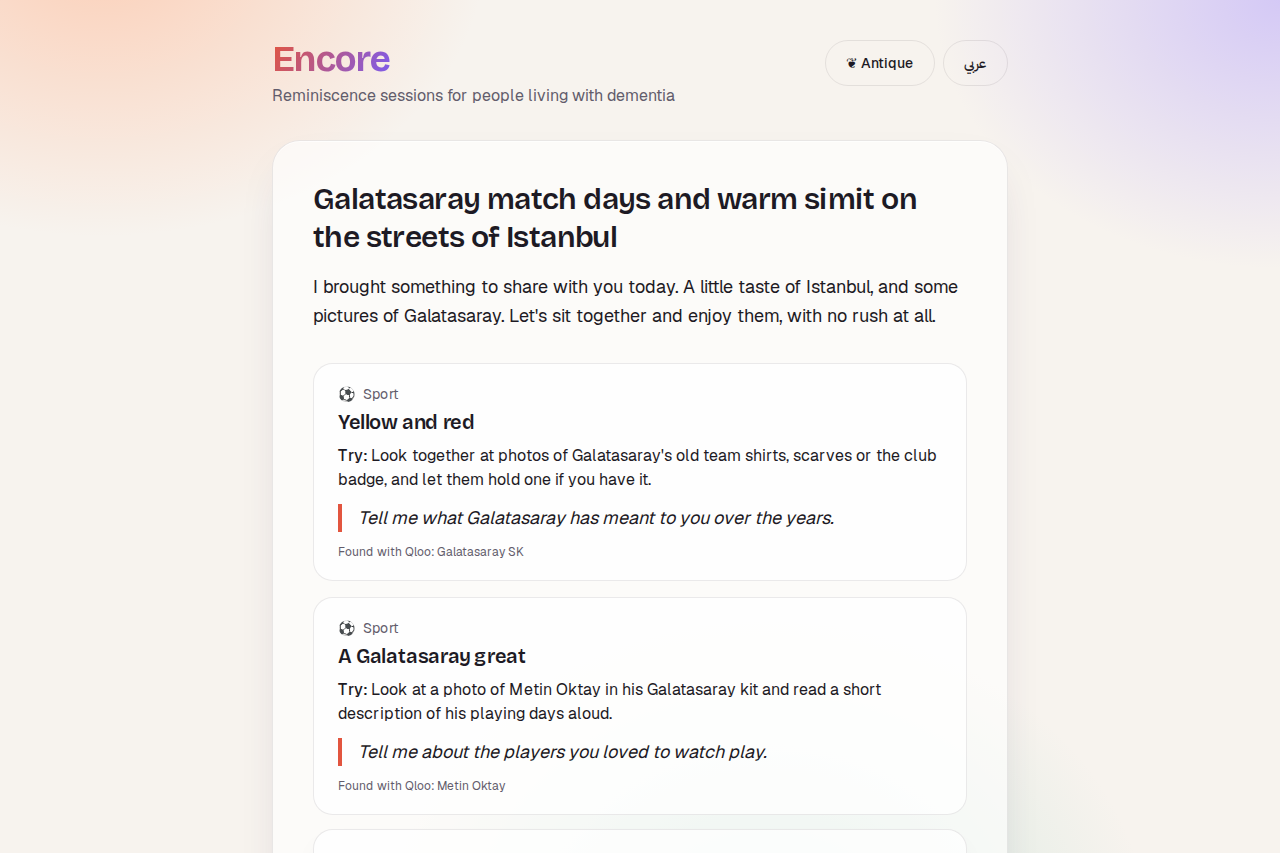
A freshly built card: Galatasaray, simit and Metin Oktay, grounded in Qloo
Inspiration
Reminiscence is one of the simplest ways to connect with someone living with dementia: the books, flavours, places and sport of their youth can bring back stories and a sense of self. Families are told to try it, but they rarely know what someone who grew up in 1950s Madinah, Cairo or Chicago would actually recognise. Ask a general chatbot and you get the same generic nostalgia for everyone.
What it does
A caregiver gives Encore a few public facts: the decade the person was born, where they grew up, and a handful of things they loved (a book, a team, a dish, a place, a hobby). Encore asks Qloo's taste graph what that generation and hometown loved, and writes a gentle session card:
- a theme and a warm opener,
- 5 to 7 prompts, each with a simple activity (read aloud, cook together, look at photos) and one open "Tell me about..." question that never tests memory,
- prompts from the family's private memory book,
- tips for the session, and plainly stated limitations.
The card is printable and works in English and Arabic (full right-to-left interface). While it is being built, the caregiver watches the real Qloo calls happen live.
How I built it
- Agent + Qloo MCP. A Next.js server starts the official
qloo mcpserver and gives its tools to the LLM. The research step resolves each loved thing (qloo_describe,qloo_find_tags), then asks the taste graph (qloo_recommend,qloo_where_popular,qloo_rank) with an older audience, the person's hometown asfilter_location, andexclude_tagsfor modern chains. Older and non-Western entities often have no taste data, so it falls back to cuisine, genre, region or occupation tags. - Grounding enforced in code, not just prompts. The server keeps every raw Qloo result. Any card prompt whose source Qloo did not return is dropped; leaked Qloo ids are replaced with the names Qloo returned. The research loop must make at least 3 Qloo calls and at least 2 taste-graph calls before it may finish, and stops at 14.
- Privacy by design. The family memory book (a sibling, a family dish, a childhood home) never leaves the browser. The server only learns which fields are filled in; the model writes placeholders such as
{{relative}}and the browser fills them in. No names are collected and no personal data is sent to Qloo. - Reliable by design. C O 5.5 is the primary model, and a second model takes over automatically if it is unavailable.
- Built for real phones. Each card is built as a server-side job, so if a phone locks or the connection drops, the page reconnects and still gets the card.
- Deployment. A standalone Next.js build runs as a systemd service behind Apache, with the live progress streamed as NDJSON, plus per-IP and concurrency limits.
Why Qloo matters (measured)
Each example card has a With Qloo / Without Qloo switch. Without Qloo, the same AI model with the same profile mostly repeats back what the caregiver typed, and no suggestion has a data source. Across the 8 example profiles:
- 100% of Encore's prompts trace to a real Qloo result (37 of 37), versus 0% without Qloo.
- About 3 times as many new, specific things to talk about beyond what the caregiver typed (1.4 per card versus 0.5): Khan el-Khalili and Orman Garden in Cairo, Wrigley Field in Chicago, Maple Leaf Gardens in Toronto, teh tarik and roti canai in Kuala Lumpur.
- Era fit was equally high both ways, because the plain model mostly restates the caregiver's own era-appropriate words.
Live cards also show How Encore found these: the real Qloo calls behind the card. Full results: docs/BENCHMARK.md in the repo.
Challenges I ran into
- Models that pretend to use tools. In early tests a model sometimes wrote "resolved via qloo_describe" without calling anything. That is why grounding is checked in code against real Qloo results.
- Lookups are not taste. Some runs spent their whole budget looking things up and never asked for recommendations, so the loop now requires taste-graph calls before it can finish.
- Coverage across regions and eras. Qloo knows today's world best. Niche older entities (for example some classic Arabic titles) appear in search but have no taste data, and some city names resolve to the wrong place. Tag fallbacks, country checks and an explicit "youth years" window made cards from Madinah to Toronto work.
- Arabic and right-to-left layout, including mixed Arabic and Latin names.
Accomplishments that I'm proud of
- Grounded, era-appropriate cards for people who grew up in Saudi Arabia, Egypt, Turkey, Malaysia, Brunei, the US, the UK and Canada, in English and Arabic.
- A privacy design where the family's memories never leave their device, yet still appear on the card.
- The live view of the agent's real Qloo calls ("Finding what fans of Galatasaray SK, Metin Oktay also love"), which makes the "why" visible to a caregiver.
- Two looks: a modern 2026 design and an antique, keepsake-style theme with photo-album corners, in English and Arabic.
What I learned
Grounding is a property you have to enforce, not request. And the most useful thing an agent can do for a caregiver is turn "what did they love?" into "what can we talk about today?".
What's next for Encore
- Session memory: the caregiver marks which prompts sparked a reaction, and the next card builds on them.
- Care homes and home-care agencies: activity coordinators run dozens of these sessions a week; Encore can produce a ready plan per resident in a minute, with a printable record of each session.
- More languages and voice read-aloud for caregivers.
- Work with dementia-care professionals to shape prompt guidelines and measure impact.
Encore is a conversation aid, not a medical tool.
Built With
- apache
- claude
- model-context-protocol
- next.js
- node.js
- qloo
- qloo-mcp
- react
- tailwindcss
- typescript
