-
-

-
Pricing
-
Live agents
-
twelve agents
-
build your own agents with safety rails
-
company pages
Inspiration
Enterprises have been handed a new kind of worker and no way to hold it accountable. This is Meridian, an AI-native SaaS for enterprise HR and finance with human oversight. Agents run the work around the clock. When something needs a decision, a question box appears in front of a person. The agents that actually get adopted are narrow. Each one is scoped to a single workflow, runs on the customer's own structured data under the customer's own security model, produces a number the vendor can quote, and stops at a named person before doing anything consequential. They are not assistants. They are governed workers.
That gap became the product. Buyers in HR and finance are not blocked by model capability. They are blocked on governance: who owns this agent, what it can read, what it can do without asking, and whether I can hand the log to an auditor. Nobody was selling the answer to that question, so we built the company that does.
What it does
Meridian is a subscription SaaS platform for enterprises that want AI agents doing real HR and finance work without losing the accountability trail.
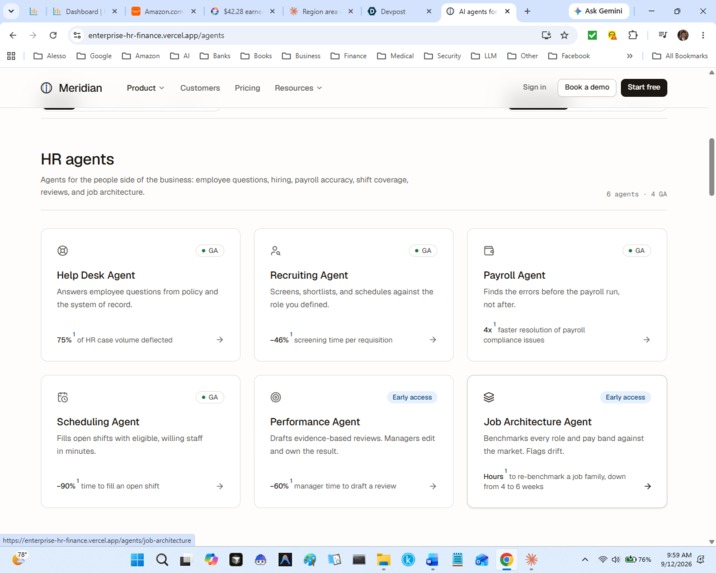
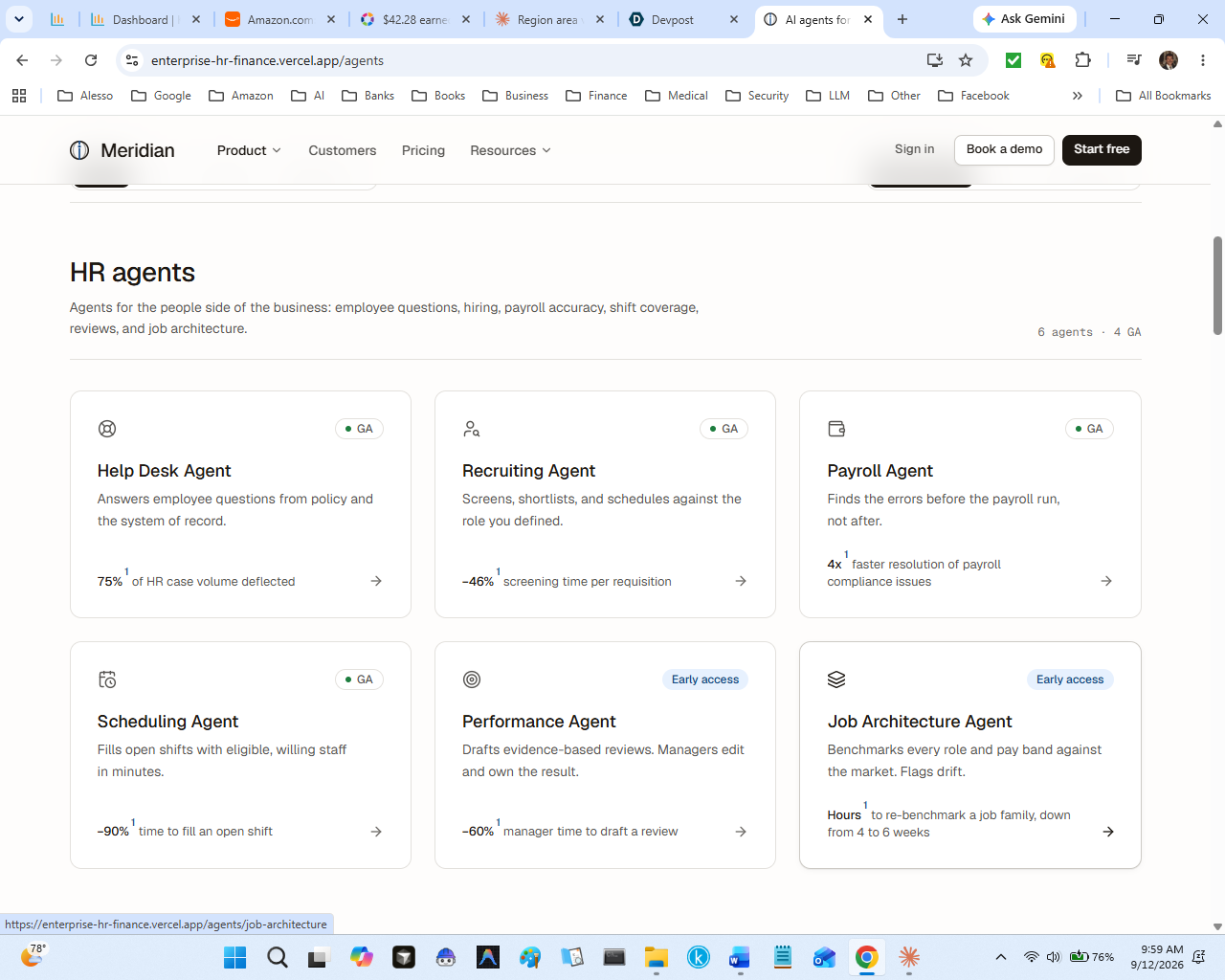
Twelve governed agents, each scoped to one workflow and each carrying a measurable outcome: a Help Desk Agent that resolves employee cases from policy and the system of record, a Payroll Agent that catches missing W-4s and configuration errors before the run, a Controls Agent that tests every transaction for duplicates and policy breaches, a Close Agent that orchestrates month-end, a Contract Review Agent that redlines third-party paper against your playbook. Six more across recruiting, scheduling, performance, job architecture, audit, planning, and revenue contracts.
Currently, two open-source agents of those twelve are running as a demo. They are locally hosted, open-weight LLMs that demonstrate the security concerns commercial companies face in keeping their data proprietary. The Controls Agent tests a population of invoices and raises exceptions with evidence attached; the Help Desk Agent answers a policy question and cites the sections it used. The other ten are specified end to end — data sources, guardrails, credit costs, FAQs — but not yet built, and the product says so rather than implying otherwise. These would become open-source LLMs as more servers become available for full implementation of the system.
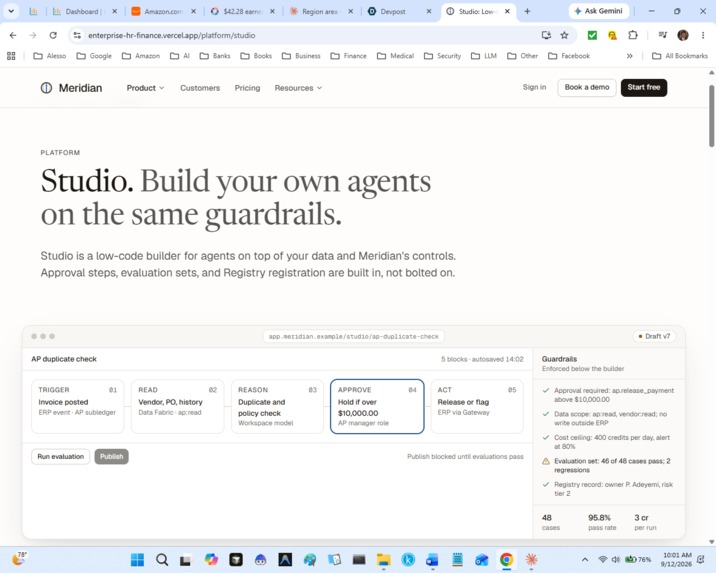
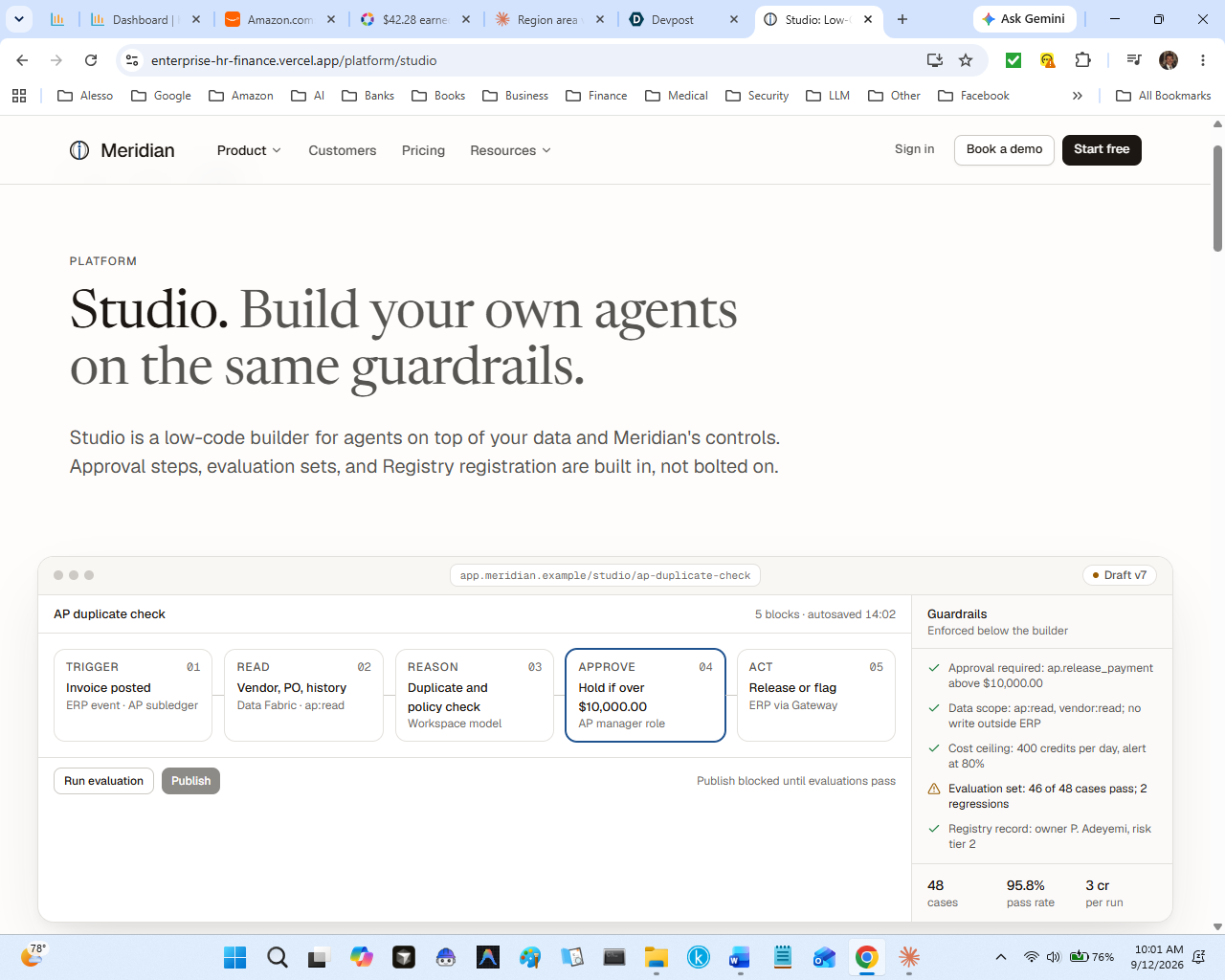
A platform layer that governs all of them. The Registry is the system of record for every agent in the enterprise — Meridian's, a partner's, or one your own team built — recording owner, role, permission scope, data touched, and compliance status, with workforce analytics that count agents and people together. The Gateway connects third-party agents through open standards: Model Context Protocol for tools, agent-to-agent protocols for handoffs, OpenTelemetry for observability, your IdP for access. Data Fabric reads your warehouse zero-copy. Studio is the low-code builder. Assist is the conversational front door.
The agent contract, printed on every agent page and enforced in code: scoped to one workflow, reads only permitted data, every action logged, consequential actions require human approval, measurable outcome, runs on your chosen model.
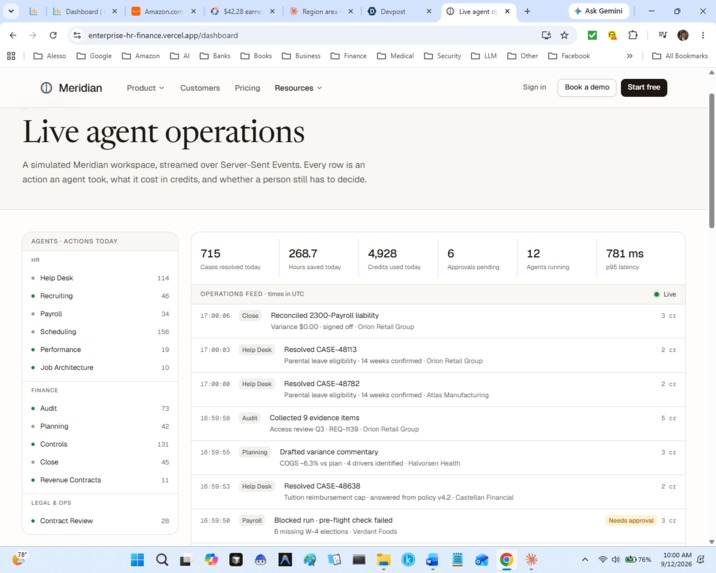
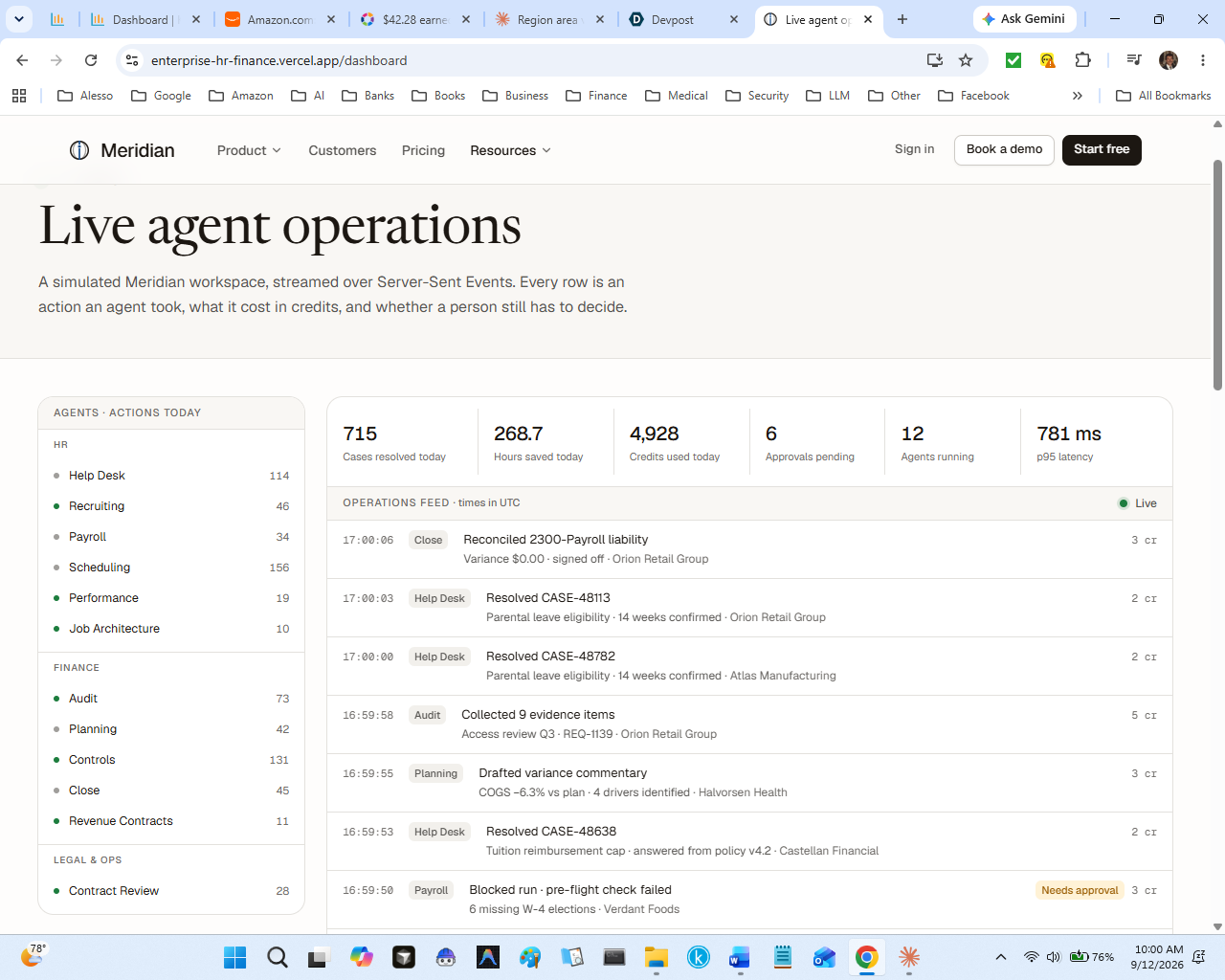
A live operations dashboard at /dashboard that streams a Meridian workspace over Server-Sent Events — the agent roster with today's counts, six live metrics, the operations feed with per-action credit costs, the approvals queue a human still owns, and the credit meter against plan allowance. This feed is a deterministic simulation, separate from the two agents that really run, and the page states that plainly.
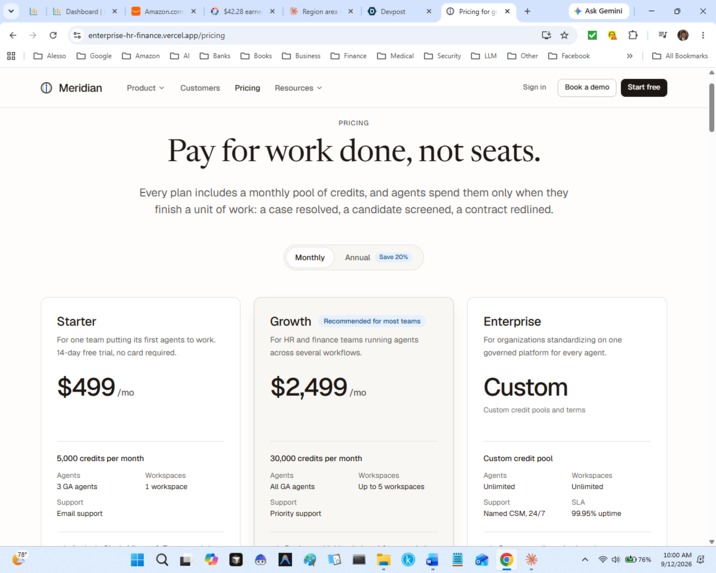
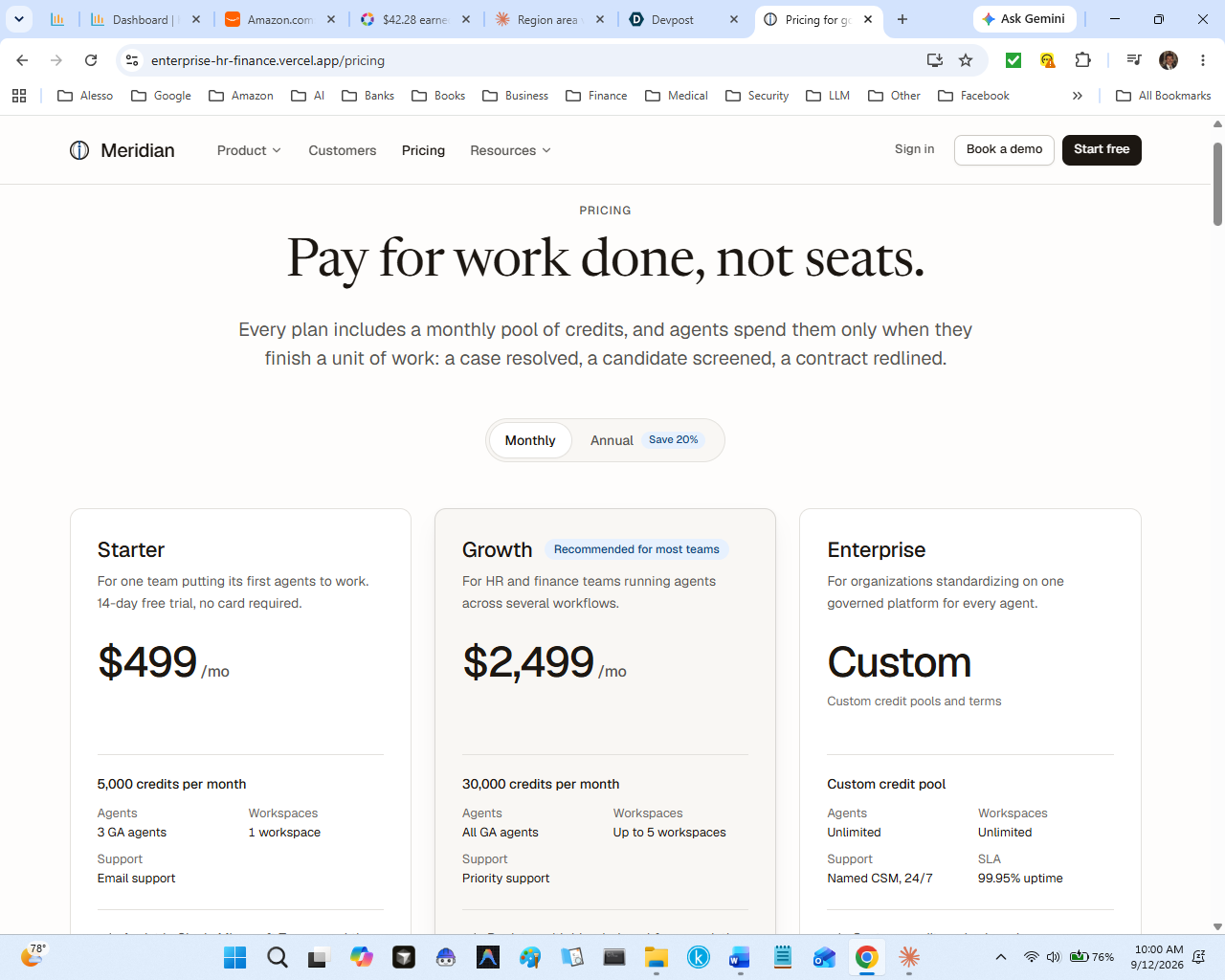
Consumption pricing in credits rather than seats, because when the software does the work, charging per human is charging for the wrong thing. Three tiers with a working calculator that turns your employee count, case volume, hiring rate, and invoice volume into a credit estimate, a recommended plan, and hours saved.
How we built it
Stack. Next.js 16 App Router, React 19, TypeScript in strict mode, Tailwind CSS v4 with CSS-first OKLCH tokens, Three.js via React Three Fiber, Stripe, deployed on Vercel. 29,000 lines of TypeScript across 285 files.
The agent runtime and why the model only gets one job. The product's claim is that a prompt instruction is a suggestion and a permission boundary is a control. The runtime makes that literally true. A run has six stages, and the model participates in exactly one of them:
- Scope — code projects rows onto the agent's declared field allow-list. The invoice fixture carries an approver email, a bank account, and a national ID; all three are physically absent from the context window, not just discouraged by a prompt.
- Retrieve — code settles what it can deterministically. Exact duplicate keys and three-way-match arithmetic never reach the model.
- Reason — the LLM judges only the cases code could not settle, and must return JSON matching a zod schema.
- Decide — a policy engine maps each finding to auto-file, needs-approval or rejected. The model has no vote, and the money-movement rule is checked before confidence, so a confident model cannot talk its way past it.
- Act — nothing consequential executes. There is no code path from a finding to a payment system.
- Log — a hash-chained audit entry per stage: input hash, model id, output, and the policy rule that fired.
Two properties are load-bearing. Deterministic first, so a model outage degrades an agent rather than disabling it. Fail closed, so a missing endpoint or output that will not validate twice puts an error on the run instead of falling back to the simulation or inventing a finding. Evidence is checked against the IDs actually retrieved: a model citing an invoice it was never shown is treated as a hallucination and discarded.
Open weights only, and no vendor SDK. The single integration surface is the OpenAI-compatible chat completions API, so Ollama, vLLM, llama.cpp, Hugging Face TGI, Together, Groq, Fireworks, and OpenRouter all work by changing an environment variable. The repository calls no proprietary model. We verified against Qwen2.5 3B Instruct (Apache-2.0, 1.9 GB) running locally under Ollama, with a triage tier for extraction and a judgment tier for finance decisions.
Rendering. Server Components by default; 165 pages prerender at build time, including every agent, glossary term, article, and case study, plus a generated Open Graph image for each. Only routes that read the clock or a query string render on demand. Every page is complete HTML before JavaScript runs — the home page is 3,000 crawlable words with no client hydration required to read it.
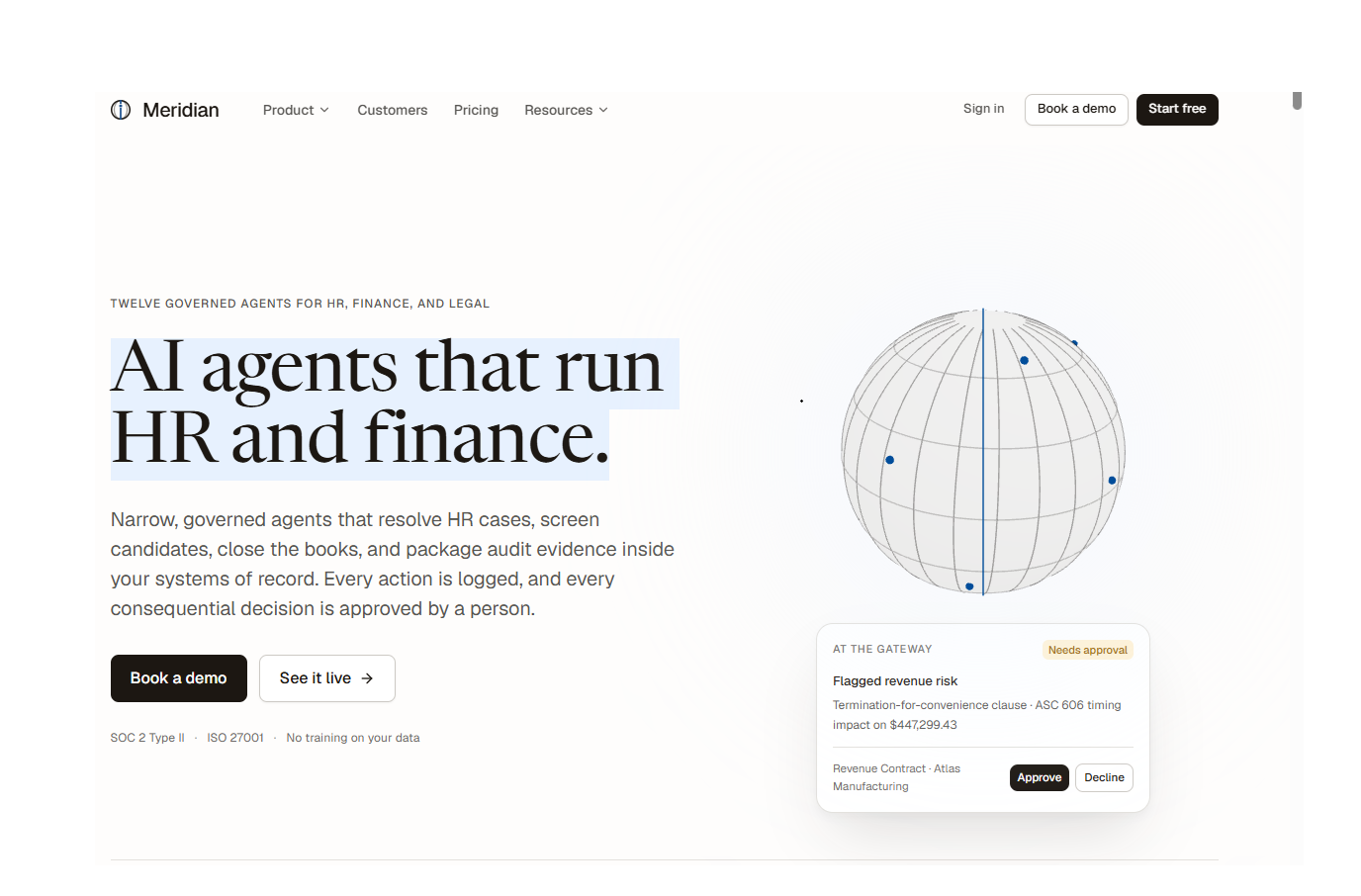
The hero. A globe drawn as a graticule with one accent meridian that does not rotate. Twelve agent nodes travel their own latitudes, and each time one crosses that line, the approval card beneath it changes to what that agent just did and what a person still has to decide. The geometry argues the product. It is gated hard: WebGL mounts only above 768px, without prefers-reduced-motion, with WebGL available, and only once the container is in view and the browser is idle. Everyone else gets a static poster generated from the same constants by a build script. The Three.js chunk is 231 KB gzipped and never blocks the largest contentful paint.
Governance and compliance surface. Security headers (HSTS with preload, nosniff, frame options, referrer, and permissions policy) ship on every response. Stripe runs env-gated with an explicit demo mode, so no key is ever required to exercise the flow, and none is ever exposed. Zod validates input at every endpoint. A trust center documents controls by domain with a shared responsibility matrix, a data-flow diagram, subprocessors, and a security.txt.
Process. The build was orchestrated across parallel AI subagents against a written brief, a design system and a contracts file that specified every interface between modules before anyone wrote code. Quality was enforced by a blind design gauntlet we built for the project: a script screenshots every page from the production build, composites each one side by side with a captured reference page from Stripe, Attio, Ramp, Brex, Mercury, Anthropic, or Harvey in randomized order, and hands the composite to a reviewer who cannot tell which panel is ours. A separate decoder maps the verdict back. We ran it eight times and fixed what it found.
Challenges we ran into
A hydration bug only production could find. The operations feed formatted timestamps with toLocaleTimeString, which renders in the runtime's own timezone. Locally, the server and the browser shared a timezone, and the output matched perfectly. On Vercel, the server runs UTC, the browser runs local, and the two strings diverged — React error 418, invisible through every local test we had. The fix is to read the time straight off the ISO string so both sides emit identical characters. The lesson is that some classes of bug are structurally undetectable until the server and the client genuinely differ.
Accomplishments that we're proud of
The blind gauntlet result. 372 blind side-by-side judgments across eight rounds. The final round went 44 of 51, with perfect records against Attio (9-0), Ramp (10-0), Brex (6-0), Mercury (6-0), Anthropic (3-0) and Harvey (1-0). Asked at the end which set it would ship, without being told which panel was ours, the reviewer chose Meridian — and its single strongest recommendation for improving "the weaker side" turned out to be about Stripe's chat widget covering its own cards.
What we learned
Blind comparison is worth more than any amount of self-assessment. We could not have talked ourselves into the customers page being thin, or the hero being decorative. A reviewer who could not see the answer key told us in one sentence, repeatedly, until we fixed it properly.
What's next for Meridian
Make the agents real. The execution layer is the build the platform was designed around: a worker runtime behind the Gateway, MCP tool definitions per agent, per-agent evaluation sets gating promotion from early access to GA, and an approval queue backed by durable state rather than a simulation.
Built With
- edge-network
- eslint
- geist
- json-ld
- model-context-protocol
- motion
- next.js
- node.js
- oklch
- playwright
- radix-ui
- react
- react-markdown
- react-three-fiber
- recharts
- schema-dts
- server-sent-events
- stripe
- tailwindcss
- three.js
- typescript
- vercel
- zod

Log in or sign up for Devpost to join the conversation.