Inspiration
Every team has a coverage number, and almost no one trusts it. Coverage % treats every line equally - a five-line helper imported by forty modules and a two-hundred-line script nobody calls count exactly the same. So teams either chase 100% (expensive, low value) or ignore the number and the genuinely dangerous gaps, widely-depended-upon functions with no tests, hide in plain sight. GitLab Orbit already knows the dependency structure of the codebase. We realized that structure is exactly the missing signal: fan-in tells you which untested code is worth testing first.
## What it does
Test Cartographer turns the GitLab Orbit code graph into a prioritized testing worklist:
- Enumerates every function/method (
Definitionnodes) in a project. - Measures dependency fan-in by aggregating
ImportedSymbolusage across the graph - how many files depend on each symbol. - Detects tests graph-natively - a function is "tested" if a test file imports it (not a filename guess).
- Ranks by risk =
fan_in × untested(private symbols damped), so the most-depended-upon untested function floats to the top. - Generates the missing unit tests for the top items and opens a merge request.
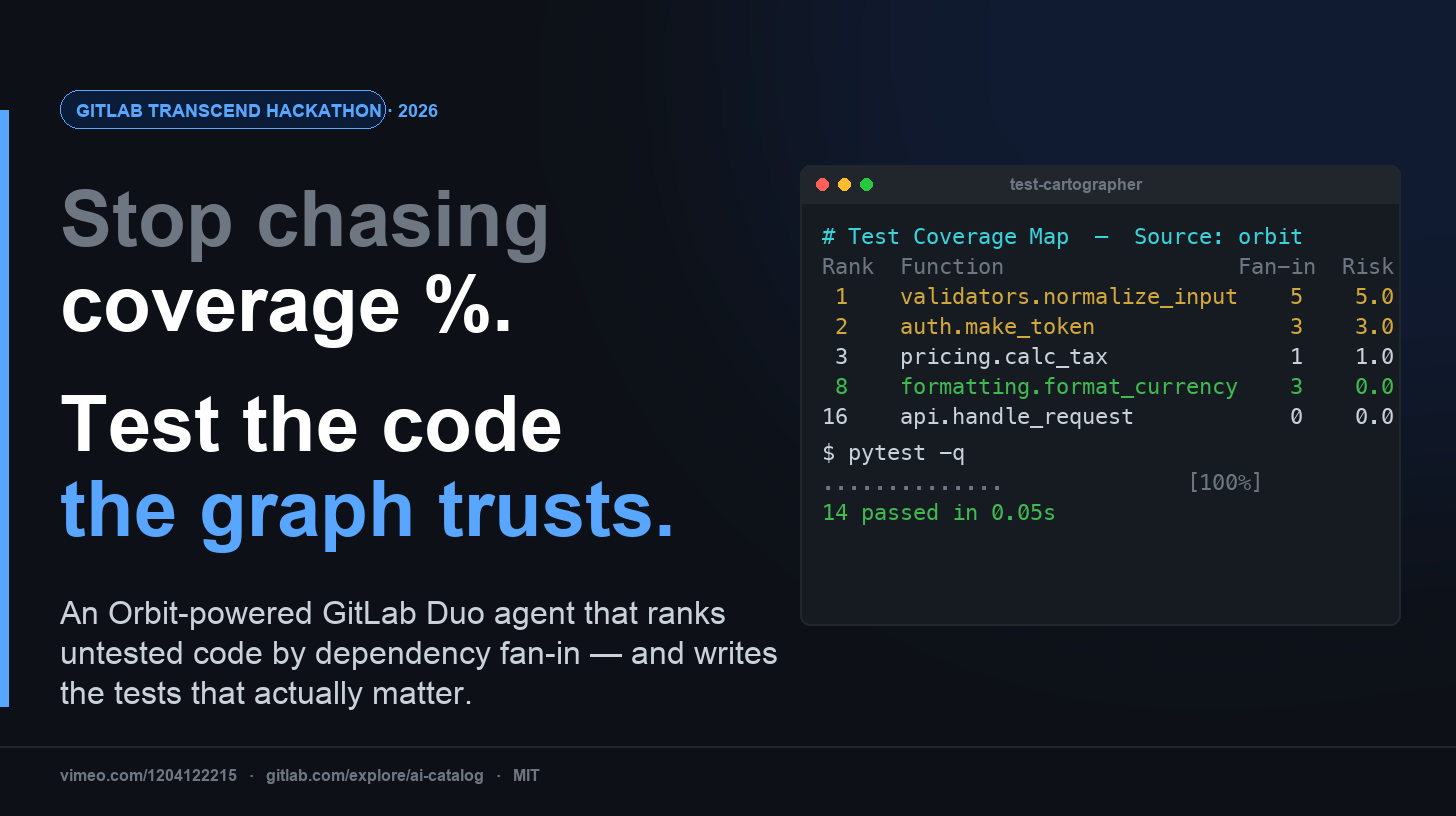
The output is a structured Test Coverage Map, not open-ended chat. On our demo project it ranks normalize_input (imported by 5 modules, untested) #1 and make_token (imported by 3) #2 - while correctly excluding format_currency (high fan-in but already tested) and deprioritizing handle_request (untested, but nothing imports it, so a test there is low-leverage). That last contrast is the whole point: untested ≠ risky; fan-in is what matters.
After Test Cartographer's procedure produces the missing tests and Orbit re-indexes the project, the same query confirms the loop closed: normalize_input and make_token flip to tested, risk 0, in the live graph.
## How we built it
- GitLab Duo Agent Platform — a code-defined agent (
agents/test-cartographer.yml) published to the AI Catalog, backed by a reusable skill (skills/test-cartographer/SKILL.md) that encodes the procedure and the risk formula. - GitLab Orbit — queried through its v2 graph DSL: a
traversalto listDefinitions, anaggregationoverImportedSymbolbyidentifier_namefor fan-in, and a test-file traversal for coverage detection. Every query isproject_id-scoped (Orbit is user-scoped). - Model - Anthropic Claude (provided by the Duo platform; we bring no key).
- Publishing - the official
ai-catalog/catalog-syncCI component publishes the agent on a Git tag (0.1.0). - Resilience - a dependency-free local AST scanner (
tools/local_ast_scan.py) reproduces the same ranking from the working tree, so the workflow still works on an unmerged branch (Orbit indexes the default branch) and is labelledsource: local_astvssource: orbit. - Demo corpus - a small layered Python library with intentional, provable test gaps so the ranking is verifiable, not hand-waved.
## Challenges we ran into
- Orbit indexes the default branch asynchronously, so a freshly pushed branch isn't instantly queryable. We added the local AST fallback and label every finding's source.
- The graph's
IMPORTS/CALLSedges toDefinitionaren't always resolved, so edge-based fan-in under-counts. We discovered (by querying live data) that aggregatingImportedSymbol.identifier_nameis the dependable signal, and built on that. - The AI Catalog schema is strict - agents don't take a
skillskey, tool names must come from a fixed allow-list, and group enablement is handled by the CI component (not a duplicatedconsumersblock). We iterated against the validator until the agent published cleanly. definition_typevalues are case-sensitive in the graph ("Function"/"Method", not lowercase). Filters silently returned zero rows until we matched the casing.
## Accomplishments that we're proud of
- The thesis is demonstrably real on live Orbit data, not mocked: the ranking, the tested/untested detection, and the low-rank-entrypoint contrast all come straight from the graph.
- It closes the loop — it doesn't just report gaps, the procedure produces working tests (committed in
tests/test_validators.pyandtests/test_auth.py, all 14 tests pass). - One-command publish to the AI Catalog via CI; the agent is live and public in the Catalog.
- A genuine before / after verifiable in the live graph: re-indexing confirms the gaps were closed.
## What we learned
Graph topology is an underused signal in everyday dev work. The same fan-in idea that powers blast-radius analysis is, flipped around, a test prioritizer. Orbit makes that a few queries rather than a research project. We also learned to validate against the live API early - the schema's real behavior (edge resolution, value casing, validator strictness) differs from what the docs suggest, and only running real queries surfaces it.
## What's next for Test Cartographer
- Multi-language fan-in (Orbit already indexes Go, Ruby, TS, etc.).
- Symbol-level precision using resolved
CALLSedges as they mature. - MR-triggered mode: rank only the functions a merge request touches and post the map as an MR note before review.
- A coverage-debt budget in CI: fail the pipeline if a high-fan-in function lands untested.
- Auto-MR with generated tests as a turnkey component, so any project can adopt the loop with one tag.
Built With
- agent
- gitlab-duo
- gitlab-orbit
- pytest
- python
Log in or sign up for Devpost to join the conversation.