-
-
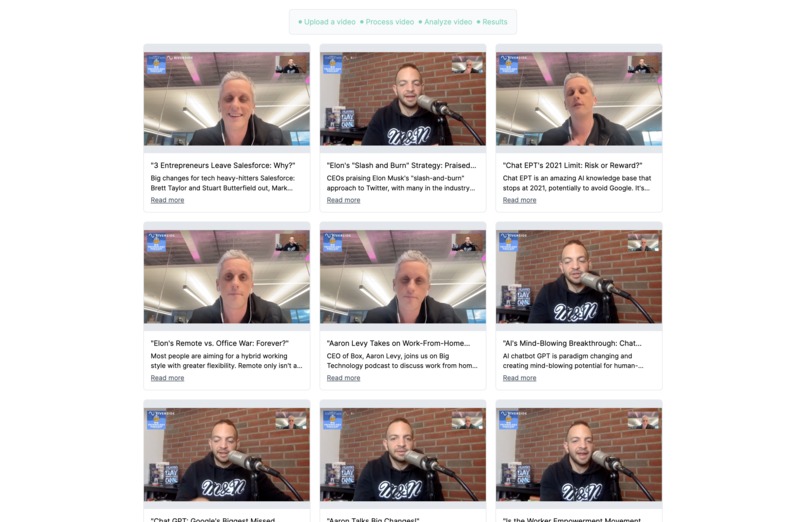
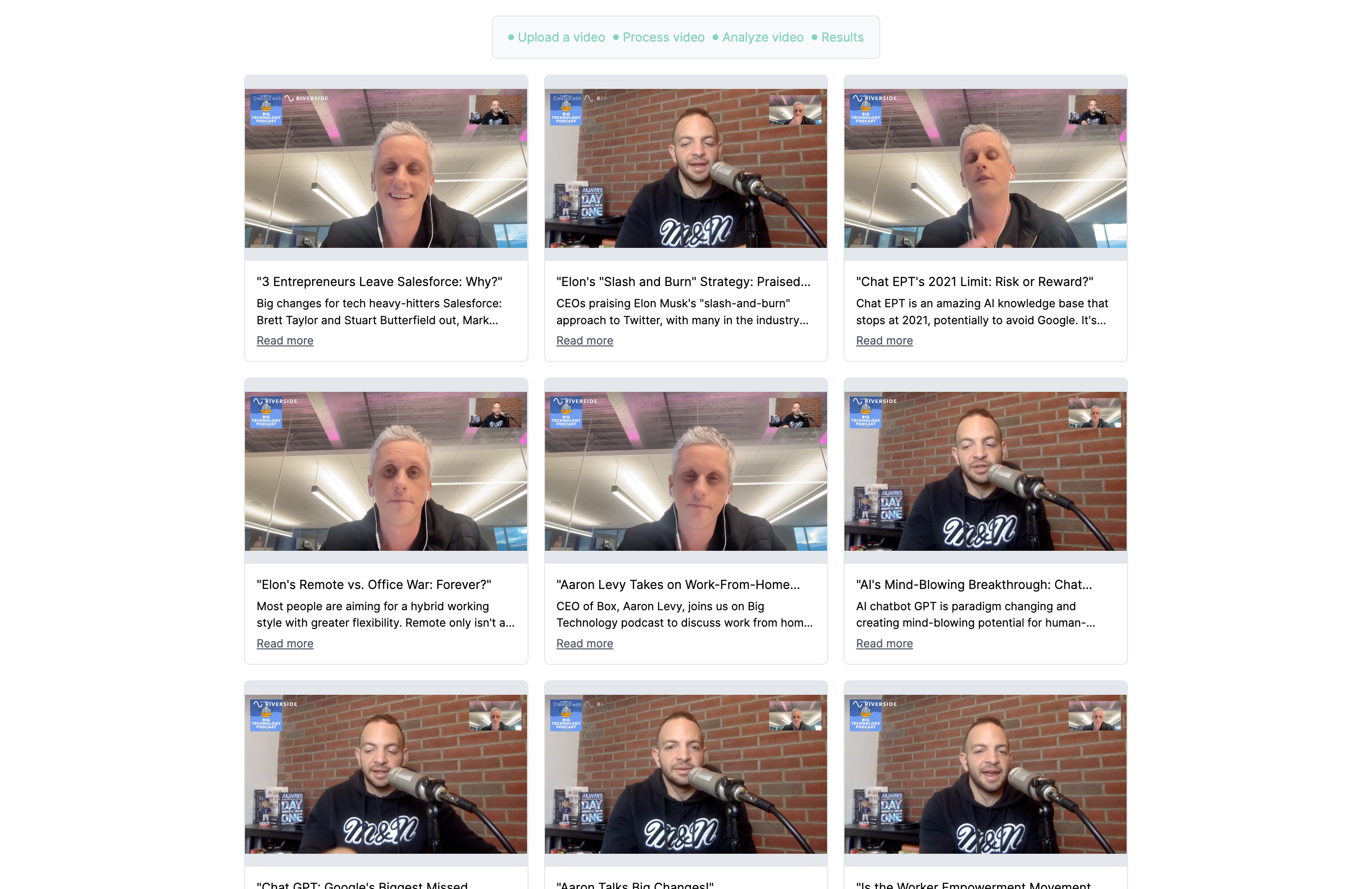
10-20 clips are automatically generated for every 60mins of video.
-
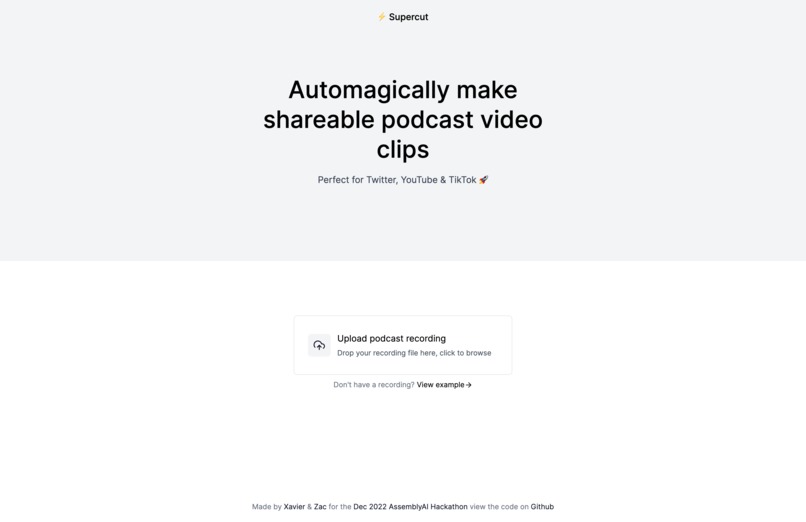
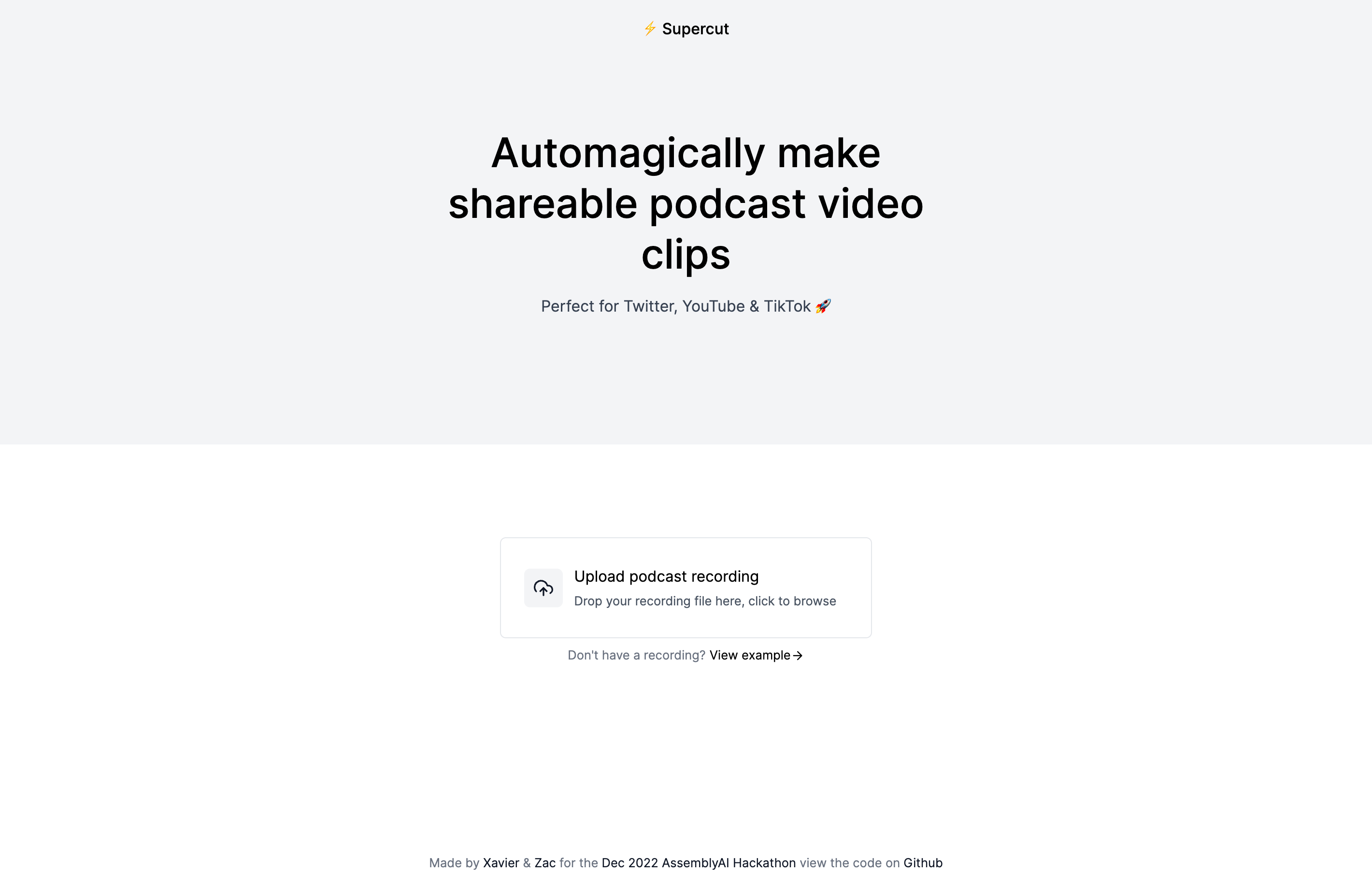
The Supercut home screen - upload a podcast recording and get clips!
Problem
Imagine you’ve just recorded a podcast, and now you’re thinking… “Wow, this is a great episode, wouldn’t it be great to quickly share a clip of this podcast on Twitter”
You go to create a clip, you have to re-watch the entire recording, find the interesting moments, then download and learn software to clip the videos…
Wouldn’t it be great if there was an AI that worked for you, almost like a personal video editor?!
Solution
Introducing Supercut, your personal autonomous clip maker. Simply upload a podcast video recording, and Supercut will create the clips for you. Even generating Tweets for you to post alongside your clips!
Inspiration
We've been creating podcast clips for tech/business podcasts, including Lenny's Podcast, for the last 3-4 months. We thought, wouldn't it be cool if an AI could do this?
What it does
Supercut uses AssemblyAI and OpenAI to detect chapters in videos, automatically clip those chapters into short new videos and then generate Tweets for those videos.
How we built it
- The website is built with NextJS and hosted via Vercel.
- When a user uploads a video, it is stored in Mux.com
- When Mux finishes processing the video file, a webhook triggers a transcription and auto-chapter via AssemblyAI.
- When AssemblyAI finishes transcribing/chaptering the video, the results are posted to our Supabase database.
- On insert, Supabase triggers a webhook that takes each video chapter start & finish timestamp and clips the original video, creating a new video, which is stored in Supabase.
- This new video clip contains the summary from AssemblyAI, which is then sent to OpenAI with a custom prompt to create a “headline” and a “Tweet” for each clip.
- These Tweets and headlines are then stored in the Supabase database.
- The outcome is between 10-20 clips for every 60mins of podcast recordings you upload.
Challenges we ran into
Supercut has to feel like magic.
Every other video editing software/tool has a steep learning curve. We wanted Supercut to feel almost like you had a personal editor working for you. This meant the interface/experience had to be incredibly simple to use, with zero learning curve.
As simple as:
- Upload a podcast recording.
- Automatically receive short video clips.
This simplicity created 2 challenges:
Challenge 1: UX/Design challenge
The app currently takes 1-2x the duration of the recording to generate the clips. We needed to have a simple and effective way to convey what is happening so that: a) A user knows what to do. b) When to expect results and what results to expect.
Solution: We designed a 4-step status indicator that updates in real-time to show how the clipping process is working.
Challenge 2: Engineering challenge
We needed to have multiple API’s all work together nicely in unison, providing real-time updates to the web app.
Solution: Store the state of the process in a real-time database and use webhooks to trigger each event when the previous event had completed.
Accomplishments that we're proud of
- We're proud that we worked on solving a real pain point and focussed on usability as much as the tech.
- We're proud that, as a team of 2, we set a clear objective and produced a working MVP in 2 days.
What we learned
- This is a proof of concept that clearly has a long way to go before it can substitute human edits. But they are better than we expected, and after building this MVP, we think there is a reasonable path to a fully autonomous editor.
- We'd need to work on the prompt for OpenAI and refine a model to truly generate effective tweets.
- We didn't have time to optimize the video processing time, so currently, the clip generation takes 1-2x the duration of the original recording. Ideally, with more time, we could make it much faster.
What's next for Supercut
- The first thing we want to test is if someone is willing to pay for this. We’re going to add a Stripe payments form on Monday.
- We’d like to know what features people care about. For example, do they want captions on the videos? Do they want the videos to be resized for TikTok or other platforms?
Built With
- assemblyai
- mux
- nextjs
- openai
- supabase
- vercel


Log in or sign up for Devpost to join the conversation.