-
-
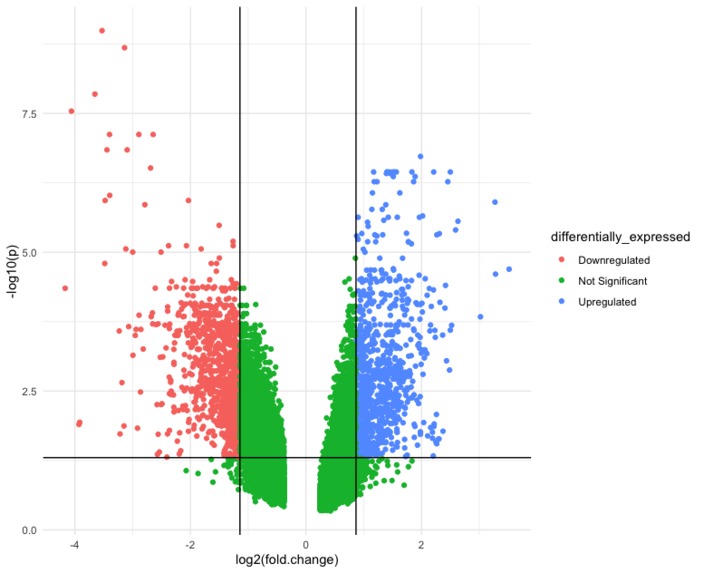
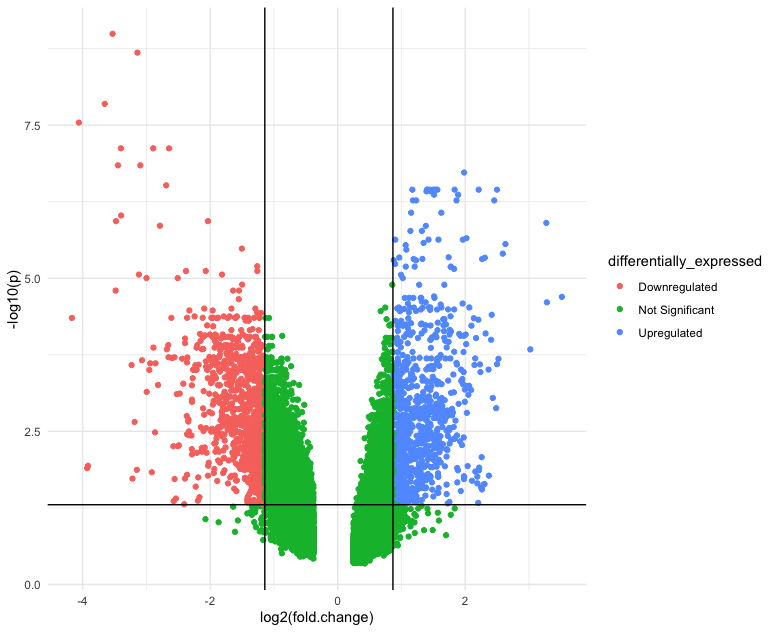
Volcano Plot of Differentially Expressed Probes
Inspiration
I was inspired to do this project because my grandmother has Parkinson's disease. After learning that neuromelanin-containing dopaminergic neurons in the substantia nigra pars compacta are lost in this disease, and that high neuromelanin levels in the brain are closely linked to the disease, I became intrigued about the role neuromelanin may play in the progression of Parkinson's. However, the process of neuromelanin formation is not completely understood, which prevents any significant advances in understanding the molecular link of Parkinson's and neuromelanin. Interestingly, by reading scientific literature, I learned that not all dopaminergic neurons contain neuromelanin—in fact, there is an entire population of dopaminergic neurons that do not contain neuromelanin (and also do not die in Parkinson's disease) in the ventral tegmental area. As a result, I figured that performing differential expression analysis between the substantia nigra pars compacta and the ventral tegmental area could provide some transcriptomic clues about the formation of neuromelanin.
What it does
The software developed uses data from the Allen Human Brain Atlas to identify genes that are significantly upregulated or downregulated in the substantia nigra pars compacta with respect to the ventral tegmental area. It can be run by downloading the "all_code.R" file from the GitHub repository and running the code in R or RStudio.
How I built it
The software was developed using RStudio. Details about the individual steps taken to perform the analysis can be found in the GitHub repository under "NucleoTIDE Hackathon Project Documentation.Rmd" or "NucleoTIDE-Hackathon-Project-Documentation.pdf".
Challenges I ran into
The differential expression analysis data downloaded from Allen Human Brain Atlas contained p-values and fold changes for individual microarray probes, not individuals genes. This meant the probes needed to be aligned to individual genes. Doing so required probe expression data from all brain regions, which had to be downloaded from Allen Human Brain Atlas. I had to add an extra section of code in order to do this, and it also took a long time for the computer to filter through all the probe and assign them to genes (~5-7 minutes just for that part of the code).
Accomplishments that I'm proud of
I was able to identify 696 genes that are either significantly upregulated or downregulated in the substantia nigra pars compacta with respect to the ventral tegmental area. The upregulation and downregulation of these genes may contribute to the formation of neuromelanin.
What I learned
I learned that one of the genes coding for an enzyme that has been experimentally shown to be inversely related to neuromelanin levels (SLC18A2, coding for VMAT2) is upregulated in melanized brain regions (i.e., the substantia nigra pars compacta). Interestingly, this contradicts previous results, and suggests that although VMAT2 allow may decrease neuromelanin levels, its action alone does not contribute to changes in neuromelanin levels.
What's next for the project
Further analysis would include assigning gene ontology terms to the 696 genes, and also performing gene set enrichment analysis to determine other molecular mechanisms and pathways that may contribute to neuromelanin formation.
Built With
- allen-brain-atlas
- r
- rstudio

Log in or sign up for Devpost to join the conversation.