-
-
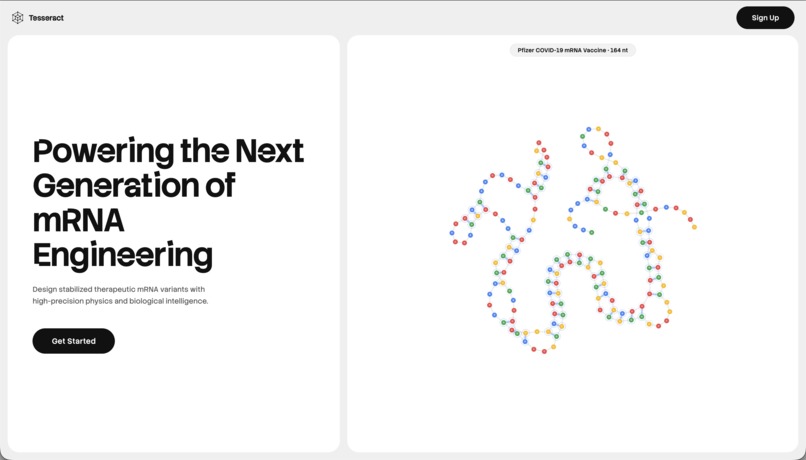
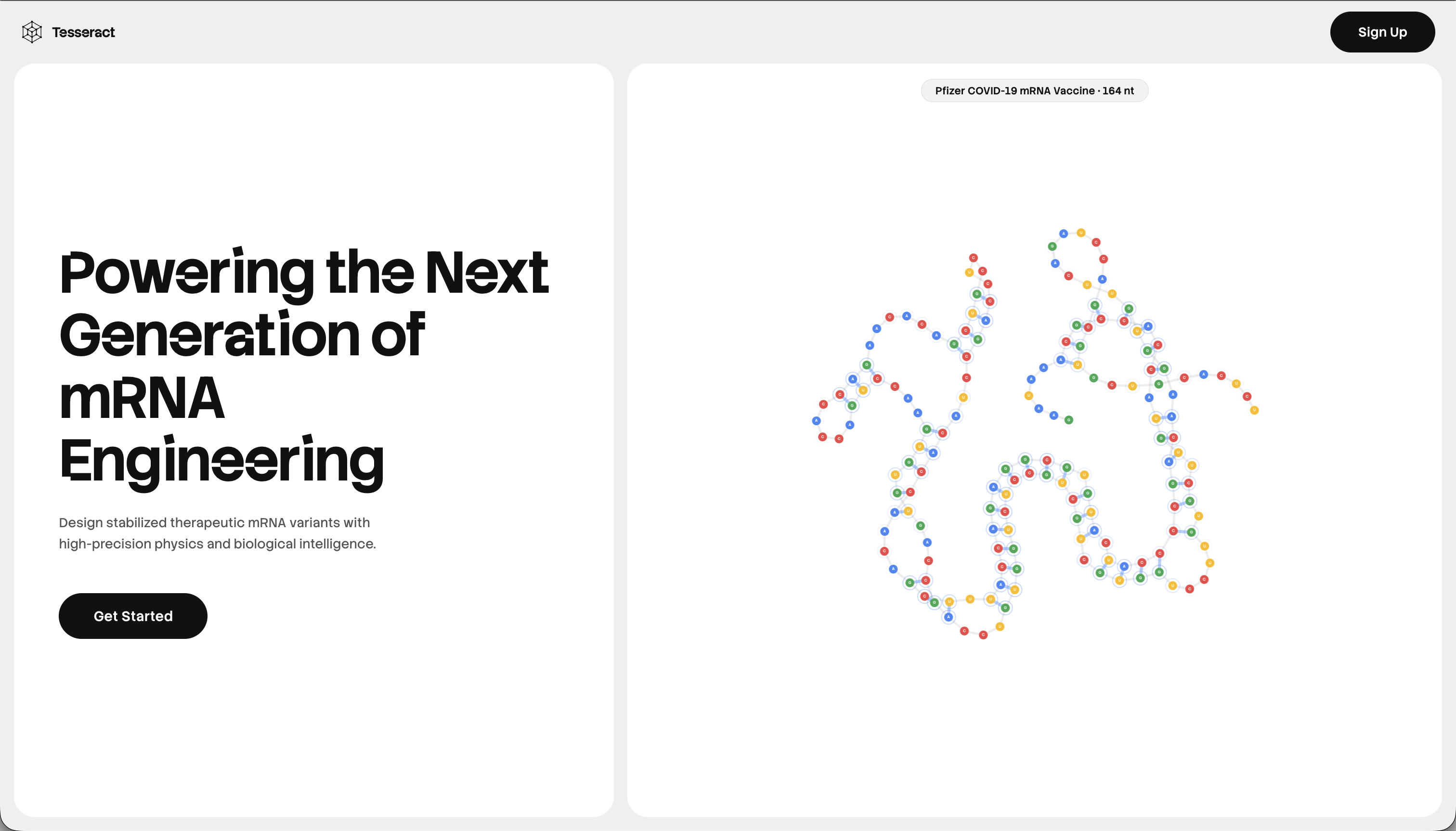
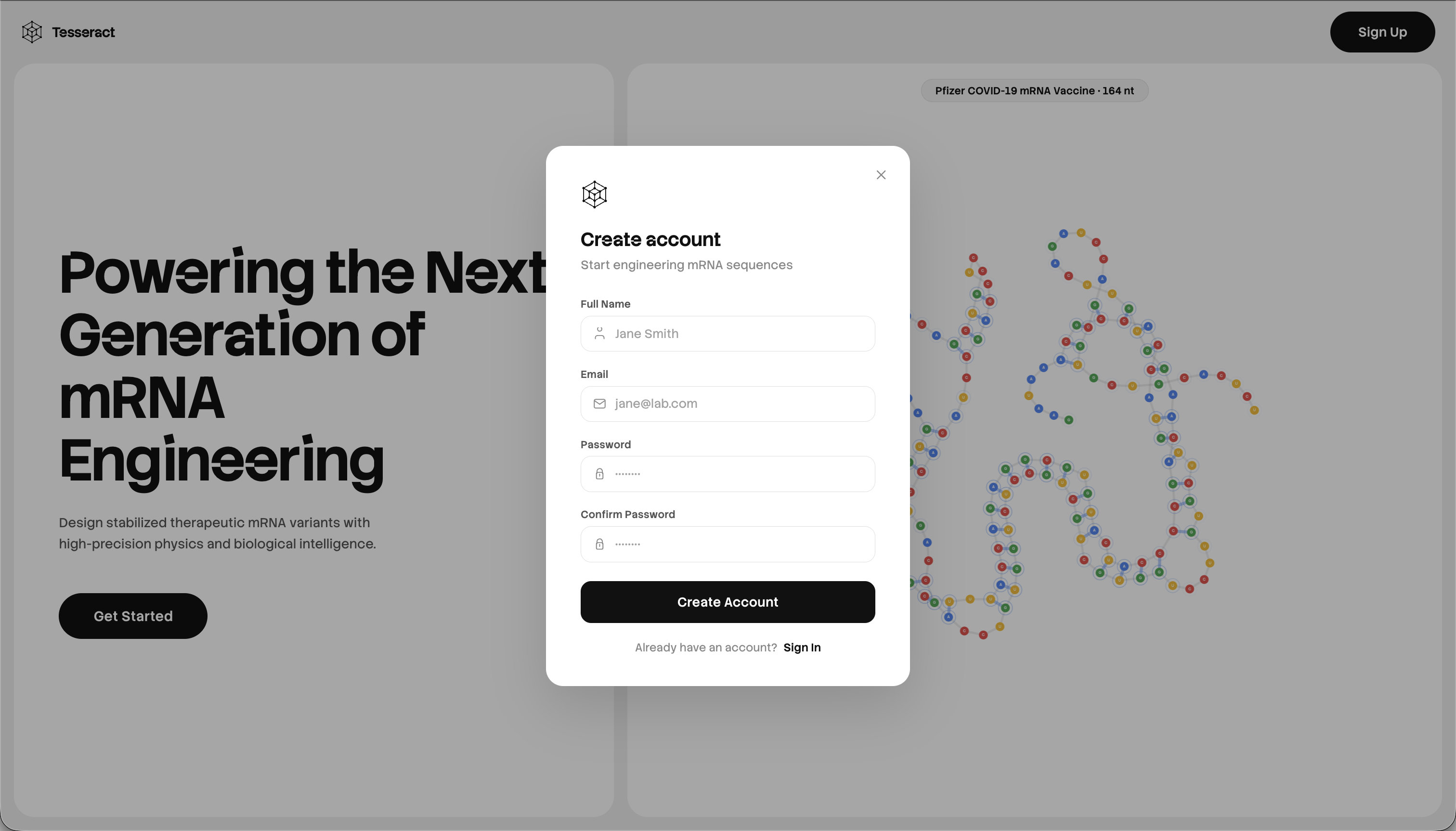
Landing Page
-
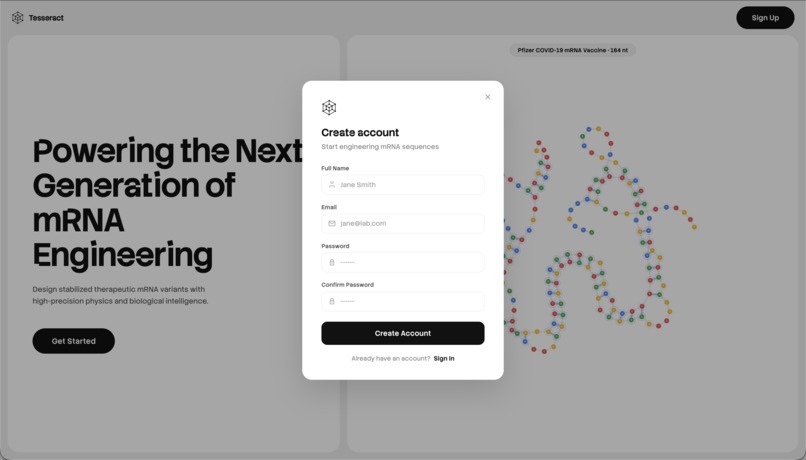
Sign Up
-
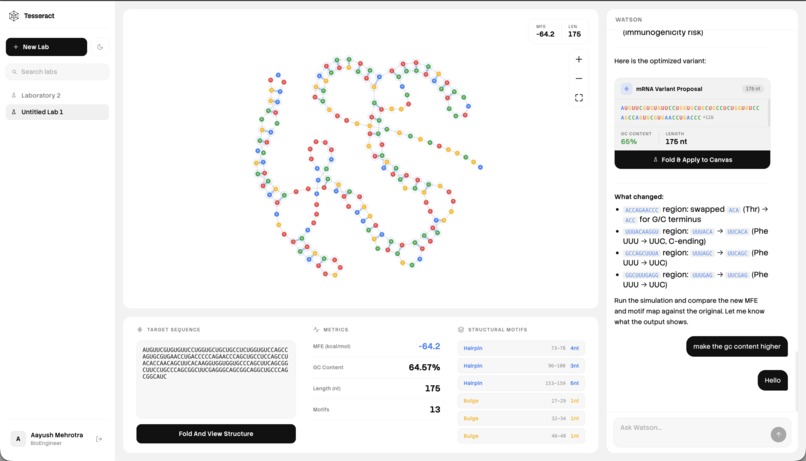
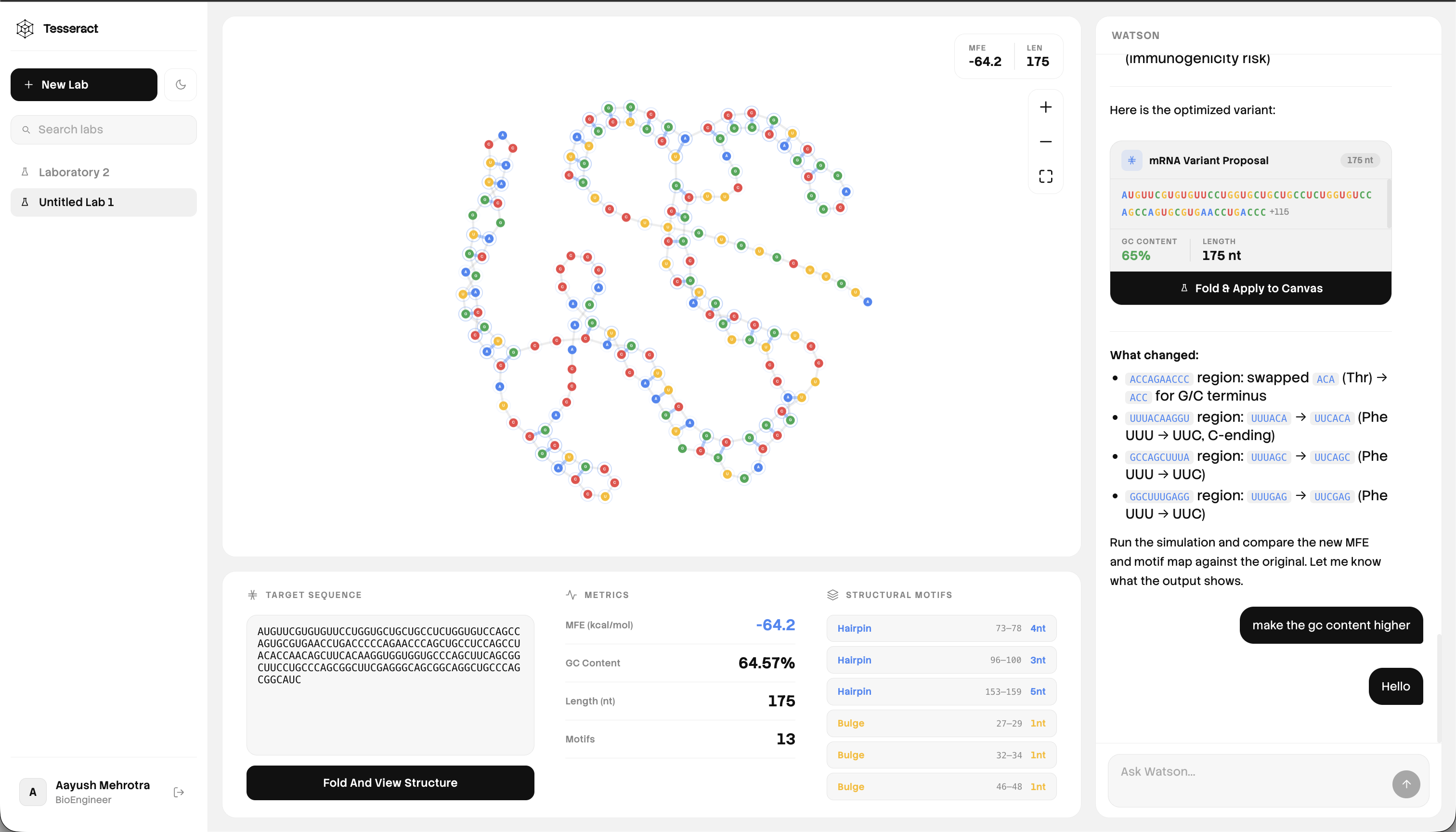
Main App View
Inspiration
One of our high school electives, Introduction to Cellular Biology Research, introduced us to how vaccines and therapeutics are developed at the molecular level. A key concept that stood out was the importance of mRNA structure. Before a vaccine can work, researchers must design sequences that fold into stable configurations so ribosomes can accurately translate them into proteins.
As we explored this process, we learned that researchers rely on advanced computational tools to optimize mRNA structures using thermodynamic models. However, these tools are often proprietary, expensive, or require deep expertise in mathematics and computer science, making them inaccessible to many researchers. This creates a disconnect between designing a sequence and understanding how it behaves structurally.
This gap has real consequences. Vaccine development typically takes over a decade, with early-stage research lasting years and failure rates exceeding 90%. Much of this time is spent iterating on molecular designs using tools that are complex, fragmented, or difficultxx to visualize.
We set out to bridge this gap by creating Tesseract, an interactive platform that leverages modern machine learning and AI to help researchers design, visualize, and optimize mRNA structures in a more intuitive and accessible way.
What it does
Tesseract is an molecular engineering application designed for the visualization and structural optimization of mRNA variants.
- Geometric Force-Directed Folding: We moved away from traditional static diagrams. Tesseract simulates RNA secondary structures (MFE) as physical systems. Researchers can click, drag, and tactilely manipulate nucleotides to explore conformational geometries in real-time.
- Watt Intelligence: An integrated AI assistant (Llama 3.3 backbone) that is structurally aware. Watt analyzes thermodynamic risk, detects structural motifs (Hairpin Loops, Stems), and proposes "Lab-Ready Variant" simulations that can be applied to the view with one click.
* Persistent Research Labs: Using Firebase, we built a multi-session architecture where researchers can isolate different optimization tracks into separate "Labs," each with its own persistent folding data and chat history.
How we built it
- The Simulation Engine: A Python (Flask) backend powered by ViennaRNA (C-Bindings). We built custom data contracts to translate thermodynamic matrices into structured context for our AI system.
- The Workstation: A modern React 19 frontend using Vite. We built the visualizer from scratch using the Canvas API and custom physical force constants to simulate atomic backbone constraints.
* Security & Persistence: Firebase Authentication handles researcher identity, while Cloud Firestore provides real-time, reactive synchronization of laboratory sessions.
Challenges
- Handling the physical simulation of RNA was the hardest part. Maintaining rigid backbone distances (22 pixels) while allowing for the "explosive" repulsion of high-density loops required fine-tuning a custom force-graph engine. We also struggled with making the AI "structurally aware"—eventually developing a pipeline that injects Dot-Bracket notation and GC-content directly into the assistant's analytical stream.
- We started out unsure whether we would be able to complete such a large project. However, we divided the work based on each person’s strengths and made the most of our individual skills. From there, we tackled the project step by step, and slowly but surely, it came together until it was complete.
* Parsing through the AI's responses, and figuring out where the simulation data started and ended. While the AI was extremely accurate, and did give us the data in the form we requested, not all sequences of nucleotides were actually valid. We would have to go through and test the provided simulations and crop out the ones that failed the tests.
Accomplishments
- We are most proud of the Watt cards. Seeing the AI propose a simulation, clicking "Apply," and watching the physical graph re-equilibrate into a new stable state feels like the future of molecular design.
- We successfully unified sequence editing, structural visualization, and AI-guided optimization into a single continuous workflow. There is no mode switching, every change is immediately reflected both geometrically and analytically.
* We built a physically consistent RNA interaction model from scratch rather than relying on static rendering, enabling direct manipulation of molecular structures with predictable outcomes.
What we learned
- AI systems become materially more useful when grounded in domain-specific representations. Injecting structured biological context (Dot-Bracket, GC content, loop classification) shifted the assistant from generic text generation to actionable analysis.
* Precision in data contracts is critical. Small ambiguities between simulation output and AI input compound quickly and degrade reliability. Strict schema design reduced downstream failure cases.
What's next for Tesseract
In the future, we hope to expand and further develop the capabilities of our application.
- Transition from secondary structure (2D) into tertiary (3D) folding approximations, enabling spatial reasoning about steric hindrance and binding accessibility.
- Integrate codon optimization layers for organism-specific expression while preserving structural stability.
- Introduce automated validation pipelines to filter AI-proposed variants against thermodynamic thresholds before visualization.
- Expand collaboration features into shared, multi-user labs with version control for molecular designs.

Log in or sign up for Devpost to join the conversation.