-
-
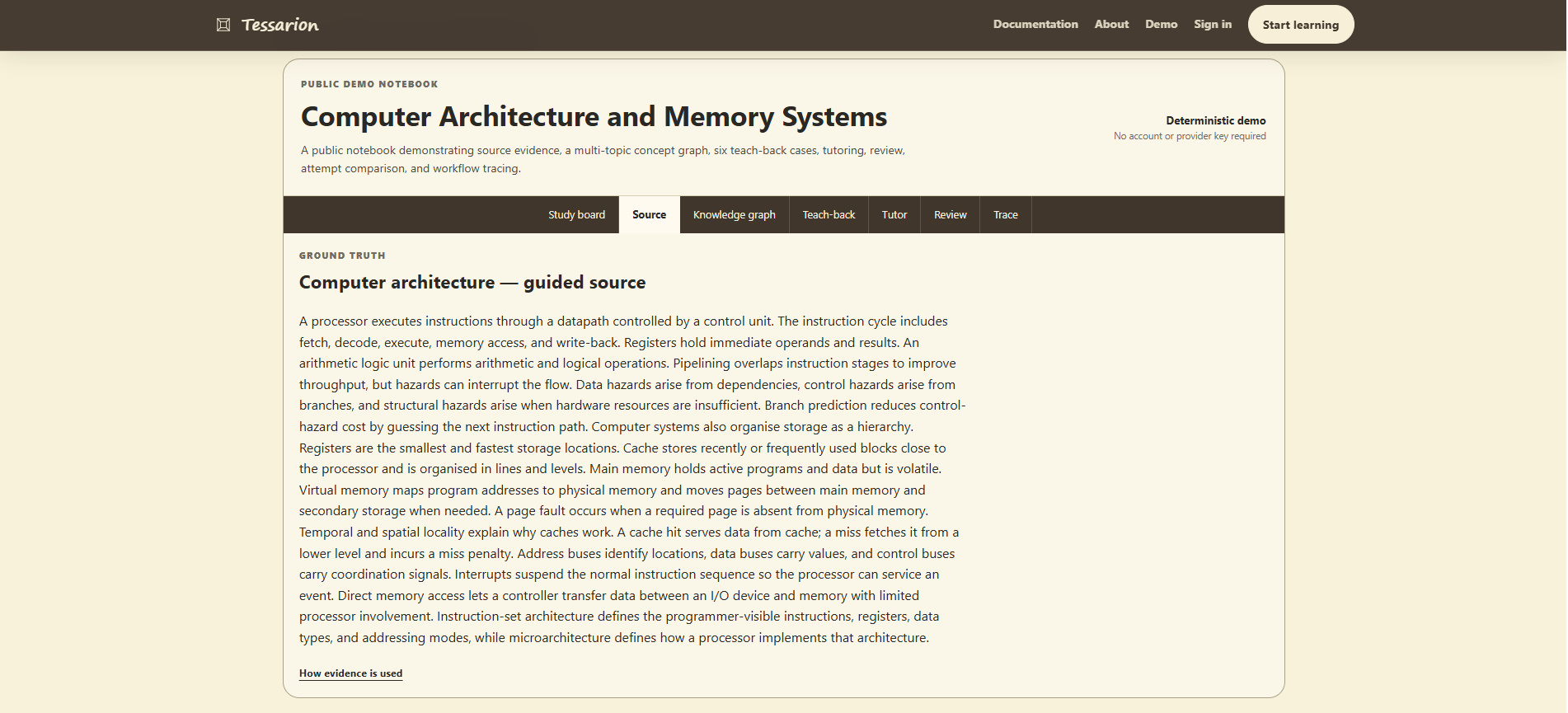
Tessarion: an evidence-grounded learning system built around explanation, diagnosis, and improvement.
-
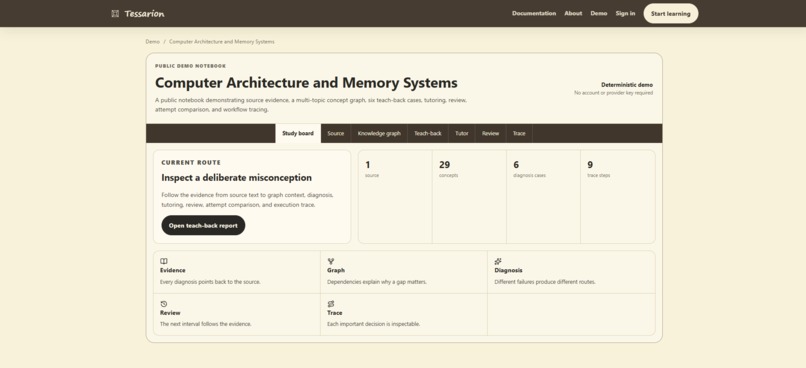
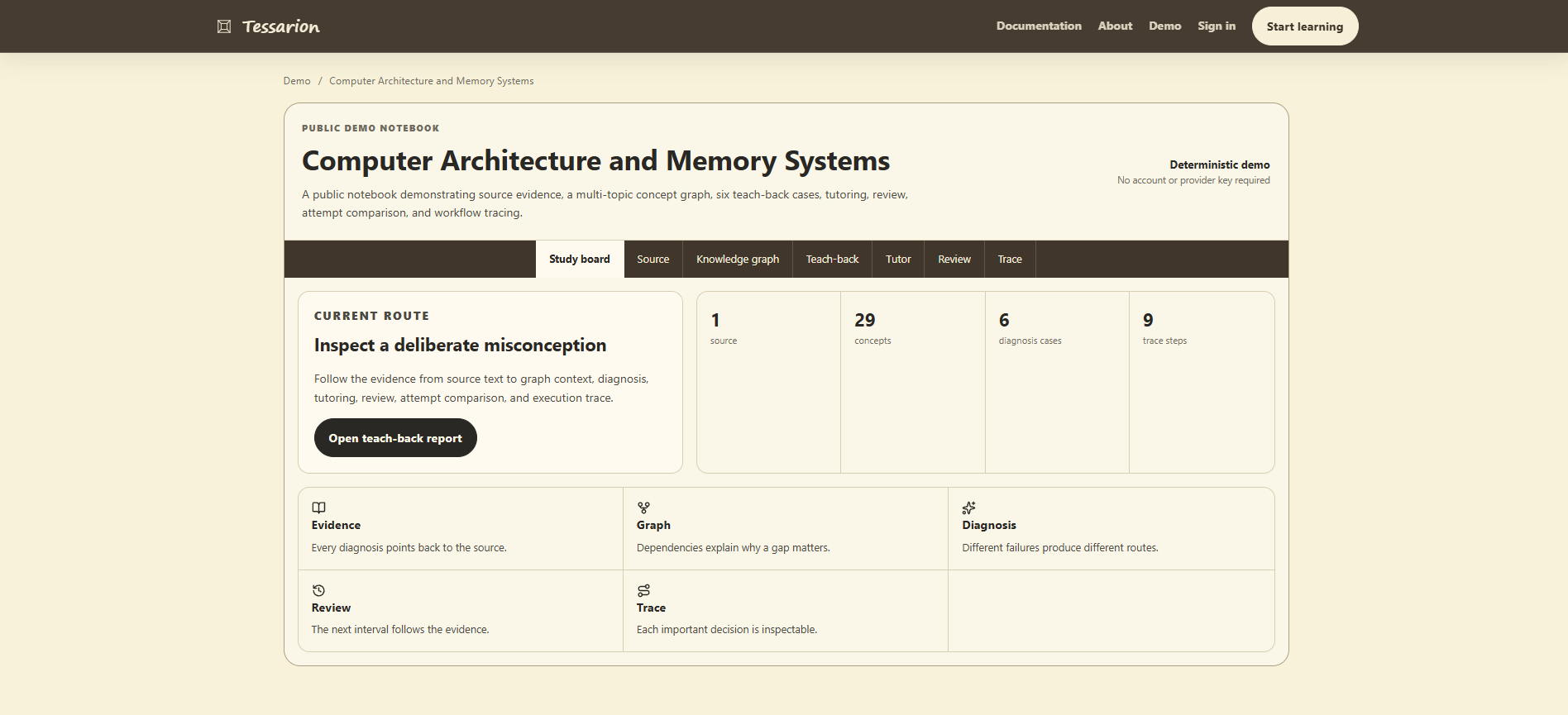
The public demo notebook brings sources, concepts, teach-back, tutoring, reviews, and traces into one workspace.
-
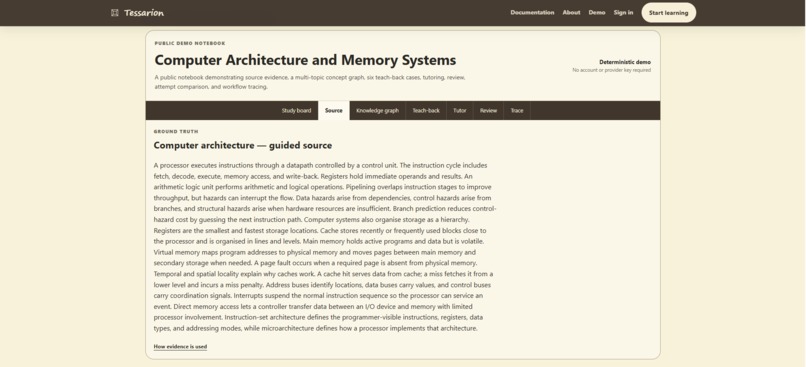
Learning decisions remain grounded in inspectable source material rather than unsupported generation.
-
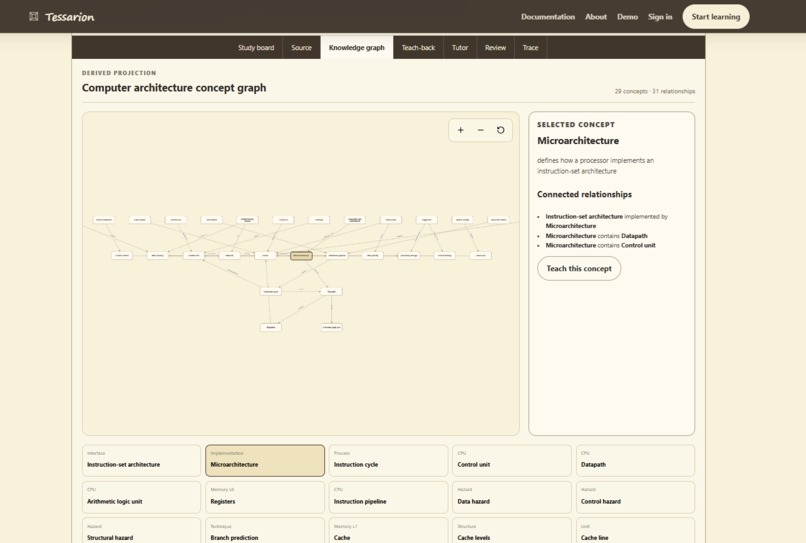
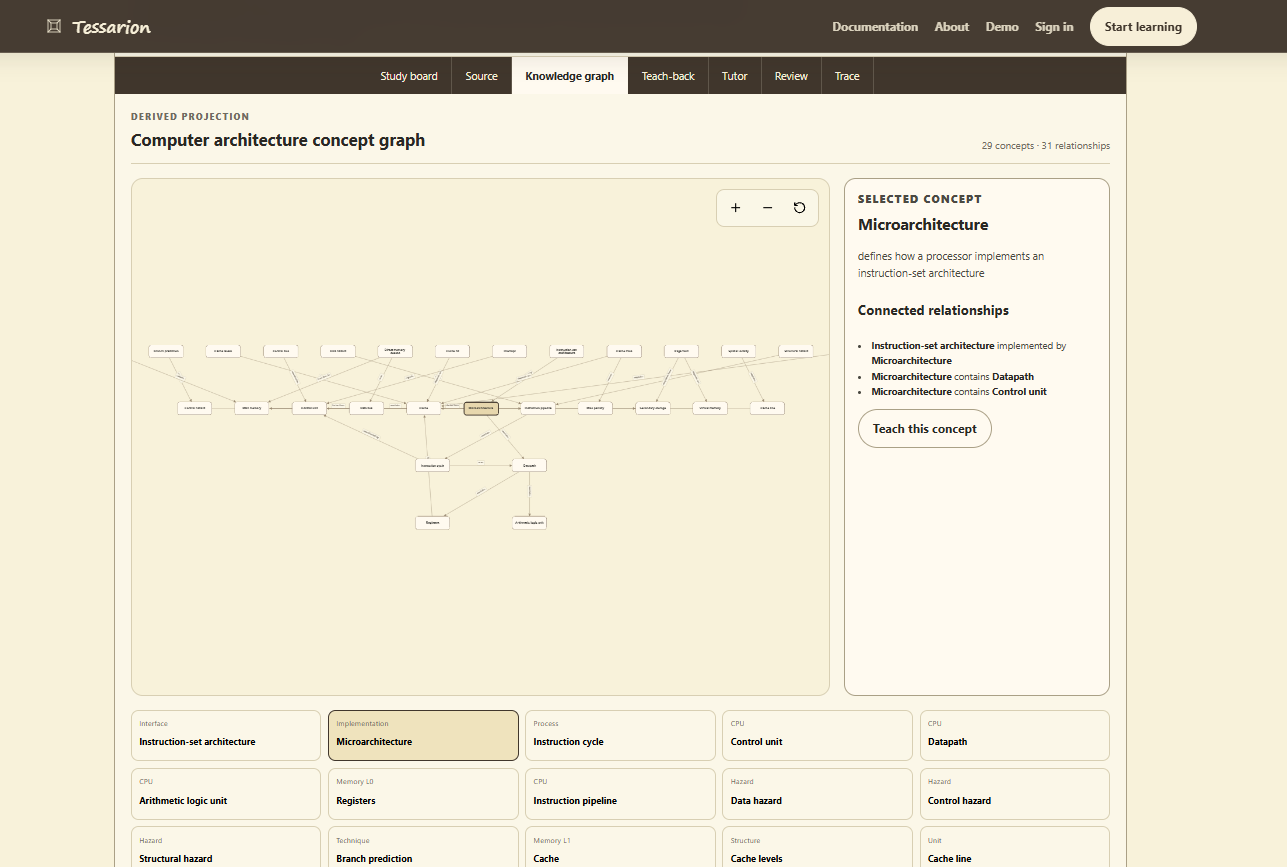
The knowledge graph exposes prerequisites, explanations, contrasts, and dependencies between concepts.
-
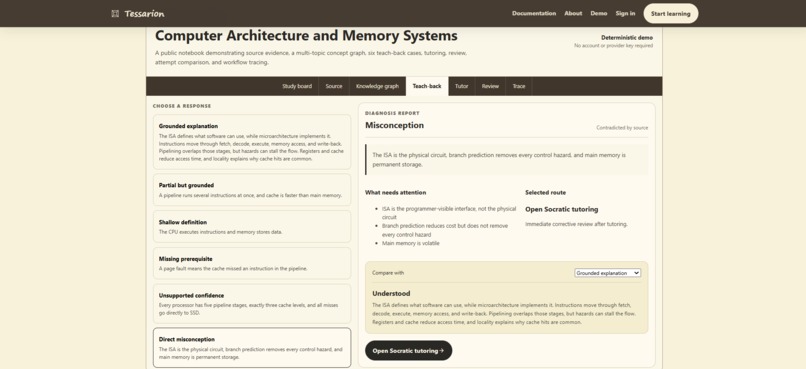
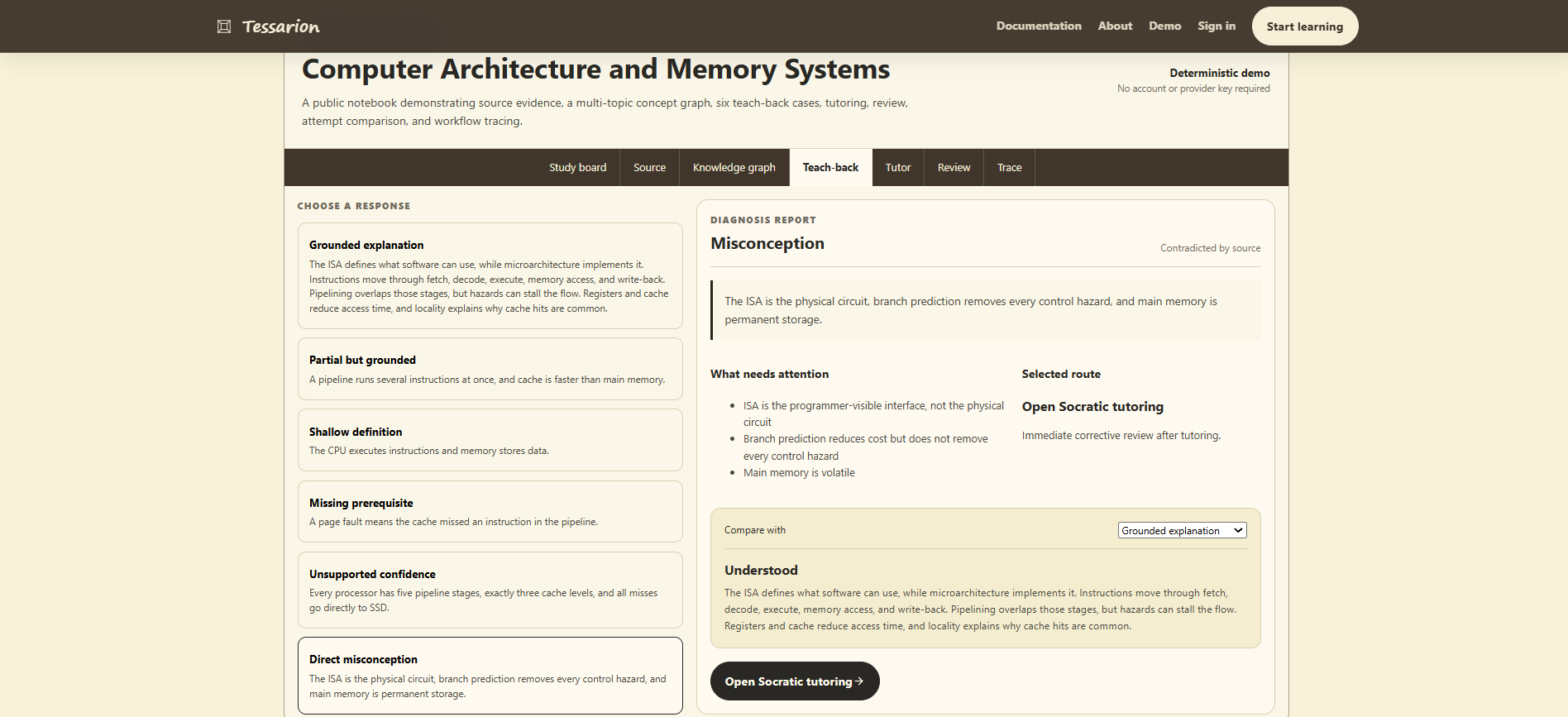
Teach-back separates what the learner understood, what contradicts the source, and what should happen next.
-
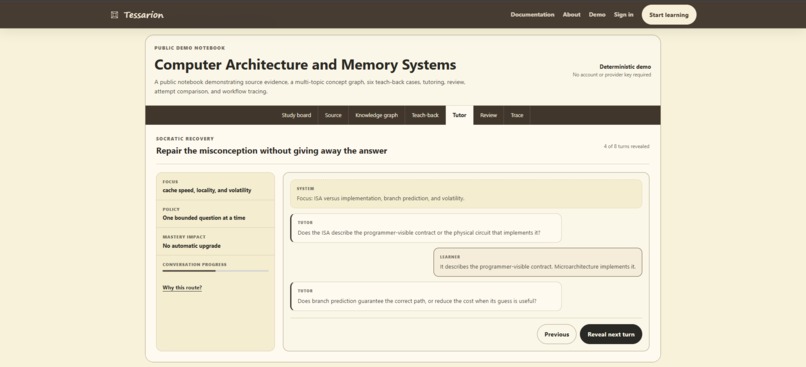
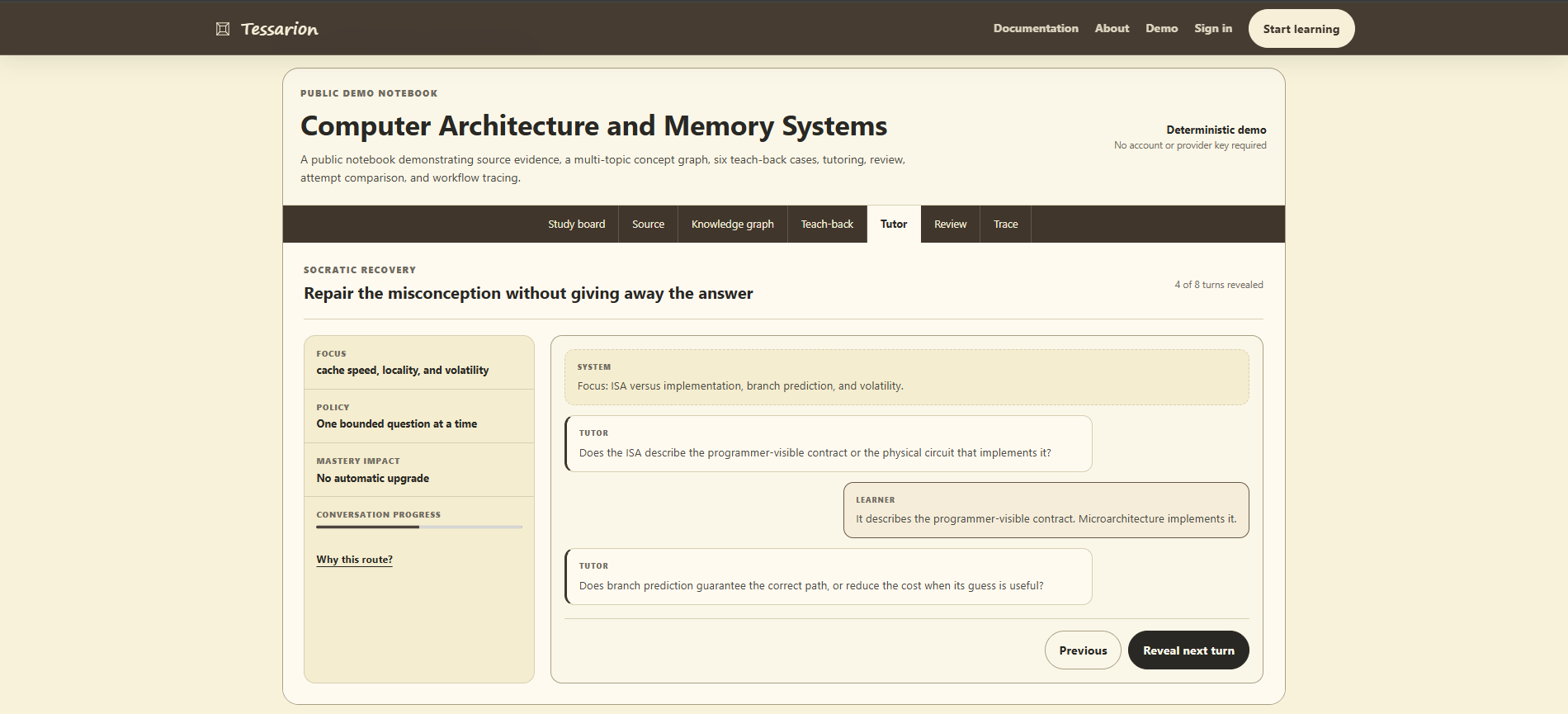
Socratic tutoring repairs misconceptions one bounded question at a time, while the workflow trace keeps every decision inspectable.
Inspiration
Most learning tools are good at generating explanations, summaries, or answers. They are much weaker at showing why a learner is wrong, which evidence contradicts the mistake, how concepts are connected, and what the learner should do next.
Tessarion was built around a different idea: learning decisions should remain grounded in source material, visible concept relationships, and the learner’s own explanation.
What it does
Tessarion turns study material into an evidence-linked learning workspace.
Learners can:
- add source material to a notebook;
- retrieve grounded evidence from their own sources;
- explore concept relationships through a knowledge graph;
- explain concepts through teach-back;
- identify misconceptions, shallow understanding, and missing prerequisites;
- enter bounded Socratic tutoring instead of receiving the answer immediately;
- schedule reviews based on demonstrated learning gaps;
- inspect the workflow trace behind important learning decisions.
A public demo notebook demonstrates the complete experience without requiring an account.
How I built it
Tessarion uses Next.js, React, TypeScript, Tailwind CSS, Supabase, PostgreSQL, Gemini, LangGraph, Inngest, Qdrant, Neo4j, Cytoscape.js, Arize AX, OpenTelemetry, Zod, Vitest, GitHub Actions, and Vercel.
Supabase remains the canonical source of truth for users, notebooks, documents, mastery states, and review records.
Qdrant supports workspace-filtered hybrid retrieval. Neo4j stores a derived concept-graph projection. LangGraph coordinates structured learning workflows, while Inngest handles durable background execution and retries. Arize AX records traces for retrieval, graph traversal, diagnosis, routing, and persistence.
Prompts, tools, workflow states, and structured outputs are versioned and validated through typed contracts. The project also includes deterministic evaluation datasets and regression gates for retrieval, diagnosis, tutoring, review, resilience, and workflow behaviour.
Challenges I ran into
The hardest challenge was keeping the system reliable across multiple layers rather than building isolated features.
Important problems included:
- preserving strict workspace isolation across Postgres, Qdrant, and Neo4j;
- separating canonical data from derived vector and graph projections;
- designing teach-back diagnosis without overclaiming learner mastery;
- keeping tutoring Socratic instead of allowing the model to reveal answers immediately;
- making long-running source processing durable;
- tracing multi-step workflows without exposing secrets or private data;
- building evaluations that produce meaningful metrics rather than suspiciously perfect results;
- maintaining a consistent public, authenticated, and demo experience.
Accomplishments that I'm proud of
- Built a complete evidence-grounded learning loop from source ingestion to review.
- Implemented hybrid retrieval with source traceability and workspace filtering.
- Added a concept graph that explains relationships behind learning gaps.
- Built structured teach-back diagnosis with deterministic fallbacks.
- Implemented bounded Socratic tutoring with explicit mastery boundaries.
- Added review scheduling based on demonstrated weaknesses.
- Added durable background jobs through Inngest.
- Added production tracing through Arize AX and OpenTelemetry.
- Created a public demo notebook that exposes the full workflow without login.
- Built automated evaluations, CI checks, production infrastructure validation, and cross-account security controls.
What I learned
The strongest learning systems are not defined by the model alone.
Reliable behaviour depends on:
- evidence quality;
- retrieval strategy;
- graph structure;
- prompt contracts;
- workflow state;
- validation nodes;
- deterministic fallbacks;
- observability;
- evaluation datasets;
- and careful product design.
I also learned that the learner model must remain conservative. Completing a tutoring conversation should not automatically imply mastery. Progress should come from evidence across explanation, correction, retry, and review.
What's next for Tessarion
Tessarion v1.0.0 is complete and deployed.
Future work will focus on extending the system without weakening its core principles of provenance, workspace isolation, measurable quality, and inspectable decisions. Possible extensions include additional learning formats, richer source types, more evaluation datasets, and broader provider support.
Built With
- agentic
- ai
- arize
- cytoscape.js
- gemini
- github
- graph
- inngest
- langgraph
- neo4j
- next.js
- opentelemetry
- postgresql
- qdrant
- rag
- react
- reviews
- sdk
- socratic-tutoring
- supabase
- tailwind
- teach-back-diagnoses
- typescript
- vitest
- zod


Log in or sign up for Devpost to join the conversation.