-
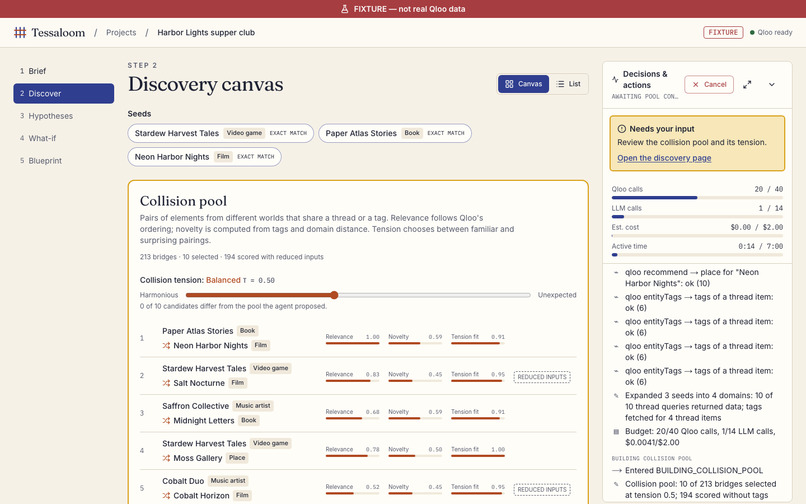
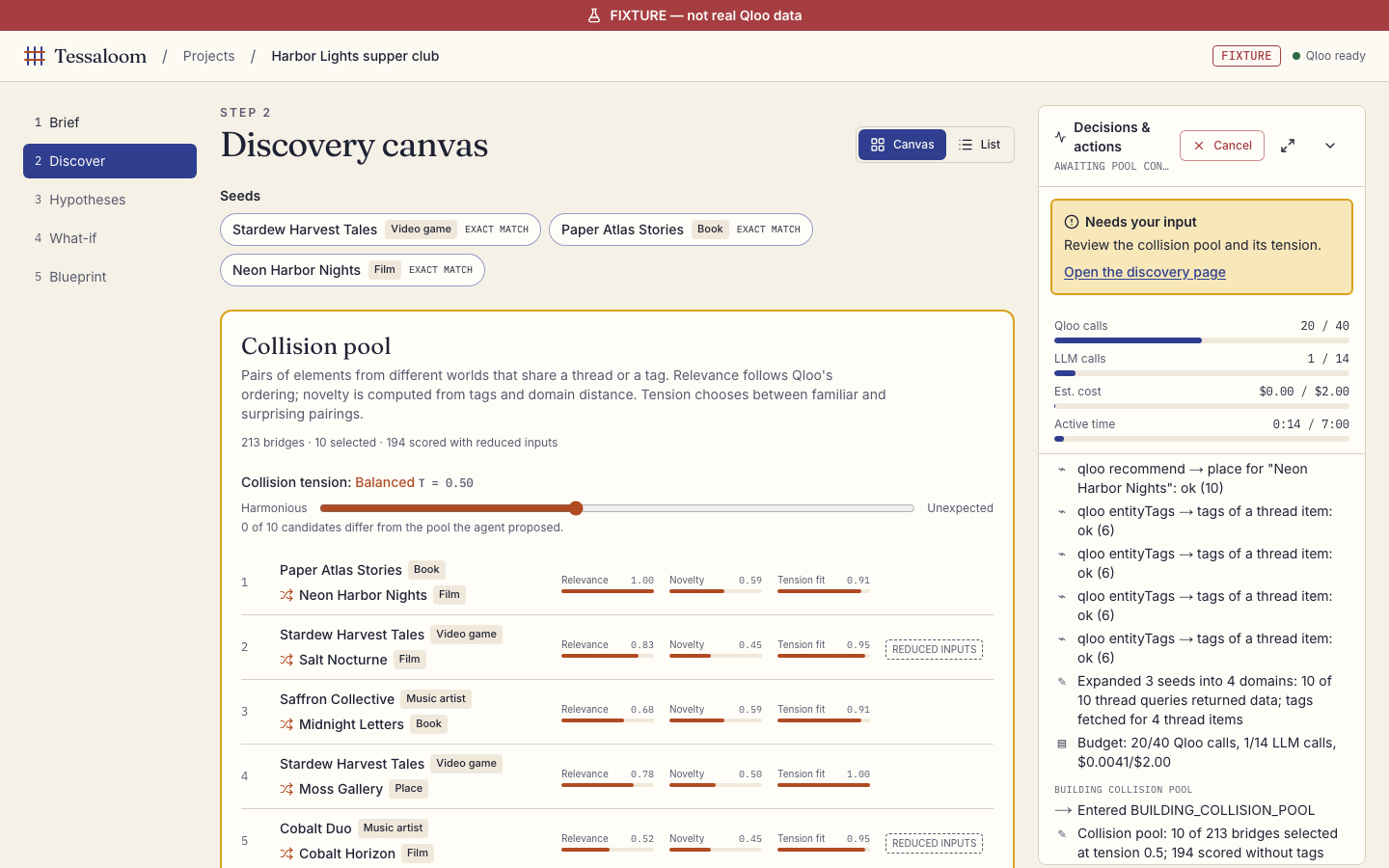
Explore cultural connections across different interests, with traceable bridges and evidence-aware discovery.
-
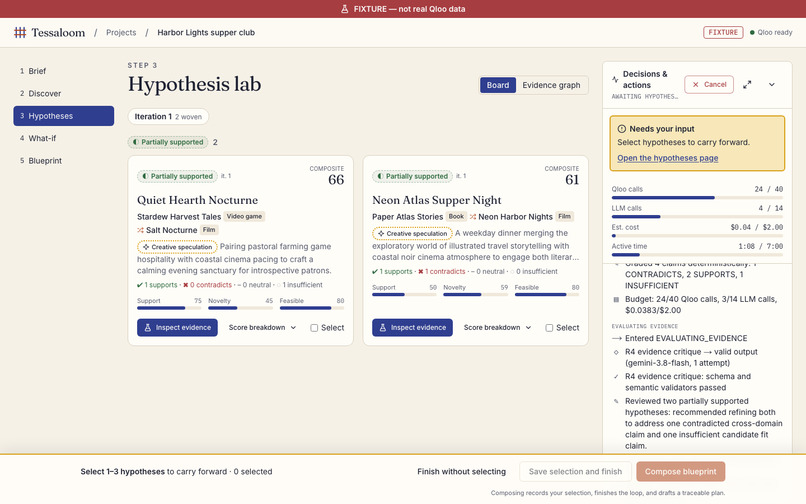
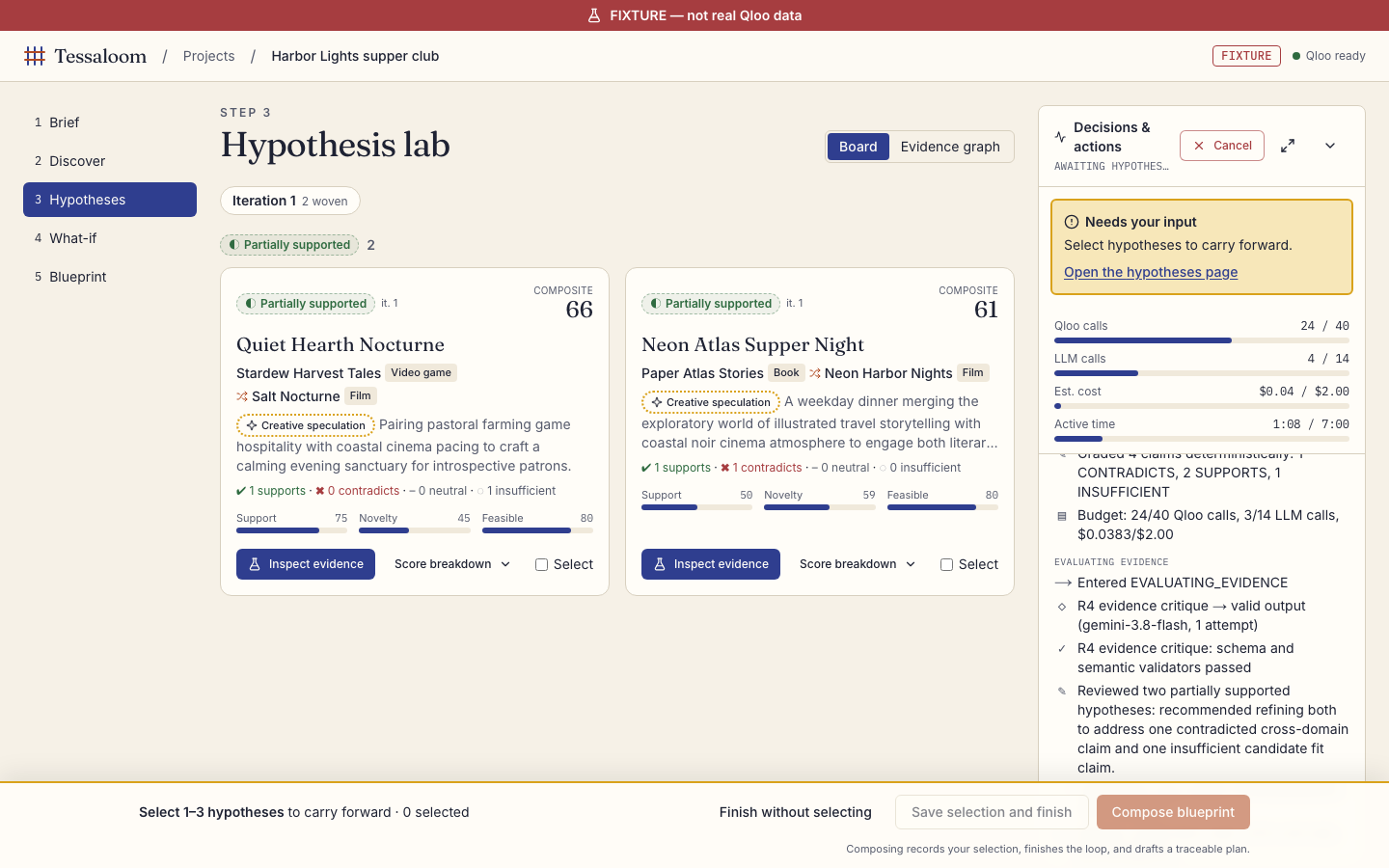
Gemini 3.8 Flash generates creative hypotheses while evidence checks identify support, contradictions, and uncertainty.
-
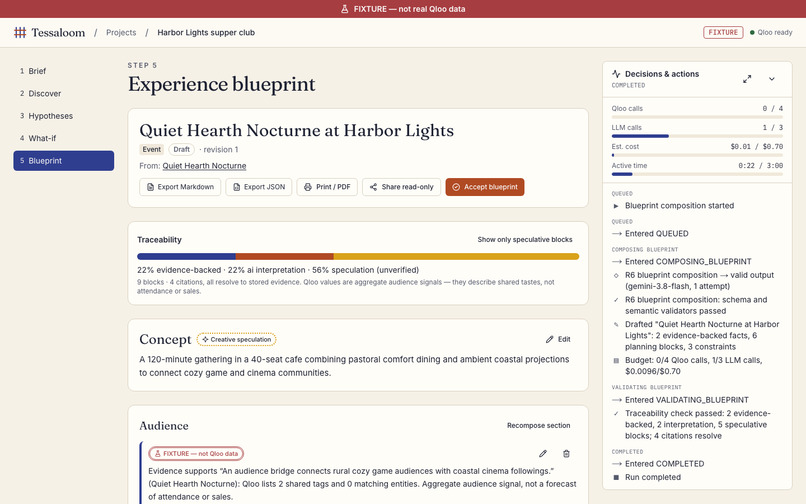
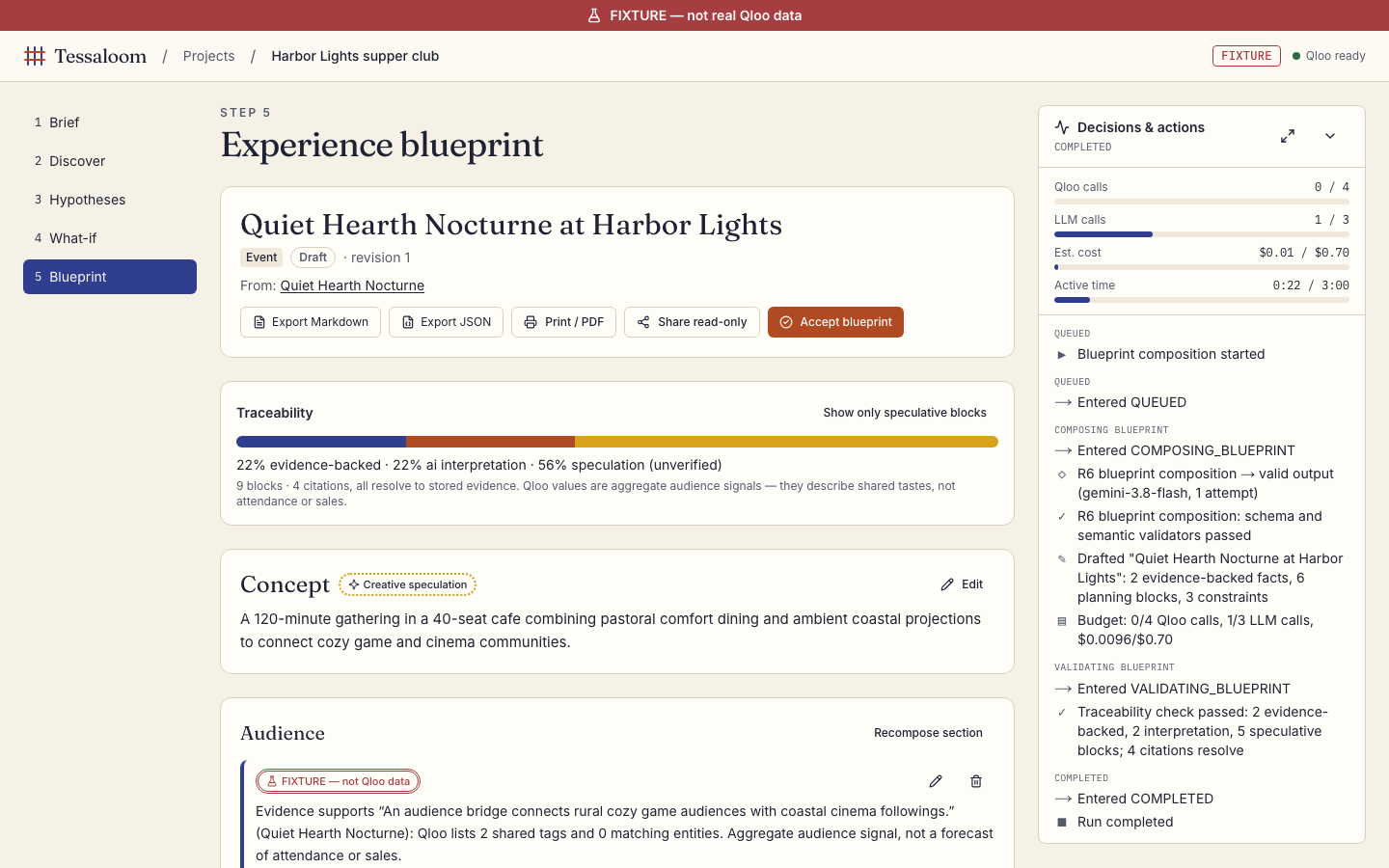
A Gemini-generated event blueprint with structured plans, evidence labels, and traceable citations.
-
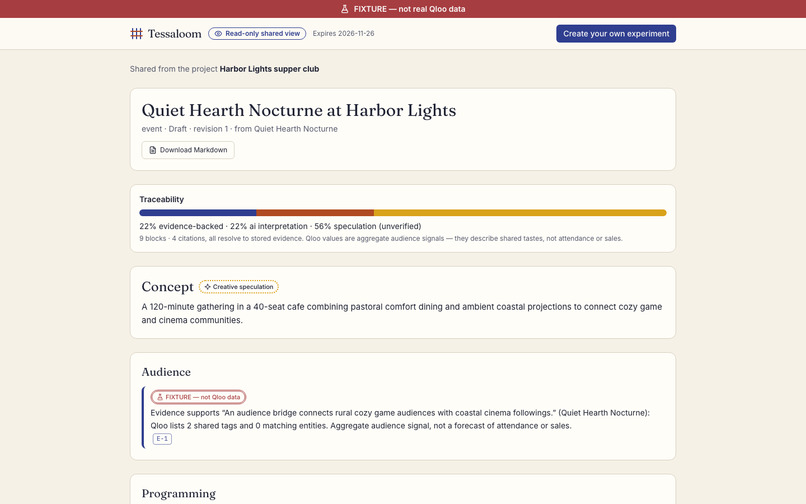
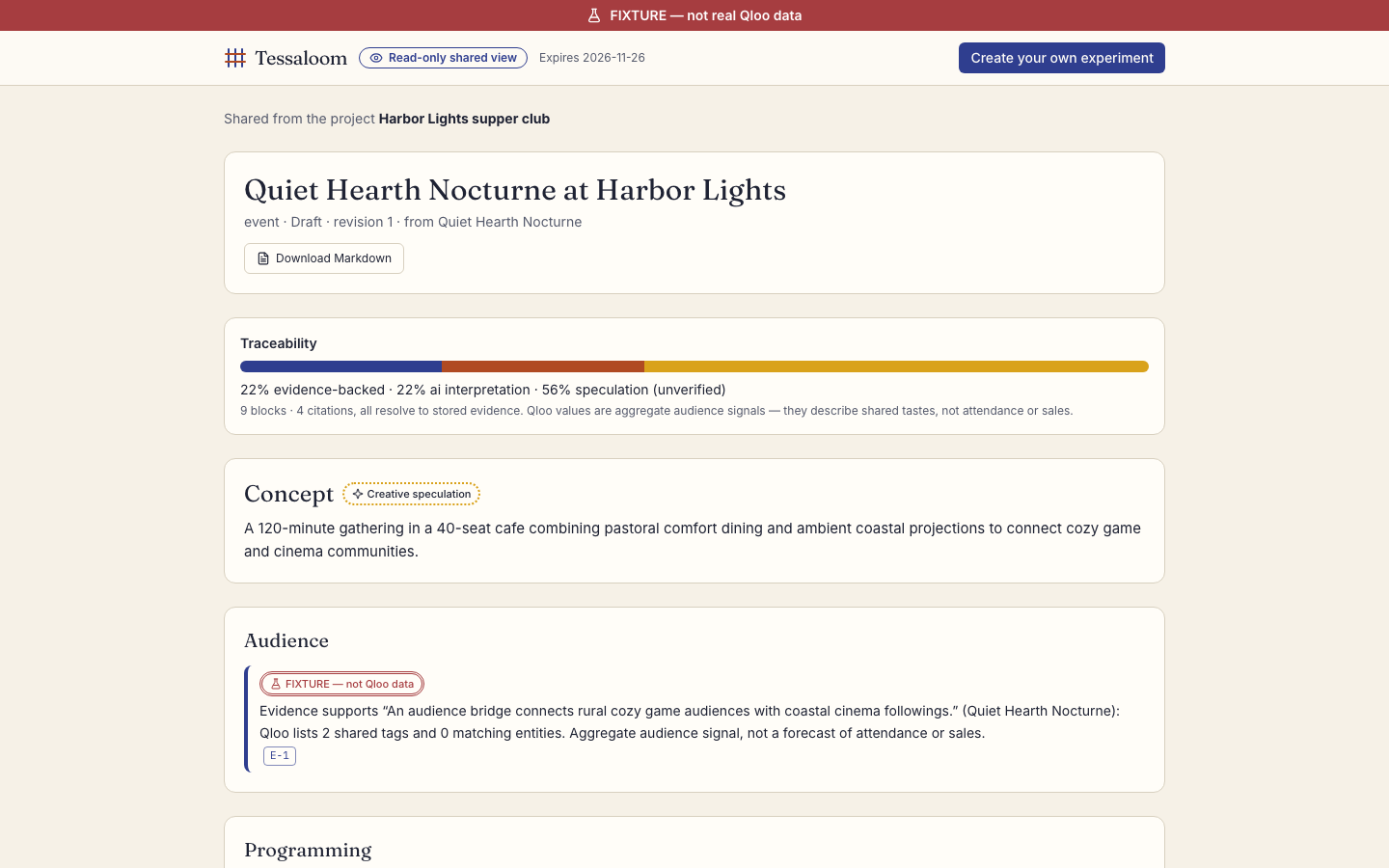
Share the completed creative blueprint through a read-only link, with clearly labelled fictional cultural data.
Inspiration
Imagine a small café trying to turn a quiet weekday evening into an experience people want to return to. Its customers love films, music, books, and games, but the owner has no data science team to uncover meaningful connections between those interests.
A traditional chatbot can suggest an appealing event in seconds. The problem is that an imaginative connection can easily be presented as a verified fact.
I built Tessaloom to explore a different approach: an AI agent system that can be creative without confusing evidence with imagination.
What it does
Tessaloom is an evidence-aware cultural experience designer. It helps cafés, bookstores, galleries, libraries, and community venues turn cultural interests into testable event concepts.
Its workflow connects cultural discovery with hypothesis generation, evidence evaluation, and creative planning:
- Understand the brief. The user describes a venue, its goals, constraints, and cultural interests. An AI agent interprets the request and identifies ambiguities.
- Discover cultural connections. A Qloo-powered discovery adapter explores connections across cultural domains. The interactive canvas highlights cross-world bridges and competing possibilities.
- Generate hypotheses. The agent proposes creative concepts with explicit, testable claims.
- Evaluate evidence. Deterministic evaluators classify claims as supported, contradicted, neutral, or insufficient. A critic agent examines weaknesses without rewriting the underlying evidence judgments.
- Compose a blueprint. The AI turns a selected concept into a structured event plan with supporting citations and a traceability meter.
- Export and share. Users can download their blueprint or share a read-only view through an expiring link.
The central idea is simple: cultural evidence informs the creative process, but creative speculation must remain identifiable as speculation.
How we built it
Tessaloom is a TypeScript application built with Next.js, React, React Flow, PostgreSQL, Drizzle ORM, and pg-boss.
The system uses six cooperating roles:
- R1 — Intent: Interprets the user's brief.
- R2 — Discovery: Coordinates cultural discovery and data retrieval.
- R3 — Hypotheses: Creates candidate concepts and testable claims.
- R4 — Critic: Reviews evidence and identifies unsupported assumptions.
- R5 — What-if: Explains changes between alternative scenarios.
- R6 — Composer: Produces an evidence-aware creative blueprint.
A provider-agnostic LLM gateway manages structured outputs, schema validation, retries, and spending reservations. The worker uses a recoverable state machine, with human confirmation points between important stages.
Qloo integration: Tessaloom uses the Qloo Insights API through the official Qloo Harness for entity resolution, cross-domain recommendations, rankings, tags, and audience comparisons. Deterministic evaluators convert retrieved signals into explicit evidence judgments.
Live AI model: The current public demo uses Google Gemini 3.8 Flash. A separate local real-Qloo-data workflow was successfully tested with Claude Sonnet 5.5 through the Claude Agent SDK.
Public demo and data transparency
The public demo uses real Gemini 3.8 Flash inference on clearly labelled fictional cultural data, rather than live Qloo responses.
The application displays "FIXTURE — not real Qloo data" so visitors can distinguish synthetic demonstration data from real API evidence.
The real Qloo integration is implemented and was independently verified in a local end-to-end run. Live Qloo-derived results are not transmitted to Gemini or publicly displayed while the relevant data-processing and display permissions remain unresolved.
This distinction is intentional: the demo provides a genuine AI-generated experience without misrepresenting fictional cultural signals as real Qloo findings.
Challenges we ran into
Making agent outputs trustworthy. Language models can produce convincing but unsupported claims. Tessaloom uses structured schemas, deterministic evidence grading, semantic validation, and a controlled repair mechanism to catch some of these failures.
Keeping evidence traceable. Every supported claim must link to stored evidence. The blueprint separates evidence-backed statements, AI interpretation, and creative speculation.
Handling uncertain provider outcomes. A timed-out request can still be billed. The gateway avoids blindly resending requests with unknown outcomes and maintains conservative spending reservations.
Making the full workflow usable. Discovery, hypothesis generation, critique, and blueprint composition take place across multiple asynchronous steps. The interface shows progress, preserves intermediate results, and offers a way forward when a run reaches a configured limit.
Accomplishments
- Real Qloo integration verified locally: A cultural brief involving Spirited Away and Joe Hisaishi produced 93 cross-world bridge candidates, five evaluated hypotheses, and a blueprint with seven resolving citations.
- Real Gemini end-to-end test passed: A complete synthetic-data workflow used five Gemini 3.8 Flash calls, finished in 95 seconds, and recorded approximately $0.044 in estimated model costs.
- Evidence guardrails worked: A blueprint draft included unsupported numbers. The semantic validator rejected those claims, and one controlled repair produced a valid result.
- Public browser acceptance passed: The deployed website completed a full Gemini-powered journey in 2 minutes 35 seconds, producing a nine-block blueprint with four resolving citations. Markdown export and read-only sharing were also verified.
- Public accessibility: Visitors can explore the demonstration without creating an account or paying for API usage.
These are measured validation results from specific test runs, not claims about average performance or real-world business outcomes.
What we learned
The hardest part of building an AI agent is not generating ideas. It is designing a system that explains which ideas are supported, which are interpretations, and which still need testing.
I also learned that responsible agent design requires practical safeguards: structured data contracts, human decisions, spending controls, accurate source labels, and graceful handling of incomplete results.
What's next
Future work includes broader evaluation of Qloo-backed cultural connections, better handling of sparse discovery results, improved hypothesis comparison, and collecting real-world feedback from venues.
The immediate priority is a reliable, transparent experience that demonstrates how cultural discovery and AI reasoning can work together.
Try Tessaloom
Live demo: https://p01--tessaloom--mpfcqkyl42yb.code.run
Open-source code: https://github.com/LZH-1-G/tessaloom
Testing instructions
No account, access code, or payment is required.
- Open the live demo and select Start a new project.
- Enter a project name and choose Create project.
- Click Use the fixture example, or enter your own cultural interests.
- Click Interpret brief, then Confirm & discover to explore cultural bridges.
- Click Generate hypotheses with this pool, open Hypotheses, and use Inspect evidence to examine claims.
- Select a hypothesis and click Compose blueprint. If exploration ends at a configured limit, use Compose a blueprint from the completed-run panel instead.
- Review the generated blueprint, inspect its citations, and try exporting or sharing the result.
The cultural data is fictional and labelled throughout; the AI reasoning is powered by real Gemini 3.8 Flash calls. Public AI usage is subject to a $1 daily application-wide spending cap, so new runs may be temporarily unavailable after the limit is reached.
Built With
- axe-core
- claude
- docker
- drizzle-orm
- google-gemini-api
- next.js
- node.js
- northflank
- pg-boss
- playwright
- postgresql
- qloo
- qloo-insights-api
- react
- react-flow
- tailwind-css
- typescript
- vitest
- zod

Log in or sign up for Devpost to join the conversation.