-
-
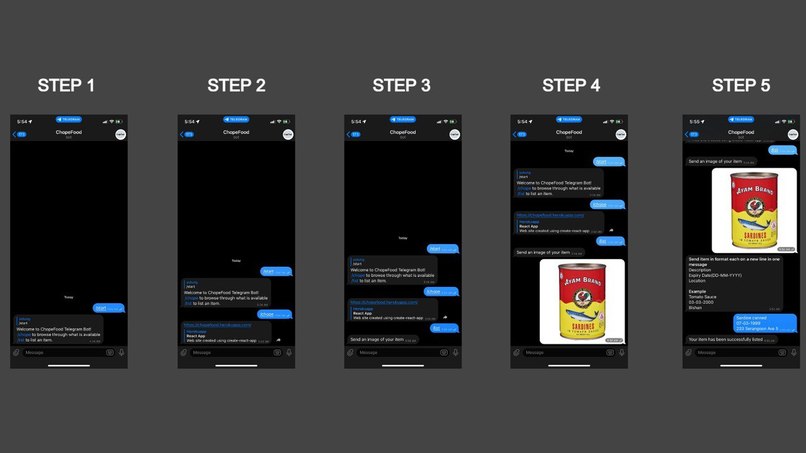
Flowchart of Listing
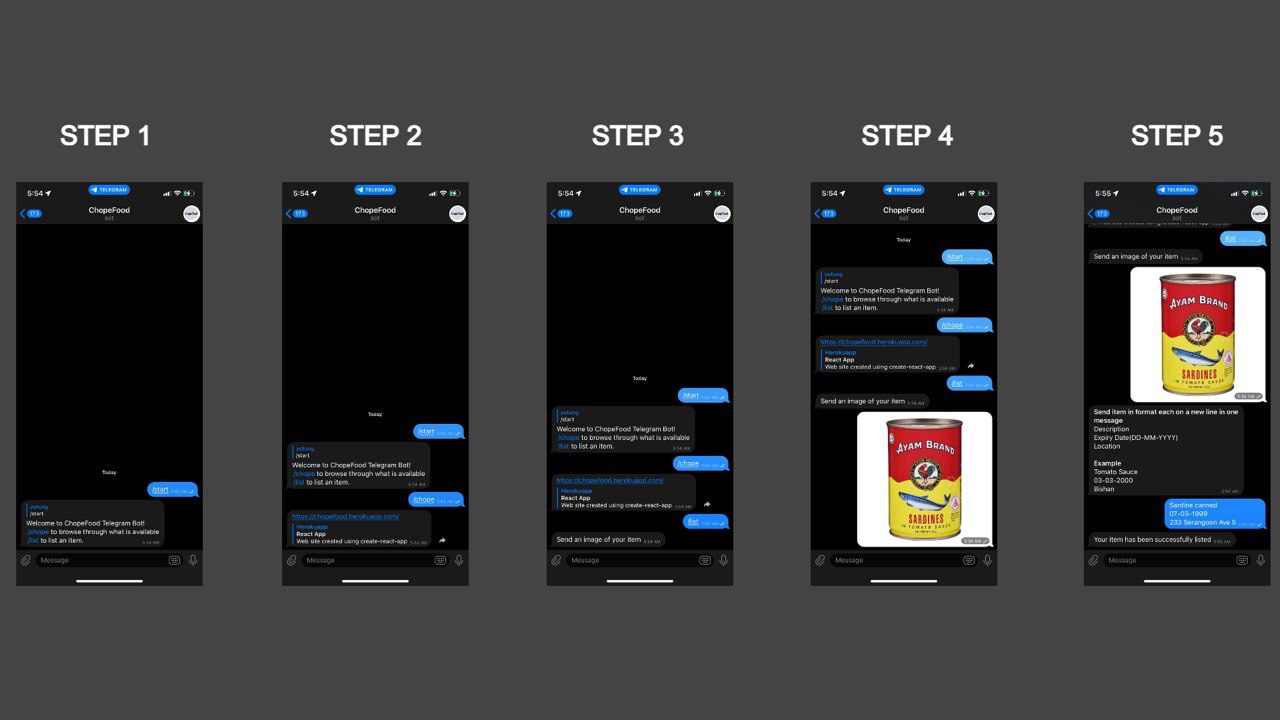
ChopeFood
The problem statement we have chosen to tackle is Environment #1.
The astonishing amount of food discarded by Singaporean households annually can largely be attributed to over-purchasing patterns that lead to food aging past the expiry date and leaving households with no choice but to discard them. While there exist applications that aim to tackle the problem of food wastage through consumer-to-consumer food donations, we believe that their solutions are inadequate as they are not as convenient or user friendly, since they require users to go through the process of downloading an app, setting up an account, and other administrative hassles. Such a tedious process is not optimal for most people as most people donate food on a ad-hoc basis or on rare occasion.
Our hack simplifies the food donation process by allowing individuals to tap on popular pre-existing applications like Telegram to communicate with one another. “Givers” (food donors) can easily list their items online without the trouble of registering an account. “Takers” (food recipients) are able to view the listed items in a web UI instead of just in a Telegram chat which allows them to better navigate and filter selected food items. “Takers” are able to instantly connect to “Givers” through a Telegram chat. This allows the users to find out more details about the listed items and to arrange a mode of collection.
By using a popular and familiar application like Telegram, we are able to simplify the listing process which will help enable individuals who may have the intention of donating their food items but either lack the awareness of existing apps or are annoyed by the need of a registration process. By increasing the accessibility between givers and takers, we reduce the hesitance of people donating food and receiving food. Thus, reducing the amount of near expired food being simply disposed of.
For our hack, we firstly implemented a Telegram bot. “Givers” can access the bot and immediately list the item by simply providing an image and key information such as the expiry date. The data is stored in Firebase real-time database via an API. The data in the real-time database will be formatted and displayed on the Web UI for “Takers” who can access the website via the Telegram bot. The “Taker” is able to signal interest in the food item on the Web UI which is done by clicking on the food image. This automatically connects the “Taker” to the “Giver” via a Telegram chat for them to further iron out details regarding collection. After the donation, the "Taker" simply has to unlist their item through the bot.
From a logistical standpoint, we encountered some difficulty as one of our teammates unfortunately contracted Covid-19. This disrupted our communication as we could not meet in person for more in-depth discussions.
We also had to figure out how to utilise new libraries when managing the data on Firebase. As none of our members were experienced with backend programming, it was a learning process for us.
The biggest learning point for us was the importance of having experience and practice in different parts of the programming process (backend/frontend/languages), especially in a limited time frame. Under such a tight period, we had to learn how to adapt to different scenarios. An example of this learning process was our merging of the use of Python for the telegram bot and JavaScript in the websites via a Firebase bridge, hence, playing to the programming strengths of our team members despite us having only learnt programming at an introductory level.
Built With
- firebase
- heroku
- javascript
- pytelegrambotapi
- python
- react

Log in or sign up for Devpost to join the conversation.