Inspiration
Every day, millions of developers push code that silently consumes energy. CI/CD pipelines run dozens of times per week. Container images carry unnecessary bloat. Cloud infrastructure is often two to three times larger than it needs to be. The carbon cost is real, but the work to fix it is buried across scattered YAML files, Dockerfiles, and Terraform configs. We believed there had to be a better way to make sustainability actionable for engineering teams.
What it does
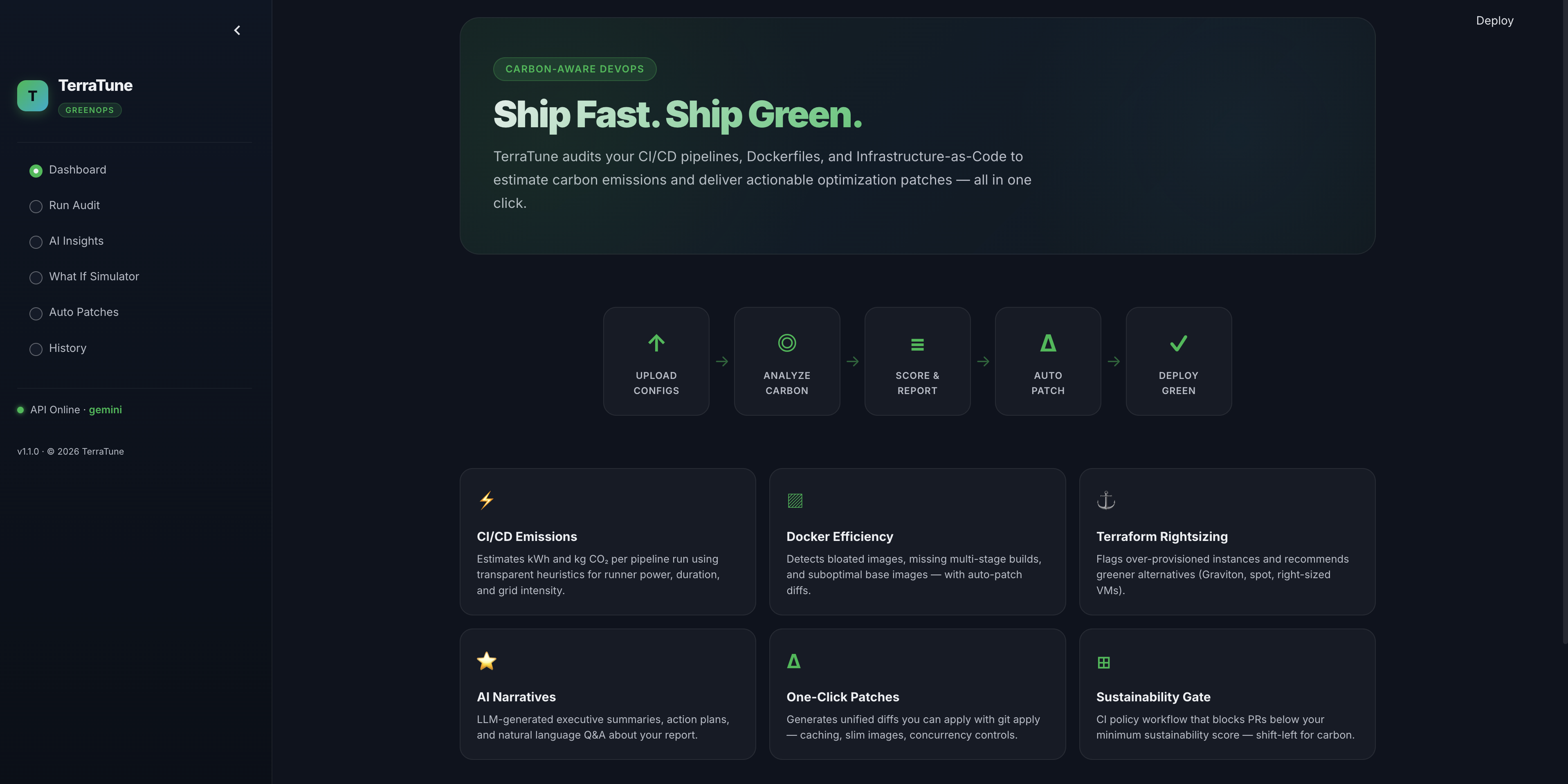
TerraTune is an enterprise GreenOps platform that audits your CI/CD pipelines, Docker images, and Infrastructure as Code to estimate carbon emissions and deliver ready to apply optimization patches in seconds. Upload your GitHub Actions workflows, Dockerfiles, and Terraform configs. TerraTune analyzes each file, estimates CO2 per run and per week, scores your project on a zero to one hundred sustainability scale, and generates production ready patches you can merge immediately. It includes unified diffs for git apply, pull request description templates, SVG sustainability badges for your README, and a CI gate workflow to prevent future regressions.
How we built it
We built TerraTune with a Streamlit frontend for rich interactive dashboards, a FastAPI backend for analysis, and Python for all component analyzers. The architecture is modular with separate analyzer modules for GitHub Actions, Docker, and Terraform. Each analyzer returns suggestions and estimated emissions. An LLM service layer supports OpenAI, Google Gemini, GitHub Copilot, or an offline deterministic provider. We use Plotly for interactive data visualization and SQLite for job persistence. The entire stack runs in Docker Compose for easy local development and deployment.
Challenges we ran into
Estimating carbon emissions for infrastructure is not straightforward. We had to research and synthesize heuristics for CI runner power consumption, Docker layer efficiency, and cloud instance carbon intensity by region. Balancing analysis speed with accuracy required careful tuning. We encountered challenges with LLM integration costs and latency, so we built an offline fallback provider that uses deterministic rules. Getting the UI to feel responsive while computing complex analyses required optimizing state management in Streamlit. We also had to navigate the complexity of multiple LLM provider APIs with different authentication and model naming schemes.
Accomplishments that we're proud of
We shipped a fully functional end to end platform in a short time frame with a polished Streamlit UI that feels professional and responsive. The auto patch generation feature is genuinely novel and differentiating. We built a modular architecture that allows easy addition of new analyzers and LLM providers. Our what if simulator lets users explore the real world impact of optimizations before committing to changes. We include comprehensive documentation, a demo recording master plan, and four sample scenarios for users to test with. The system gracefully handles multiple LLM providers and falls back to offline when APIs are unavailable.
What we learned
We learned that making sustainability concrete and actionable requires more than dashboards and numbers. Users want specific, ready to apply changes they can deploy immediately. We discovered that LLM integration is powerful but adds complexity around costs, latency, and API changes. We learned that demo scenarios are crucial for onboarding and testing without requiring users to set up real infrastructure. We also gained appreciation for the importance of transparent, explainable heuristics over black box ML models for critical business decisions.
What's next for Terratune Greenops
We plan to expand analyzer coverage to include Kubernetes manifests, Lambda functions, RDS instances, and more cloud services. We want to integrate with real CI/CD telemetry from GitHub, GitLab, and other platforms to calibrate our heuristics with actual measured data. We are exploring partnerships with cloud providers to include more accurate carbon intensity data by region and time. We want to build a sustainability dashboard for entire organizations to track carbon trends across all projects. Finally we plan to open source the entire platform and build a community around GreenOps best practices.


Log in or sign up for Devpost to join the conversation.