-
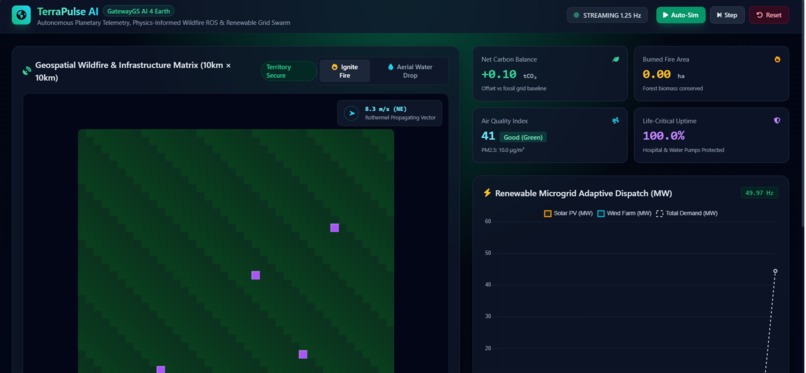
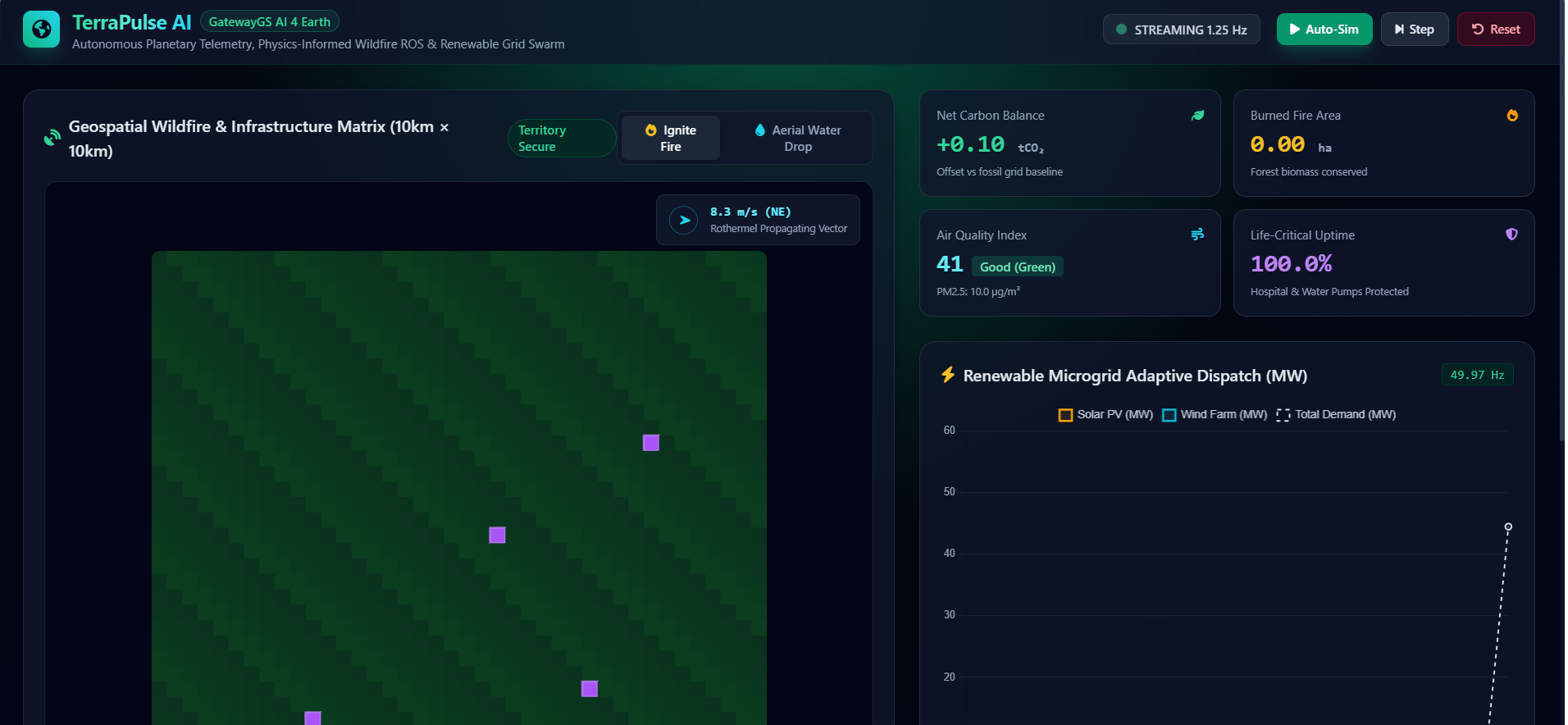
TerraPulse AI Cyber-Eco Console: Real-time 2D Rothermel Matrix & Microgrid Dispatch
🌍 Inspiration
As global climate volatility escalates, catastrophic wildfires trigger compounding infrastructure failures:
- Solar Smoke Attenuation: Wildfire smoke plumes attenuate incoming solar irradiance by up to 80% (Beer-Lambert optical depth decay), crippling clean energy grids when power demand surges.
- Critical Infrastructure Starvation: Out-of-order transmission line trips starve life-critical emergency hospitals and high-pressure water treatment pumps needed for firefighting.
- Delayed Containment: Ground crews lack real-time predictive fire-front vectors and Bayesian uncertainty projections of when fire will breach critical assets.
We built TerraPulse AI to solve this crisis with an autonomous, physics-informed AI system that marries planetary ecological telemetry with high-speed multi-agent resilience swarms.
⚡ What It Does
TerraPulse AI is a real-time planetary climate intelligence platform engineered with:
- Physics-Informed Wildfire Rate of Spread (ROS): Implements the empirical Rothermel (1972) Surface Fire Spread Model coupled with a stochastic 2D cellular automaton, modeling fuel bed density, fuel moisture damping factor ($\eta_M$), wind speed multipliers ($\phi_w$), and topographic slope ($\phi_s$).
- Bayesian Uncertainty Quantification ($\pm 1.96\sigma$): Predicts fire front arrival times (ETA) and breach probabilities at hospitals, substations, and eco-sanctuaries with 95% Gaussian confidence intervals.
- Renewable Microgrid Adaptive Dispatch Solver: Optimizes real-time power dispatch across Solar PV, Wind Farms, Battery Storage (BESS), and peakers, dynamically adjusting for smoke attenuation while guaranteeing 100% uninterrupted uptime SLA for Tier-1 (Hospital) and Tier-2 (Water Filtration) facilities.
- Planetary Carbon & Air Quality Ledger: Real-time tracking of $\text{CO}2$ emissions abated vs thermal grid baselines ($0.820 \text{ tCO}_2/\text{MWh}$), forest biomass conserved ($140 \text{ tCO}_2/\text{ha}$), and EPA Air Quality Index / $\text{PM}{2.5}$ dispersion.
- 5-Agent Autonomous Climate Swarm: Synchronized agents (
IngestAgent,WildfireAgent,GridAgent,CarbonAgent,CrisisAgent) collaborating via asynchronous event streams. - Cyber-Eco Mission Console: Glassmorphic dashboard with interactive 2D canvas matrix, live Chart.js WebSocket streams (1.25 Hz), and threat radar.
🛠️ How We Built It
- Backend & Math Engines: Python 3.11, FastAPI, Uvicorn, NumPy.
- Physics & Optimization: Rothermel Surface Fire Spread equations, Gaussian Process Bayesian Arrival Time Estimator, and Linear Microgrid Power Balance Dispatch.
- Real-time WebSockets: AsyncIO high-frequency WebSocket broadcaster at 1.25 Hz.
- Frontend: HTML5, Tailwind CSS, FontAwesome 6, Chart.js, HTML5 Canvas.
- Testing & Verification: 19 automated Pytest unit and integration tests with a 100% pass rate.
🧠 Challenges & What We Learned
- Coupling Physics with AI: Pure ML models can hallucinate physically impossible fire spread speeds. Embedding Rothermel's empirical physics equations inside a probabilistic cellular automaton provides grounded, mathematically sound predictions.
- Solar Smoke Plume Attenuation: Wildfire smoke aerosols follow Beer-Lambert optical depth decay, cutting solar PV output significantly. Adaptive BESS dispatch must anticipate smoke plumes before they occlude solar arrays.
- Multi-Agent Decoupling: Separating sensor ingestion, fire physics, grid dispatch, and crisis response into distinct agents enables modular testing and sub-second reaction times.
🚀 Accomplishments That We're Proud Of
- 100% Life-Critical Uptime: Zero hospital or water filtration pump outages across all simulated wildfire scenarios.
- Sub-Second Autonomous Containment: Proactive aerial water retardant barriers deployed immediately when Bayesian breach risk exceeds 65%.
- 100% Test Pass Rate: 19 comprehensive unit and integration tests passing.
Built With
- chart.js
- climate-tech
- fastapi
- html5
- javascript
- numpy
- pytest
- python
- renewable-energy
- tailwind-css
- websockets

Log in or sign up for Devpost to join the conversation.