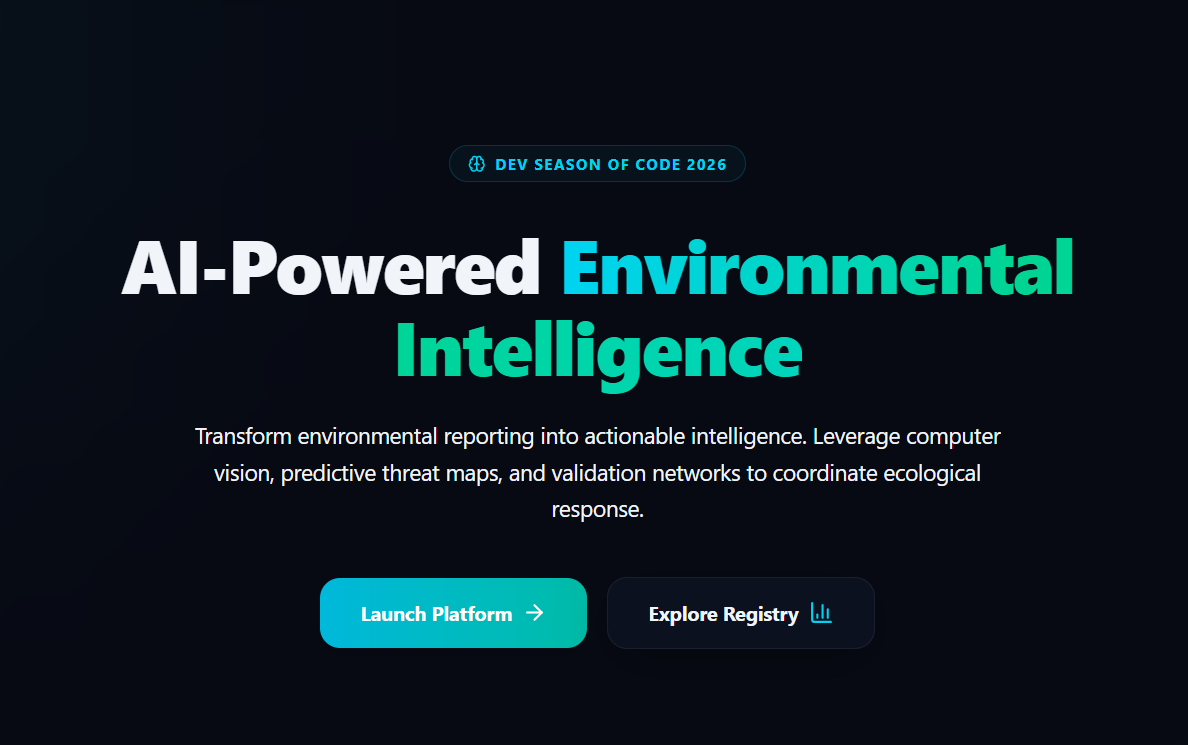
TerraMind AI
💡 Inspiration
Environmental threats are often reported too late.
Illegal waste dumping, water contamination, chemical leaks, and deforestation frequently go unnoticed until significant damage has already occurred. Existing reporting systems are often fragmented, difficult to access, and slow to respond.
We envisioned a platform where anyone could instantly report environmental hazards, while artificial intelligence helps analyze the situation, prioritize urgency, and provide actionable insights for communities, NGOs, and local authorities.
That vision became TerraMind AI — an AI-powered environmental intelligence platform designed to transform environmental reporting into a faster, smarter, and more transparent process.
🛠️ How We Built It
TerraMind AI was built as a modern full-stack web application focused on usability, scalability, and real-world impact.
Core Technologies
- Next.js 15 with TypeScript for the frontend and routing
- Supabase for authentication, database, and backend services
- Google Gemini Vision for environmental image analysis
- Leaflet Maps for geospatial visualization
- Recharts for environmental analytics and reporting dashboards
- Tailwind CSS for responsive UI design
Key Features
- AI-powered environmental incident analysis
- Interactive geospatial incident mapping
- Community verification and trust scoring
- Environmental trend analytics
- Predictive hotspot monitoring
- Administrative response dashboard
Analytical Models
To prioritize incident response, we designed a composite environmental risk score:
$$ R = \text{clip}\left(3.5S + 1.5V + 2P + 2E + F,\ 0,\ 100\right) $$
Where:
- $S$ = AI-detected severity
- $V$ = Community validation score
- $P$ = Population density factor
- $E$ = Environmental sensitivity factor
- $F$ = Nearby incident frequency
This allows high-risk incidents to surface quickly for review and action.
For community verification, we implemented a Laplace-smoothed trust model:
$$ T = \frac{C + 1}{C + D + 2} \times 100 $$
Where:
- $C$ = Confirmations
- $D$ = Disputes
This creates a fair confidence score while preventing manipulation and ensuring newly submitted reports begin from a neutral baseline.
🚧 Challenges We Faced
1. Integrating Maps with Server-Side Rendering
Leaflet relies heavily on browser APIs and does not work seamlessly during server-side rendering. We encountered hydration issues when rendering interactive maps in Next.js.
To solve this, we implemented dynamic imports and client-side rendering gates, ensuring maps loaded only when browser resources became available.
2. Reliable Environmental Image Analysis
Environmental incidents vary significantly in lighting, quality, angle, and context. Designing prompts that consistently guided the AI to produce structured and useful environmental assessments required extensive experimentation.
We refined prompt engineering strategies and validation rules to generate more accurate severity estimates and environmental impact assessments.
3. Balancing AI and Human Verification
AI alone should not make critical environmental decisions. We needed a mechanism that combined automated analysis with community input.
This led us to build a hybrid verification system where AI assessments are strengthened by community consensus and trust-weighted validation.
📚 What We Learned
Building TerraMind AI taught us that effective environmental technology is not just about artificial intelligence—it is about combining technology, transparency, and community participation.
We learned how geospatial systems, computer vision, predictive analytics, and public engagement can work together to create meaningful environmental impact.
Most importantly, we discovered that technology becomes significantly more valuable when it helps people take action on real-world problems rather than simply generating information.
🌍 Impact
TerraMind AI transforms environmental reports into actionable intelligence.
By combining AI diagnostics, geospatial monitoring, and community verification, the platform helps organizations identify threats earlier, prioritize resources more effectively, and improve environmental response workflows.
Our goal is to help communities move from reactive environmental management to proactive environmental protection.
🚀 Future Vision
We plan to expand TerraMind AI with:
- Satellite imagery integration
- Mobile reporting applications
- Advanced pollution forecasting
- NGO and government collaboration tools
- Climate and ecosystem monitoring capabilities
We believe environmental protection should be accessible, data-driven, and community-powered.
TerraMind AI is our step toward building that future.
Built With
- gemini-vision-api
- leaflet.js
- lucide-icons
- next.js
- node.js
- postgresql
- react
- recharts
- supabase
- tailwind-css
- typescript

Log in or sign up for Devpost to join the conversation.