-
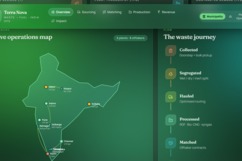
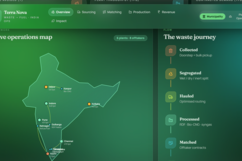
Live Operations map
-
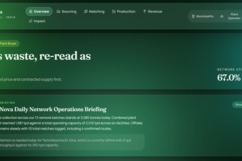
Ai integration - can be viewed differently
-
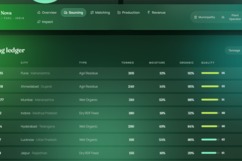
Sourcing
-
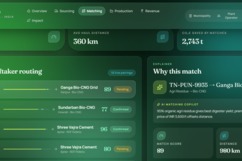
Matching
-
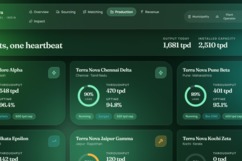
Production
-
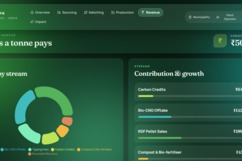
Revenue
-
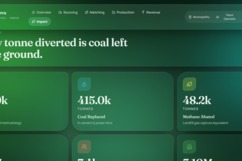
Impact
Inspiration
India generates enormous quantities of municipal solid waste, yet a significant portion remains poorly segregated, inefficiently transported, or ultimately sent to landfills. At the same time, industries such as cement manufacturing continue to depend heavily on conventional fossil fuels.
We were inspired by the gap between these two realities: waste is available as a potential resource, while industries need cleaner alternative fuels but the ecosystem connecting them remains fragmented and difficult to monitor.
Our research showed that the challenge is not only about building waste-to-fuel plants. A major barrier to scaling is the lack of operational visibility, coordination, and intelligent decision-making across the value chain.
Municipalities, plant operators, logistics providers, and industrial offtakers often operate with disconnected information. This makes it difficult to answer basic but critical questions:
- Where is the waste?
- What is its quality?
- Where is it currently in the processing pipeline?
- Which plant can process it?
- How much alternative fuel can be produced?
- Which offtaker is the best match?
- Are operations performing as expected?
- Where are anomalies or bottlenecks emerging?
TERRA NOVA was inspired by the idea that digital infrastructure and AI can make the waste-to-fuel ecosystem visible, measurable, and coordinated.
What it does
TERRA NOVA is an AI-powered operations platform for India's waste-to-fuel ecosystem.
It acts as a digital operating layer connecting municipal waste sources, collection networks, processing plants, logistics, fuel production, and industrial offtakers.
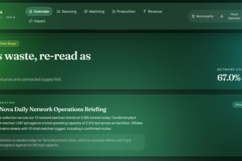
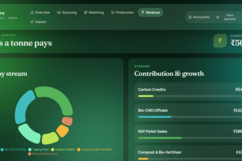
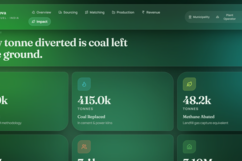
The TERRA NOVA Operations Dashboard provides a unified view of the entire waste-to-fuel journey.
Real-Time Operations Intelligence
The dashboard monitors key indicators such as:
- Network utilization
- Tonnes of waste in pipeline
- Landfill diversion
- Average segregation score
- CO₂e avoided
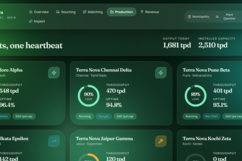
- Plant throughput
- Contracted fuel demand
Live Operations Map
An interactive geographic view connects:
Municipalities → Waste Networks → Processing Plants → Offtakers
This allows users to understand the spatial relationship between waste generation, processing capacity, and fuel demand.
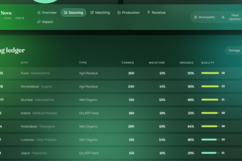
Waste Journey Tracker
TERRA NOVA provides batch-level visibility across the complete journey:
Collection → Segregation → Transportation → Processing → Matching → Combustion
This creates traceability from waste generation to final fuel utilization.
Municipality View
ULBs can monitor collection coverage, segregation quality, waste volumes, landfill diversion, feedstock movement, and operational performance.
AI-Powered Operations
AI is a core part of the platform rather than a standalone chatbot.
The system currently includes four live AI capabilities:
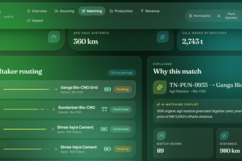
1. AI Match Explanations
When waste-derived fuel is matched with an industrial offtaker, AI generates an explanation of why the match is appropriate and provides a confidence score.
2. AI Operations Copilot
A floating AI assistant allows users to ask questions about operational data and receive grounded responses based on the dashboard's information.
3. AI-Generated Daily Briefing
The system automatically summarizes the day's operational situation, highlighting important metrics, developments, and areas requiring attention.
4. Animated Anomaly Notifications
AI-supported monitoring identifies unusual operational patterns and surfaces them through visual notifications so users can investigate potential problems faster.
Together, these features turn the dashboard from a passive reporting interface into an intelligent operational decision-support system.
How we built it
TERRA NOVA was designed as a web-based operations platform with a focus on real-time visualization, modular data flows, and AI-assisted decision-making.
The dashboard brings together operational information across municipalities, waste streams, processing facilities, transportation, fuel production, and offtake.
Core Architecture
The platform uses:
- A modern web application architecture
- Interactive operational dashboards
- Geographic visualization for network mapping
- Batch-level waste journey tracking
- Server-side AI processing
- React Query for session-level AI data caching
- Server functions/server routes for AI requests
- Lovable Cloud's AI Gateway
- Gemini 3.6 Flash for AI-powered capabilities
AI calls are handled server-side, meaning users do not need to provide their own model API keys.
React Query caches AI-generated information per session, reducing unnecessary repeated requests while maintaining a responsive experience.
AI Architecture
The AI layer is designed around operational context rather than generic conversation.
Instead of simply adding a chatbot, we use AI at multiple decision points:
Operational Data → AI Analysis → Explanation / Summary / Alert → Human Decision
For example, the match-explanation capability does not merely recommend an offtaker. It also communicates why a match makes sense and how confident the system is, making the AI output more useful for operational decision-making.
Challenges we ran into
One of our biggest challenges was determining how to use AI meaningfully without turning the project into a conventional dashboard with a chatbot attached to it.
We therefore focused on AI capabilities that directly support operational decisions: explaining matches, summarizing operational conditions, identifying anomalies, and answering questions about the network.
Another challenge was representing a highly fragmented physical ecosystem digitally.
Waste-to-fuel operations involve multiple entities, locations, processes, and handoffs. We had to design the dashboard so that users could move between high-level network performance and individual waste journeys without losing context.
We also had to balance ambition with the constraints of a hackathon. A complete waste-to-fuel ecosystem would require integration with municipal systems, GPS/IoT devices, plant SCADA systems, logistics platforms, laboratory data, and offtaker systems. Instead, we built the digital foundation and demonstrated how these data streams can ultimately be unified.
Finally, AI responsiveness and cost were important considerations. We addressed this through server-side processing and session-level caching using React Query.
Accomplishments that we're proud of
We are proud that TERRA NOVA evolved beyond a concept into a working operational prototype with live AI capabilities.
Our biggest accomplishment is demonstrating how one platform can connect the complete waste-to-fuel journey:
Waste Generation → Collection → Segregation → Transportation → Processing → Fuel Matching → Industrial Offtake
We are particularly proud of four AI capabilities being live in the platform:
- Streamed AI match explanations with confidence scores
- An AI Operations Copilot grounded in dashboard information
- Automatically generated daily operational briefings
- Animated anomaly notifications
We are also proud of the platform's ability to combine operational analytics, geographic intelligence, environmental impact metrics, and AI decision support within a single interface.
Rather than treating sustainability as a static reporting exercise, TERRA NOVA attempts to make environmental impact an operational metric that can be monitored alongside throughput, demand, utilization, and logistics.
What we learned
We learned that solving sustainability problems is often as much about coordination and information infrastructure as it is about physical technology.
A waste-to-fuel plant can have strong technology, but if the feedstock is inconsistent, logistics are inefficient, demand is uncertain, or stakeholders cannot see what is happening across the network, scaling becomes difficult.
We also learned that AI is most valuable when it is connected to a specific workflow.
A generic chatbot can answer questions, but an AI system that explains a fuel match, identifies an operational anomaly, or summarizes the day's most important developments can directly support a real-world decision.
Most importantly, we learned that visibility creates the foundation for optimization.
Before a fragmented system can be optimized, it needs to be measurable. TERRA NOVA therefore focuses first on creating a common operational picture and then applying AI to that shared context.
What's next for Terra Nova
Our next goal is to move TERRA NOVA from a hackathon prototype toward a real-world digital infrastructure layer for waste-to-fuel operations.
Future versions could integrate directly with:
- Municipal waste-management systems
- GPS-enabled collection and logistics fleets
- Weighbridges and RFID systems
- Material Recovery Facilities
- Plant SCADA and IoT sensors
- Feedstock quality and laboratory data
- Fuel production systems
- Industrial offtaker demand
- Carbon and emissions accounting systems
With these integrations, TERRA NOVA could progress from operational visibility to predictive and autonomous optimization.
Future AI capabilities could include:
- Predictive feedstock availability
- Plant performance forecasting
- Predictive maintenance
- Dynamic logistics optimization
- Automated offtaker matching
- Feedstock quality prediction
- Early detection of supply-chain disruptions
- Carbon-impact forecasting
- Network-level capacity optimization
Our long-term vision is to build the digital operating layer for India's waste-to-fuel ecosystem—helping municipalities divert more waste from landfills, helping operators utilize plants more efficiently, and helping industries transition toward reliable alternative fuels.
From waste generation to fuel utilization, TERRA NOVA makes the entire journey visible—and uses AI to help make it smarter.
Built With
- framermotion
- lucidereact
- react
- shadcn/ui
- supabase
- tailwindcss
- typescript

Log in or sign up for Devpost to join the conversation.