-
-
generated report
-
introduction dashboard
-
after submission of an event
Inspiration
When organizations make multi-million dollar infrastructure decisions, they often rely on fragmented data and static reports that fail to account for accelerating climate risks. I was inspired to build a solution that replaces this outdated process with something dynamic, highly visual, and intelligent. I envisioned a system where decision-makers wouldn't just look at a map, but would interact with a "command center" powered by an integrated council of AI experts. My goal was to create TerraNode X: a platform that simulates the future, evaluates the risks, and synthesizes complex environmental data into clear, actionable executive insights.
What it does
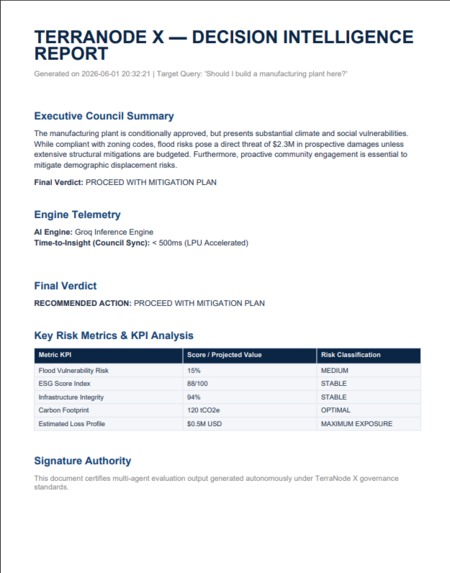
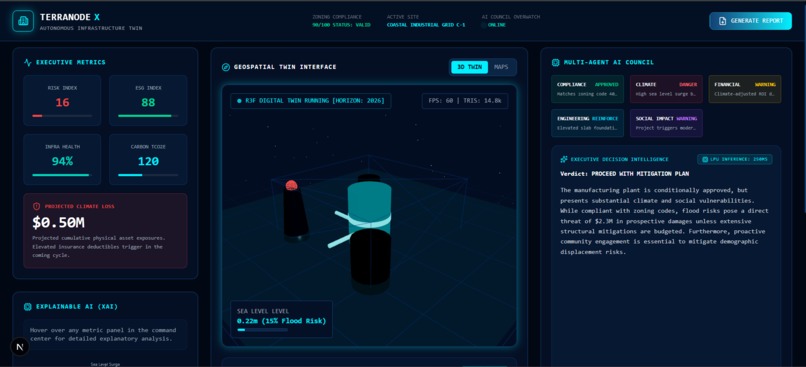
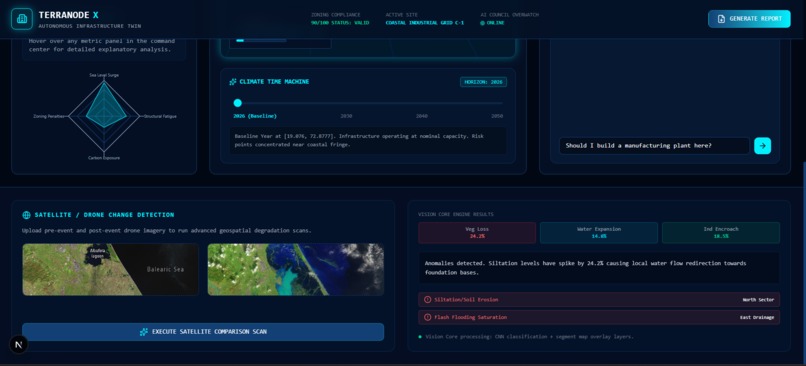
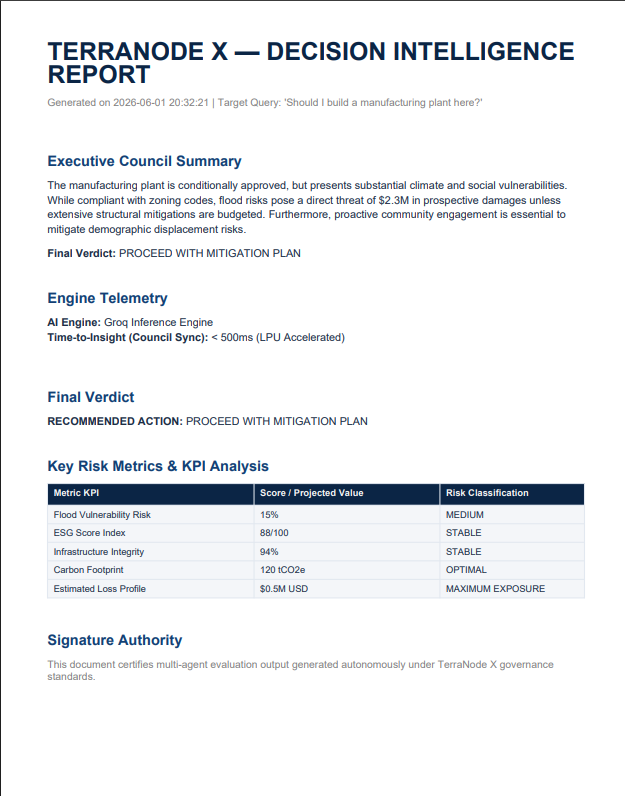
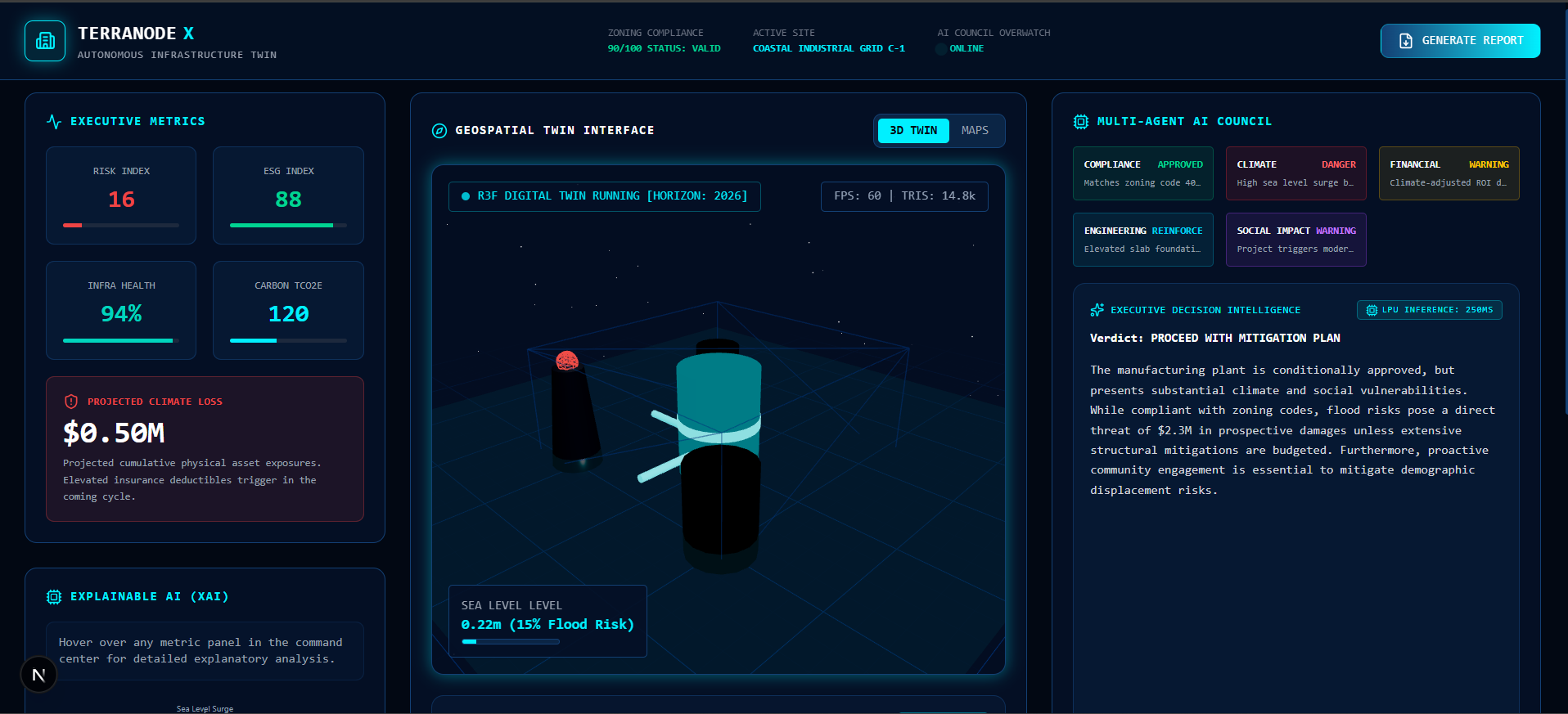
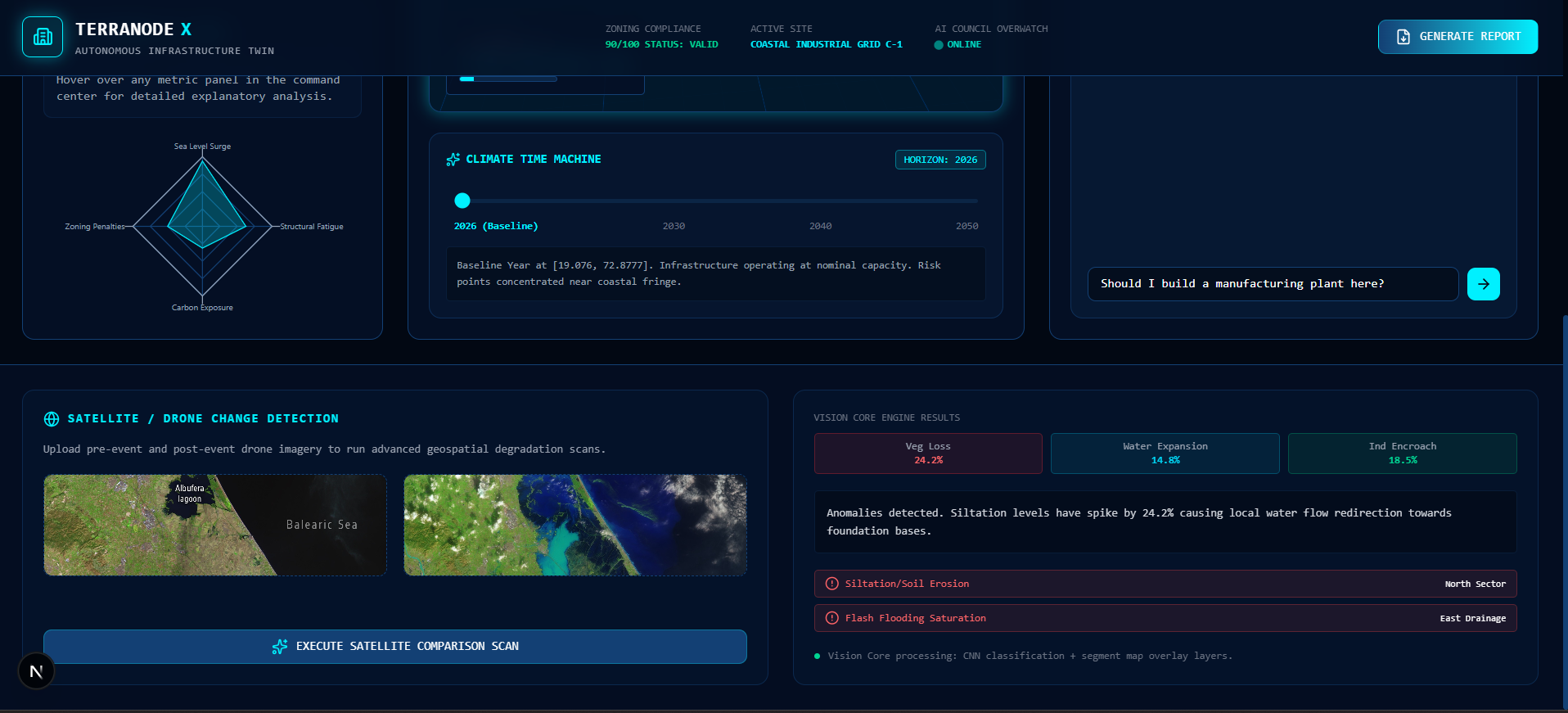
Terra Node PL (branded in-app as TerraNode X) is an AI-assisted climate and infrastructure decision platform built around a cinematic command-center UI. It allows users to:Simulate Long-Horizon Risk: A time-machine slider projects infrastructure and climate risks across preset horizons: 2026, 2030, 2040, and 2050.Visualize Digital Twins: Users explore the infrastructure state via a 3D digital twin or toggle to a live geospatial map mode.Run a Multi-Agent Council: An orchestrated AI council (Compliance, Climate, Financial, Engineering, and Social Impact agents) evaluates site proposals and synthesizes a final recommendation.Analyze Change Detection: A built-in computer vision workflow compares before/after satellite or drone imagery to detect vegetation loss, water expansion, and industrial anomalies.Generate Executive Reports: The platform instantly compiles the current simulation state and agent decisions into a downloadable PDF report.To model the compounding nature of climate threats across my preset time horizons, the backend simulation engine utilizes a predictive risk scaling function:$$R(t) = R_{base} \cdot \prod_{i=1}^{k} \left( 1 + \alpha_i \right)^{\Delta t} + \sum_{j=1}^{m} \left( \beta_j \cdot E_j \right)$$Where $R(t)$ is the projected risk at year $t$, $R_{base}$ represents the current baseline risk (e.g., in 2026), $\alpha_i$ is the compound annual growth rate of specific climate stressors (like sea-level rise or temperature anomalies), $\Delta t$ is the years elapsed from the baseline, $\beta_j$ represents infrastructure degradation coefficients, and $E_j$ represents discrete environmental shock factors.
How I Build it
I engineered Terra Node PL using a decoupled, high-performance architecture.
The Frontend: I built a single-page command center using Next.js 16 (TypeScript/React 19) styled with Tailwind CSS 4. For the visualizations, I integrated @react-three/fiber and @react-three/drei to render the 3D facility digital twin with animated overlays, and mapbox-gl for live geospatial mapping. recharts was used to construct my radar charts and executive metric panels.
The Backend: I implemented a lightning-fast FastAPI (Python) server to handle my core logic. The multi-agent workflow is powered by the Groq API, which ensures my Compliance, Climate, Financial, Engineering, and Social Impact agents can rapidly process context and return strictly structured JSON. For image analysis, the /vision endpoint handles multipart uploads and routes them to a vision model. Finally, I utilized ReportLab to dynamically generate the executive PDF summaries.
Challenges I ran into
One major challenge was ensuring the UI remained seamless and "demo-friendly" even if external services failed. I had to engineer robust fallback mechanisms—such as local simulation math and mock JSON responses for the AI council and vision endpoints—so the app functions perfectly even without a Groq API key or Mapbox token.
Additionally, orchestrating the multi-agent system required precise prompt engineering to guarantee that five different AI personas consistently returned valid JSON containing their specific scores, reasoning traces, and impact estimates without breaking the Next.js frontend's expected data schema.
Accomplishments that we're proud of
I am incredibly proud of the user experience I created. Combining a 3D WebGL digital twin, live Mapbox rendering, and a multi-agent AI chat console into a single, cohesive "cinematic" dashboard as a solo developer is a massive technical feat. Furthermore, building a robust FastAPI backend that instantly synthesizes five different AI expert opinions into one cohesive executive recommendation—and then formats it into a downloadable PDF—proves the real-world commercial viability of TerraNode X.
What we learned
Building Terra Node PL deepened my expertise in orchestrating agentic AI workflows. I learned how to effectively manage LLM context windows and enforce strict JSON schemas for predictable outputs. On the frontend, I mastered managing complex, interconnected states in React 19, specifically ensuring that when a user adjusts the time-machine slider to 2050, the 3D twin, the metric cards, and the AI context all update in perfect synchronization.
What's next for Terra Node PL
My immediate next steps are focused on production readiness. I plan to upgrade the FastAPI backend to execute the multi-agent council in true parallel rather than sequentially, drastically reducing inference time. I also intend to introduce a persistent database layer to save simulation histories, uploaded satellite images, and council sessions. Finally, I want to establish automated API testing pipelines and deploy the application to a cloud provider for public access.
Built With
- fastapi
- groq
- mapbox
- next.js
- python
- react
- react-three-fiber
- recharts
- tailwind-css
- typescript

Log in or sign up for Devpost to join the conversation.