
Inspiration
Everyone talks about sustainability, but almost nobody acts on it consistently — not because people don't care, but because there's no immediate feedback loop. Recycling a bottle or biking to work instead of driving doesn't feel like it does anything in the moment, so the habit never sticks. We kept coming back to the same question: what if taking care of the planet felt like the apps people already can't put down — Strava, Duolingo, a leaderboard with your friends on it? Terra started from that idea: turn real carbon-reducing actions into a game with actual stakes — XP you earn, rewards you can redeem, and a community you're visibly part of.
What it does
Terra is a personal carbon coach built around one loop: log a real action, get it verified, earn XP, and spend that XP on rewards funded by sponsor brands.
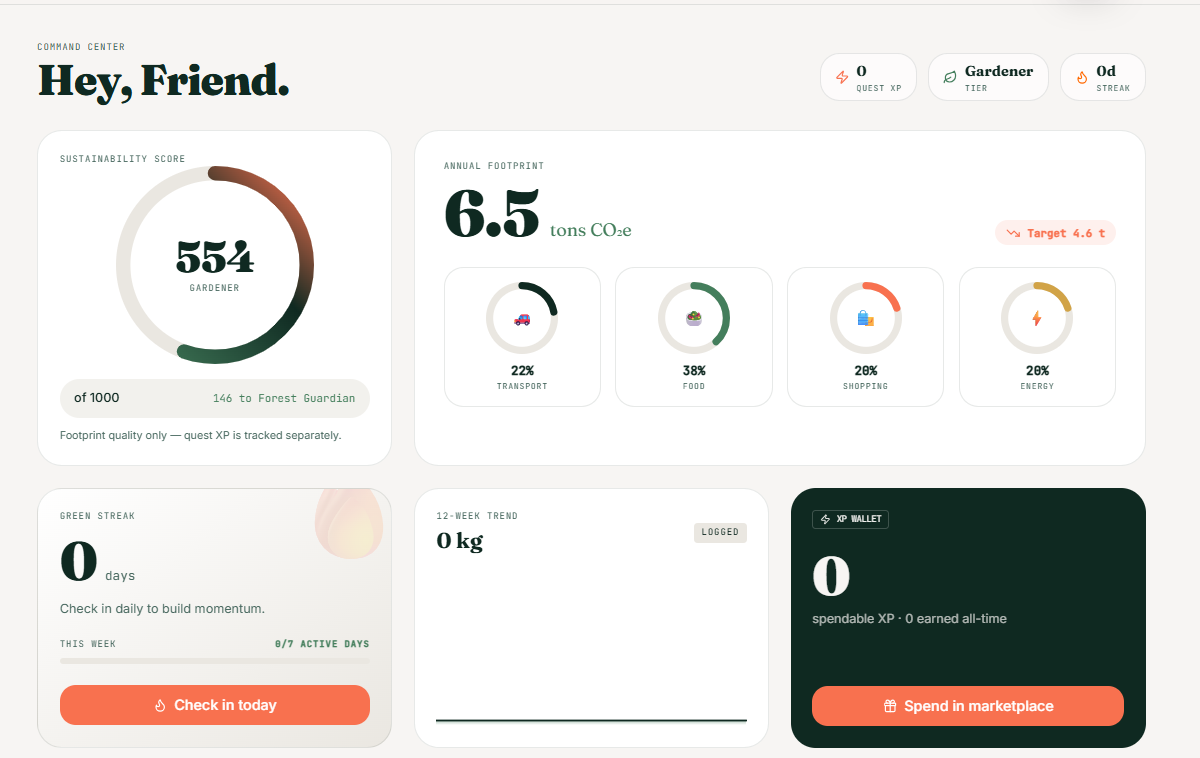
- Command Center dashboard — the moment you land, you see your Sustainability Score (a 0–1000 rating with named tiers like "Gardener" and "Forest Guardian"), your annual footprint in tons of CO₂e broken down by Transport, Food, Shopping, and Energy, a green streak counter, a 12-week trend, and your spendable XP wallet — all in one screen instead of scattered across pages.
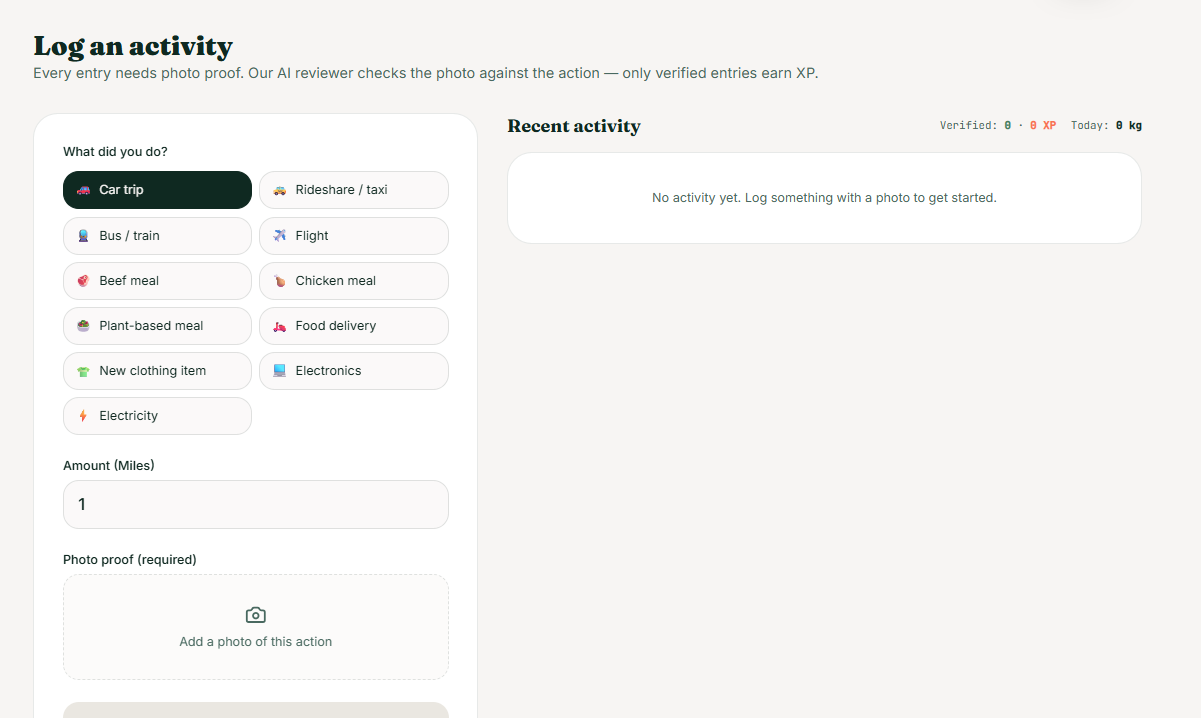
- Activity logging with mandatory AI-verified photo proof — you pick what you did (car trip, flight, a meal type, a purchase, electricity use, etc.), enter the amount, and attach a photo. The app is explicit about it: "Every entry needs photo proof. Our AI reviewer checks the photo against the action — only verified entries earn XP." There's no way around it — no photo, no verification, no XP.
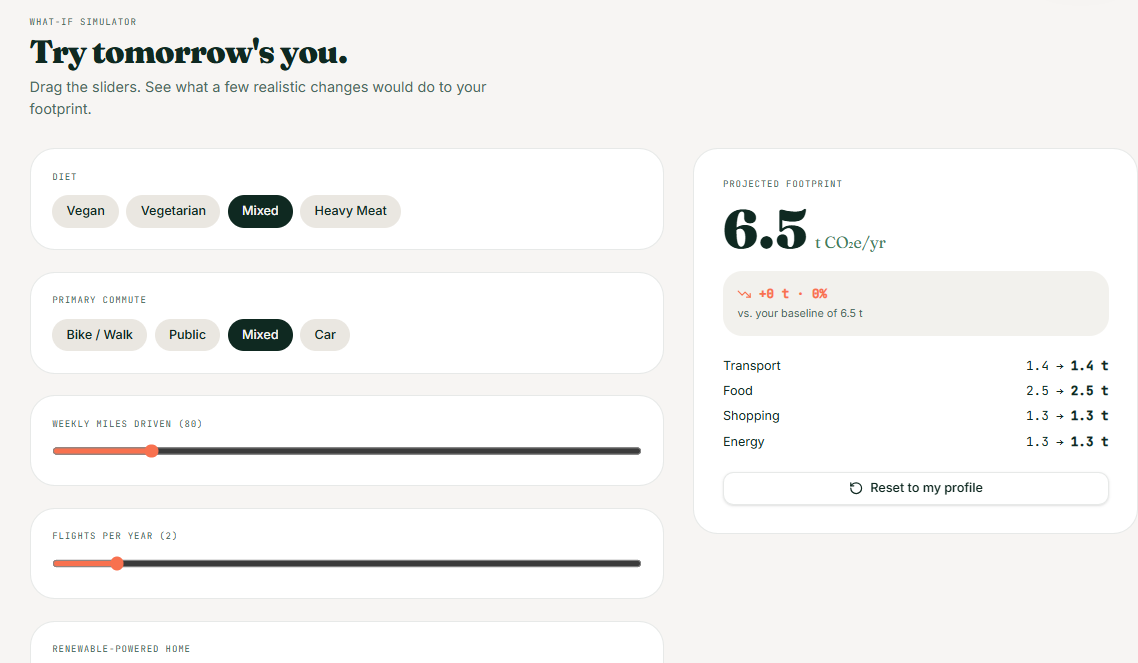
- What-If Simulator — a genuinely useful planning tool, not just a gimmick: drag sliders for diet, commute type, weekly miles driven, flights per year, and home energy source, and watch your projected annual footprint update live against your actual baseline. It's the difference between "you should drive less" and showing someone exactly what switching to mixed commuting would save them.
- XP, streaks, and a rewards marketplace — verified actions earn XP, build your streak, and get logged to your wallet ("0 spendable · 0 earned all-time" shown transparently, not hidden). That XP is spendable in the marketplace on rewards funded directly by sponsor brands.
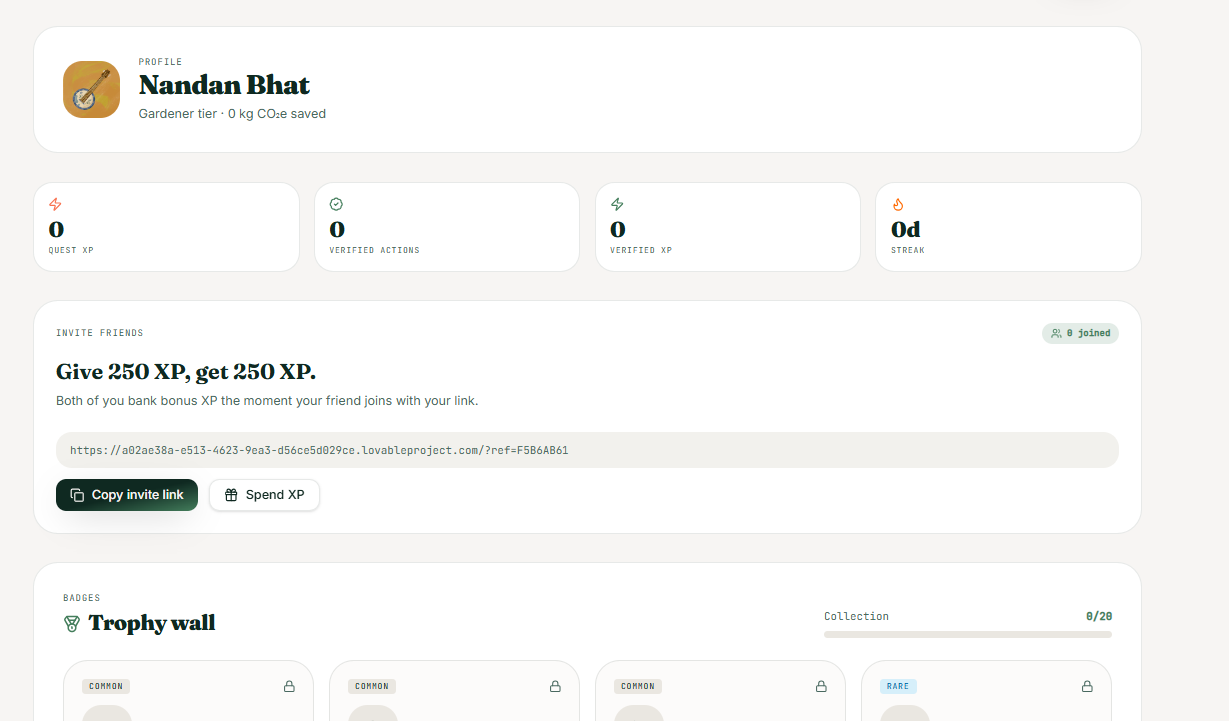
- Referral system built into the profile — "Give 250 XP, get 250 XP." Both people bank bonus XP the moment a referred friend joins via your personal invite link, with a live "joined" counter next to it.
- Achievements as a trophy wall on your own profile — badges (Common, Rare, etc., with a visible collection count like "0/20") live directly on your profile instead of a separate nav page, so progress is part of your identity on the platform, not buried in a menu.
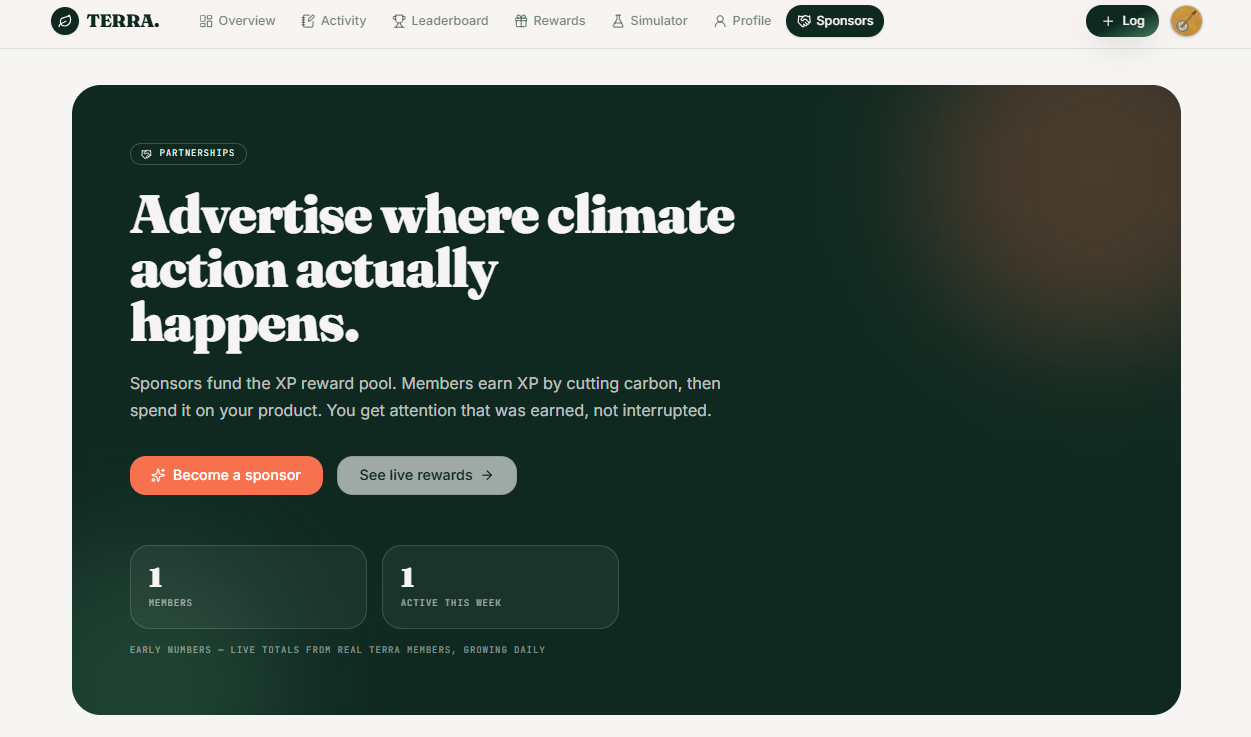
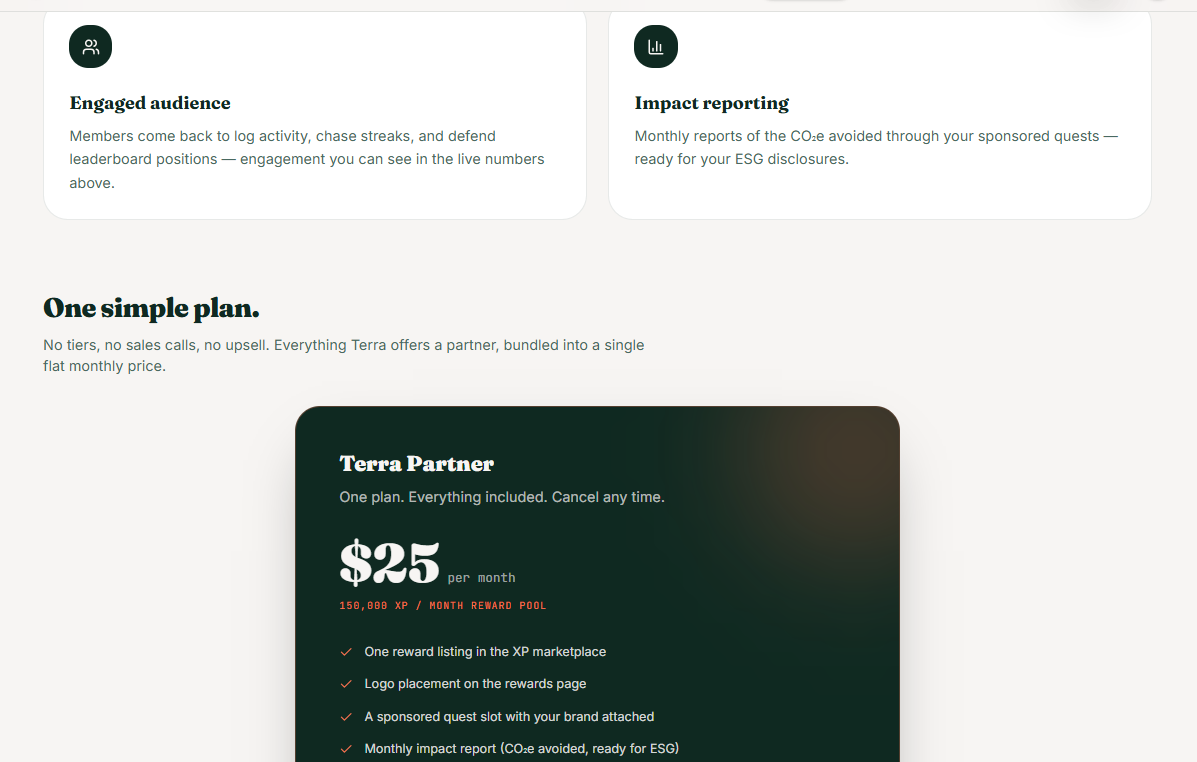
- Sponsors, at one honest flat price — sponsors fund the XP reward pool that pays users back for real climate action. Instead of a tiered enterprise pricing table, it's one plan: $25/month, "One plan. Everything included. Cancel any time," funding a 150,000 XP/month reward pool, and including a reward listing, logo placement, a sponsored quest slot, and a monthly CO₂e impact report for ESG disclosures.
The thing we're most particular about: every number on the sponsor page is real. It currently shows "1 members" and "1 active this week," labeled directly underneath as "Early numbers — live totals from real Terra members, growing daily." We could have shipped fake social-proof numbers to look more impressive in a demo — we deliberately didn't, because a reward economy sponsors are meant to trust has to be honest about where it actually stands.
How we built it
Terra started as a single idea, not a spec — we didn't write a feature list first, we built by describing the product to Lovable and iterating through prompts to shape it into what it is now. The whole frontend and app logic were built through Lovable using prompt engineering as the primary "coding" interface, then connected via Git to a GitHub repository so the project had real version control and a persistent, ownable codebase instead of living only inside the builder.
The build happened in deliberate passes rather than one shot: first getting the core loop working (activity logging, XP, quests, leaderboard, rewards, sponsors), then a dedicated pass to kill layout bugs (an overlapping floating XP element was a recurring problem across several passes before it was fully removed), then a pass to replace placeholder/fake statistics with real data pulled from the app itself, then a pass to add mandatory photo capture with AI review before any XP is granted, then folding the standalone Quests page into Activity so quest completion and action logging became one unified flow with one verification standard, then collapsing sponsor pricing from a three-tier structure down to the single $25/month plan, and finally a pass purely on animation and micro-interactions — XP counters, streak elements, smoother transitions — layered on top of the existing visual design rather than a redesign.
Challenges we ran into
The biggest challenge wasn't the idea, it was translating the idea into prompts precise enough for the AI to execute correctly. Vague prompts produced vague, generic-feeling output — early passes had real usability problems: an orange CTA button that kept overlapping other elements across multiple rebuilds before it was actually fixed, sections that felt cramped, and fake placeholder statistics ("70 people did this," inflated member counts) that looked fine in a demo but would fall apart under any real scrutiny. Fixing that took multiple rounds of increasingly specific prompts — naming the exact bug, stating explicitly what to remove and not just what to add, and setting a hard rule of zero new fake data once we realized the AI would otherwise default back to placeholder content to fill visual gaps. Lovable also has credit limits per session, so we couldn't dump everything into one giant prompt — we had to sequence the work in priority order so nothing shipped half-finished.
Building real trust into the core loop was its own challenge: an XP-for-rewards system is only meaningful if the actions behind it are real, which is what pushed us toward mandatory photo capture with AI verification before any XP is granted — that single feature, and merging it consistently across both regular activity logging and quest completion, took the most iteration of anything in the app.
Accomplishments that we're proud of
- Getting AI photo verification to actually gate XP end-to-end, on every entry type, not just as a cosmetic badge — this is what makes Terra's reward economy trustworthy instead of just a checkbox app.
- The What-If Simulator turning out to be genuinely useful on its own, not just a supporting feature — being able to drag sliders and see a real projected footprint change makes the abstract concept of "carbon footprint" concrete.
- Cutting real scope: merging Quests into Activity and folding Achievements into a profile trophy wall instead of stacking more nav items, so the finished product feels focused instead of padded out with half-built pages.
- Shipping a sponsor page with real, unembellished numbers — "1 member, 1 active this week," labeled honestly as early and growing — instead of the inflated placeholder stats we started with.
- Landing on one simple, honest $25/month sponsor plan that a small local sustainable brand can actually say yes to on the spot, instead of a tiered enterprise pricing table built for a scale we don't have yet.
- Getting the dashboard, activity flow, and profile to feel cohesive and alive through animation and micro-interactions without a visual redesign — proving the product could be elevated through iteration, not a rebuild.
What we learned
The biggest lesson was that with AI-assisted development, the idea and the prompting matter more than raw coding ability. A strong original idea executed with vague prompts produces a mediocre app; a clear idea executed with precise, deliberate prompts — naming exact bugs, exact features to cut, exact rules like "never fabricate data" — produces something that actually works. Prompt engineering isn't a shortcut around product thinking, it is product thinking, just expressed as instructions instead of code. We also learned to treat each build pass like a real product sprint: fix bugs before adding features, cut scope before adding more, and never let "it looks fine in the demo" replace "it actually works" — the recurring orange-button bug across multiple passes was a direct lesson in that.
What's next for Terra Sustainability
The next priority is deepening the verification system beyond a single AI photo check — moving toward more robust confirmation (metadata checks, pattern detection for repeat or fraudulent submissions, and possibly lightweight community or manual review for edge cases) so the reward economy can scale without being gamed as the user base grows past its current early numbers. Alongside that, we're focused on growing the sponsor side of the platform — bringing on more local and small sustainable brands at the $25/month tier to grow the 150,000 XP/month reward pool, since a bigger, real reward pool is what makes the whole loop worth it for users at scale. Longer term, that's the actual business: Terra as the honest, verifiable platform that connects everyday climate action to the brands who want to reward it.
Built With
- claude
- git
- lovable
- original-ideas
- prompt-engineering
- supabase
- typescript

Log in or sign up for Devpost to join the conversation.