Inspiration
Neurodivergent students don’t struggle because they lack ability—they struggle because campus systems assume everyone processes information the same way. At the University of Maryland, navigating crowded spaces, juggling dense schedules, and accessing support services can create constant cognitive friction. Existing apps offer generic wellness advice, but none provide real-time, situational support. We wanted to build something that actively reduces that friction moment-to-moment.
What it does
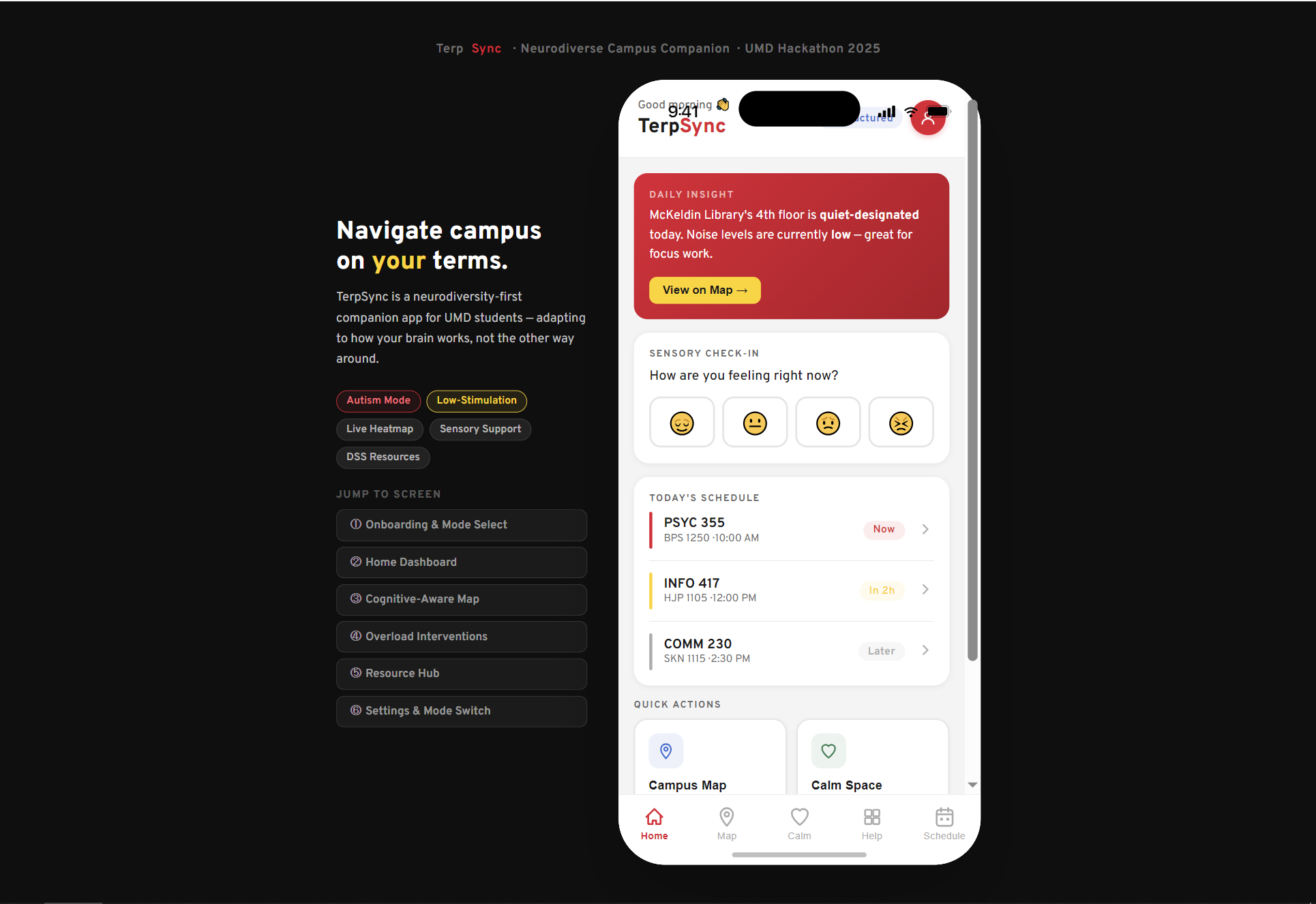
TerpSync is a real-time cognitive support app that helps neurodivergent students:
- Navigate campus using low-stimulation routes that avoid crowds and noise
- Break down overwhelming assignments into clear, actionable steps
- Detect cognitive overload and suggest timely interventions (breaks, quiet spaces, task adjustments)
- Connect directly to UMD resources like the Counseling Center at UMD and Accessibility & Disability Service with guided support
- Adapt its behavior with ADHD, Autism, and low-stimulation modes
It acts as a real-time cognitive copilot, always answering: what’s the easiest next step right now?
How we built it
- Frontend: React Native via Expo for rapid cross-platform development
AI Layer:
- Claude (via Claude Code + Claude Design) for task decomposition, UX flows, and system design
- GitHub Copilot for rapid implementation and iteration
Backend (conceptual / partial):
- Firebase (Firestore + Realtime DB) for user state and live sensory data
Core systems:
- Heuristic overload detection (schedule density + context)
- LLM-powered task breakdown + support suggestions
- Mode-based response shaping (ADHD / Autism / low-stimulation)
We leaned heavily into AI-assisted development, orchestrating multiple agents for coding, design, and product decisions.
Challenges we ran into
- Scoping real-time intelligence: Balancing ambition (true context awareness) with what’s feasible in a hackathon
- Signal vs noise: Avoiding overwhelming the user with too many suggestions—the app itself must not add cognitive load
- Designing for neurodivergence: Making UX decisions that are genuinely helpful, not just “minimal”
- Agent coordination: Getting consistent outputs across Claude + Copilot required clear prompting and iteration
- Data realism: Simulating crowd/sensory data without a live user base
Accomplishments that we're proud of
- Built a non-generic mental health solution that is actually situational and actionable
- Designed a system that integrates real UMD infrastructure, not just abstract wellness features
- Created a compelling end-to-end demo (routing → task help → overload intervention → resource connection)
- Successfully used multiple AI tools together as a coordinated development workflow
- Framed neurodivergent support as a systems + environment problem, not just an individual one
What we learned
- Coordinating multiple AI agents is powerful, but requires clear boundaries, roles, and prompt design
- AI is especially strong at task decomposition and reducing initiation friction, which maps well to ADHD support
- Good accessibility design is about predictability and context, not just simplicity
- The hardest part isn’t building features—it’s deciding when not to surface them
- Rapid prototyping with tools like Expo + Copilot dramatically accelerates iteration, but design clarity is still critical
What's next for TerpSync
- Integrate with real data sources (e.g., class schedules, campus APIs, possibly Canvas)
- Build a live sensory map with actual user contributions
- Improve overload detection with better behavioral signals or wearable integration
- Partner with UMD services like the University Health Center and ADS for real deployment
- Conduct user testing with neurodivergent students to refine interaction models
- Expand beyond UMD into a generalizable campus support platform
Built With
- claude
- claude-design
- copilot

Log in or sign up for Devpost to join the conversation.