💡 Inspiration
Most finance apps only help after the money is already spent. We wanted to build something that steps in before a bad financial decision happens.
TerpSense was inspired by a simple question:
What if your bank account could stop you before you made an impulsive purchase?
Instead of building another budgeting dashboard or expense tracker, we focused on the real problem: impulse spending in the moment. Students and young adults often do not need more charts. They need something that can catch risky purchases in real time, explain the tradeoff, and help them make a better choice before checkout.
⚙️ What it does
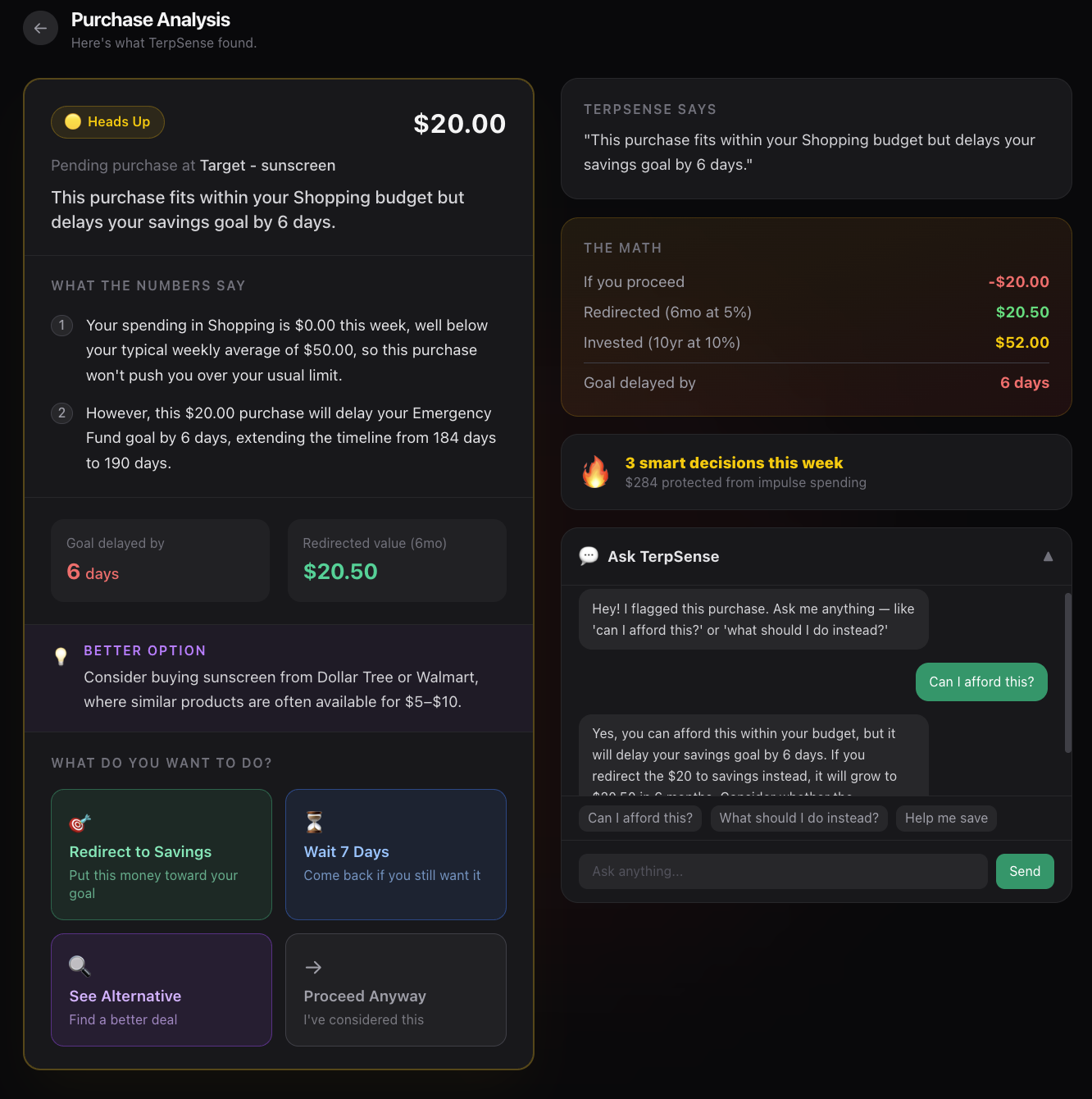
TerpSense is a real-time AI financial intervention agent that analyzes a pending purchase before it happens.
When a user is about to make a purchase, TerpSense:
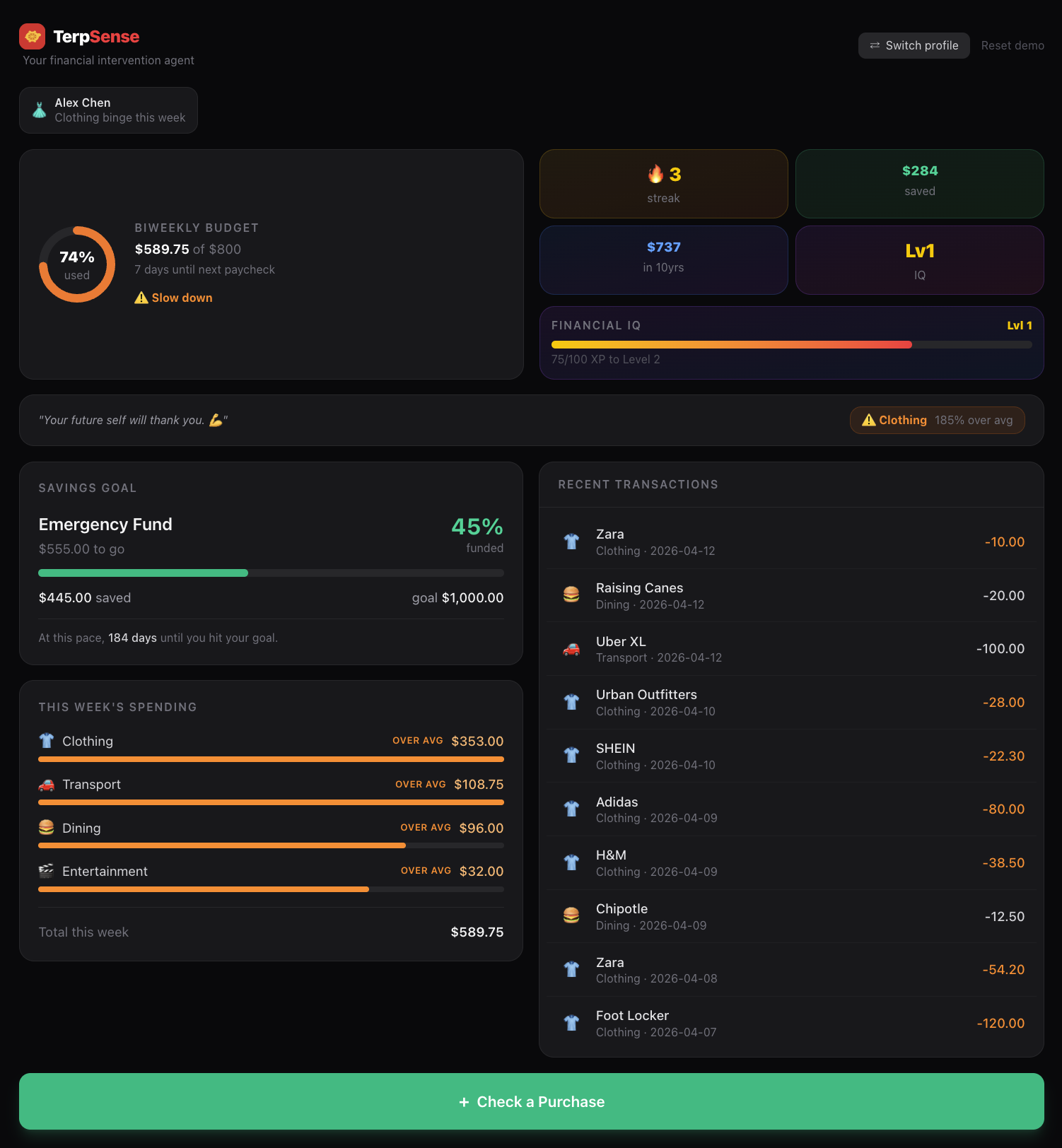
- checks recent transaction history and spending patterns
- looks at category-level overspending
- measures how the purchase affects a savings goal
- evaluates the purchase using deterministic scoring logic
- uses AI to generate a personalized intervention
- recommends one next best action:
- proceed
- delay
- redirect to savings
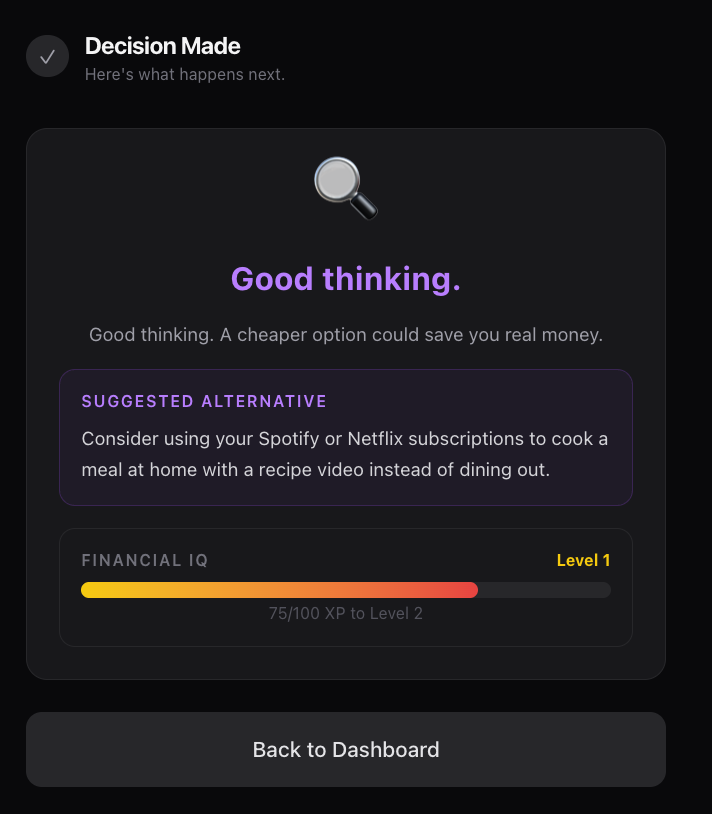
- choose an alternative
The result is a smarter, more behavioral financial experience that helps users pause and rethink purchases before they spend.
🛠️ How we built it
We built TerpSense as a full-stack web application using:
- Next.js + Tailwind CSS for the frontend
- FastAPI for the backend
- Azure OpenAI for personalized intervention reasoning
- Capital One Nessie API for mock banking and transaction data
- LangGraph to structure the intervention workflow as a lightweight agent system
Our backend processes transaction and goal context, computes deterministic financial signals like severity score and goal impact, then passes structured context into Azure OpenAI. The AI returns a recommended action, confidence, and personalized reasoning.
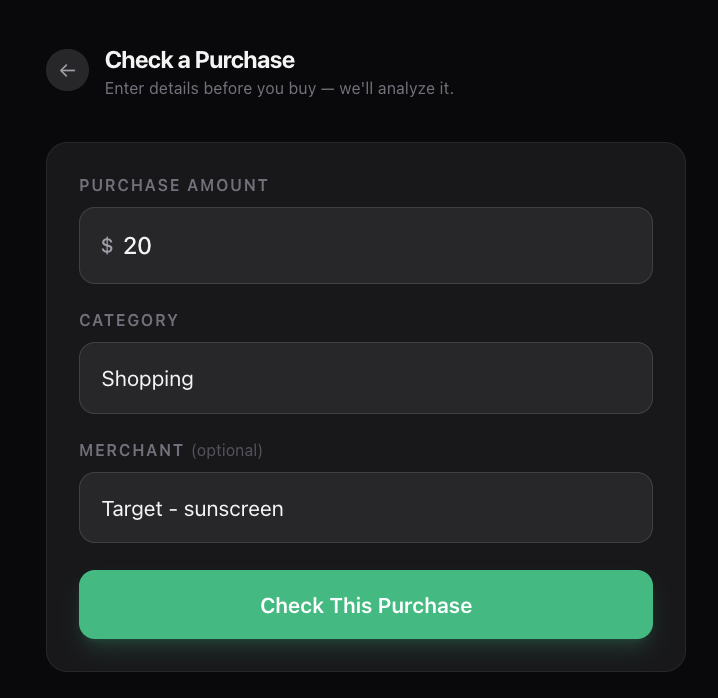
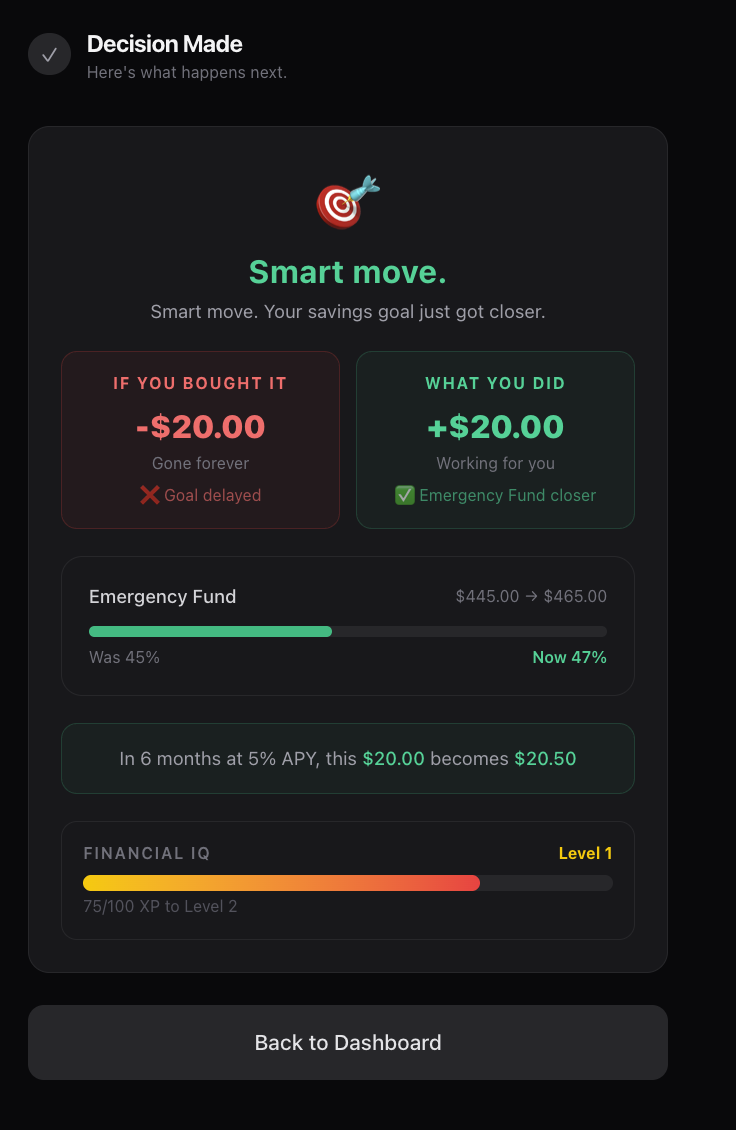
On the frontend, users can switch between customer profiles, review spending activity, simulate a purchase, and see TerpSense intervene in real time with a recommendation and outcome flow.
🚧 Challenges we ran into
One of our biggest challenges was making the product feel like a true agent rather than just a chatbot or one-off AI response.
We also had to balance:
- deterministic financial logic with AI-generated explanations
- using realistic banking data without overcomplicating the demo
- keeping the intervention persuasive without making it feel judgmental
- integrating multiple systems across the frontend, backend, Azure, and Nessie in a hackathon timeframe
Another major challenge was reliability. Since hackathon demos need to work every time, we had to design the system so that the core flow stayed smooth even if an external AI response failed or changed unexpectedly.
🏆 Accomplishments that we're proud of
We are proud that TerpSense is not just another budgeting app. It delivers a clear, memorable product experience centered around behavior change before purchase.
Some highlights we are especially proud of:
- building a polished end-to-end flow from dashboard to intervention to outcome
- integrating Capital One Nessie data to ground the experience in realistic banking context
- using Azure OpenAI to generate personalized, contextual interventions
- structuring the recommendation flow as a lightweight agent-based workflow
- creating dynamic customer/profile switching to show how recommendations adapt to different users
- keeping the product focused on one strong, demoable core use case
📚 What we learned
We learned that the most effective AI experiences are not always the ones with the most complexity. In our case, the strongest solution came from combining:
- clean deterministic business logic
- realistic financial context
- a focused user flow
- AI only where it adds the most value
We also learned that in fintech-style products, trust matters. That means the model should not hallucinate important numbers. Instead, the backend should compute the financial facts, and the AI should explain them clearly and persuasively.
Finally, we learned how to connect sponsor technologies in a way that feels meaningful rather than forced: Nessie provides the financial context, Azure powers the reasoning, and our application turns that into real-time intervention.
🚀 What's next for TerpSense
Next, we want to make TerpSense even more personalized and proactive.
Future directions include:
- stronger long-term memory of user behavior and spending habits
- Implementing other Azure tools (Face API, CV)
- better recommendation adaptation based on past user decisions
- more nuanced intervention strategies by category and purchase pattern
- real-time notifications and post-delay check-ins
- deeper financial wellness insights beyond a single purchase
- expanded bank/account integrations beyond mock data
Our long-term vision is to turn TerpSense into an intelligent financial companion that does not just track money, but actively helps people build better financial habits over time.
Built With
- azure
- capitalonehackathonapi
- fastapi
- langgraph
- nessie
- next.js
- openai
- python
- react
- tailwind
- typescript

Log in or sign up for Devpost to join the conversation.