-
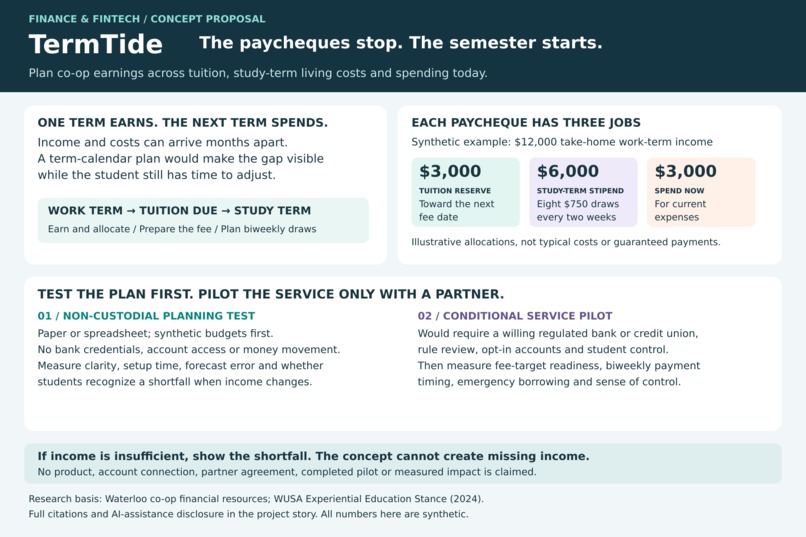
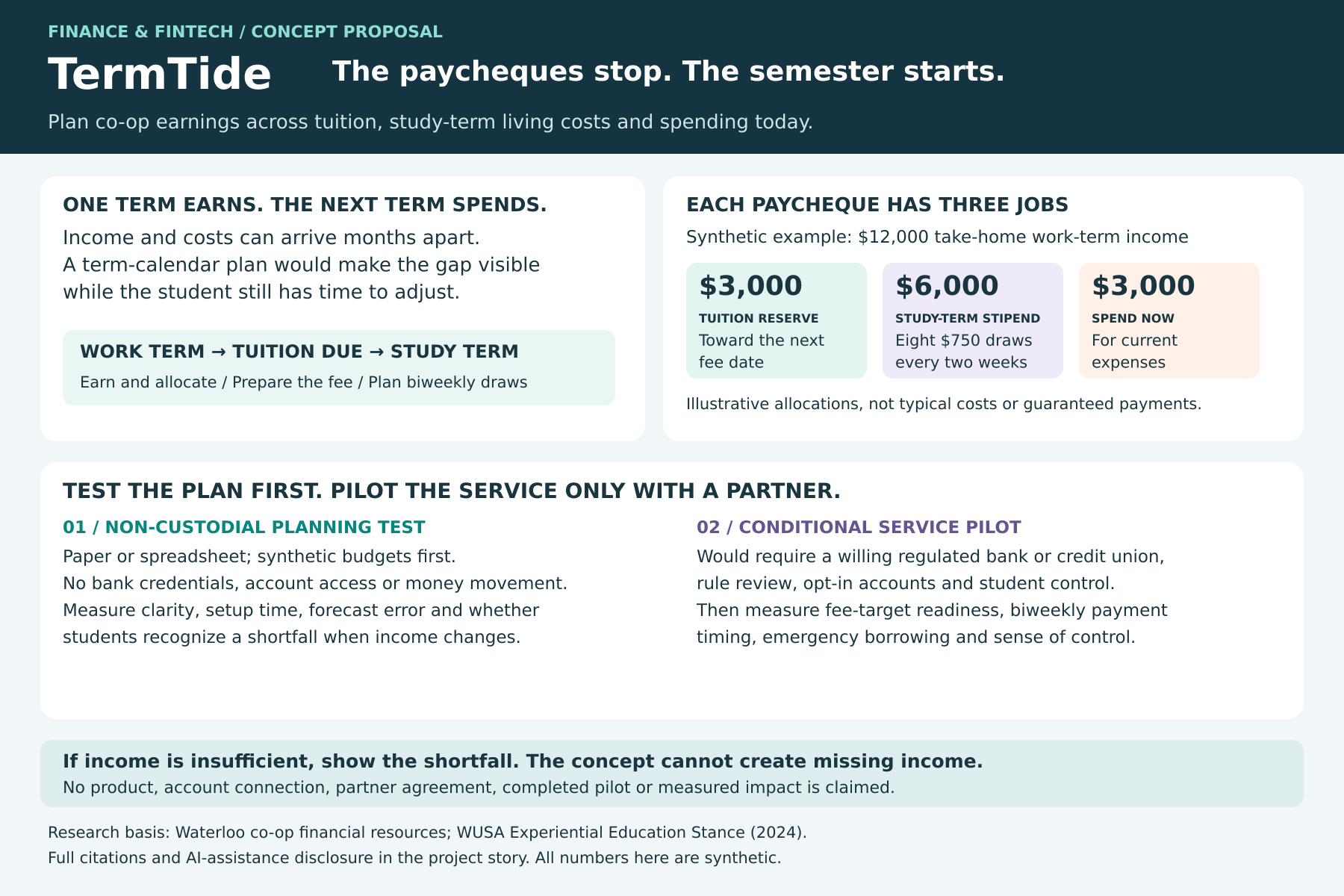
Concept: synthetic allocations, a non-custodial planning test and a conditional partner pilot. No product or pilot has been built.
Primary theme: Finance & FinTech. Related themes: Education & Learning and Social Impact.
The problem: the paycheques stop; the semester starts
TermTide proposes a way to carry co-op earnings into the study term: a tuition reserve, a biweekly draw from the student's own savings, and a clear amount available to spend now. The idea would first be tested as a non-custodial plan that neither connects to a bank nor moves money. A later service pilot would require a willing regulated financial-institution partner and review of the relevant rules.
Co-op students often alternate a paid work term with a study term that carries tuition, rent and daily costs. The cash can arrive months before the bills. Even a student who earns enough across the year can face a shortage at a tuition deadline or gradually spend a work-term balance before the next term begins. This is especially difficult for students without a family cash buffer. Waterloo's co-op financial resources acknowledge the challenge of balancing income, OSAP, rent and daily expenses. WUSA's experiential-education position also identifies tuition and living-cost planning across the co-op cycle as a student vulnerability.
A savings target alone does not specify when tuition is due or how long the remaining balance must support a study term. A line of credit can cover a gap but adds debt. Splitting a paycheque between accounts can help save, but does not automatically turn those savings back into a predictable study-term income. Student aid remains valuable; its rules and timing are separate from a student's personal cash-flow plan.
The proposed solution
TermTide is a concept for an opt-in, academic-calendar-based service proposed for a future credit-union or bank partner. At the start of a work term, a student would enter their academic calendar, estimated next-term tuition, and a realistic study-term budget. The plan would allocate each paycheque across three student-owned pockets:
- Tuition Reserve: A configurable share would be set aside toward the next fee date. The proposed service would let the student adjust or withdraw it, with a clear reminder of the resulting shortfall.
- Study-Term Stipend: Another share would be set aside during work for planned biweekly releases to the student's everyday account during study, subject to available funds and partner arrangements. It is the student's own earnings, not a loan or a new grant.
- Spend Now: The remainder would be available for current expenses.
An illustrative plan might allocate $12,000 of take-home work-term income as $3,000 for fees, $6,000 to be released as eight $750 biweekly study-term payments, and $3,000 for current spending. These are example numbers, not a claim about typical earnings or tuition. If pay varies or the student changes programs, the proposed plan would be recalculated to show the trade-off rather than silently promising a target it cannot meet.
Why this is different
The planning unit is an academic term, not a weekly budget or pay cycle. TermTide would combine dated tuition preparation with a self-funded study-term schedule, aiming to align the student's own savings with the timing of costs. It is deliberately a service design, not a new bank, investment product or lending product. A paper or spreadsheet planning test would come first, without bank access or money movement. A later partner-supported service pilot could test scheduled transfers using ordinary student-owned accounts. The design calls for student control, plain-language rules, no penalty for changing the plan, and no claim that a reserve is legally locked; any real account terms would need review before a pilot.
The concept draws on familiar savings pockets and scheduled transfers; its proposed innovation is connecting both directions of the flow to a co-op calendar. It would complement, rather than replace, bursaries, OSAP, employment income or financial counselling.
Implementation and resources
Discover (one term): Interview 20–30 co-op students with different incomes and programs, including those who have had difficulty covering a fee date. Map when money arrives and when obligations fall due. Ask a campus financial-aid office and a regulated deposit institution to review the design, including accessibility and consumer-protection implications.
Test the plan before moving money: Use synthetic budgets first, then opt-in anonymized examples if appropriate, in a paper or spreadsheet walkthrough. Test whether students understand the three allocations, can identify a shortfall, and can revise the plan when pay changes. Assess clarity, setup time and forecast error in those scenarios. This non-custodial test would collect no bank credentials, connect to no accounts and move no money. It has not been conducted.
Later service pilot (one academic cycle, conditional on a partner): With a willing financial-institution partner, invite a small opt-in cohort to use ordinary student-owned accounts, configurable scheduled transfers and a simple term-calendar plan. Provide a paper or spreadsheet version as well as any interface mock-up. Start without automated tuition payments; the student approves each payment. Offer a pause and immediate withdrawal path. No institution or partner has agreed to participate yet.
Evaluate the later service pilot before scaling: Measure whether students have their self-selected tuition target ready by the deadline, the percentage of planned study-term payments made on time, any overdraft or emergency borrowing, the time required to set up the plan, and participants' reported sense of control. Compare these with their own previous-term experience where appropriate. Proposed pilot goals could include 80% of participants reaching their chosen fee target and fewer emergency shortfalls, but these are hypotheses, not results.
The main challenges are variable pay, affordability when income is insufficient, student control over funds, privacy, and the interaction with aid rules. TermTide cannot fix too little income. It must show an honest shortfall and refer students to existing grants and support. Financial-aid and deposit treatment must be checked for each jurisdiction before a real pilot; this concept makes no eligibility promise. The service would store only the data needed for the plan and should never sell transaction histories.
What exists today and AI disclosure
This is an original concept submission. No bank product, prototype deployment, interview study, partner agreement or measured impact is being claimed. Devin Max Ultra assisted with idea research and drafting; Codex helped edit and prepare the submission. The cited Waterloo and WUSA material informs the problem statement, and conventional savings pockets and scheduled transfers are acknowledged as prior art. The proposed academic-calendar combination and pilot plan are the submission's new contribution. No third-party images or pre-existing project assets are used.
Built With
- service-design

Log in or sign up for Devpost to join the conversation.