-
-
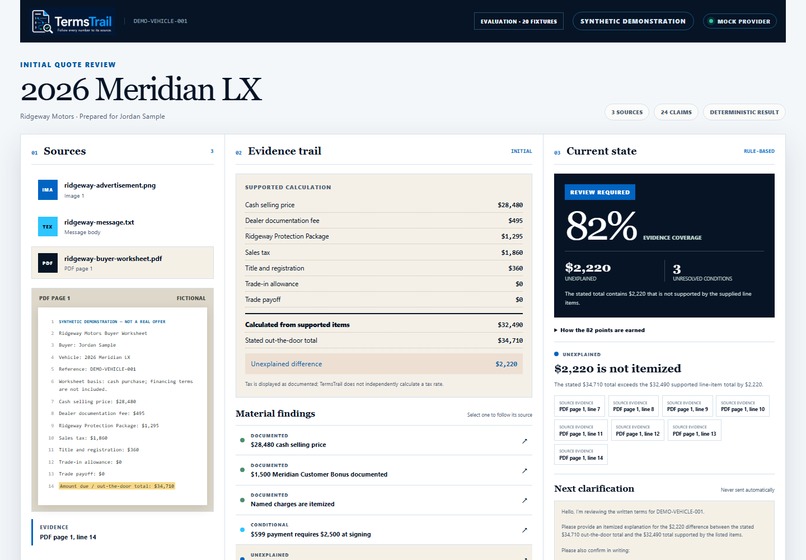
01-initial-result
-
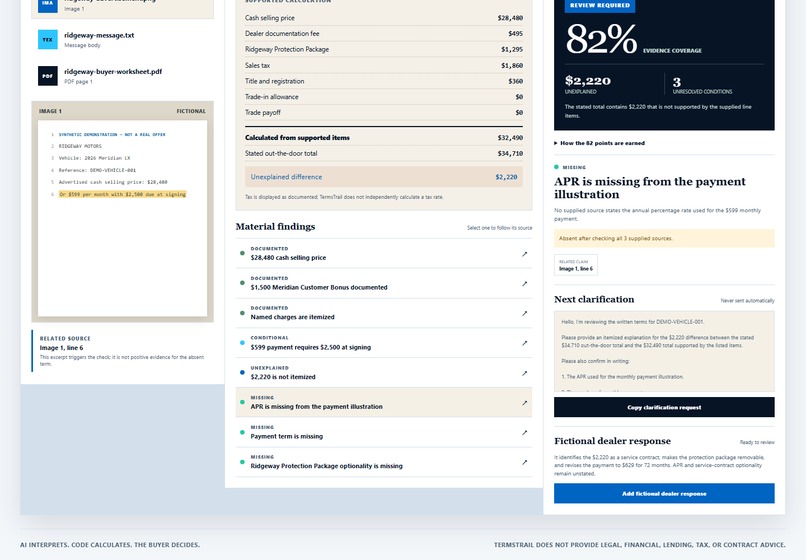
02-source-linked-evidence
-
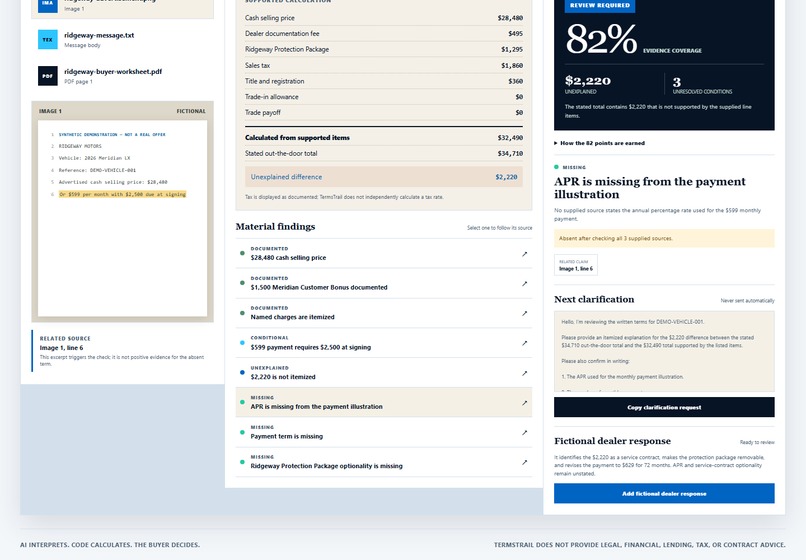
03-clarification-request
-
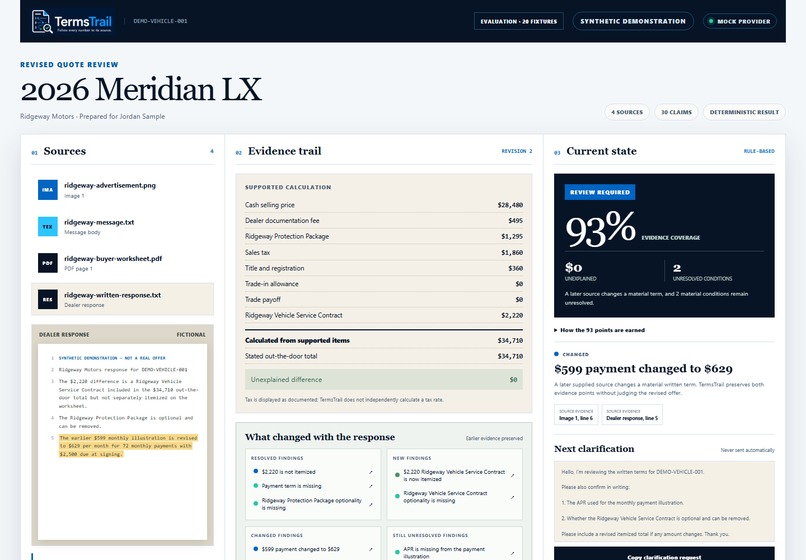
04-revised-trail
-
05-evaluation-and-gpt56
-
06-architecture-or-mobile
Inspiration
Buying a vehicle often means piecing together information from an online advertisement, text messages, monthly-payment claims, worksheets, rebates, fees, and financing conditions. A quote can look complete while still leaving the buyer unable to answer basic questions:
- Which numbers are actually documented?
- Which discounts have conditions?
- Does the stated total match the itemized charges?
- What important information is still missing?
- Did the terms change after the buyer asked for clarification?
TermsTrail was inspired by the need for a simpler way to follow every important number back to its source before committing to a major purchase.
What it does
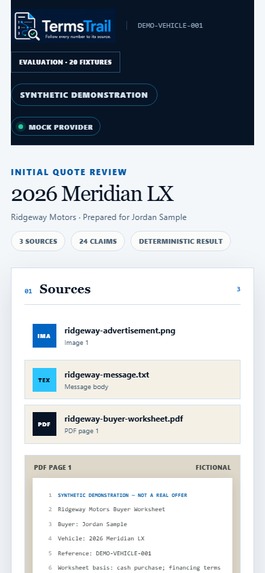
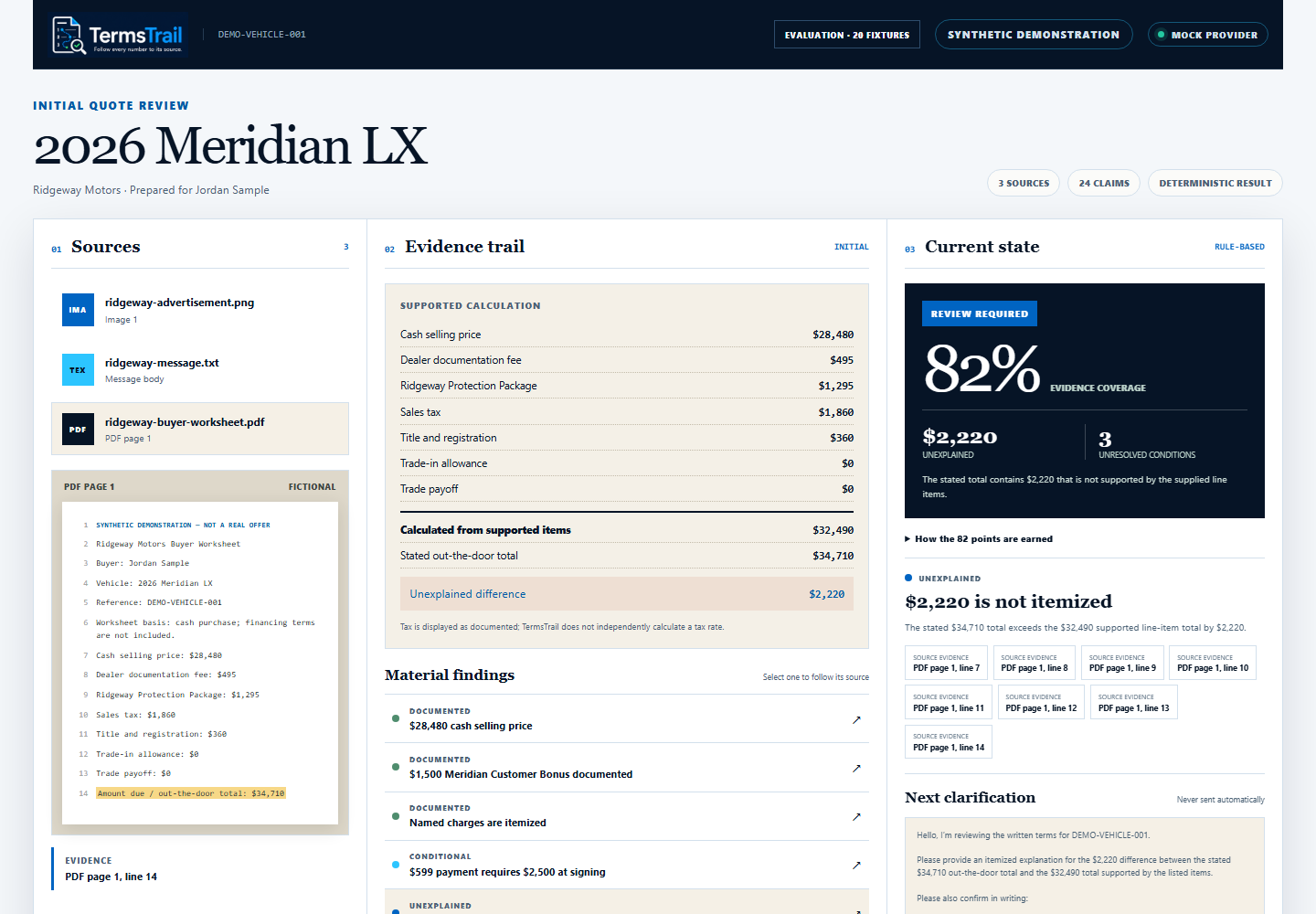
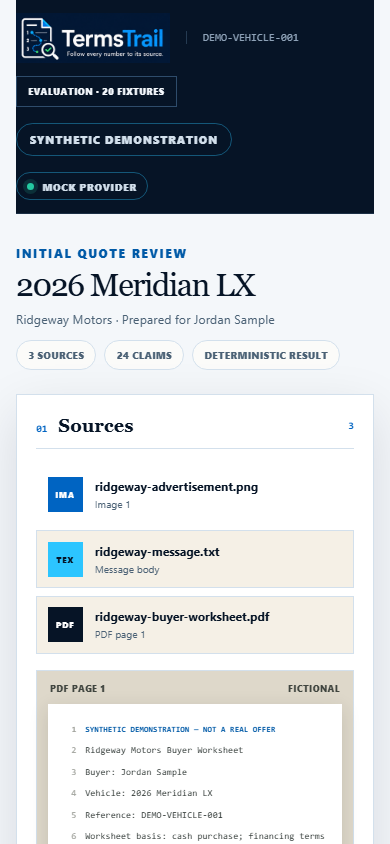
TermsTrail turns dealer advertisements, screenshots, messages, PDFs, and worksheets into an evidence-linked deal trail.
It identifies terms as:
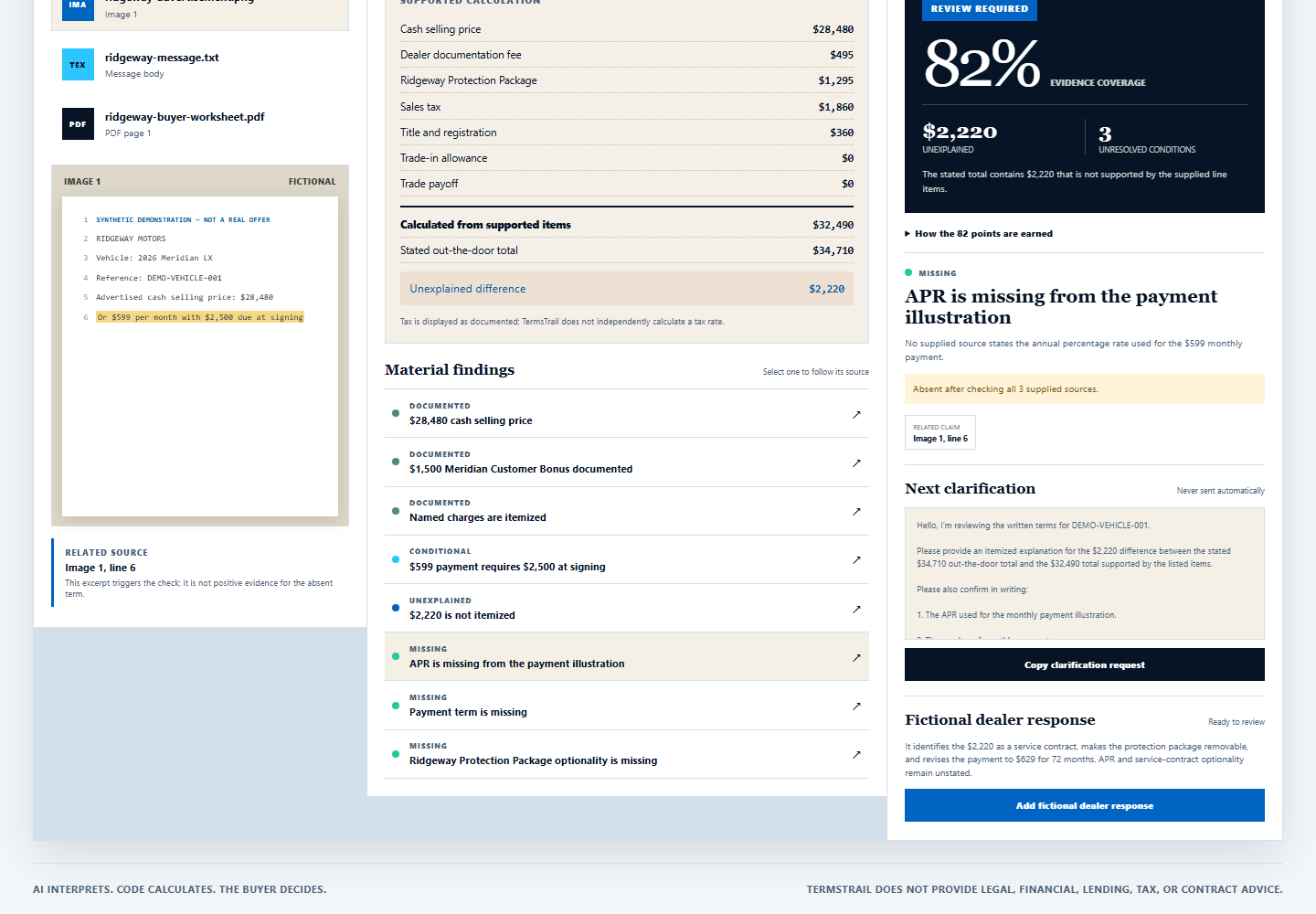
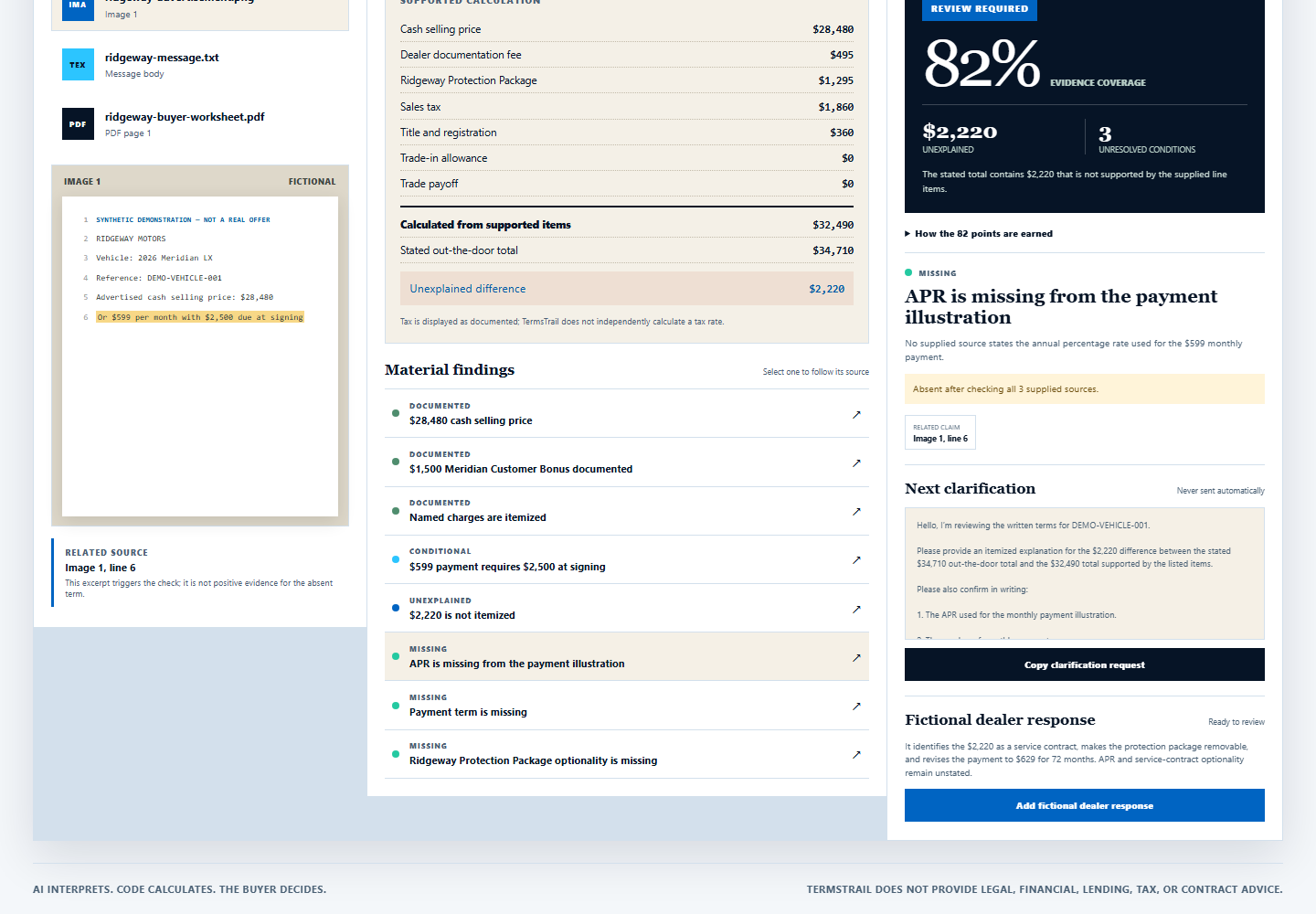
- Documented — explicitly supported by the supplied material
- Missing — necessary information that was not provided
- Conditional — dependent on financing, trade-in, loyalty, military status, credit, residency, or another qualification
- Unexplained — a difference between the stated total and the itemized amounts
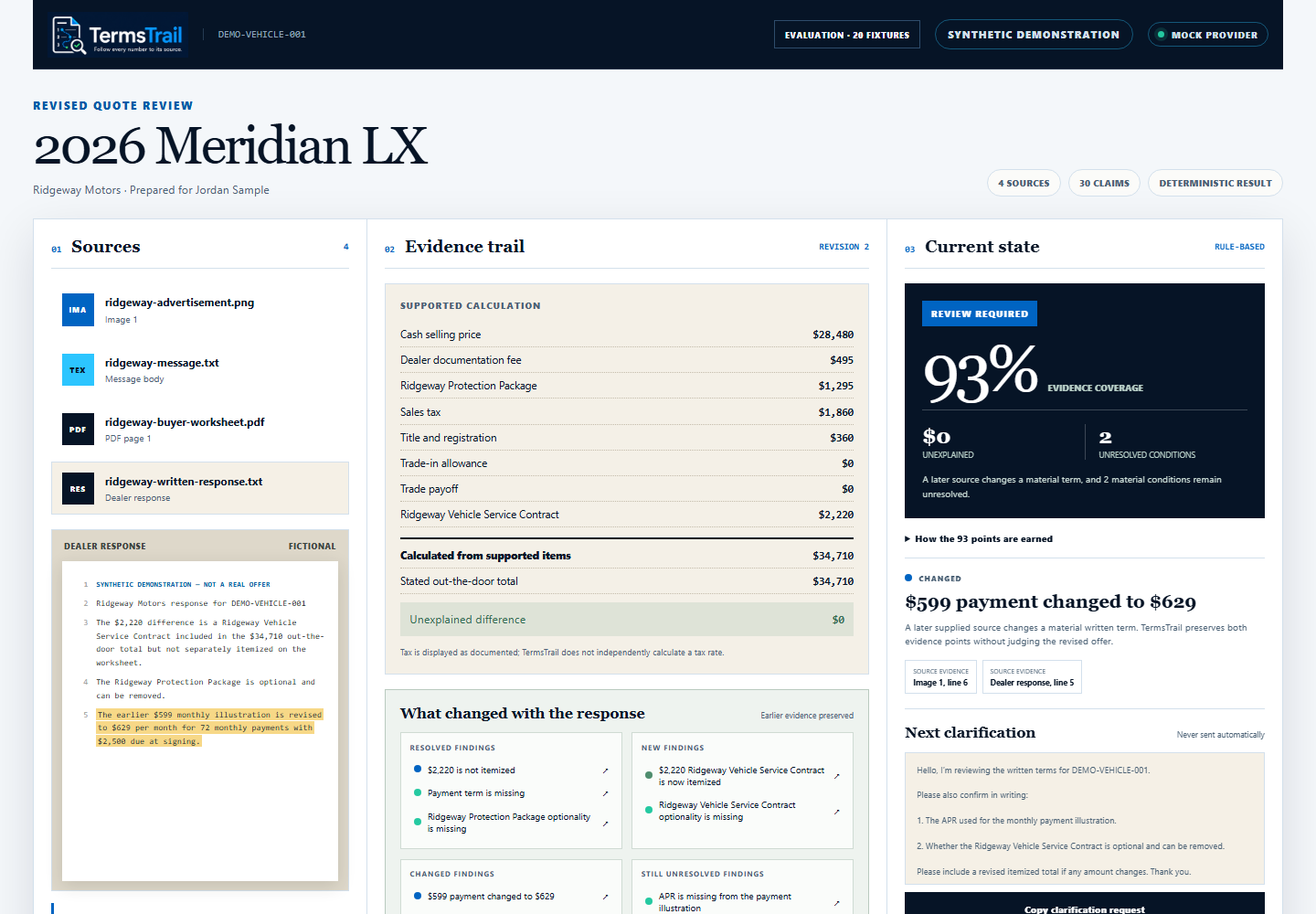
- Changed — a term that differs from an earlier source
TermsTrail then:
- Recalculates the quote using deterministic code.
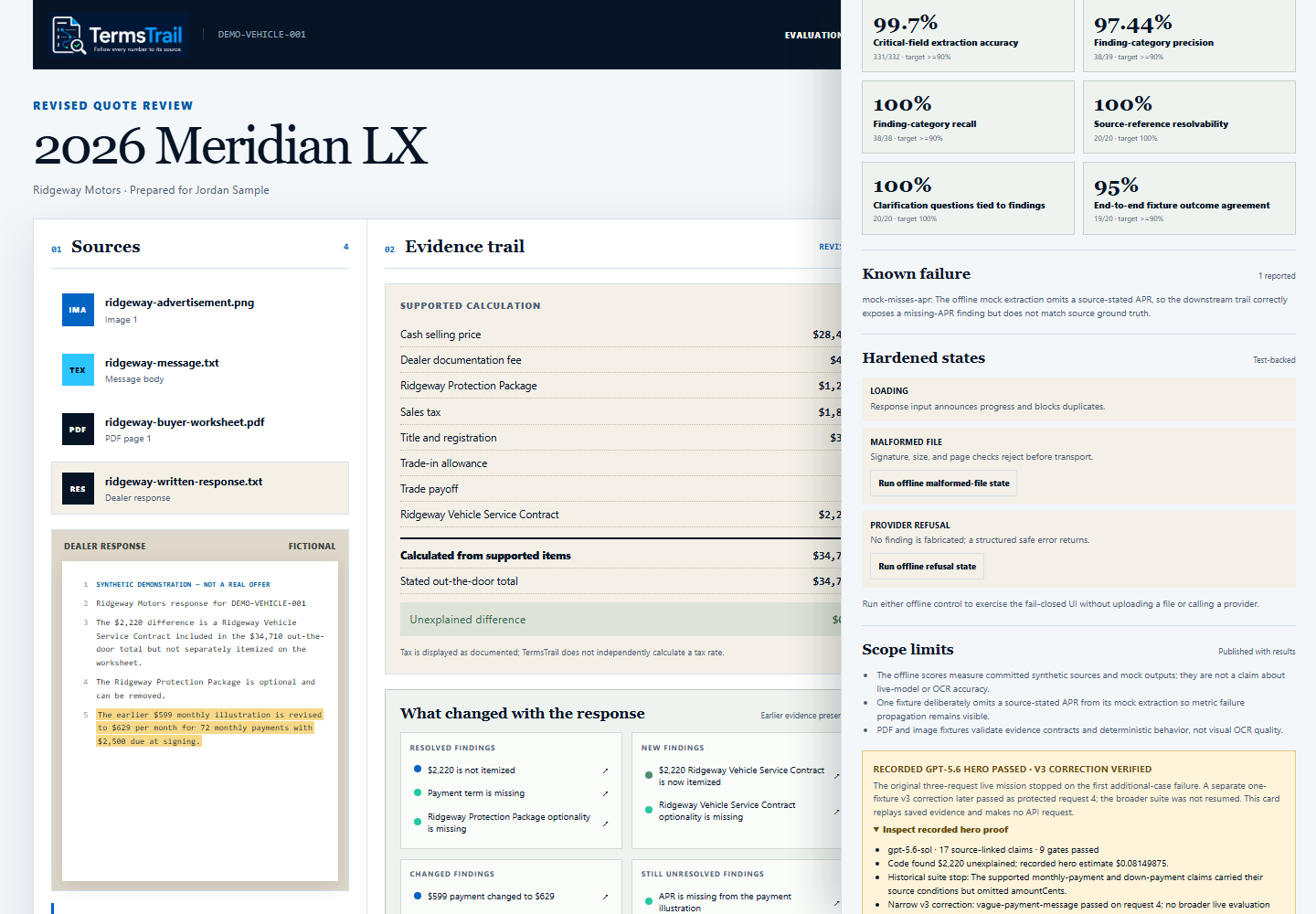
- Measures Evidence Coverage using explicit completeness rules.
- Links each finding to its source page or excerpt.
- Creates a precise clarification request for the buyer to copy.
- Accepts a later dealer response and updates what was resolved, changed, or remains uncertain.
TermsTrail does not decide whether a deal is fair, legal, or safe to sign. It shows what the supplied evidence supports and what still needs clarification.
How we are building it
TermsTrail is a new standalone OpenAI Build Week project.
Codex is being used to design and implement the repository structure, schemas, interface, deterministic reconciliation engine, tests, synthetic fixtures, and evaluation framework.
GPT-5.6 uses the OpenAI Responses API and Structured Outputs to interpret mixed PDFs, screenshots, and natural-language messages. It extracts normalized claims while preserving source references and unresolved ambiguity.
Deterministic TypeScript code handles:
- Currency normalization
- Arithmetic verification
- Unexplained-dollar calculations
- Evidence Coverage
- Critical-field rules
- Revision comparison
- Evidence-reference validation
The core principle is:
AI interprets. Code calculates. The buyer decides.
The public demonstration uses fictional dealerships, vehicles, buyers, and documents. TermsTrail does not contact dealers automatically and does not process payments, credit applications, or real customer information.
Challenges
The largest technical challenge is separating model interpretation from authoritative calculations. A language model can understand that differently worded fees refer to similar concepts, but the application must independently verify the arithmetic.
Other challenges include:
- Preserving evidence links across visually inconsistent documents
- Handling vague messages that contain only a monthly payment
- Distinguishing an explained charge from an acceptable charge
- Representing uncertainty without inventing missing facts
- Updating the trail when a later response introduces new conditions
- Keeping the project narrow enough for a clear three-minute demonstration
Build Week boundary
TermsTrail is informed by general lessons learned while developing the pre-existing OTDZEN business, including structured outputs, deterministic arithmetic, evidence-linked findings, explicit uncertainty, and user-controlled drafts.
No OTDZEN source files, prompts, routes, schemas, migrations, interface components, branding, customer data, or production integrations are copied into TermsTrail. The implementation, fixtures, tests, interface, and evaluation materials are being created in a new repository during Build Week.
What we aim to demonstrate
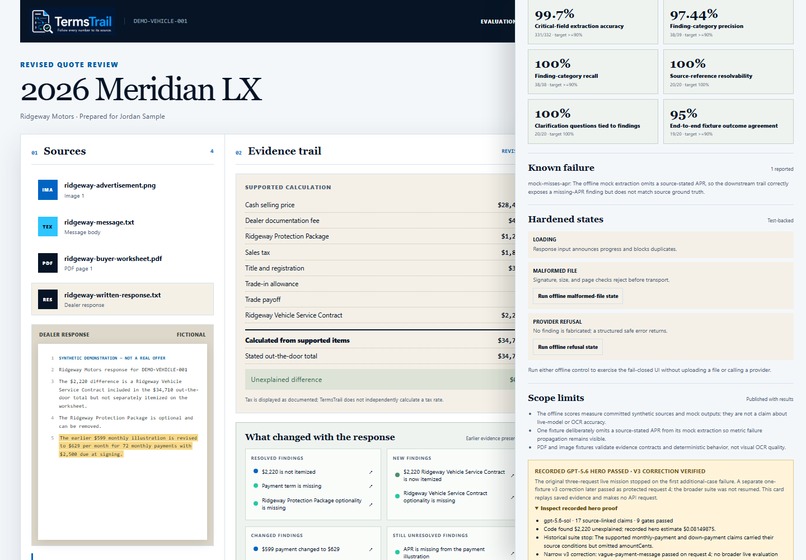
The central demonstration follows one fictional deal through several stages:
- A dealer advertisement presents a price and monthly payment.
- A worksheet introduces fees, add-ons, and a conditional rebate.
- TermsTrail detects an arithmetic mismatch and missing conditions.
- It prepares the exact questions the buyer should ask.
- A dealer response explains part of the difference.
- TermsTrail updates the evidence trail and shows what remains unresolved.
The intended result is not another generic quote summary. It is a traceable explanation of what each supplied source actually proves.
What's next
After Build Week, the concept could expand to other high-stakes purchases where terms are distributed across advertisements, proposals, messages, and contracts, including home improvements, solar installations, leases, insurance proposals, and medical estimates.
Built With
- api
- chatgpt
- codex
- gpt-5.6
- next.js
- openai
- outputs
- playwright
- react
- render
- responses
- structured
- typescript
- vitest
- zod

Log in or sign up for Devpost to join the conversation.