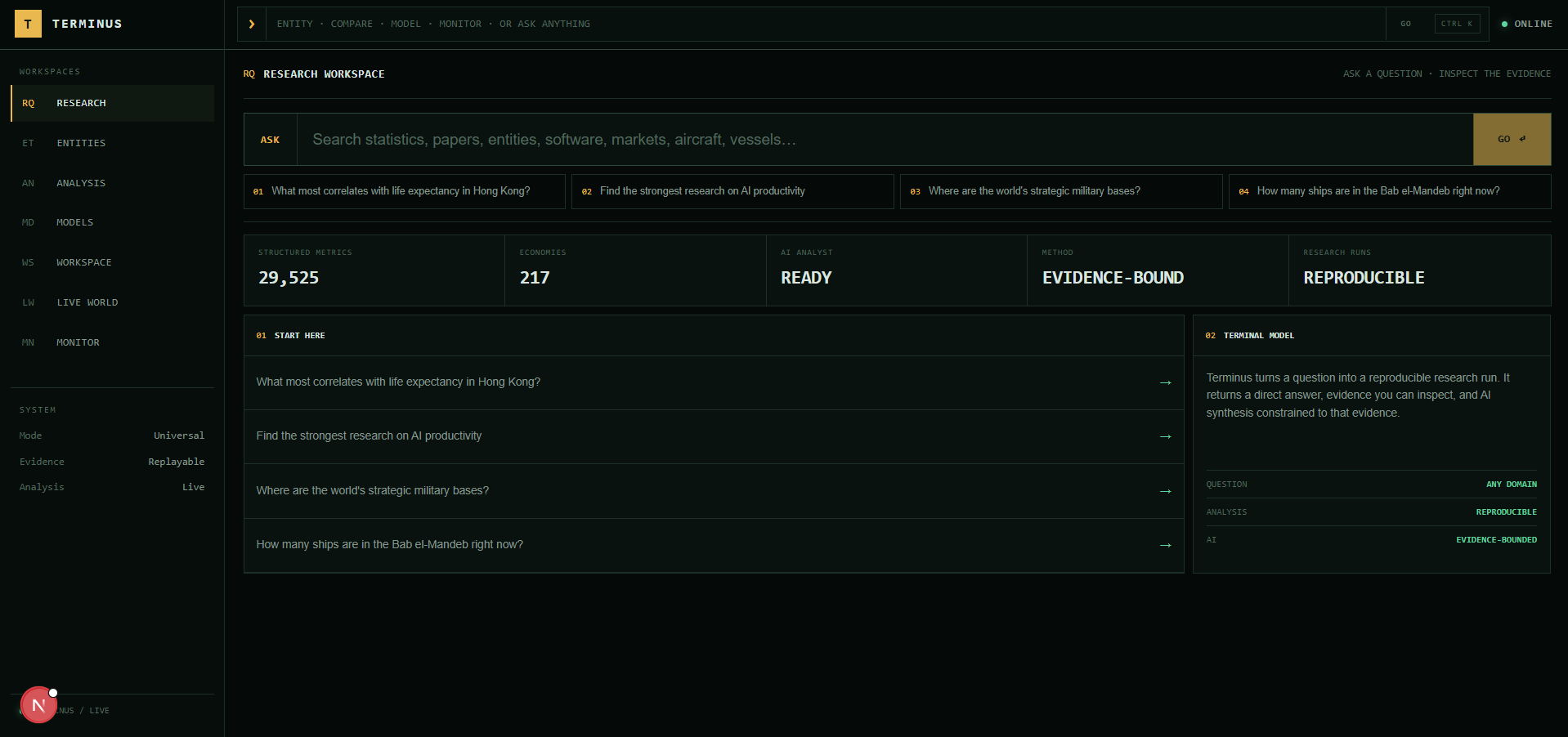
Inspiration In today's hyper-connected world, critical information is massively fragmented. If an analyst wants to understand a developing geopolitical situation, they have to cross-reference flight maps, look up SEC filings, check prediction markets, read academic research on arXiv, and monitor global news across a dozen different tabs. We wanted to build a "Bloomberg Terminal for everything", a single, entirely open-source platform that democratizes access to cross-domain OSINT (Open Source Intelligence). We wanted an engine capable of synthesizing reality in real-time.
What it does Terminus is a federated intelligence platform that aggregates, routes, and synthesizes data across every domain imaginable. At its core, it acts as a universal router, parsing natural language queries and fetching real-time data from 29 specialized intelligence connectors; everything from NASA Earth Observation data and global flight telemetry to live prediction markets, SEC filings, GitHub repos, and scholarly articles.
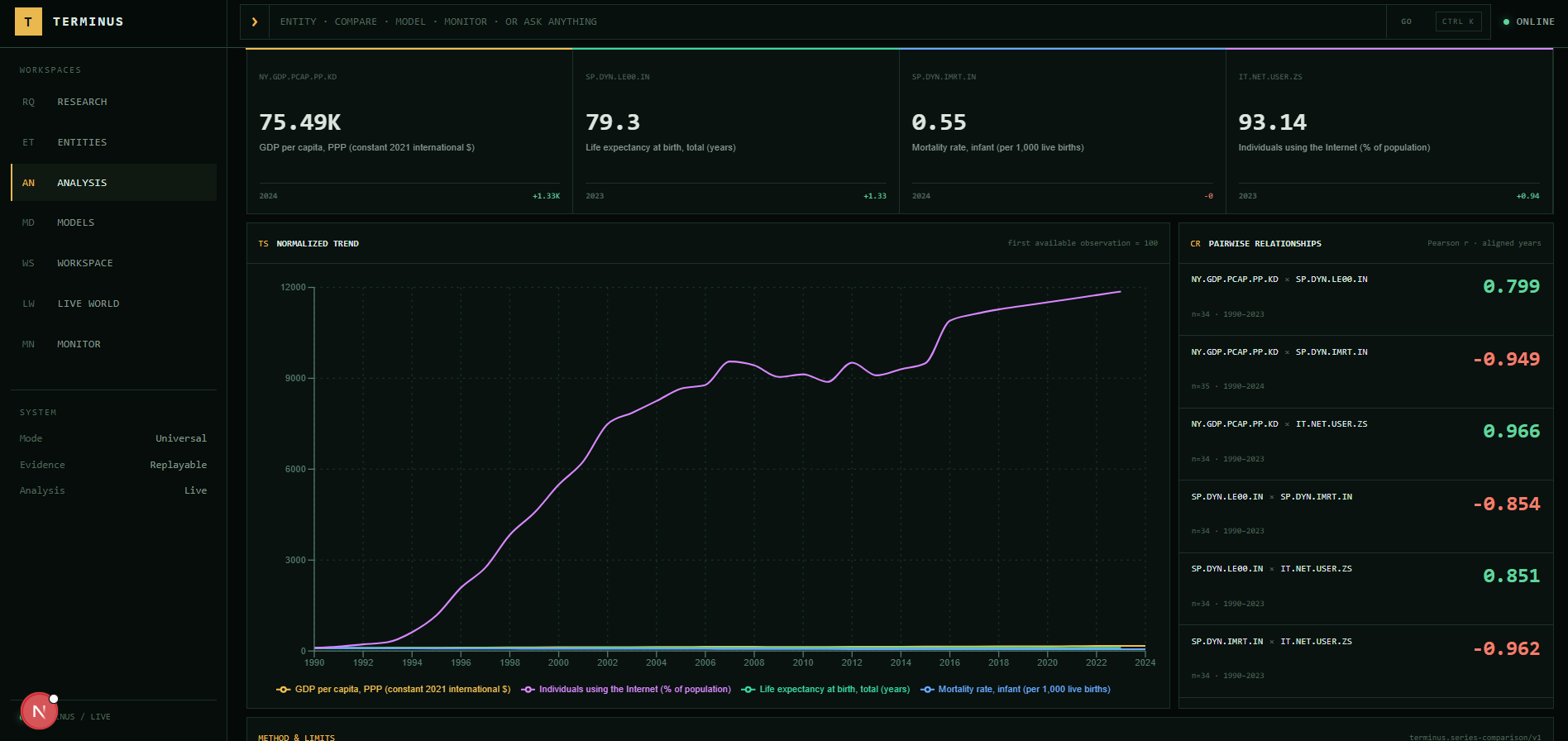
Beyond standard text search, Terminus features a live Situation Dashboard that continuously monitors global strategic infrastructure, real-time maritime vessel traffic, financial indices, and geopolitical news feeds, automatically resolving entities and surfacing relationships.
How we built it We built the backend using a high-performance Python / FastAPI architecture to handle massive parallel I/O. We engineered a proprietary "FederationEngine", capable of heavily concurrent asynchronous ingestion. When a query is made, this engine dynamically selects which lanes (connectors) are relevant and dispatches asynchronous tasks to gather the data.
Challenges we ran into Building a "dashboard for everything" meant tangling with the idiosyncrasies of 29 different external APIs simultaneously.
Concurrency vs. Blocking Code: We had to battle event-loop bottlenecks. For example, integrating the yfinance library blocked our async loops, causing the server to stall. We had to carefully re-architect our monitor feeds to utilize thread-pools (asyncio.to_thread) bridging synchronous C-extensions with our async API. Aggressive Rate Limiting: Public endpoints like the OpenSky Network have extremely harsh rate limits (10 calls per 5 seconds). If a provider throttles us, it threatened to leave gaping "unavailable" holes in our polished UI. Data Resiliency: We had to build sophisticated fallback mechanisms and localized cache layers to seamlessly mock or reconstruct data environments when external network requests timed out, ensuring a flawless user experience regardless of third-party downtime.
Accomplishments that we're proud of We are incredibly proud of the unified ontology we created. Normalizing data from a NASA satellite feed, a Polymarket smart contract, and a semantic scholar astrophysics paper into a single, cohesive entity relationships graph is an immense technical hurdle that we successfully climbed.
We are also incredibly proud of the sheer stability of the application. Despite firing dozens of complex concurrent network requests upon every page load, the frontend dynamically hydrates and renders in a fraction of a second without crashing.
What we learned We learned the deep nuances of asynchronous Python, specifically how to orchestrate graceful degradation in microservice architectures. We gained a massive appreciation for defensive programming: when you rely on the global internet for live data, you have to expect latency, missing JSON keys, and sudden 403 Forbidden errors, and handle all of them silently and gracefully.
What's next for Terminus This is just the ground floor. What's next is moving from observation to prediction.
Deeper AI Interoperability: We plan to integrate localized LLM processing directly into our data plane, allowing models to automatically synthesize cross-domain intelligence reports on demand. Proprietary Data Ingestion: Expanding the platform to allow users to ingest their own enterprise datasets, intersecting private company statistics with global public data streams. Advanced Geospatial Mapping: Moving beyond bounding boxes to render fully interactive vector maps natively inside the terminal for live airplane and vessel tracking.
Built With
- apis
- codex
- openai
- python
- typescript

Log in or sign up for Devpost to join the conversation.