-
-
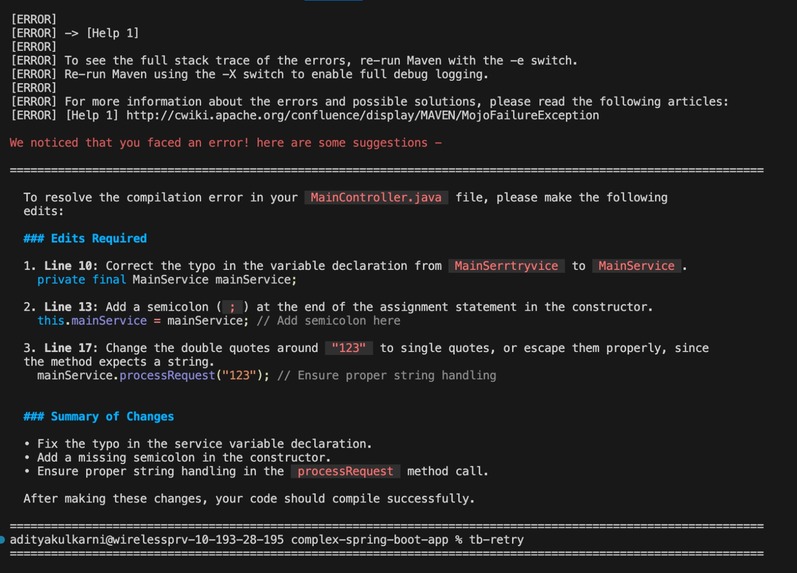
In-Action
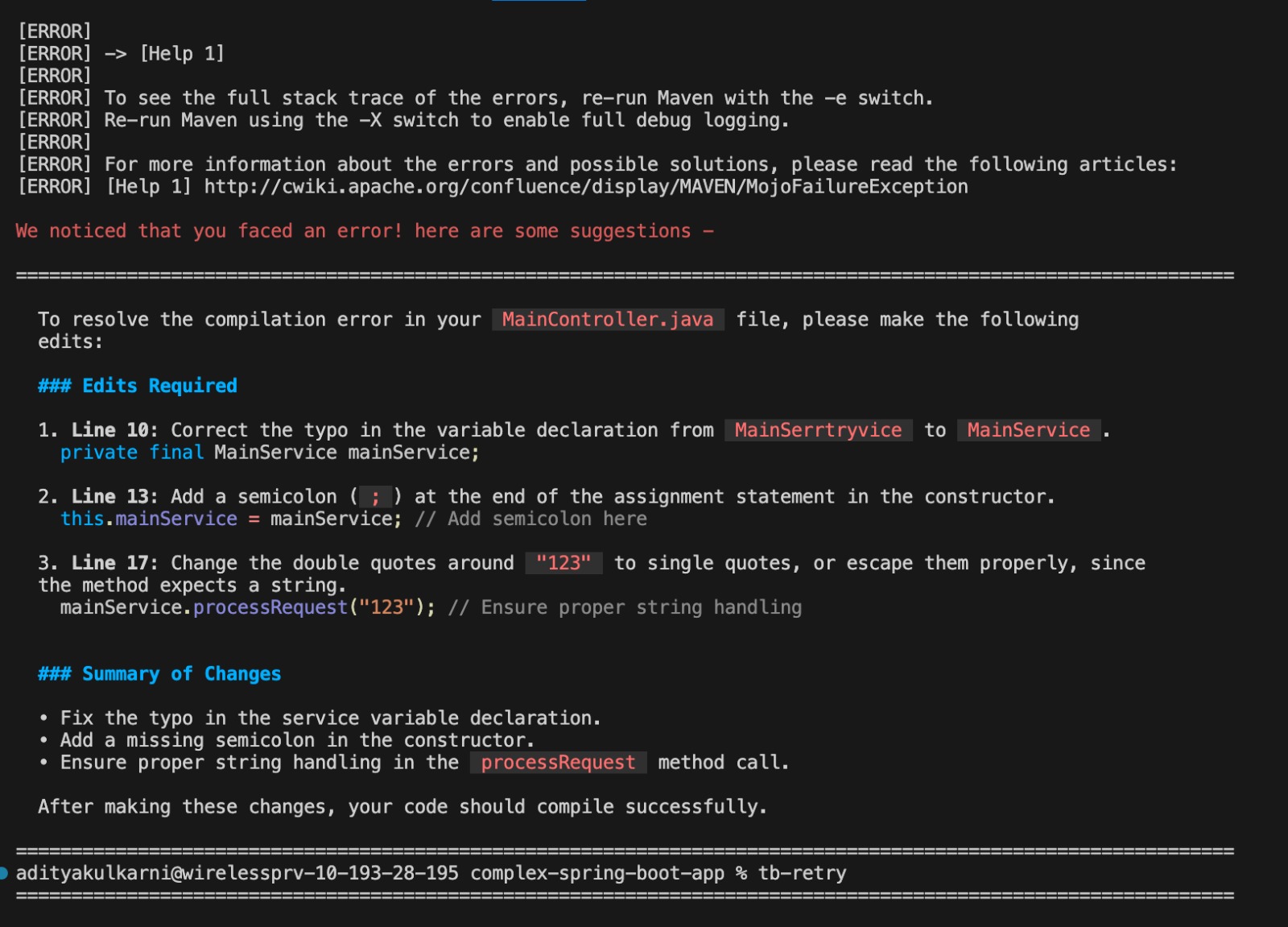
Inspiration
Developers spend a significant amount of time diagnosing build failures and runtime errors—often digging through logs, searching Stack Overflow, and testing multiple fixes manually. We wanted to build a tool that reduces debugging time by integrating AI-powered solutions directly into the terminal, keeping developers focused on coding instead of troubleshooting.
What it does
TermBuddy is a command-line AI debugging assistant that:
- Detects build-time and runtime errors in real-time.
- Automatically retrieves relevant discussions from Stack Overflow and GitHub Issues.
- Uses LLMs to suggest precise fixes, formatted as structured patches.
- Scrapes Java and Spring Boot documentation from TutorialsPoint for API-specific solutions.
- Rewrites queries dynamically based on the API being searched to get the most accurate results.
- Seamlessly integrates into the developer workflow, reducing the time spent debugging.
How we built it
- Error Capturing: Hooks into the terminal to detect build failures and exceptions.
- Query Generation: Uses NLP to generate optimized search queries from error logs.
- Retrieval System: Queries Stack Overflow & GitHub Issues using FAISS-based semantic search.
- Documentation Scraping: Extracts Java & Spring Boot references from TutorialsPoint for API-specific solutions.
- Dynamic Query Rewriting: Adjusts search queries based on context (API, error type, language-specific debugging best practices).
- LLM-Generated Fixes: Uses OpenAI’s GPT models to generate structured, actionable fixes.
- Multi-threaded API Calls: Ensures fast retrieval of relevant discussions.
- Formatted Output: Fixes are returned in Markdown patches, making them easy to apply.
Challenges we ran into
- Query Optimization: Crafting precise search queries from cryptic error messages.
- Latency Reduction: Speeding up retrieval from multiple sources while keeping results relevant.
- Structured Fixes: Ensuring LLM-generated fixes are clear, applicable, and formatted properly.
- Handling Edge Cases: Errors vary across programming languages, requiring adaptive query generation.
- Scraping and Parsing Documentation: Ensuring extracted content is accurate and relevant to API issues.
Accomplishments that we're proud of
- Successfully integrated AI-assisted debugging into the command line.
- Developed a high-speed retrieval system using Stack Overflow, GitHub Issues, and TutorialsPoint documentation.
- Optimized query rewriting for different error categories and API searches.
- Created structured, Markdown-formatted fixes that are developer-friendly.
What we learned
- Context-aware debugging significantly reduces time spent resolving errors.
- Combining structured data retrieval (Stack Overflow, GitHub Issues, documentation scraping) with LLMs results in more accurate solutions.
- Multi-threading API calls drastically improves response times.
- Developers prefer inline fixes over external documentation—integrating AI within their workflow is key.
What's next for TermBuddy
- Expanding language support for more programming environments.
- Adding more documentation sources (e.g., JavaDocs, Microsoft Docs, and Python Docs).
- Fine-tuning query rewriting for more APIs and frameworks.
- Caching frequent error solutions for instant recommendations.
- Terminal plugins for VSCode, JetBrains, and other IDEs.
- Collaborative debugging—allowing teams to share debugging sessions with AI-enhanced insights.
TermBuddy is the future of AI-assisted debugging, making error resolution smarter, faster, and seamlessly integrated into developer workflows.

Log in or sign up for Devpost to join the conversation.