Inspiration
In a world drowning in fragmented information, traditional search engines often feel like piles of disconnected links. I realized that true learning doesn't come from just reading snippets; it comes from understanding the relationships between concepts. I wanted to build a "Second Brain" that doesn't just give you answers, but maps out the hidden logic of the web.
What it does
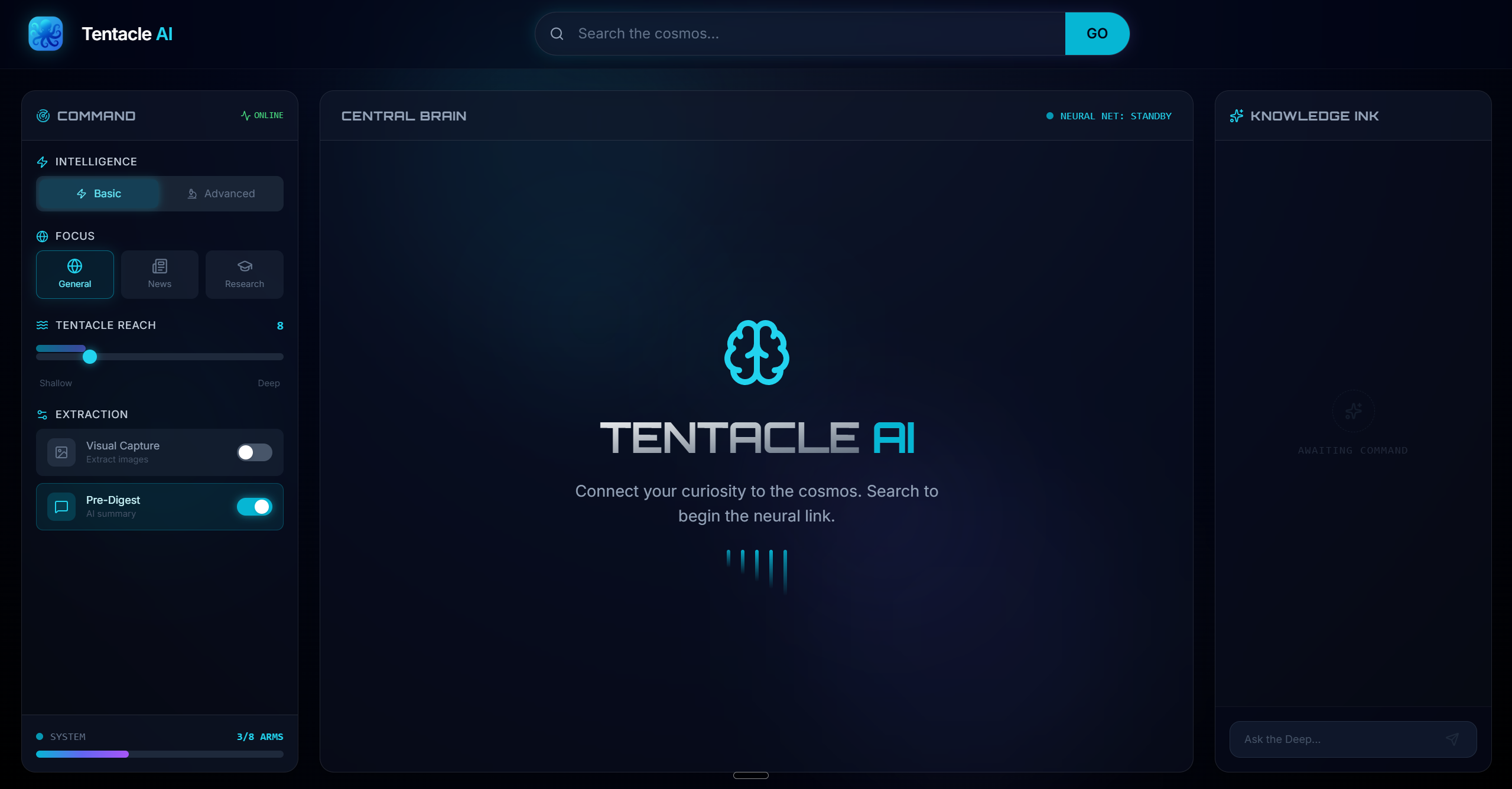
Tentacle AI functions like a neural explorer. When a user enters a query, it reaches out through the "tentacles" of deep search to gather raw intelligence. It then processes this data through a logical filter to construct an interactive, 2D knowledge graph. Users can physically drag concepts, see how different topics influence each other, and ask follow-up questions to dive deeper into specific branches of knowledge.
How I built it
The project is built on a modern Vite + React foundation. I prioritized a premium developer aesthetic using Tailwind CSS and custom Glassmorphism effects.
- The Search: Integrated Tavily AI for high-precision, search-engine-optimized data retrieval.
- The Brain: Used Zhipu AI (GLM-4) as my reasoning engine to transform unstructured text into structured JSON nodes and edges.
- The Vision: Leveraged react-force-graph-2d to render a high-performance, interactive neural net.
Challenges I ran into
- Prompt Engineering: Ensuring the LLM consistently outputted valid, connected data for the graph without hallucinating broken links was a major iteration process.
- State Coordination: Synchronizing the sequence between a multi-region search, an AI analysis phase, and the rendering engine while maintaining a smooth user experience.
- Visualization Performance: Fine-tuning the physics of the force-directed graph to remain stable and readable even with dozens of concept nodes.
Accomplishments that I'm proud of
- Creating a unified UI that feels alive, thanks to custom particle animations and reactive "brain" states.
- Successfully mapping complex, multi-layered topics (like "The Future of Quantum Computing") into a single, understandable visual logic map.
What I learned
I gained extensive experience in AI-driven structural data extraction and the power of force-directed graph physics in UI/UX design. I also learned how to balance "wow-factor" aesthetics with functional performance.
Built With
- lucide-react
- react-19
- react-force-graph-2d
- tailwind-css
- tavily-ai-api
- vite
- zhipu-ai-(glm-4)


Log in or sign up for Devpost to join the conversation.