-
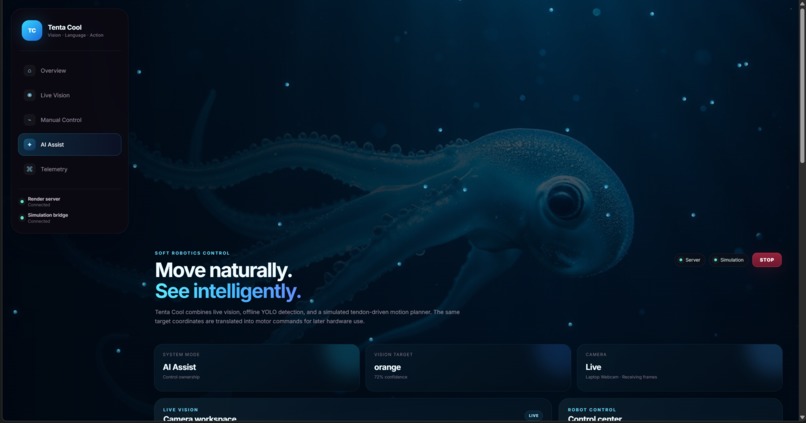
Mainpage
-
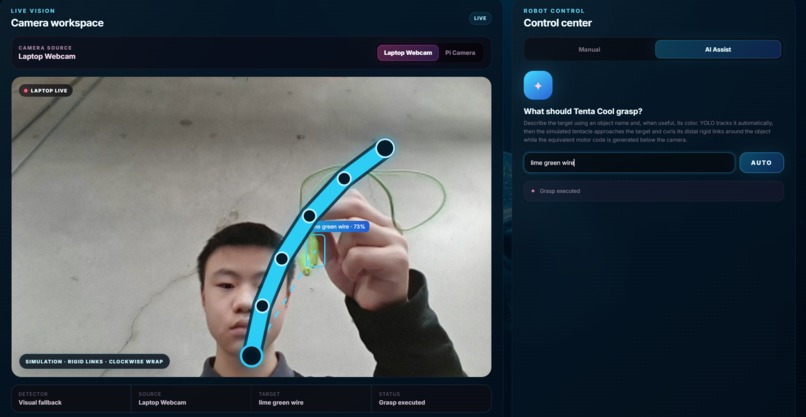
Tentacle animation and curvature demo
-
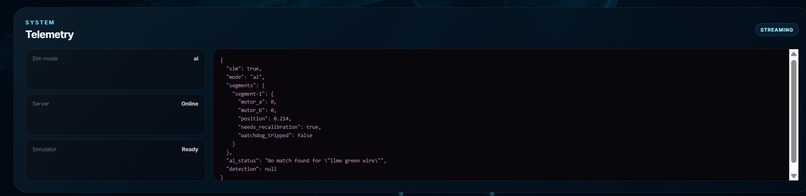
Motor control code (adaptive)
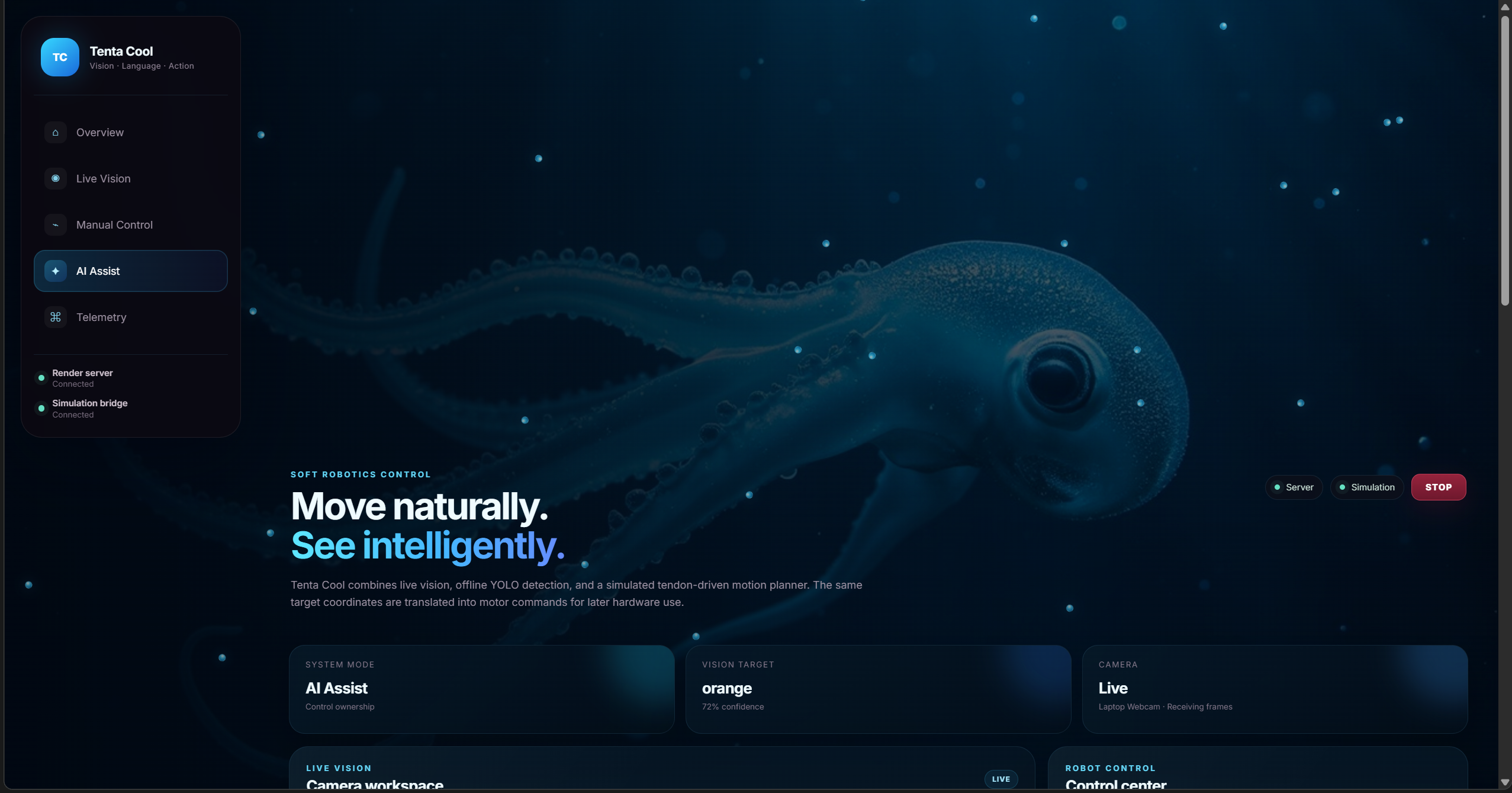
TENTACOOL, the world's first magnet and string powered tentacle robotics arm.
Inspiration We were inspired by the way an octopus can reach, bend, and adapt its arm around objects without relying on a traditional rigid robotic gripper. Most robot arms are precise but mechanically complex. We wanted to explore whether a simpler, flexible tentacle could combine camera vision and adaptive motion to interact with objects more naturally.
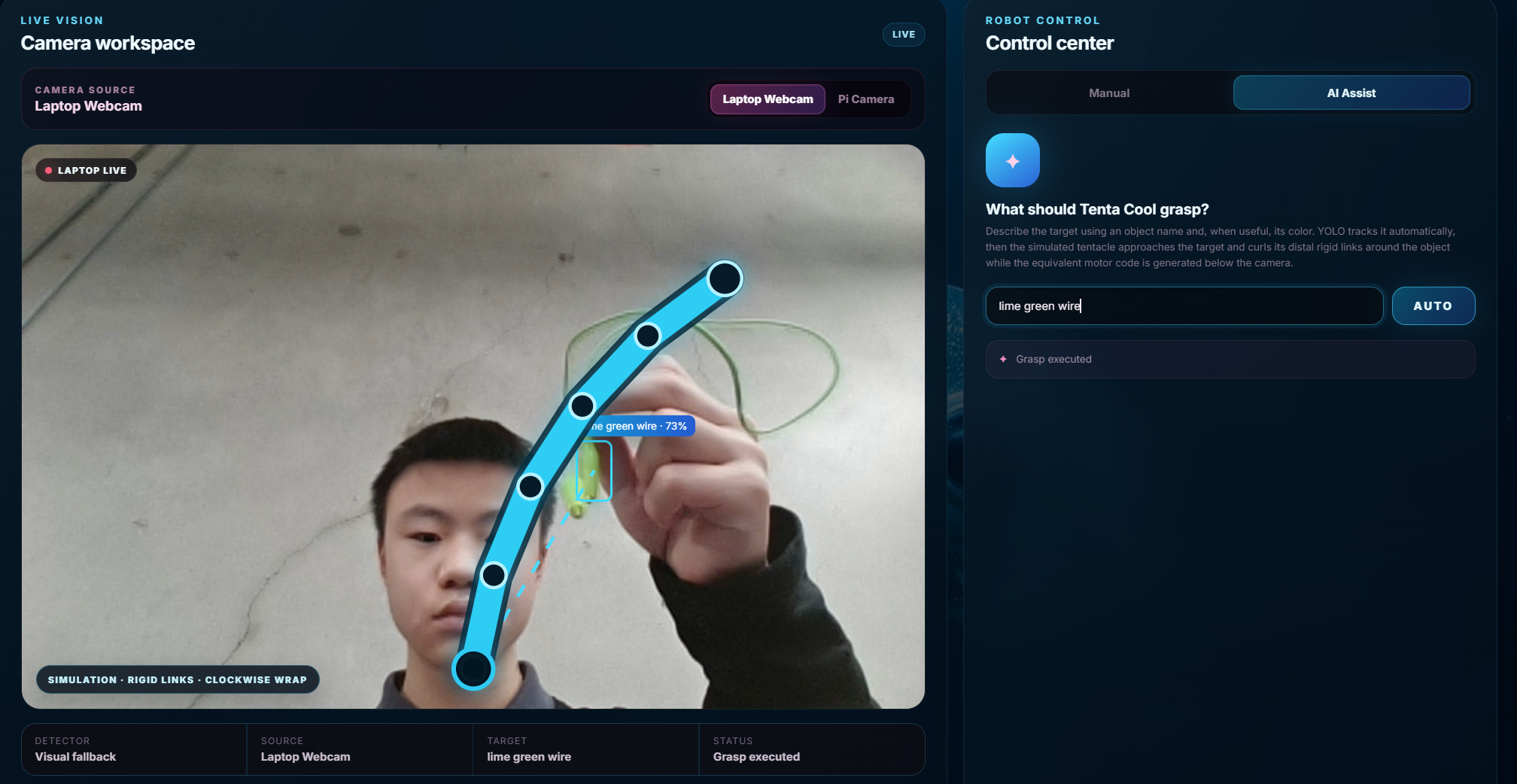
What it does Tenta-Cool is a vision-guided robotic tentacle system. A camera observes the environment while YOLO detects and tracks the object the user wants to interact with. The detected position is translated into a target direction, and our software simulates how a multi-link tentacle would smoothly curve toward that object.
The system also shows the corresponding motor-control commands that could drive the physical tentacle, creating a complete pipeline from:
Camera → Object Detection → Target Position → Tentacle Motion → Motor Commands
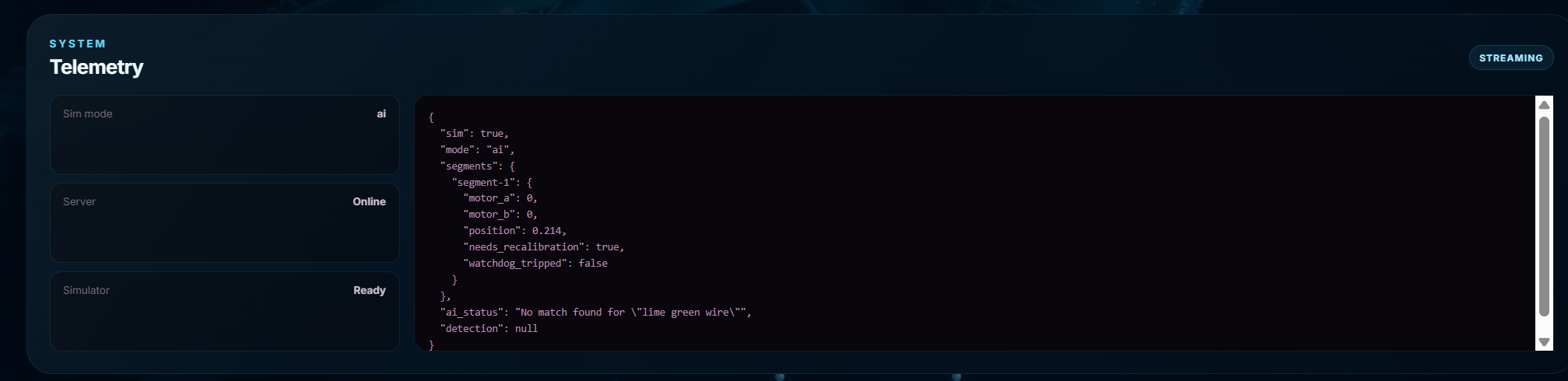
How we built it We built Tenta-Cool as a combination of hardware, computer vision, and robotics software. The physical prototype uses articulated links designed to behave like a flexible tentacle. On the software side, we use YOLO-based computer vision to locate objects from the live camera feed. The detected bounding box gives us the object's position in the frame. We then convert that position into a smooth articulated trajectory. Each simulated link has a fixed physical length, and only its joint angle changes. The arm forms a controlled curved arc toward the detected target rather than stretching. We also built a browser-based control interface with live camera input, automatic detection, simulation, telemetry, emergency stop controls, and generated motor-control code.
Challenges we ran into One of our biggest challenges was connecting the physical motors reliably through the Raspberry Pi. Because we could not get the complete motor system working consistently during the hackathon, we shifted the final demonstration toward a simulation-first architecture while keeping the real motor-control logic visible. Computer vision was another challenge. YOLO sometimes confused similarly colored background objects with the requested target, so we added filtering and fallback detection logic to reduce false positives. The tentacle simulation also required several iterations. Early versions accidentally allowed links to visually stretch or caused the joints to bunch together. We eventually changed the model so every link remains rigid and the arm bends through controlled joint angles.
Accomplishments that we're proud of We are proud that Tenta-Cool became much more than a CAD model or mechanical prototype. We built a complete perception-to-action pipeline where the system can: see an object, detect its position, track it, determine how the tentacle should bend, visualize that movement, and generate the corresponding motor-control commands. We are especially proud of combining a biologically inspired mechanism with real-time computer vision instead of relying only on manually programmed positions.
What we learned We learned that robotics is not just about building the mechanism. Mechanical design, perception, control, and software all have to work together. We also learned that computer vision outputs cannot simply be passed directly to a robot. Detections need filtering, motion needs smoothing, physical constraints need to be respected, and safety controls need to remain available throughout the process. Most importantly, we learned how quickly simulation can become a valuable engineering tool when physical hardware is not yet reliable.
What's next for Tenta-Cool Our next step is to connect the vision and control system back to the physical tentacle.
We want to add reliable motor drivers and feedback sensors so the real arm can reproduce the trajectories currently shown in simulation. We also want to improve object tracking, add depth perception, and eventually allow multiple tentacles to coordinate around irregular objects.
The long-term goal is for Tenta-Cool to evolve from a vision-guided prototype into an adaptive soft robotic manipulator capable of safely interacting with objects that conventional rigid grippers struggle to handle.
Using Render, Claude, and our hacking skills, we were able to make this project possible, despite the many challenges we faced.
Built With
- claude
- hardware
- html
- javascript
- phython
- raspberry
- software
- yolo

Log in or sign up for Devpost to join the conversation.