-
Home Page
-
Comparison of both ISAs
-
Run any program on the new ISA
Inspiration
Every computer ever built quietly assumes that time only moves forwards. Each step overwrites a register, and the old value is gone forever. Billions of times a second, information is destroyed, so there's no way back.
The challenge asked, "What if they worked in reverse?" We took that literally. What if a computer could never destroy anything, and so could run any program backwards to its exact starting point, with no saved history?
There's a real reason this matters. Physics (Landauer's principle) puts a minimum energy cost on destroying information. A computer that never destroys anything is the theoretical route to near-zero-energy chips, and quantum computers already have to work this way.
What it does
TENET is a computer that runs in reverse.
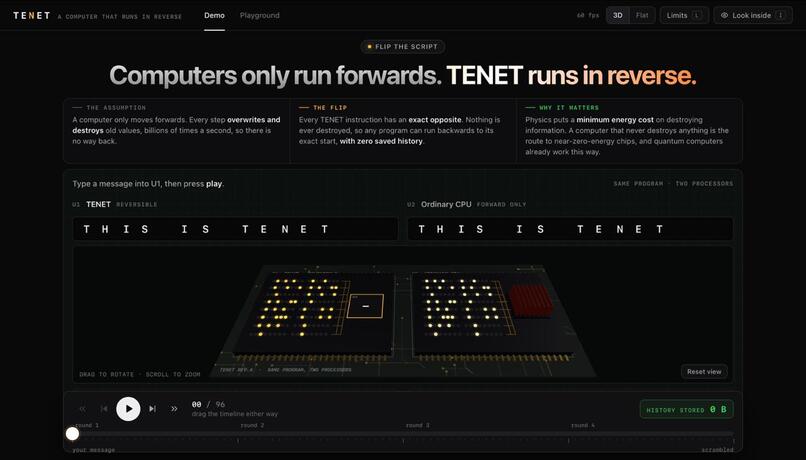
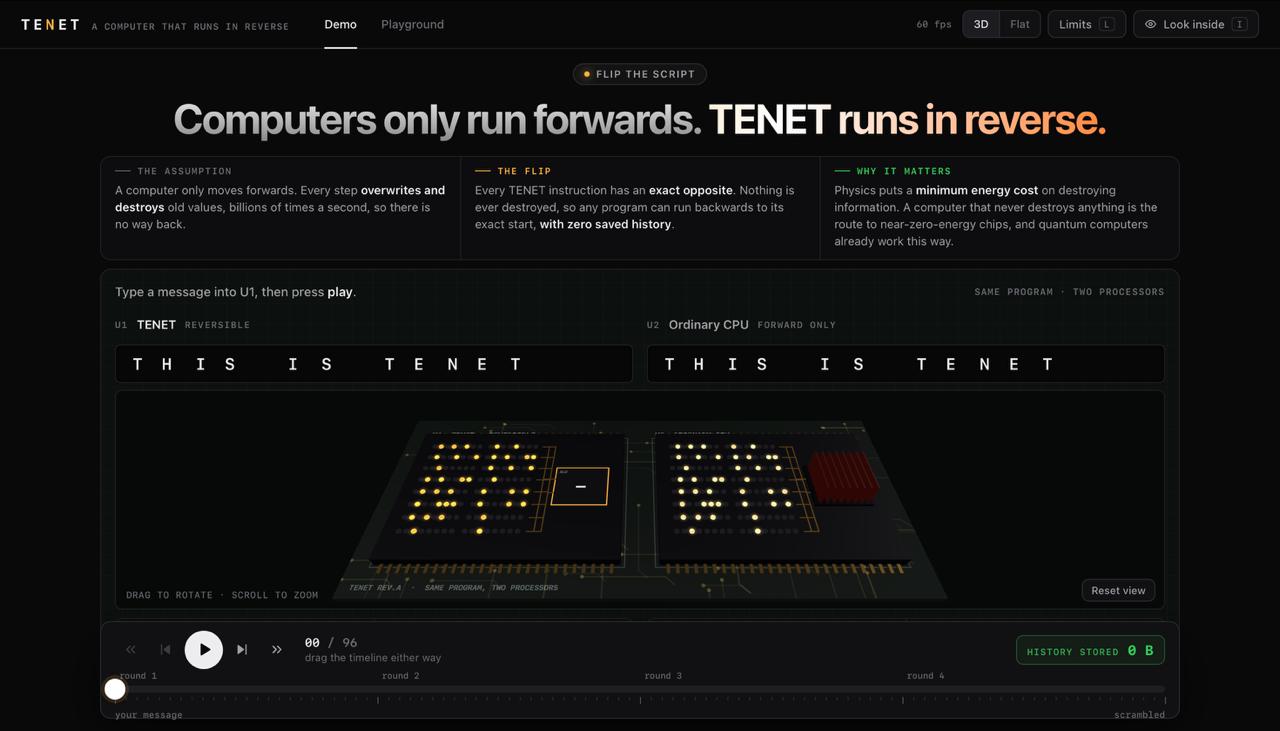
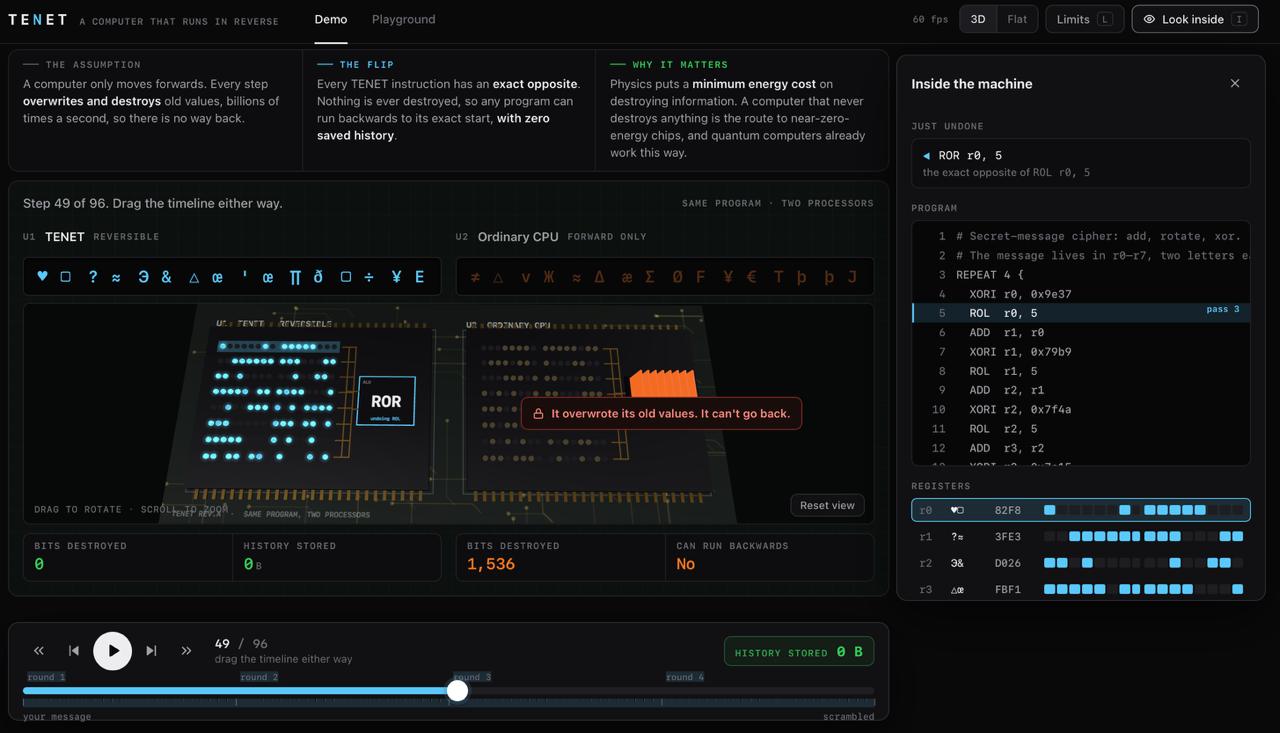
- Demo: type a message and press play. The program scrambles it.
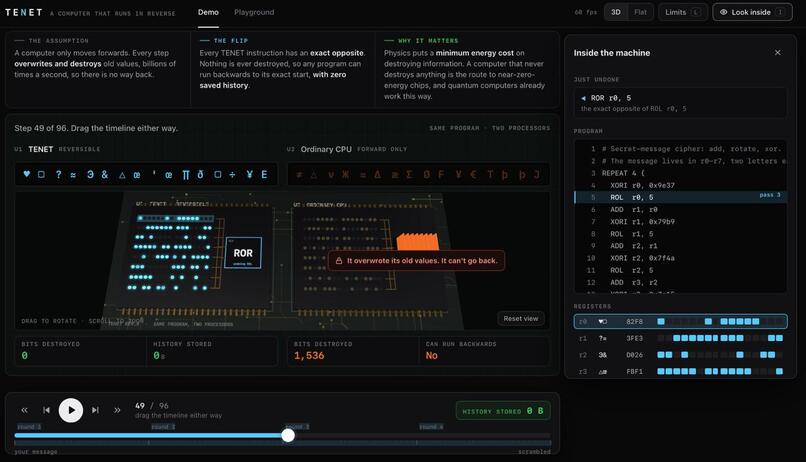
- An ordinary CPU runs the same program side by side on a 3D circuit board. You can watch it destroy bits: sparks fly into its heat sink and a counter climbs.
- Then you drag the timeline back. TENET's message reappears exactly, while the ordinary CPU is stuck because its old values are gone.
- There is no decryption program and no undo log: History stored: 0 bytes. We just ran time backwards.
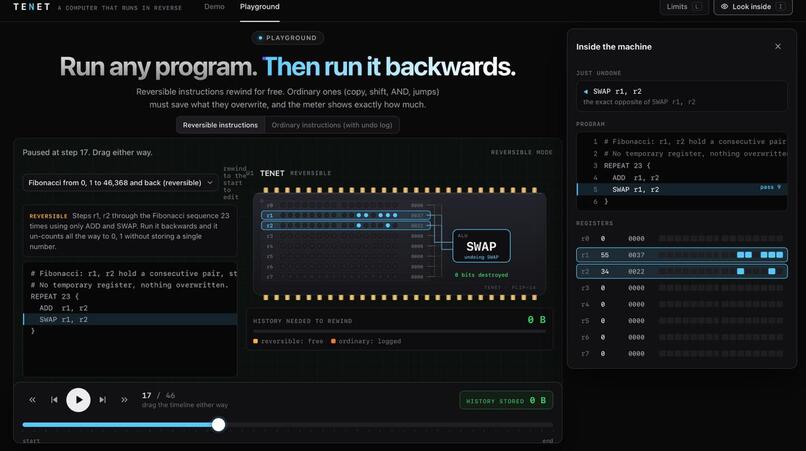
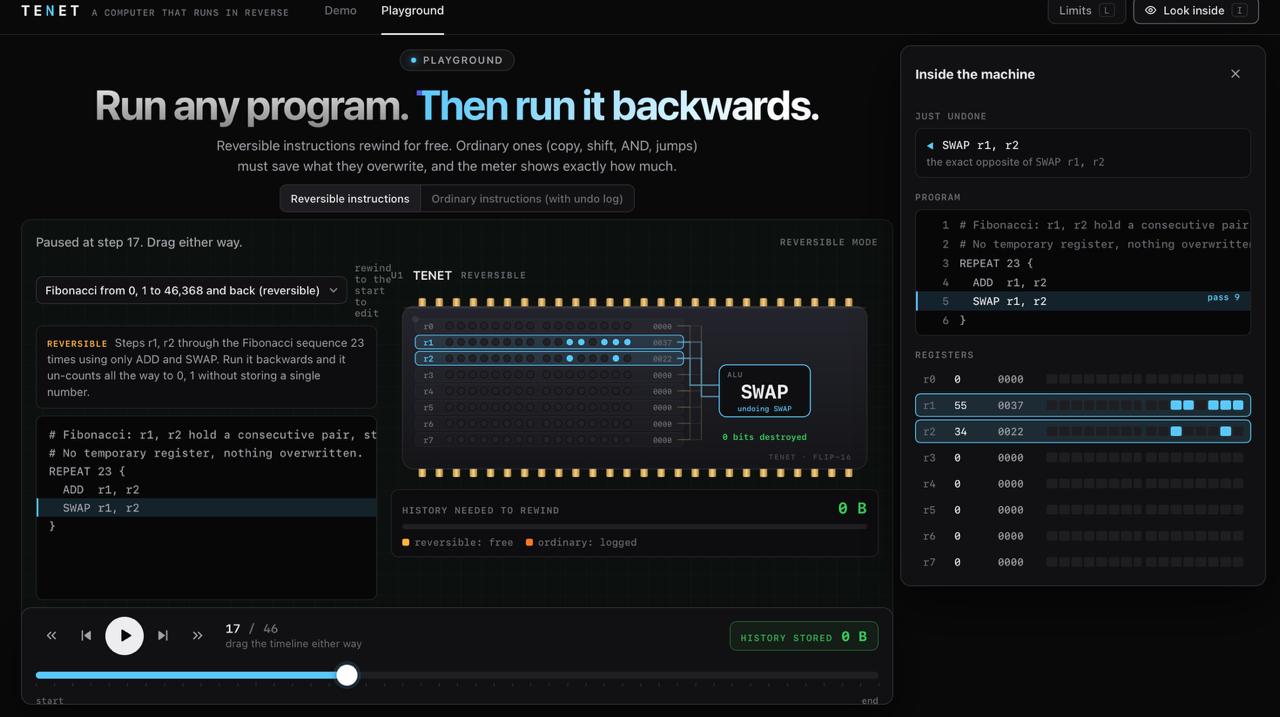
- Playground: write or pick any program, run it forwards, then backwards.
- Switch to ordinary instructions (copy, shift, AND, jumps) and a meter shows exactly how many bytes of history a normal computer must save to undo them.
- Swapping two numbers the normal way needs 32 bytes saved. The reversible way needs 0.
- Limits panel: always one key away. It says plainly what's real, what's theoretical and what's simplified.
How we built it
- Our own CPU, FLIP-16, in TypeScript.
- 8 registers with 16-bit arithmetic. Every instruction has an exact inverse: ADD↔SUB, ROL↔ROR, while XOR and SWAP undo themselves.
- Anything that destroys data, like MOV or
XOR r1, r1, is refused by the assembler. - Stepping backwards runs the inverse instruction using only the current registers and the program, never a stored copy.
- Hybrid mode: ordinary instructions are allowed, but each one pushes exactly the bytes it destroys onto an undo log. That lets us measure the cost of "normal" computing precisely.
- Vitest: 5,000 random instructions and 500 random programs all rewind to the exact starting state.
- React + Motion for the interface. SVG for the flat chip view, with one LED per bit.
- three.js (React Three Fiber + Drei) for the rotatable 3D circuit board. It has per-bit LEDs, pulses along the traces (amber forwards, cyan backwards), and a heat sink with sparks on the ordinary CPU. It runs at 60 fps.
- Vite, running entirely in the browser: no server, no API keys.
- We used Claude Code (Anthropic) as a coding assistant while building it.
Challenges we ran into
- Programming without overwriting. Without MOV, even "copy a value" or "clear a register" needs a different approach. We had to rethink simple programs, using things like XOR swaps and un-computing scratch values back to zero.
- A scrambler that undoes itself. We built the message cipher only from invertible steps (add, rotate, XOR) so that it would also run perfectly in reverse.
- Being honest about the cost. For ordinary instructions, we had to count exactly what each one destroys (a MOV costs 8 bytes, a jump 7) so the comparison is real, not hand-waved.
- Making an abstract idea visible. "Information is destroyed" is invisible on a normal computer. Turning it into something you can see took many design rounds: two chips side by side, sparks for lost bits, and a CPU that visibly locks when it can't rewind.
- Cutting scope. We first built a feature where Claude rewrote programs into reversible form. We cut it to keep the demo focused on the one idea that matters.
Accomplishments that we're proud of
- It truly runs backwards, with zero stored history. The tests prove it on thousands of random programs, not just our demo.
- The moment your message reappears while the ordinary CPU is stuck makes the idea click in seconds, with no physics background needed.
- The Playground puts an exact number on how much history ordinary computing has to throw away or store.
- A smooth 3D circuit board running at 60 fps in the browser.
What we learned
- Reversibility isn't a trick bolted on afterwards. It's a constraint you design the whole instruction set around, and it changes how you write even simple programs.
- Most of what a normal CPU does is destroy information it could have kept.
- The difference between undo (keeping a history) and reversibility (needing none) is subtle but fundamental.
- Being upfront about limits makes a demo stronger, not weaker.
What's next for Tenet
- Reversible if-statements and loops that depend on data, using exit assertions as in reversible languages like Janus, so more programs need zero history.
- A compiler that turns ordinary code into reversible code automatically, cleaning up its scratch work (Bennett's trick).
- Bigger demos: reversible sorting, hashing and invertible neural-network layers.
- Real hardware: mapping FLIP-16 onto reversible logic gates and, eventually, the adiabatic circuits that could actually deliver the energy savings.

Log in or sign up for Devpost to join the conversation.