Inspiration
Every LLM agent with "memory" today is really RAG over a transcript log — append-and-retrieve. That's fine until a fact changes: you move cities, change jobs, update a preference — and the agent still has both the old and new statement in its retrieval pool, sometimes surfacing the stale one. On a controlled benchmark a strong RAG memory falls from 100% → 50% current-value accuracy as one fact is updated 2→12 times, and the collapse is identical under gpt-4o-mini and gpt-4o readers — so it is structural, not reader weakness. Track 1 names exactly this gap: facts that change, forgetting what's stale, recall under a small context budget.
Tenet is an original project built new during the Hackathon Submission Period — the engine, benchmarks, MCP server, adapters, and Alibaba Cloud deployment were all created for this entry.
What it does
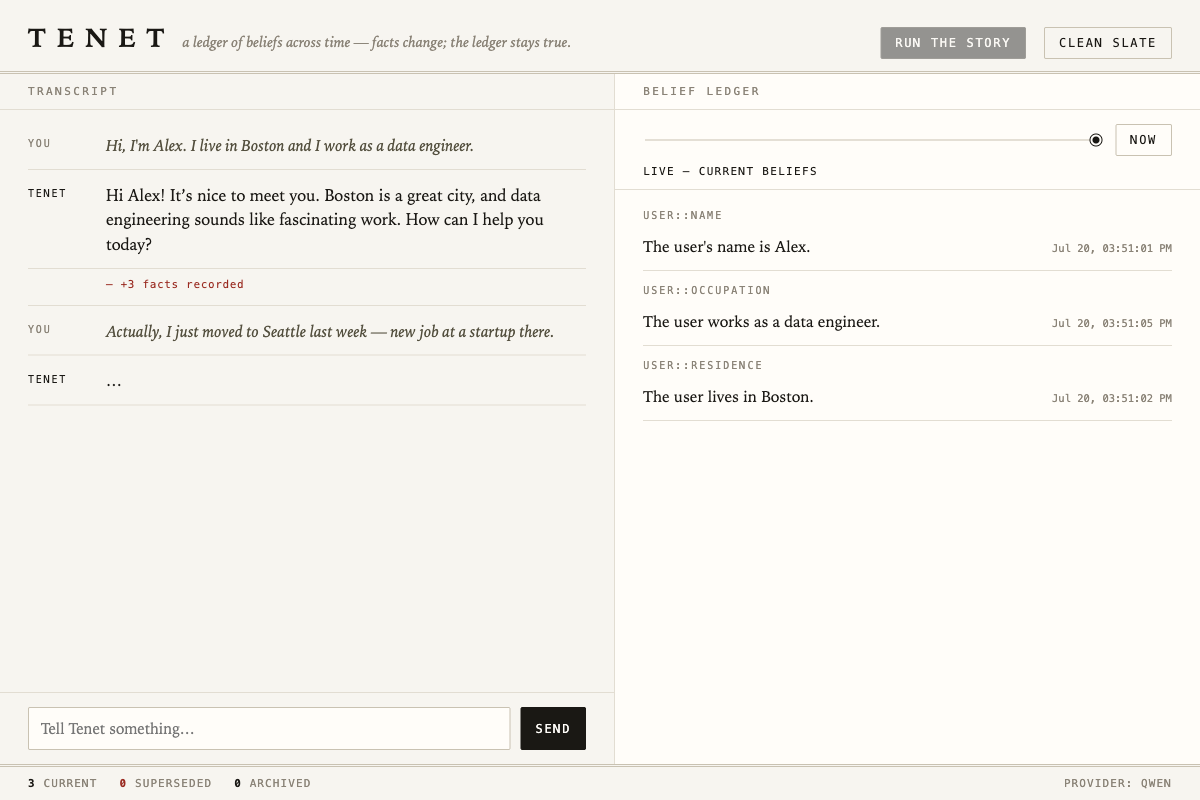
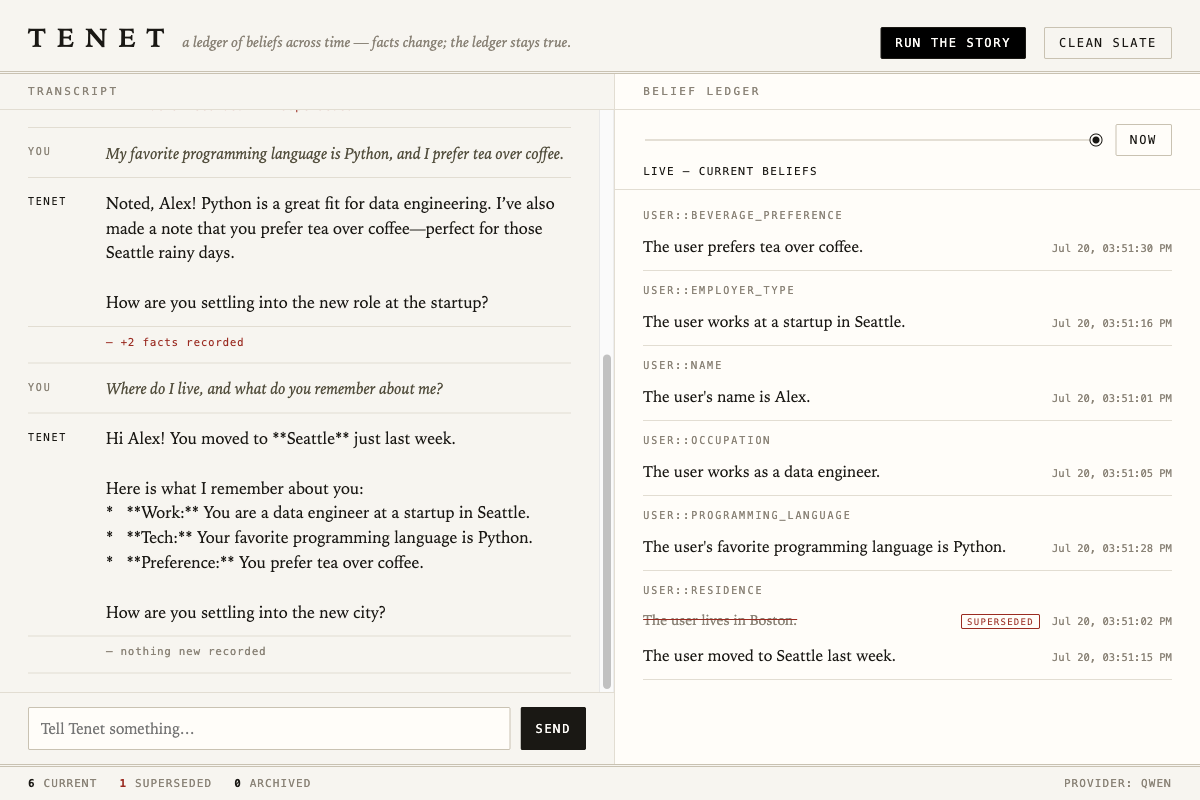
Tenet reframes agent memory as a self-consistent belief state — a compact, supersession-aware set of current facts over plain SQLite + numpy (no graph DB, no vector service):
- Bi-temporal supersession. Every fact carries event time (
valid_at/invalid_at) and transaction time (created_at/expired_at). A changed value is superseded — retired to history, not overwritten — sorecall()returns the truth now andrecall(as_of=t)time-travels to "what I believed in March." - Write-time distillation. Qwen (
qwen3.6-flash) turns raw messages into atomicsubject::attributefacts, so later updates collide and supersede deterministically instead of piling up as near-duplicates. - Timely forgetting. A salience-weighted decay sweep archives stale, low-value memories; pinned identity facts are never forgotten.
- Zero LLM calls on read.
recall,doubts, time-travel, budget-fill and adaptive multi-hopnavigate()are embeddings + closed-form math — ~11 ms, flat from 1k to 100k facts. - MCP-native.
learn / remember / recall / doubts / time_travel / forget_stale / memory_stats— any MCP client gets persistent, self-managing memory with no glue code.
How we built it
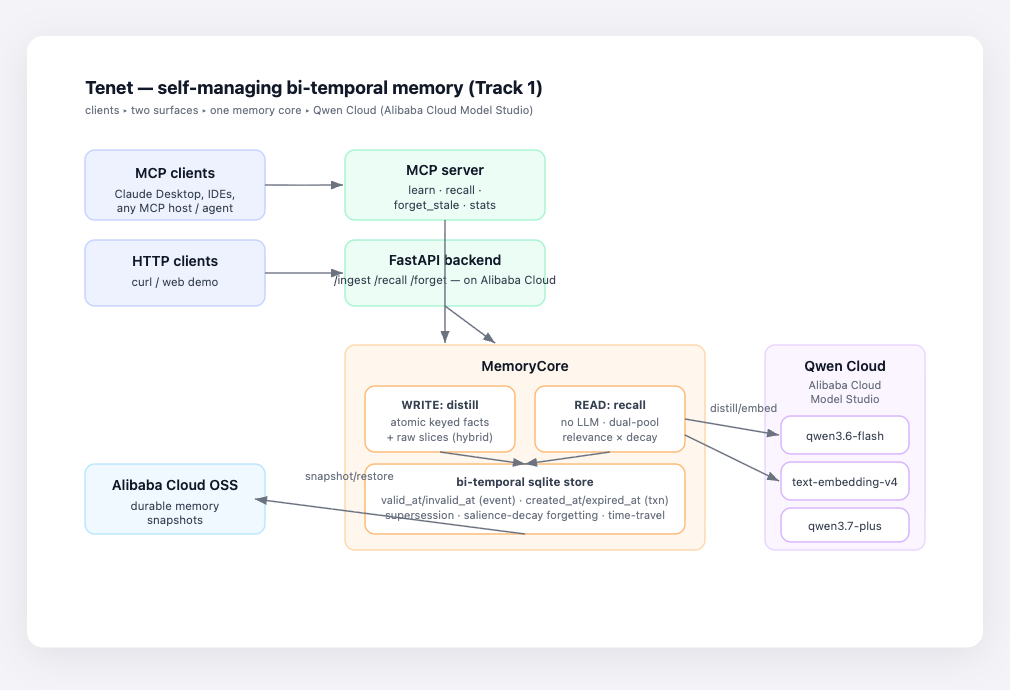
Built on Qwen Cloud end to end, three Qwen Cloud APIs each doing what it's best at, behind one fail-loud provider layer that swaps Qwen/OpenRouter/Ollama by env var:
text-embedding-v4for retrieval,qwen3.6-flashfor write-time distillation,qwen3.7-plusfor the assistant reader.- A learned drift model (
dynamics.py): a closed-form Gamma–Lomax survival model fit per key class from the ledger's own supersession history — no hardcoded half-lives. - An RTX-trained LoRA distiller (
tenet-distiller-1.5b-v2, Qwen2.5-1.5B) for a fully local air-gapped write path — 6/6 clean-churn supersessions, 0.0 fabrication, 0.775 key-consistency, beating the cloud reference's own 0.707 on held-out eval. - Ships as a real product: CLI, HTTP API + belief-ledger web demo, LangGraph
BaseStore+ LlamaIndex adapters, MCP server, and a 2-page paper + full preprint.
Challenges we ran into
- We pre-registered two success gates so a negative result couldn't be reframed as a win — and both failed, honestly reported. Confidence-routed reader spend: an 84-config sweep found no setting saving tokens within 2pp of baseline (
p_validis a currency signal, orthogonal to the relevance errors that sink extractive routing) — confidence stays annotation-only, regression-tested. Multi-hop decomposition scored identically to baseline (25.0 vs 25.0): FactConsolidation multi-hop is reader-reasoning-bound, not retrieval-bound. - Stale raw-turn leakage under real churn. Superseded raw turns slipped past the write-time filter and outvoted current facts; fixed with a read-time, key-scoped consistency check — churn half-life rose <2 → 8 (reported as a partial, honest fix, not a full close).
Accomplishments that we're proud of
- Numbers that reproduce, in a field where audits show they usually don't (Mem0's 93.4% LongMemEval reproduces at 73.8%; LoCoMo's key is 6.4% wrong). Every Tenet number carries a Wilson 95% CI, four flags ship default-OFF because we measured them as no-benefit, and we publicly falsified our own churn claim before fixing it.
- Beats published SOTA on MemoryAgentBench FactConsolidation: single-hop 97.0% 94.8, 98.3, multi-hop 45.8% 40.9, 50.6 — on a weaker local-7B backbone. Every result reproduces from one command.
What we learned
Temporal correctness for agent memory does not need a graph database or an LLM in the read path — a stable subject::attribute key plus bi-temporal supersession delivers Zep's job with pip install and $0 per read. And the field's real gap isn't a new mechanism, it's evaluation discipline.
What's next
Publish tenet-memory on PyPI; wire OSS-backed snapshot/restore into the Function Compute deploy for durable storage; close the churn half-life gap to flat-32.


Log in or sign up for Devpost to join the conversation.